Market Summary
Executive Summary and Global Market Analysis
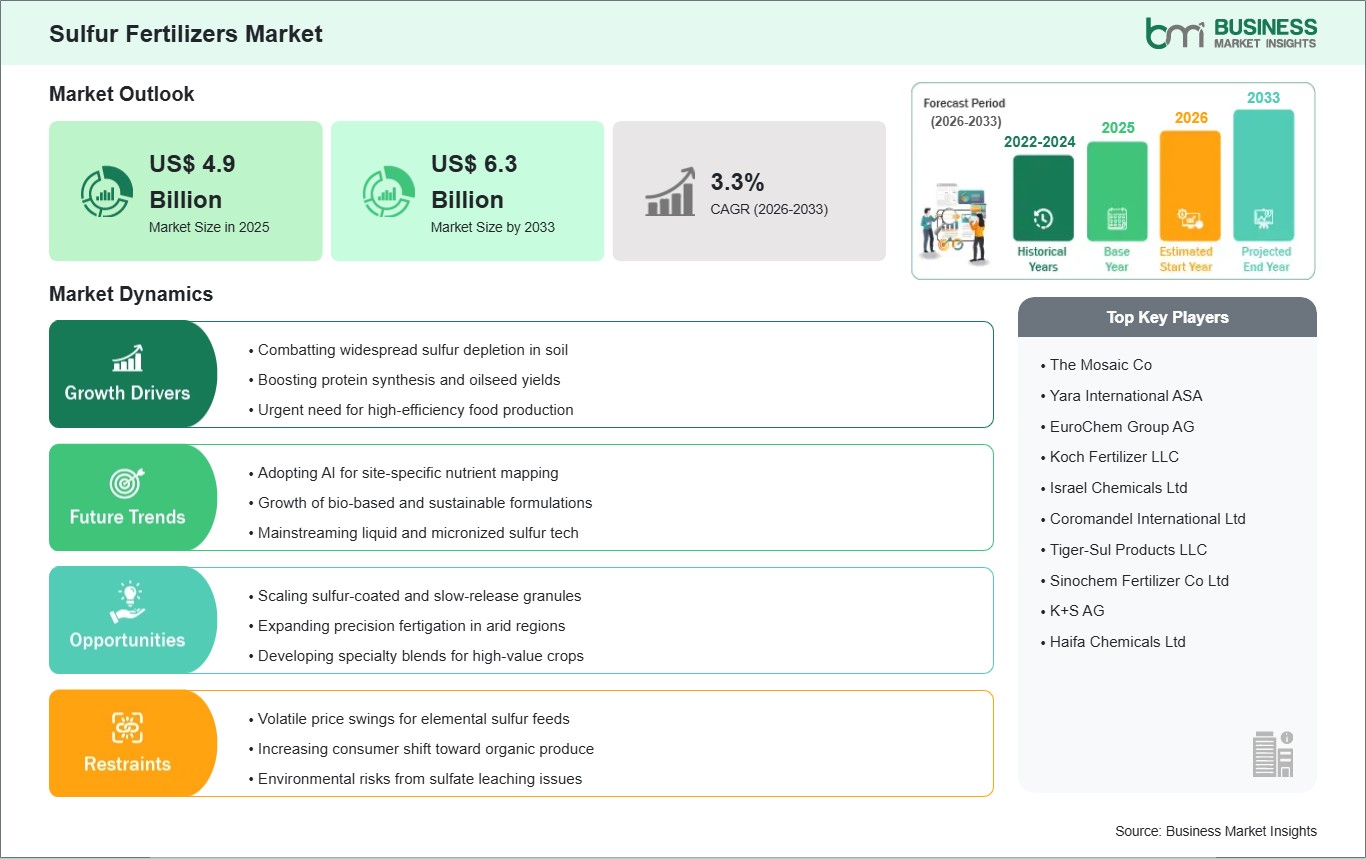
Sulfur fertilizers play a key role in providing sulfur, the fourth major plant nutrient, to address soil deficiencies and improve crop yield and quality. They are important for crops like cereals, oilseeds, pulses, and fruits and vegetables. Benefits include better protein production, more efficient nitrogen use, and stronger crops. The market is growing due to rising soil sulfur deficiencies worldwide, less sulfur from industrial emissions, the need to boost food production, and the high sulfur needs of crops like canola and soybean.
There are some challenges for the market, such as unstable prices for elemental sulfur, which depend on natural gas and oil markets, making costs unpredictable for producers. Environmental issues, like the risk of sulfate leaching into groundwater, also require careful management. The market faces competition from other soil improvement methods and the growing preference for organic farming, which uses natural nutrients. Still, there are opportunities as more farmers use precision agriculture, new slow-release sulfur fertilizers are developed, and demand grows in the Asia-Pacific due to intensive farming and sulfur-poor soils. Government programs that support balanced fertilization are also expected to help the market grow.
Segment Analysis
Sulfur Fertilizers Market Segmentation
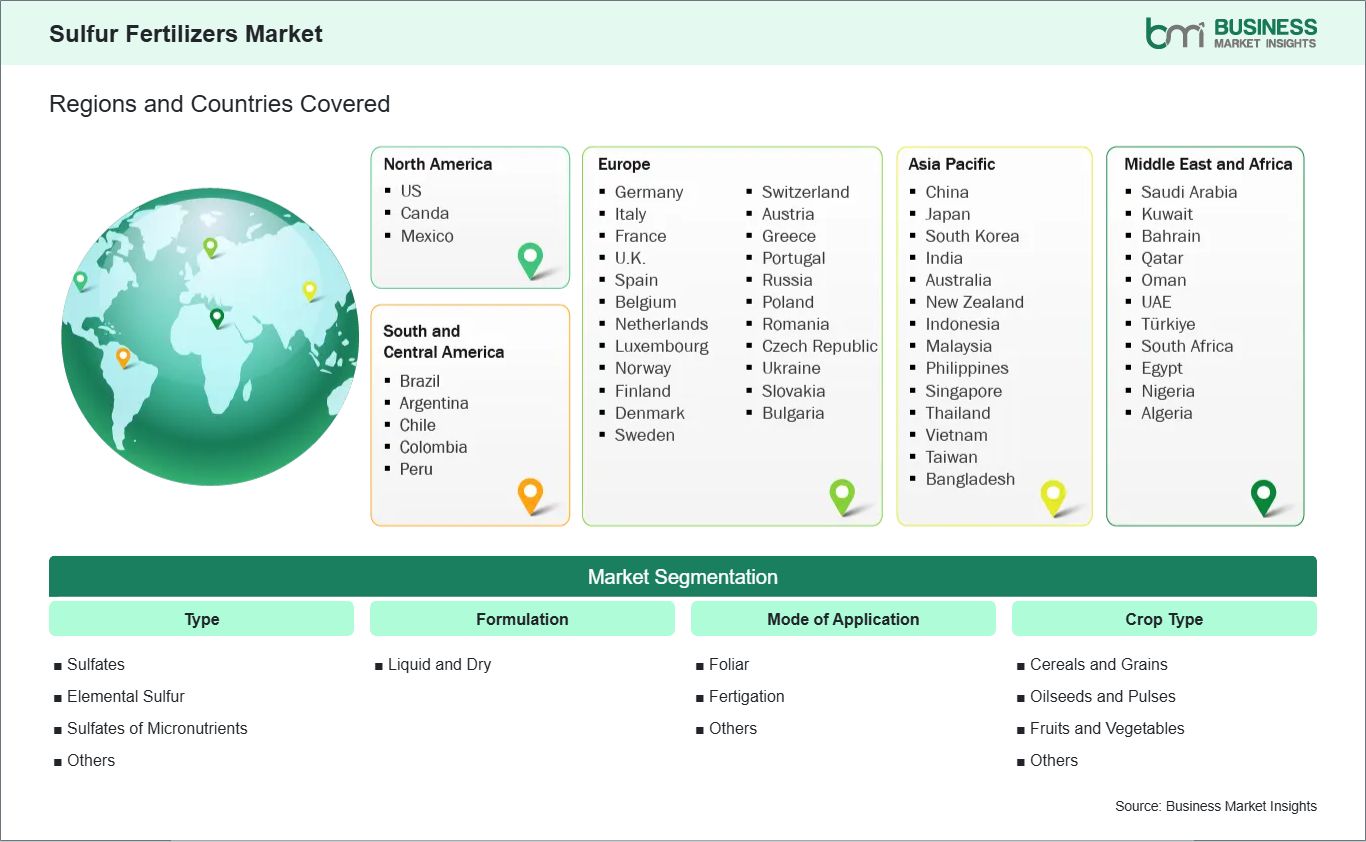
Key segments that contributed to the derivation of the sulfur fertilizers market analysis are type, formulation, mode of application, and crop type.
- By Type, the market is segmented into Sulfates, Elemental Sulfur, Sulfates of Micronutrients, and Others.
- By Formulation, the market is bifurcated into Liquid and Dry.
- By Mode of Application, the market is segmented into Foliar, Fertigation, and Others.
- By Crop Type, the market is segmented into Cereals and Grains, Oilseeds and Pulses, Fruits and Vegetables, and Others. The Cereals and Grains segment is further divided into Corn, Wheat, Rice, and Others. The Oilseeds and Pulses segment is further categorized into Soybean, Sunflower, and Others. The Fruits and Vegetables segment is further divided into Root and Tuber Vegetables, Leafy Vegetables, Pome Fruits, Berries, Citrus Fruits, and Others.
Market Forces
Sulfur Fertilizers Market Drivers and Opportunities
Widespread Soil Sulfur Deficiency
The major factor defining the market growth in the sulfur fertilizers market is the lack of sulfur in soils globally, caused by environmental changes and modern farming. In the past, sulfur came from acid rain and traditional fertilizers; however, cleaner air laws have greatly reduced industrial sulfur emissions.
At the same time, modern high-yield farming uses crops that need a lot of sulfur, like oilseeds, pulses, and canola, and often relies on fertilizers that do not contain sulfur, such as urea or DAP. This has quickly used up the sulfur in soils. As sulfur is important for making protein and oil in plants and helps them use nitrogen well, farmers now need to regularly add sulfur fertilizers to keep up crop yields, quality, and soil health.
Elemental Sulfur and Precision Nutrition
The major opportunities in the market lie in creating new types of elemental sulfur fertilizers and using sulfur products in precise, balanced crop nutrition plans. While traditional sulfate fertilizers are easy to get, they can wash away from the soil easily.
New technology is making highly concentrated, slow-release sulfur fertilizers. These use smaller particles or mix elemental sulfur into NPK granules, so the sulfur becomes available to plants slowly and steadily. This helps prevent the fertilizer from washing away and matches the crop's needs during its growth. As more farmers use precision farming and balanced fertilization, sulfur is now seen as the fourth key nutrient after NPK. This gives manufacturers a chance to make custom sulfur fertilizers that help crops use nutrients better and increase profits, especially for valuable fruits and vegetables.
Size and Share Analysis
Sulfur Fertilizers Market Size and Share Analysis
The Sulfur Fertilizers Market is growing steadily. Analysis of market size and share shows changing trends and how key companies are positioned. The report also looks at different subsegments by type, formulation, application method, and crop type to show how each part affects the market.
For example, sulfate fertilizers, usually in dry granular form, are often used on cereals and grains with standard soil application methods. They are popular as they provide nutrients and help fix sulfur shortages in major grain areas.
Elemental sulfur is being used more for oilseeds and pulses, especially through fertigation or spreading on the soil. This type is valued for releasing sulfur slowly, giving crops a steady supply during their long growth, which is important for high oil and protein levels.
Report Coverage
Sulfur Fertilizers Market Report Coverage and Deliverables
The "Sulfur Fertilizers Market Size and Forecast (2022 - 2033)" report provides a detailed analysis of the market covering below areas:
- Sulfur Fertilizers Market size and forecast at global, regional, and country levels for all the key market segments covered under the scope
- Sulfur Fertilizers Market trends, as well as market dynamics such as drivers, restraints, and key opportunities
- Sulfur Fertilizers Market analysis covering key market trends, global and regional framework, major players, regulations, and recent market developments
- Industry landscape and competition analysis covering market concentration, heat map analysis, prominent players, and recent developments for the Sulfur Fertilizers Market
- Detailed company profiles, including SWOT analysis
Geographic Insights
Sulfur Fertilizers Market Geographic Insights
The geographical scope of the Sulfur Fertilizers Market report is divided into five regions: North America, Asia Pacific, Europe, the Middle East & Africa, and South & Central America.
The Asia-Pacific Sulfur Fertilizers Market is segmented into China, Japan, South Korea, India, Australia, New Zealand, Indonesia, Malaysia, the Philippines, Singapore, Thailand, Vietnam, Taiwan, Bangladesh, and the Rest of Asia. The market in Asia-Pacific is driven by the region's massive agricultural land base and the increasing awareness among farmers regarding sulfur deficiency in soils, which enhances crop yield and quality.
The shift towards balanced fertilization practices and the expanding production of high-value commercial crops further accelerates growth. The increasing adoption of sulfate-containing complex fertilizers and the government's focus on improving food security are solidifying Asia-Pacific as the critical global center for sulfur fertilizer demand.
Industry Activity
Recent Developments
The Sulfur Fertilizers Market is evaluated by gathering qualitative and quantitative data post-primary and secondary research, which includes important corporate publications, association data, and databases. A few of the key developments in the Sulfur Fertilizers Market are:
- In March 2025, Coromandel International Limited, one of India’s leading agri-solutions providers, inaugurated its second Sulphur manufacturing plant at its Visakhapatnam facility in Andhra Pradesh. Visakhapatnam site is the company’s wholly backward integrated unit and produces approximately 12 LMT of complex fertilisers along with Phosphoric acid and Sulphuric acid. The site also hosts a Sulphur Fertiliser plant with 25000 MT production capacity. With the inauguration of this new plant, the company’s Sulphur fertiliser capacity is doubled, ensuring a steady supply of high-quality bentonite Sulphur fertilisers to the farmers.
- In December 2025, Mosaic announced it was idling single super phosphate (SSP) production at two Brazilian facilities and suspending future sulphur purchases in response to a sharp increase in sulphur prices. This highlights supply chain sensitivity to raw material costs.
Trust & Transparency
Research Methodology
The market analysis combines proprietary research with secondary data from government agencies, company disclosures, regulatory filings, industry databases and expert interviews. Market estimates are validated through data triangulation, cross-market benchmarking and analyst
review.
View Full Research Methodology
Key Sources Referred:
World Bank - Global Trade IndicatorsWorld Trade Organization (WTO)International Monetary Fund (IMF)International Trade Administration (ITA)Company WebsitesCompany Annual ReportsCompany Investor Presentations