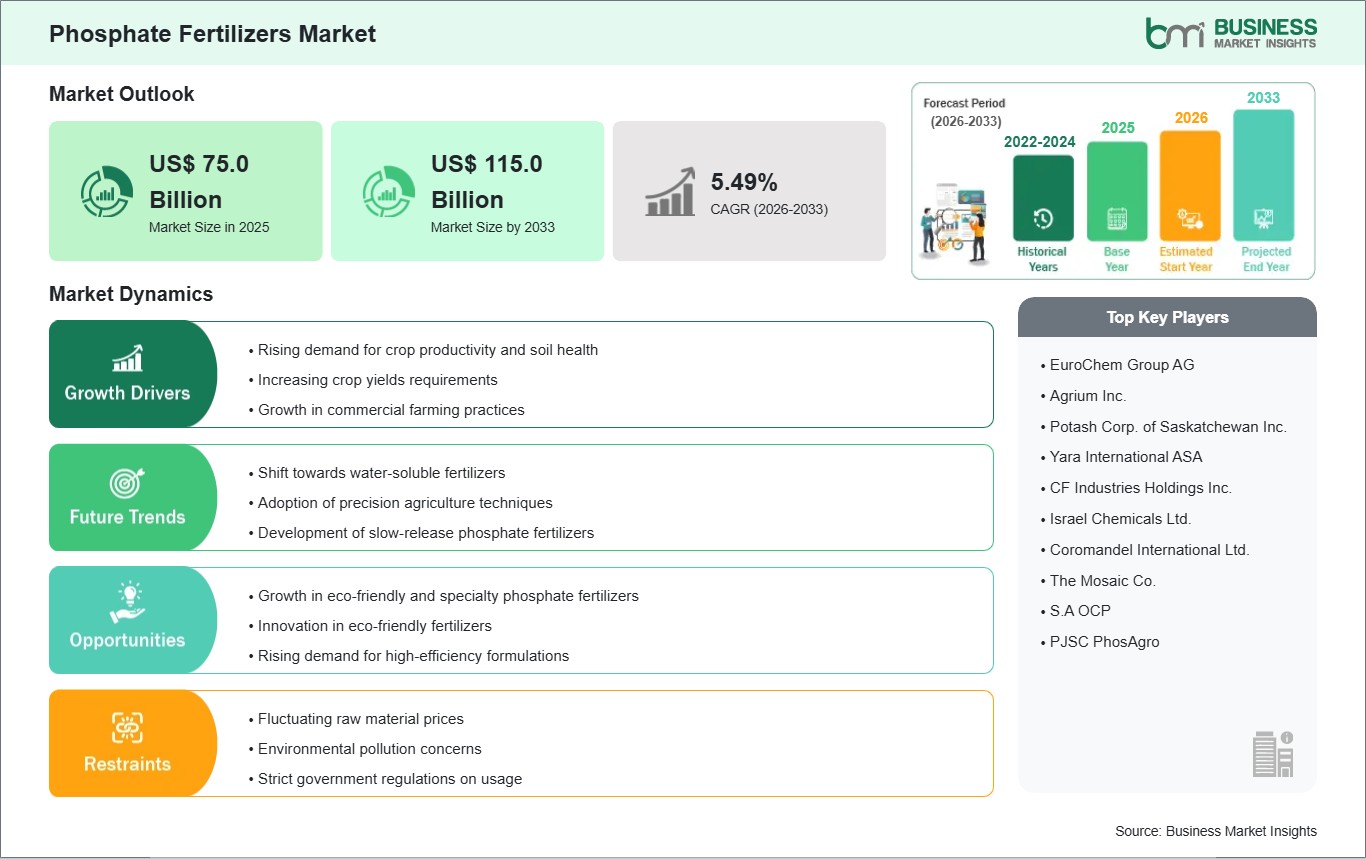
The Phosphate Fertilizers Market size is expected to reach US$ 115. billion by 2033 from US$ 75. billion in 2025. The market is estimated to record a CAGR of 5.49% from 2026 to 2033.
The market for phosphate fertilizers is recording continuous growth, with the global market driven by the need for increased agricultural productivity, soil fertility, and the quest for increased food production. Phosphate fertilizers, such as monoammonium phosphate, diammonium phosphate, and triple superphosphate, are crucial for the development of better root growth, flowering, and yield. The increased use of the product in the cultivation of cereals, oil crops, fruits, and vegetables is boosting the market, with the product being used in both emerging and developed countries.
The trend in the phosphate fertilizer market is the increased focus on the use of the product in the development of sustainable agriculture. Farmers are increasingly adopting the use of the product in the development of site-specific nutrient management, where the product is being used in combination with micronutrients for the optimization of crop growth while ensuring the sustainability of the environment. Moreover, technological advancements in fertilizer production processes, including energy-efficient fertilizer production and better granulation processes, will help to enhance the quality and efficiency of fertilizers.
Also, the combination of phosphate fertilizers and other products such as soil conditioners, biofertilizers, and crop protectants is likely to enhance the market for fertilizer products. The market for phosphate fertilizers is highly competitive and comprises various global chemical companies and fertilizer manufacturers. Moreover, strategic alliances, long-term contracts with agricultural cooperatives, and government incentives for fertilizer use will boost market penetration. The prices of phosphate fertilizers depend on various factors such as raw material availability, geopolitical risks, and transportation costs, especially for those relying on phosphate rocks.
The market for phosphate fertilizers is characterized by a combination of agricultural needs, sustainability concerns, and technological advancements. Companies that specialize in producing efficient and sustainable phosphate fertilizers will be able to tap into new market opportunities for conventional and precision agriculture.

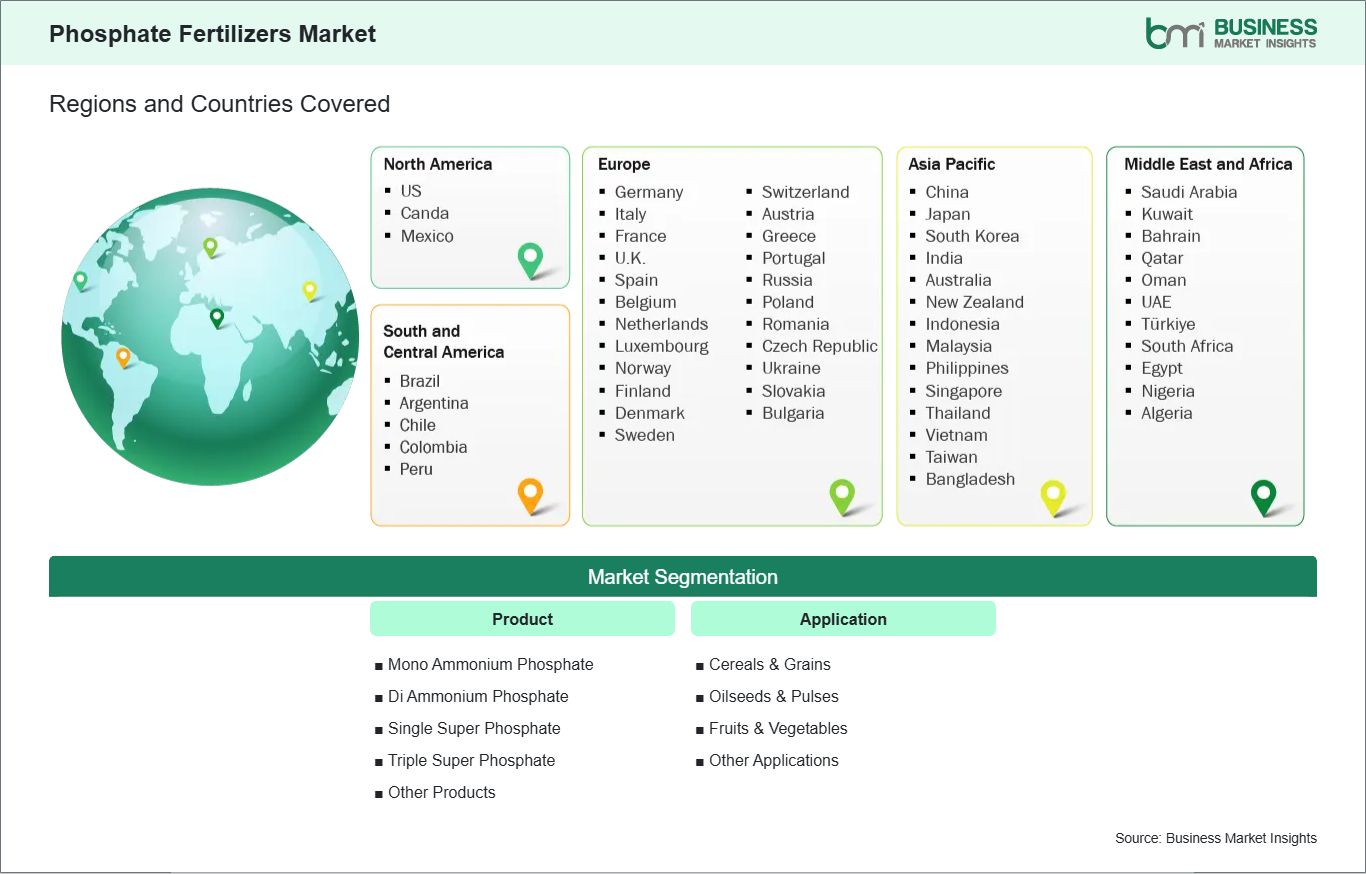
Key segments that contributed to the derivation of the phosphate fertilizers market analysis are product and application.
The need for the use of phosphate fertilizers has increased, with farmers and agricultural businesses focusing on increasing crop yield and improving the fertility of the soil. Phosphate is an important nutrient for the development of the roots, flowers, and growth of plants. As such, it has become an indispensable part of modern agriculture. With the increase in the number of people in the world, the need for food has also increased. Phosphate fertilizers have thus become very important for the growth of healthy crops.
The manufacturers are coming up with different types of fertilizers, such as mono, di, and polyphosphate, to cater to the needs of the crops. The use of such fertilizers has increased the efficiency of the crops, thus making them profitable.
Innovation in fertilizer formulations is also shaping market growth. New products aim to enhance nutrient availability, reduce environmental runoff, and improve compatibility with modern farming techniques. These advancements help farmers achieve better results while managing sustainability and cost efficiency. As agriculture continues to evolve, phosphate fertilizers remain a vital tool for achieving high-yield and resilient crops.
The need for sustainability has increased the demand for eco-friendly phosphate fertilizers. Fertilizers are being developed that are slow-release, controlled-release, and water-soluble. This helps to prevent nutrient loss, thereby reducing the overall impact on the environment. This trend reflects the increasing environmental standards and requirements.
Specialty phosphate fertilizers are becoming popular due to their application. They are used to provide specific nutrient requirements for various crops, soils, and climatic conditions. They are helpful in increasing productivity by reducing waste.
Ongoing research is focused on creating fertilizers that combine high efficiency with environmental responsibility. Advanced formulations help optimize nutrient uptake, enhance soil fertility, and reduce the ecological footprint of farming operations. As global agriculture seeks to balance productivity with sustainability, eco-friendly and specialty phosphate fertilizers are expected to drive significant growth in the market.
The phosphate fertilizers market demonstrates steady growth, with size and share analysis highlighting evolving trends and competitive dynamics among key players. The report examines subsegments categorized within product and application, offering insights into their contribution to overall market performance.
By Product, the mono ammonium phosphate (MAP) subsegment dominated the market in 2025, driven by its high phosphorus content and wide use across major crops.
Based on Application, the cereals & grains subsegment dominated the market in 2025, supported by intensive cultivation of staple crops requiring balanced phosphorus nutrition.
| Report Attribute | Details |
|---|---|
| Market size in 2025 | US$ 75.0 Billion |
| Market Size by 2033 | US$ 115.0 Billion |
| Global CAGR (2026 - 2033) | 5.49% |
| Historical Data | 2022-2024 |
| Forecast period | 2026-2033 |
| Segments Covered | By Product
|
|
Regions and Countries Covered
| |
| North America | US, Canada, Mexico |
| Europe | Belgium, Austria, Finland, Denmark, Greece, Poland, Romania, Russia, Ukraine, Czech Republic, Slovakia, Bulgaria, Italy, Luxembourg, Germany, Switzerland, France, Netherlands, Norway, Portugal, Spain, Sweden, United Kingdom |
| Asia-Pacific | Australia, China, India, Japan, South Korea, Indonesia, Malaysia, Philippines, Singapore, Thailand, Vietnam, Bangladesh, New Zealand, Taiwan |
| South and Central America | Brazil, Argentina, Peru, Chile, Colombia |
| Middle East and Africa | Bahrain, Kuwait, Oman, Qatar, Saudi Arabia, United Arab Emirates, Turkiye, South Africa, Egypt, Algeria, Nigeria |
| Market leaders and key company profiles |
|
The "Phosphate Fertilizers Market Size and Forecast (2022 - 2033)" report provides a detailed analysis of the market covering below areas:
The geographical scope of the Phosphate Fertilizers Market report is divided into North America, Asia Pacific, Europe, Middle East & Africa, and South & Central America. North America held the largest share in 2025.
Regional-level dynamics in the phosphate fertilizers market reveal distinct demand patterns shaped by agricultural intensity, soil fertility requirements, and regulatory frameworks.
North America is the dominant market, led by the United States and Canada, where large-scale commercial farming and high-value crop production drive demand for high-quality phosphate fertilizers. Precision agriculture practices, regulatory compliance, and integration with soil nutrient management programs encourage adoption of both conventional and specialty formulations.
Europe represents a mature and sustainability-focused market, with Germany, France, and Italy emphasizing efficient fertilizer use and reduced environmental impact. EU regulations on nutrient management and water quality promote slow-release and water-soluble phosphate fertilizers. Adoption is strong in cereal, vegetable, and horticultural crops where yield optimization and soil health are priorities.
Asia Pacific is experiencing rapid growth, led by China, India, and Indonesia, due to high agricultural activity, rising population, and increasing food demand. Farmers are adopting both traditional and innovative phosphate fertilizers to improve productivity and mitigate soil nutrient depletion. Local production capacities and government subsidies support widespread availability and affordability.
Middle East & Africa is an emerging market, where arid and semi-arid conditions, coupled with expanding agricultural initiatives, are driving demand for phosphate fertilizers. Market growth is concentrated in countries like Egypt, Morocco, and South Africa, where soil fertility enhancement and crop yield improvement are priorities.
South & Central America shows steady growth, particularly in Brazil and Argentina, where commercial farming and export-oriented agriculture drive phosphate fertilizer consumption. Farmers increasingly adopt granulated and water-soluble formulations to enhance nutrient efficiency and optimize crop yield, while cost considerations remain an important factor in product selection.

The Phosphate Fertilizers Market is evaluated by gathering qualitative and quantitative data post primary and secondary research, which includes important corporate publications, association data, and databases. A few of the key developments in the phosphate fertilizers market are:
The Phosphate Fertilizers Market is valued at US$ 75.0 Billion in 2025, it is projected to reach US$ 115.0 Billion by 2033.
As per our report Phosphate Fertilizers Market, the market size is valued at US$ 75.0 Billion in 2025, projecting it to reach US$ 115.0 Billion by 2033. This translates to a CAGR of approximately 5.49% during the forecast period.
The Phosphate Fertilizers Market report typically cover these key segments-
The historic period, base year, and forecast period can vary slightly depending on the specific market research report. However, for the Phosphate Fertilizers Market report:
The Phosphate Fertilizers Market is populated by several key players, each contributing to its growth and innovation. Some of the major players include:
The Phosphate Fertilizers Market report is valuable for diverse stakeholders, including:
Essentially, anyone involved in or considering involvement in the Phosphate Fertilizers Market value chain can benefit from the information contained in a comprehensive market report.
Please tell us your area of interest
(Market Segments/ Regions and Countries/ Companies)