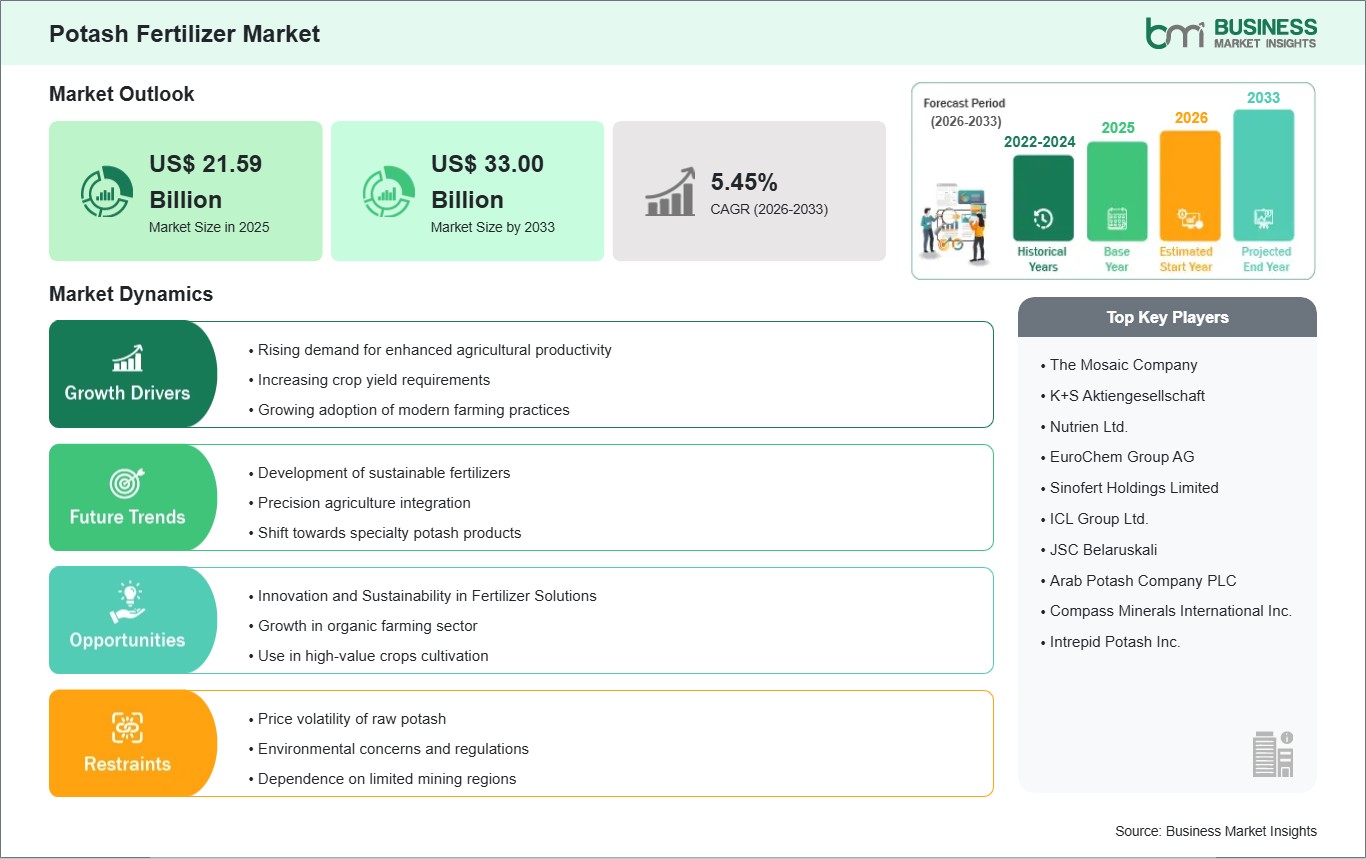
The Potash Fertilizer Market size is expected to reach US$ 33. billion by 2033 from US$ 21.59 billion in 2025. The market is estimated to record a CAGR of 5.45% from 2026 to 2033.
The international market for potash fertilizer is in an era of significant transformation, with developments in agricultural practices, fertilizer policies, and supply-side restructuring. Potash, as an essential source of potassium, an essential macronutrient for optimizing crop growth, stress resistance, and water use efficiency, continues to be an integral component of modern agricultural strategies worldwide. Its adoption is in line with the principles of precision agriculture, with farmers using the fertilizer for optimizing efficiency and minimizing environmental implications. Conventional cereal and grain crops are still the main drivers of fertilizer demand, but there is increasing support from horticulture, plantation crops, and other specialty crops, which require specific potassium supplements for quality and yield reliability.
The market structure is dominated by the presence of key players, who are also integrated agribusiness companies offering comprehensive fertilizer packages, thus creating a strong link between fertilizer supply and crop performance. The supply side of the market is also an essential component of strategic restructuring, with key fertilizer-producing countries such as Canada, Russia, and Belarus remaining the mainstay of international trade, though geopolitical tensions do affect market stability from time to time. Such drivers are causing regional importers, especially in Asia and Latin America, to look for diversification in their sourcing models, invest in storage facilities, and sign up for long-term offtake contracts to secure their supplies.
At the same time, improvements in mining technologies, processing, and logistics optimization are making production more flexible, lowering the cost of distribution on a per-unit basis. The demand fundamentals are also affected by the regulatory environment, which seeks to reduce nutrient runoff in waterways and promote sustainable fertilizer use, thus driving market players to look for innovation in low-soluble potash, improved nutrients, and their use in integrated crop nutrition systems. Some of the challenges relate to feedstock availability, energy cost volatility, and the capital-intensive nature of developing potash projects, which all contribute to market entry and growth strategies.
The potash fertilizer market thus reflects robust demand, which is driven by fundamental necessity, while adapting to trade, regulatory, and technological changes that are hallmarks of the fertilizer industry globally.

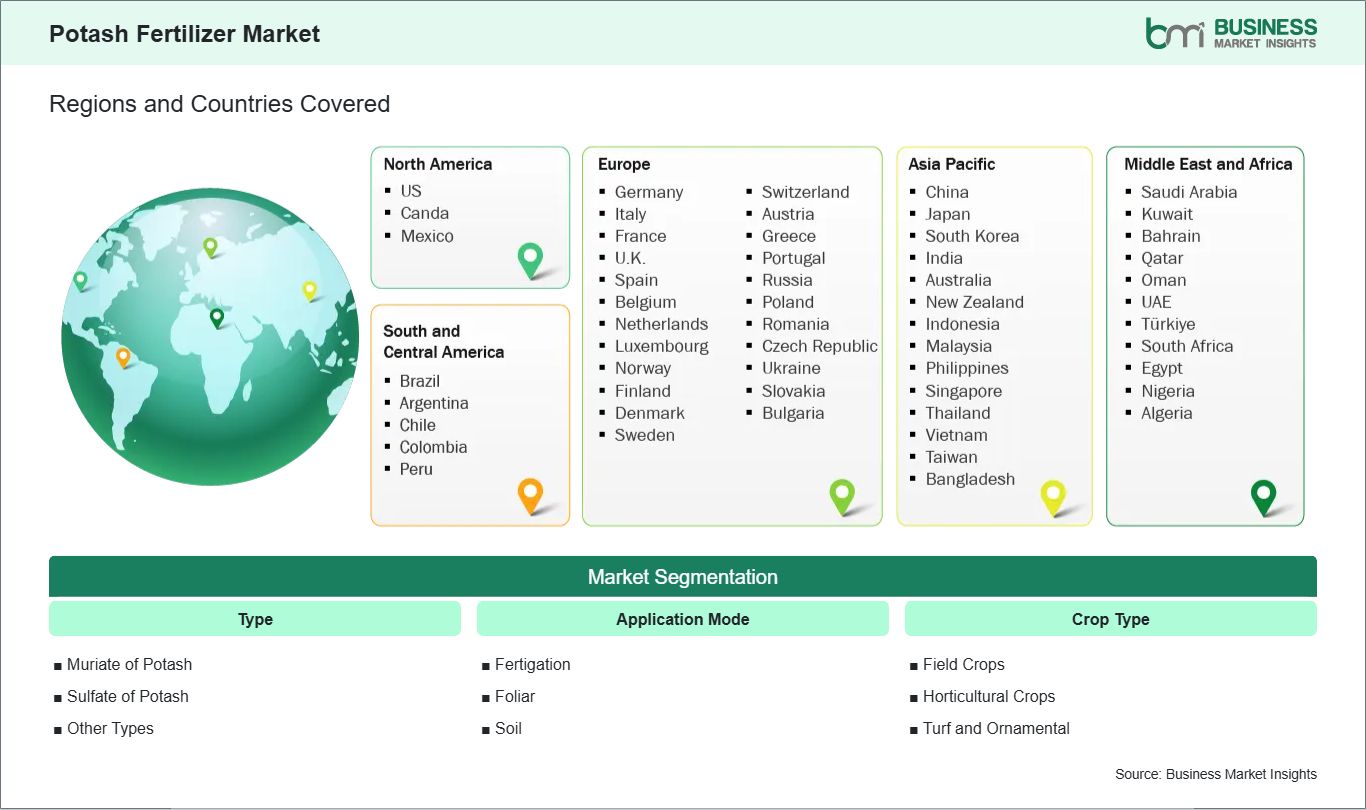
Key segments that contributed to the derivation of the potash fertilizer market analysis are type, application mode, and crop type.
By Type, the potash fertilizer market is segmented into Muriate of Potash (MoP), Sulfate of Potash (SoP), and Others. The Muriate of Potash (MoP) segment dominated the market in 2025.
Based on Application Mode, the potash fertilizer market is classified into fertigation, foliar, and soil. The soil segment dominated the market in 2025.
On the Basis of Crop Type, the potash fertilizer market is segmented into field crops, horticultural crops, and turf and ornamental. The field crops segment dominated the market in 2025.
The global potash fertilizer market is growing steadily with increasing demand for higher productivity in agriculture and better crop yield. Potash fertilizers are rich in potassium and have played an important role in increasing plant growth and root development. Potash fertilizers have been effective in increasing the resistance power of plants against disease and environmental conditions. Soils in agricultural fields are becoming depleted of nutrients, and the increasing demand for potash fertilizer has been critical in maintaining the fertility of the soil. The ability of potash fertilizers to increase water retention and nutrient absorption in plants has been beneficial in increasing crop growth and yield.
Potash fertilizers have been widely used in agricultural fields for various crops such as cereals, fruits, vegetables, and oilseeds. The effectiveness of potash fertilizers in increasing crop quality and yield has been recognized in the agricultural industry. In modern agriculture, the increasing demand for higher productivity with less cultivable land has made the agricultural industry depend on essential fertilizers.
Also, the increasing adoption of mechanized farming and precise agriculture is creating demand for potash products that are consistent in quality. Farmers are in need of fertilizers that provide consistent availability of nutrients and minimize waste. This helps in achieving the goal of cost-effectiveness and sustainability. The ability of potash to sustain long-term crop health and crop performance is the key driver that will continue to sustain the presence of potash fertilizers in the global market.
The global market for potash fertilizer is benefiting from the development of innovative, sustainable fertilizer solutions, which can meet the demands of modern agriculture. The market for innovative fertilizer solutions is gaining traction, with various players in the industry developing new, sustainable, and specialty fertilizer solutions. These innovative fertilizer solutions can increase the efficiency of fertilizer use, which can promote sustainable agricultural production. The innovative fertilizer market is gaining popularity, with players in the industry developing new fertilizer solutions such as controlled-release fertilizers, water-soluble fertilizers, and customized fertilizer solutions. These innovative fertilizer solutions can increase the efficiency of fertilizer use, which can promote sustainable agricultural production.
The innovative fertilizer market is gaining popularity, with players in the industry developing new fertilizer solutions such as customized fertilizer solutions, which can promote sustainable agricultural production. The customized fertilizer solution can increase the efficiency of fertilizer use, which can promote sustainable agricultural production. The customized fertilizer solution can increase the efficiency of fertilizer use, which can promote sustainable agricultural production. The customized fertilizer solution can increase the efficiency of fertilizer use, which can promote sustainable agricultural production.
Sustainability is also emerging as an important market driver with manufacturers adopting environmentally friendly production technologies. Initiatives aimed at reducing consumption, emissions, and producing recyclable or environmentally friendly fertilizers are changing the dynamics of the market. As global agriculture continues on its path of efficiency, productivity, and environmental friendliness, potash fertilizers have been recognized as an essential part of modern crop management. Developments that promise both performance and sustainability have strong potential for creating future opportunities in the market.
The potash fertilizer market demonstrates steady growth, with size and share analysis highlighting evolving trends and competitive dynamics among key players. The report examines subsegments categorized within type, application mode, and crop type, offering insights into their contribution to overall market performance.
By Type, the Muriate of Potash (MoP) subsegment dominated the market in 2025, driven by its high global demand and cost-effectiveness.
Based on Application Mode, the soil subsegment dominated the market in 2025, owing to its widespread adoption and ease of use in large-scale agriculture.
On the Basis of Crop Type, the field crops subsegment dominated the market in 2025, propelled by extensive acreage and consistent potash fertilizer application for staple crops.
| Report Attribute | Details |
|---|---|
| Market size in 2025 | US$ 21.59 Billion |
| Market Size by 2033 | US$ 33.00 Billion |
| Global CAGR (2026 - 2033) | 5.45% |
| Historical Data | 2022-2024 |
| Forecast period | 2026-2033 |
| Segments Covered | By Type
|
|
Regions and Countries Covered
| |
| North America | US, Canada, Mexico |
| Europe | Belgium, Austria, Finland, Denmark, Greece, Poland, Romania, Russia, Ukraine, Czech Republic, Slovakia, Bulgaria, Italy, Luxembourg, Germany, Switzerland, France, Netherlands, Norway, Portugal, Spain, Sweden, United Kingdom |
| Asia-Pacific | Australia, China, India, Japan, South Korea, Indonesia, Malaysia, Philippines, Singapore, Thailand, Vietnam, Bangladesh, New Zealand, Taiwan |
| South and Central America | Brazil, Argentina, Peru, Chile, Colombia |
| Middle East and Africa | Bahrain, Kuwait, Oman, Qatar, Saudi Arabia, United Arab Emirates, Turkiye, South Africa, Egypt, Algeria, Nigeria |
| Market leaders and key company profiles |
|
The "Potash Fertilizer Market Size and Forecast (2022 - 2033)" report provides a detailed analysis of the market covering below areas:
The geographical scope of the Potash Fertilizer Market report is divided into North America, Asia Pacific, Europe, Middle East & Africa, and South & Central America. North America held the largest share in 2025.
Regional‑level dynamics in the potash fertilizer market reflect differentiated demand drivers, import dependencies, and agricultural profiles across key geographies. North America holds a significant position, supported by high agronomic adoption rates of potassium supplementation and well‑developed distribution networks. The United States and Canada both producers and consumers benefit from advanced soil testing capabilities, precision application practices, and strong institutional support for nutrient stewardship, reinforcing stable domestic demand across row crops, grains, and specialty plantings.
Europe features a mature fertilizer market driven by institutional frameworks that emphasize balanced nutrient management and environmental protection. Countries such as France, Germany, and Poland exhibit stable potash requirements, particularly for cereals and forage crops, although regulatory constraints on nutrient runoff and carbon footprint considerations are reshaping product formulations and application practices.
The Asia Pacific region represents the fastest‑growing demand center, driven by expanding cultivated areas, rising food security imperatives, and intensifying crop yield targets in China, India, Indonesia, and Southeast Asian nations. Import reliance in this region is significant, prompting investments in deep‑sea port infrastructure, blending facilities, and logistics optimization to ensure consistency of potash supply. Industrial crop segments, particularly rice, sugarcane, and oilseeds, are key drivers of regional nutrient demand.
Middle East & Africa demand patterns vary significantly, with North African countries and the Gulf Cooperation Council (GCC) states exhibiting steady potash uptake due to irrigated agriculture, while sub‑Saharan regions show emerging potential constrained by infrastructure and affordability challenges. South & Central America, led by Brazil and Argentina, displays robust growth in potash consumption, underpinned by expansive row crop cultivation and strong export‑oriented agriculture sectors. Producers in these regions prioritize blended fertilizer programs and soil fertility enhancement strategies to maximize return on investment, even as currency fluctuations and trade tariff structures influence procurement strategies.
Collectively, these regional dynamics underscore the critical role of potash fertilizers in sustaining global food production and highlight the nuanced interplay of agricultural intensity, trade flows, and nutrient management priorities across key markets.

The Potash Fertilizer Market is evaluated by gathering qualitative and quantitative data post primary and secondary research, which includes important corporate publications, association data, and databases. A few of the key developments in the potash fertilizer market are:
The Potash Fertilizer Market is valued at US$ 21.59 Billion in 2025, it is projected to reach US$ 33.00 Billion by 2033.
As per our report Potash Fertilizer Market, the market size is valued at US$ 21.59 Billion in 2025, projecting it to reach US$ 33.00 Billion by 2033. This translates to a CAGR of approximately 5.45% during the forecast period.
The Potash Fertilizer Market report typically cover these key segments-
The historic period, base year, and forecast period can vary slightly depending on the specific market research report. However, for the Potash Fertilizer Market report:
The Potash Fertilizer Market is populated by several key players, each contributing to its growth and innovation. Some of the major players include:
The Potash Fertilizer Market report is valuable for diverse stakeholders, including:
Essentially, anyone involved in or considering involvement in the Potash Fertilizer Market value chain can benefit from the information contained in a comprehensive market report.
Please tell us your area of interest
(Market Segments/ Regions and Countries/ Companies)