Market Summary
Executive Summary and Global Market Analysis
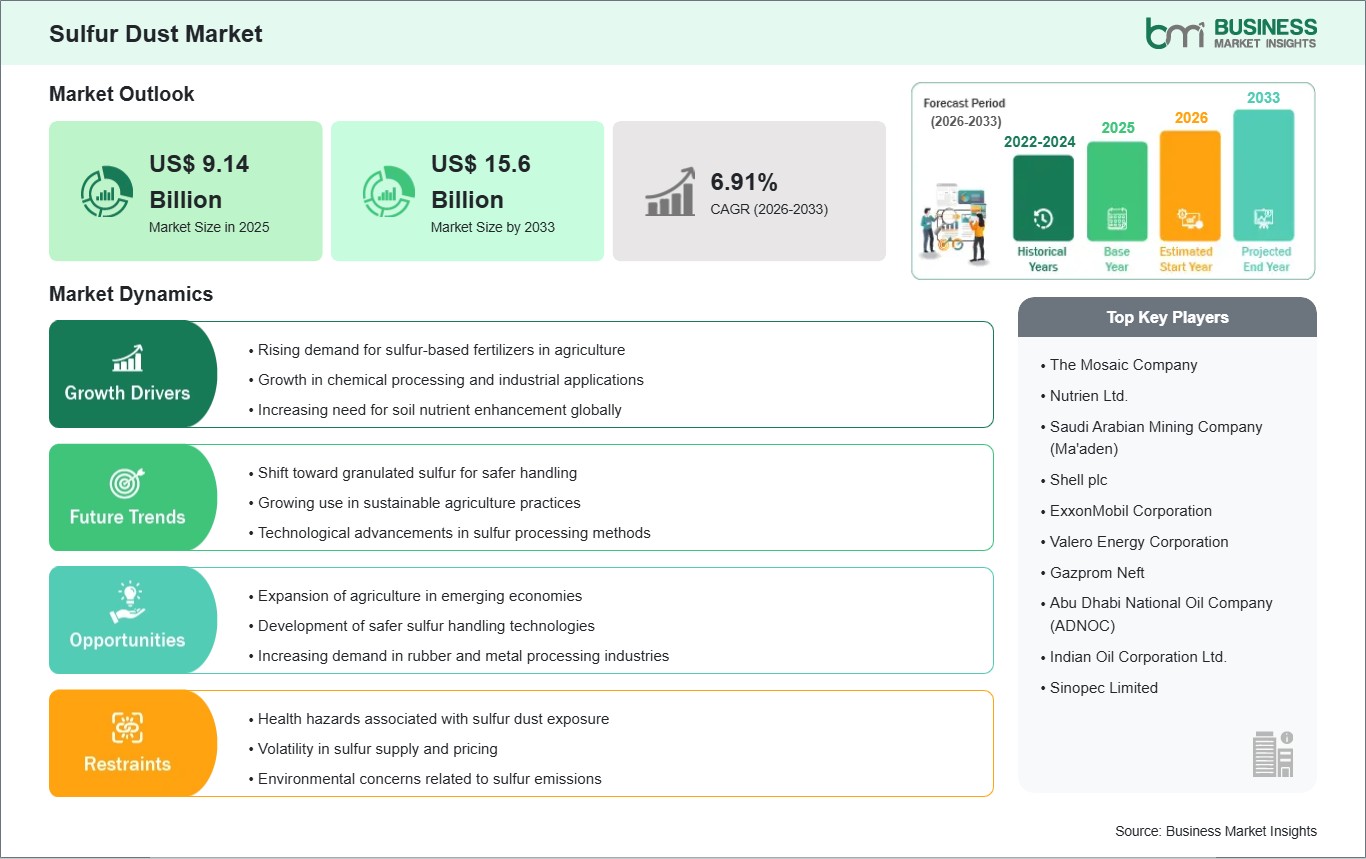
The sulfur dust market is witnessing steady growth driven by increasing demand from the agricultural sector, particularly for sulfur-based fertilizers. Sulfur plays a vital role in enhancing soil fertility and improving crop yield, making it an essential component in modern farming practices. The solid form of sulfur will likely dominate the industry because of its versatility and ease of use across so many different industries. Recent developments in sulfur processing technology have made processing sulfur much safer and reduced hazards from getting dust in the air. There are many challenges facing the industry, such as health issues from sulfur and volatility with pricing, but overall, the great agricultural and industrial demand for sulfur will continue to be the primary driver of growth in this market. The largest segment of end-use for sulfur dust will continue to be fertilizers to meet the increasing demand globally for food production. In summary, sustained growth will be experienced in the sulfur dust market due to agricultural demand and improvements in processing technology.
Segment Analysis
Sulfur Dust Market Segmentation
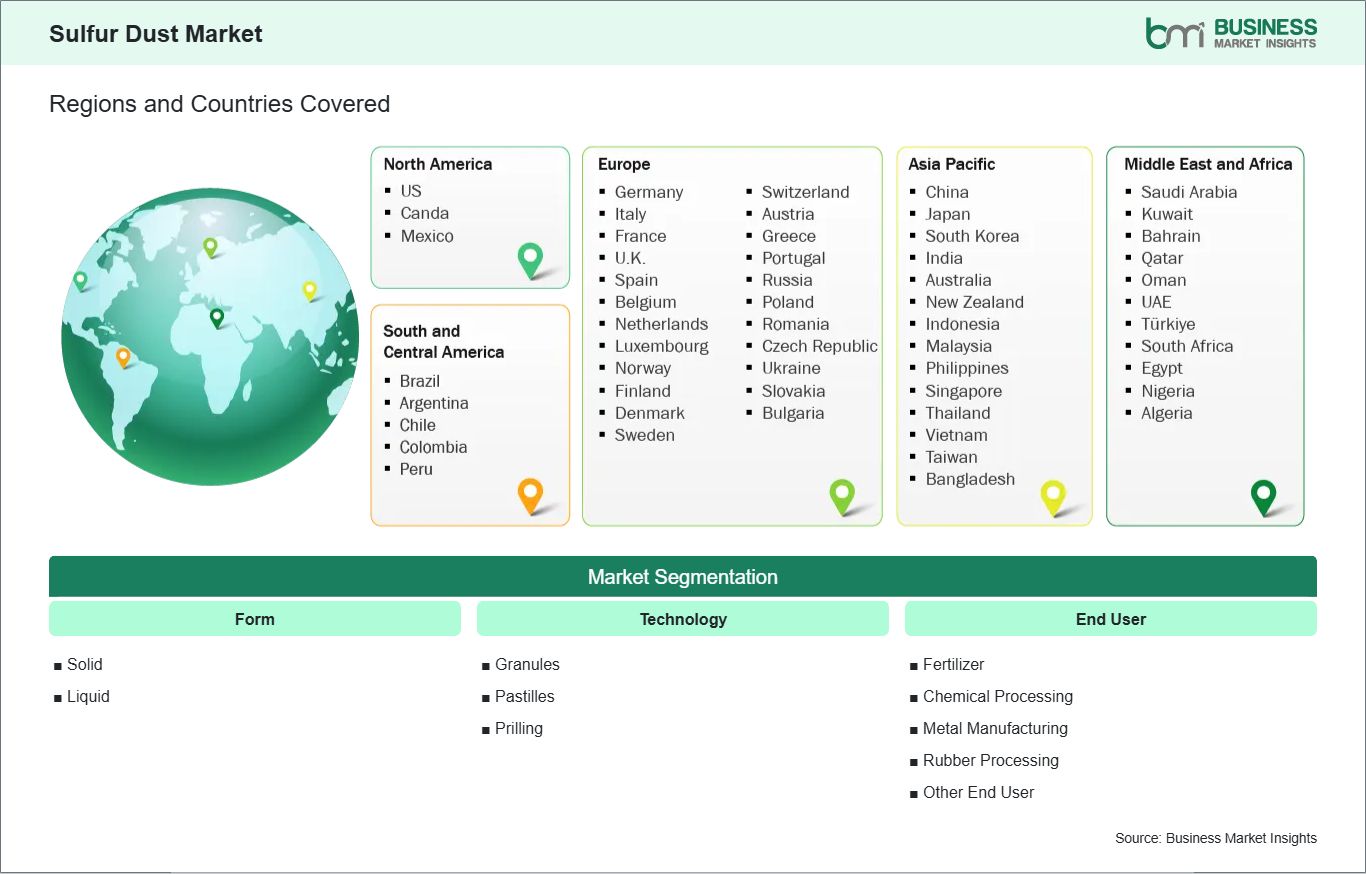
Key segments that contributed to the derivation of the Sulfur Dust market analysis are form, technology, and end user.
- By form, the sulfur dust market is segmented into Solid and Liquid. The Solid segment dominated the market in 2025.
- By technology, the sulfur dust market is segmented into Granules, Pastilles, and Prilling. The Granules segment dominated the market in 2025.
- By end user, the sulfur dust market is segmented into Fertilizer, Chemical Processing, Metal Manufacturing, Rubber Processing, and Other End User. The Fertilizer segment dominated the market in 2025.
Market Forces
Sulfur Dust Market Drivers and Opportunities
Rising demand for sulfur-based fertilizers in agriculture
The rising demand for sulfur-based fertilizers is a major driver of the sulfur dust market. Sulfur is an essential nutrient for plant growth, playing a key role in protein synthesis and enzyme function, making it increasingly important in modern agricultural practices. Depleting soil sulfur levels due to intensive farming and reduced atmospheric deposition have increased the need for sulfur supplementation. Farmers are increasingly adopting sulfur-based fertilizers to improve crop yield, enhance soil fertility, and ensure balanced nutrient management. Additionally, the global focus on food security and increasing agricultural productivity is driving the demand for fertilizers. As agricultural activities expand, particularly in developing regions, the use of sulfur dust in fertilizer production continues to grow, supporting overall market expansion.
Expansion of agriculture in emerging economies
The expansion of agriculture in emerging economies presents significant opportunities for the sulfur dust market. Countries in Asia-Pacific, Latin America, and Africa are witnessing rapid agricultural development driven by population growth and increasing food demand. Governments in these regions are promoting the use of fertilizers to enhance crop productivity and ensure food security. This is creating strong demand for sulfur-based fertilizers, thereby increasing the consumption of sulfur dust in fertilizer production processes. Moreover, improvements in farming techniques and increased awareness regarding soil health are encouraging the adoption of balanced nutrient management practices. As agricultural infrastructure continues to develop, the demand for sulfur dust is expected to rise, offering substantial growth opportunities for market participants.
Size and Share Analysis
Sulfur Dust Market Size and Share Analysis
The global Sulfur Dust market is experiencing steady growth, with market size and share analysis reflecting evolving treatment preferences and competitive dynamics among key players. The report evaluates important subsegments categorized within form, technology, and end user, highlighting their respective contributions to overall market performance.
By form, the Solid subsegment dominated the market in 2025 due to its stability, ease of transportation, and extensive use across agricultural and industrial applications.
By technology, the Granules subsegment dominated the market in 2025 due to its improved safety, reduced dust emissions, and better flowability for handling and application.
By end user, the Fertilizer subsegment dominated the market in 2025 due to increasing demand for soil nutrient enhancement and the widespread use of sulfur in agricultural applications.
Report Coverage
Sulfur Dust Market Report Coverage and Deliverables
The "Sulfur Dust Market Size and Forecast (2022 - 2033)" report provides a detailed analysis of the market covering below areas:
- Sulfur Dust market size and forecast at the regional and country levels for segments covered under the scope
- Sulfur Dust market trends, as well as drivers, restraints, and opportunities
- Sulfur Dust market analysis covering key trends, regional framework, major players, regulations, and recent developments
- Industry landscape and competition analysis covering market concentration, heat map analysis, prominent players, and recent developments for the Sulfur Dust market
- Detailed company profiles, including SWOT analysis
Geographic Insights
Sulfur Dust Market Geographic Insights
The geographical scope of the Sulfur Dust market report is divided into: North America, Asia Pacific, Europe, Middle East & Africa, and South & Central America. North America held the largest share in 2025.
North America dominates the sulfur dust market due to advanced agricultural practices and high demand for sulfur-based fertilizers. The region has well-established farming infrastructure and strong awareness regarding soil nutrient management, which supports the use of sulfur in agriculture. Additionally, the presence of a robust chemical processing industry contributes to the demand for sulfur dust in various industrial applications. Technological advancements in sulfur handling and processing further enhance market growth in the region. Regulatory frameworks focusing on environmental safety and efficient fertilizer use also play a significant role in driving demand. Meanwhile, Asia-Pacific is expected to witness substantial growth due to expanding agricultural activities, increasing population, and rising demand for food production. Governments in the region are actively promoting fertilizer use, creating significant opportunities for sulfur dust market expansion.
Industry Activity
Recent Developments
The Sulfur Dust market is evaluated by gathering qualitative and quantitative data post primary and secondary research, which includes important corporate publications, association data, and databases. A few of the key developments in the Sulfur Dust market are:
- In July 2024, Grupa Azoty announced that it had expanded its sulfur dust production capacity to meet rising demand in agriculture and rubber industries, reinforcing its role as a leading European supplier of sulfur-based products.
- In May 2023, Georgia Gulf Sulfur announced that it had upgraded its manufacturing facilities to improve efficiency and product quality in sulfur dust, targeting growth in crop protection and industrial applications.
Trust & Transparency
Research Methodology
The market analysis combines proprietary research with secondary data from government agencies, company disclosures, regulatory filings, industry databases and expert interviews. Market estimates are validated through data triangulation, cross-market benchmarking and analyst
review.
View Full Research Methodology
Key Sources Referred:
International Fertilizer Association (IFA) The Fertilizer Institute (TFI) Indian Farmers Fertilizer Cooperative Limited (IFFCO) Indian Agrochemical Industry Association (IAIA) China National Chemical Corporation European Fertilizer Manufacturers Association International Plant Nutrition Institute (IPNI) Soil Science Society of America (SSSA) American Society of Agronomy (ASA) Company Websites Company Annual Reports Company Investor Presentations