Market Summary
Executive Summary and Global Market Analysis
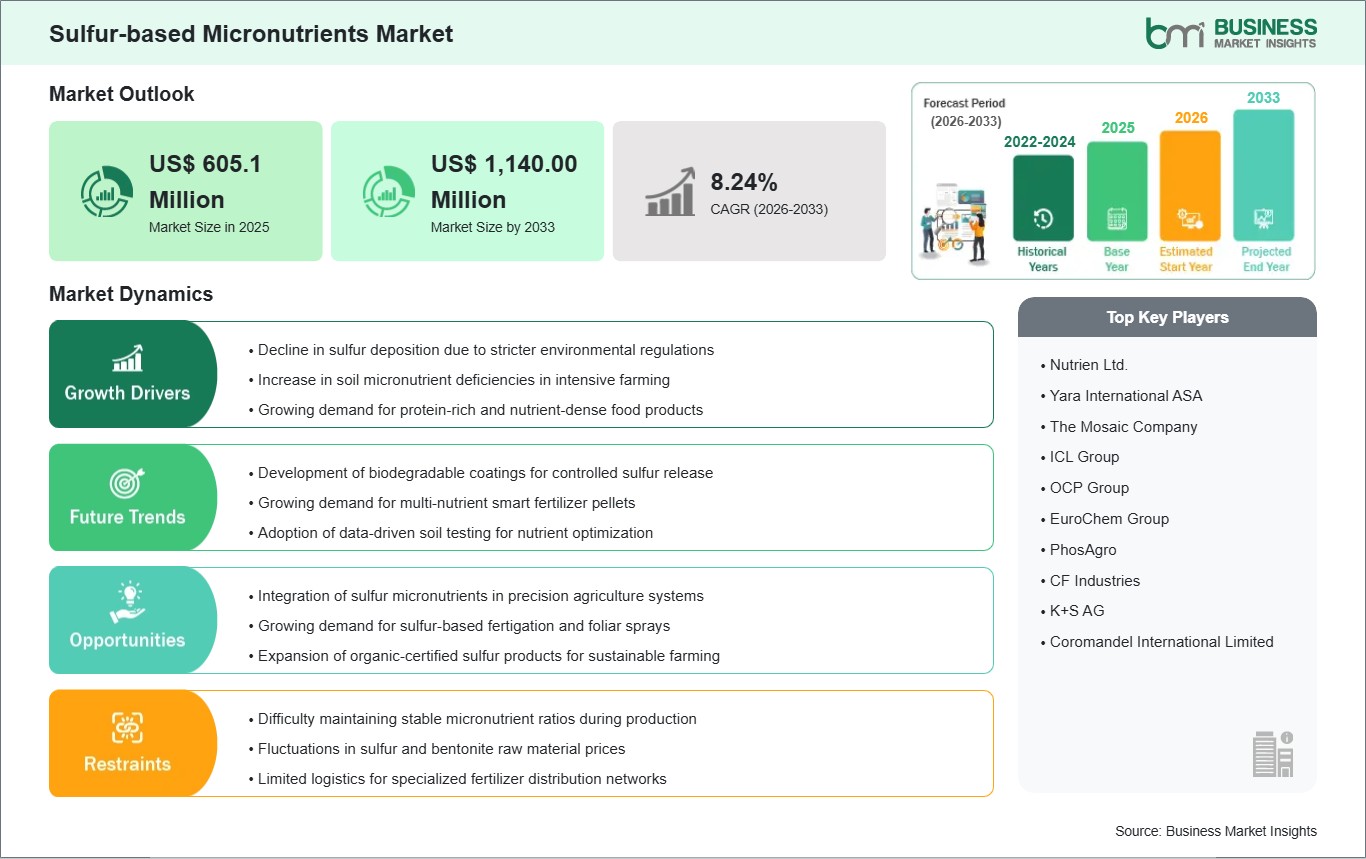
The Global Sulfur-based Micronutrients Market in 2025 was defined by its critical role in addressing the global soil nutrient crisis caused by the decline in atmospheric sulfur deposition and the rise of intensive farming. Valued as an essential component of the modern crop nutrition toolkit, the market is characterized by a high demand for complex blends like sulfur-bentonite-zinc, which provide multi-nutrient support in a single, efficient application. The cereals and grains sector remains the largest application area, reflecting the importance of sulfur in sustaining the worlds primary food sources. Meanwhile, a strategic shift toward sustainable and slow-release formulations is shaping the industry, as manufacturers aim to minimize environmental impact while maximizing nutrient uptake efficiency for a diverse range of crops. Strategic developments in 2025 centered on enhancing fertilizer delivery systems through the use of advanced pastilling and coating technologies.
While the industry faces challenges from fluctuating raw material costs and the technical complexities of manufacturing stabilized micronutrient blends, the long-term outlook remains positive due to the non-negotiable need for soil fertility. The market is also seeing increased investment in emerging economies, where government-led initiatives are promoting balanced fertilization to ensure national food security. As precision agriculture becomes more widespread, the ability to customize sulfur-micronutrient ratios based on real-time soil data is expected to be the next major phase of market evolution.
Segment Analysis
Sulfur-based Micronutrients Market Segmentation
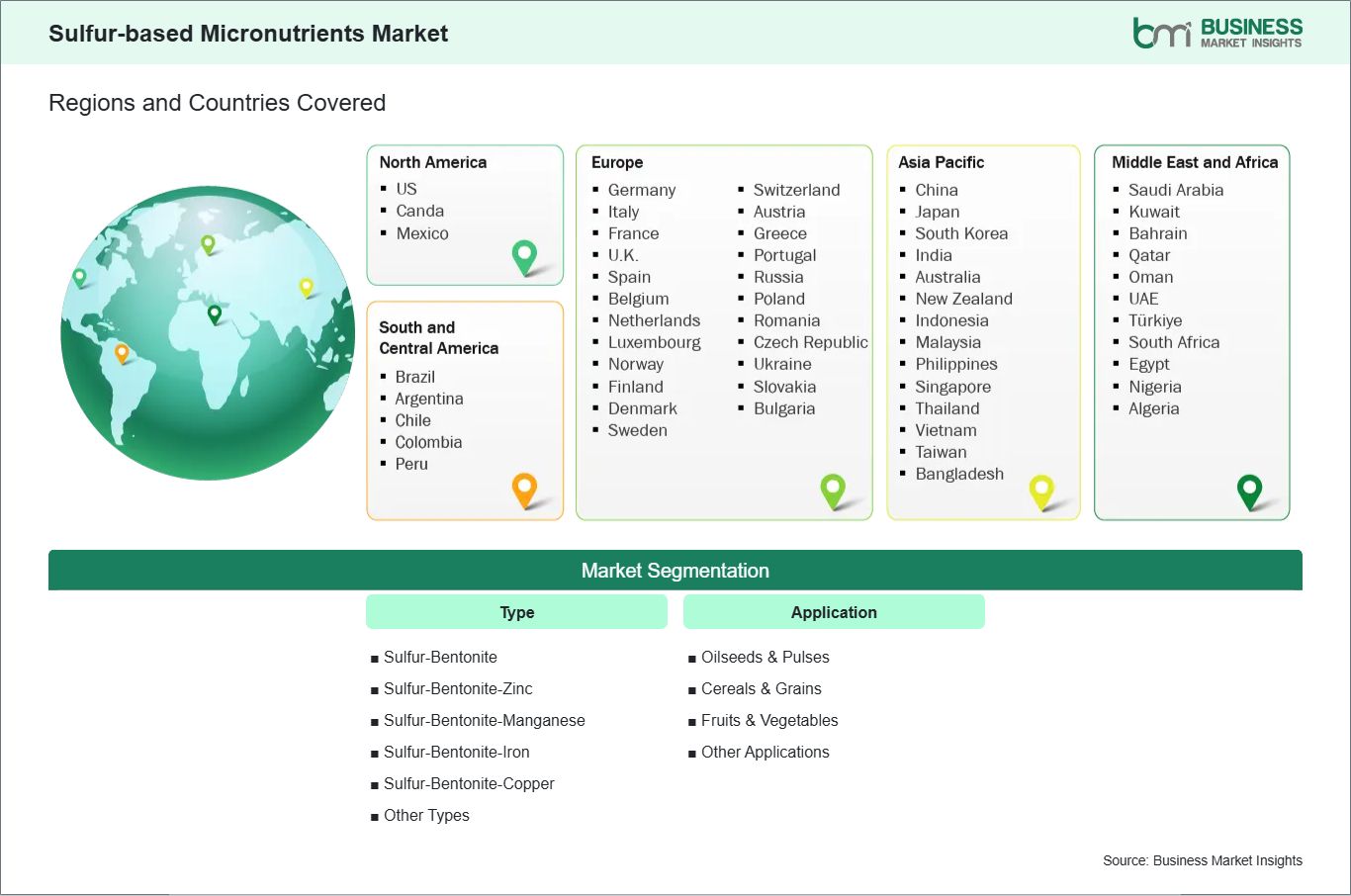
Key segments that contributed to the derivation of the Sulfur-based Micronutrients market analysis are type and application.
- By type, the market is segmented into Sulfur-Bentonite, Sulfur-Bentonite-Zinc, Sulfur-Bentonite-Manganese, Sulfur-Bentonite-Iron, Sulfur-Bentonite-Copper, and Others. The Sulfur-Bentonite-Zinc segment dominated the market in 2025.
- By application, the market is segmented into Oilseeds & Pulses, Cereals & Grains, Fruits & Vegetables, and Others. The Cereals & Grains segment dominated the market in 2025.
Market Forces
Sulfur-based Micronutrients Market Drivers and Opportunities
Declining Atmospheric Sulfur Deposition
For decades, many agricultural regions received a passive supply of sulfur through atmospheric deposition, often originating from industrial emissions. However, the success of global environmental policies aimed at reducing acid rain has significantly lowered these sulfur levels in the air. While this is a victory for the environment, it has left a nutritional void in the soil. Farmers can no longer rely on rainfall to provide the sulfur necessary for crop health, creating a forced reliance on commercial sulfur-based micronutrients to maintain soil fertility and prevent yield loss. This driver has transformed sulfur from an incidental benefit into a mandatory input for balanced plant nutrition. In regions like North America and Europe, the absence of atmospheric sulfur is most pronounced, leading to visible deficiency symptoms in crops that were historically healthy. This shift has compelled fertilizer manufacturers to innovate, creating highly efficient sulfur-bentonite and micronutrient-infused products that ensure the nutrient is available in the soil throughout the entire growing season, thereby stabilizing the global food supply in a cleaner industrial landscape.
Integration into Precision Agriculture
The rise of precision agriculture presents a transformative opportunity for the sulfur-based micronutrients market. With the advent of GPS-guided machinery and satellite soil mapping, farmers can now apply nutrients with surgical precision rather than broadcasting them uniformly across a field. Sulfur-based micronutrients are ideally suited for this approach because soil sulfur levels can vary significantly even within a single plot. By using variable-rate application technology, growers can target specific zones of deficiency, maximizing the impact of the fertilizer while minimizing waste and environmental runoff. Furthermore, precision agriculture allows for better stacking of nutrients. Manufacturers can develop specialized sulfur pellets that are engineered to work in tandem with automated sensors that detect real-time plant stress. This high-tech integration allows for the delivery of sulfur-bentonite-zinc blends exactly when the plant's metabolic demand peaks. As more commercial farms adopt digital management platforms, the demand for high-quality, flowable, and consistently sized sulfur-based micronutrients will surge, favoring companies that align their product characteristics with the requirements of automated farming equipment.
Size and Share Analysis
Sulfur-based Micronutrients Market Size and Share Analysis
The global Sulfur-based Micronutrients market is experiencing steady growth, with market size and share analysis reflecting evolving treatment preferences and competitive dynamics among key players. The report evaluates important subsegments categorized within type and application highlighting their respective contributions to overall market performance.
By type, the Sulfur-Bentonite-Zinc subsegment dominated the market in 2025 because it offers a synchronized release of nutrients that matches the crop's growth cycle, particularly in corn and wheat, where zinc is essential for early-stage development and sulfur is required for late-stage grain filling.
By application, the Cereals & Grains subsegment dominated the market in 2025 driven by the global imperative for food security. As populations rise, farmers are increasingly adopting sulfur-based micronutrients to maximize the caloric and nutritional output of every acre of grain produced.
Report Coverage
Sulfur-based Micronutrients Market Report Coverage and Deliverables
The "Sulfur-based Micronutrients Market Size and Forecast (2022 - 2033)" report provides a detailed analysis of the market covering below areas:
- Sulfur-based Micronutrients market size and forecast at the regional and country levels for segments covered under the scope
- Sulfur-based Micronutrients market trends, as well as drivers, restraints, and opportunities
- Sulfur-based Micronutrients market analysis covering key trends, regional framework, major players, regulations, and recent developments
- Industry landscape and competition analysis covering market concentration, heat map analysis, prominent players, and recent developments for the Sulfur-based Micronutrients market
- Detailed company profiles, including SWOT analysis
Geographic Insights
Sulfur-based Micronutrients Market Geographic Insights
The geographical scope of the Sulfur-based Micronutrients market report is divided into: North America, Asia Pacific, Europe, Middle East & Africa, and South & Central America. North America held the largest share in 2025.
North America maintained its position as the dominant region in the Sulfur-based Micronutrients Market in 2025, primarily due to its early adoption of advanced soil management practices and a highly sophisticated agricultural infrastructure. The region`s leadership is anchored by the United States, where large-scale commercial farming operations in the Midwest and Great Plains have long recognized sulfur as a fourth major nutrient. The presence of leading global fertilizer companies and a well-established retail distribution network allows for the rapid deployment of specialized micronutrient blends. Furthermore, strict environmental standards in the region have led to a more immediate realization of sulfur deficiencies in soil, driving a mature and consistent demand for supplementation.
The North American market is also characterized by a high degree of technological integration. American and Canadian farmers are global leaders in the use of precision agriculture, which utilizes high-quality sulfur-based pellets for variable-rate application. This technological edge ensures that the region remains the primary center for high-value product innovation, such as controlled-release and chelated sulfur formulations. While regions like Asia-Pacific are expanding rapidly in terms of total volume, North America`s focus on nutrient efficiency, regulatory compliance, and premium crop quality keeps it at the forefront of the global market in terms of both technical standards and value-added product consumption.
Industry Activity
Recent Developments
The Sulfur-based Micronutrients market is evaluated by gathering qualitative and quantitative data post primary and secondary research, which includes important corporate publications, association data, and databases. A few of the key developments in the Sulfur-based Micronutrients market are:
- In June 2024, Coromandel International Limited announced that it had expanded its crop nutrition portfolio by introducing new sulfur-based micronutrient formulations aimed at improving soil health and boosting yields in cereals and oilseeds.
- In March 2023, Mosaic Company announced that it had strengthened its fertilizer offerings with enhanced sulfur micronutrient blends, targeting North and South American markets to address sulfur deficiencies in soils.
- In October 2022, Nutrien Ltd. announced that it had launched new sulfur-enriched micronutrient fertilizers, designed to improve nutrient uptake efficiency and support sustainable farming practices across global agricultural regions.
Trust & Transparency
Research Methodology
The market analysis combines proprietary research with secondary data from government agencies, company disclosures, regulatory filings, industry databases and expert interviews. Market estimates are validated through data triangulation, cross-market benchmarking and analyst
review.
View Full Research Methodology
Key Sources Referred:
International Fertilizer Association (IFA) The Fertilizer Institute (TFI) Indian Farmers Fertilizer Cooperative Limited (IFFCO) Indian Agrochemical Industry Association (IAIA) China National Chemical Corporation European Fertilizer Manufacturers Association International Plant Nutrition Institute (IPNI) Soil Science Society of America (SSSA) American Society of Agronomy (ASA) Company Websites Company Annual Reports Company Investor Presentations