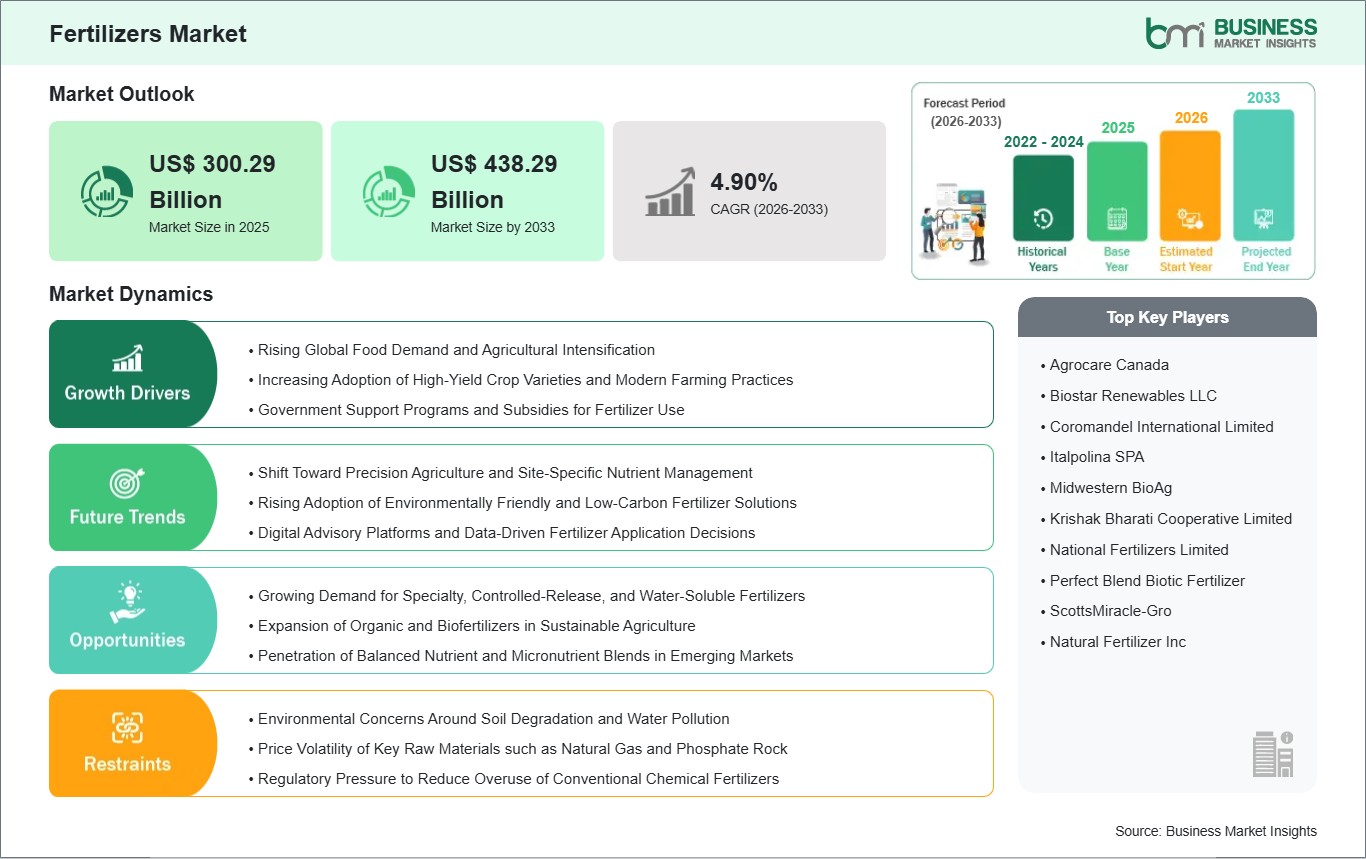
The Fertilizers market size is expected to reach US$ 438.76 billion by 2033 from US$ 300.29 billion in 2025. The market is estimated to record a CAGR of 4.9% from 2026 to 2033.
Agriculture, horticulture, and landscaping industries cannot do without fertilizers as they provide essential nutrients that make the soil fertile, stimulate plant development, and guarantee increased crop outputs. Notably, they are used in crop farming, fruit and vegetable production, turf management, and greenhouse growth. Fertilizers have the strengths of enhancing the balance of soil nutrients, can be used in various soils, and can be used in a large variety of crops and agricultural activities. The market is growing with increasing demand for food because of population growth, the demand for increased production of crops, and the use of modern farming methods. In addition, the development of bio-based and organic fertilizers, the production of controlled-release and specialty fertilizers, and innovations in nutrient formulations are increasing their use and making them more marketable.
However, the growth of the market may be limited by changes in the costs of raw materials, high environmental policies, and health issues related to excessive use of chemical fertilizers. Other challenges in the industry are soil degradation, water pollution, and region-specific regulatory structures. Despite these limitations, the business can be considered to have a high potential due to the increasing use of sustainable and organic fertilizers, the development of precision farming, and the need to address global food security. Further research and development, favorable state programs, and the transition to the fertilizers more environmentally friendly and nutritionally efficient fertilizers will stimulate the development of the fertilizers market in the world and its further evolution in the long term.

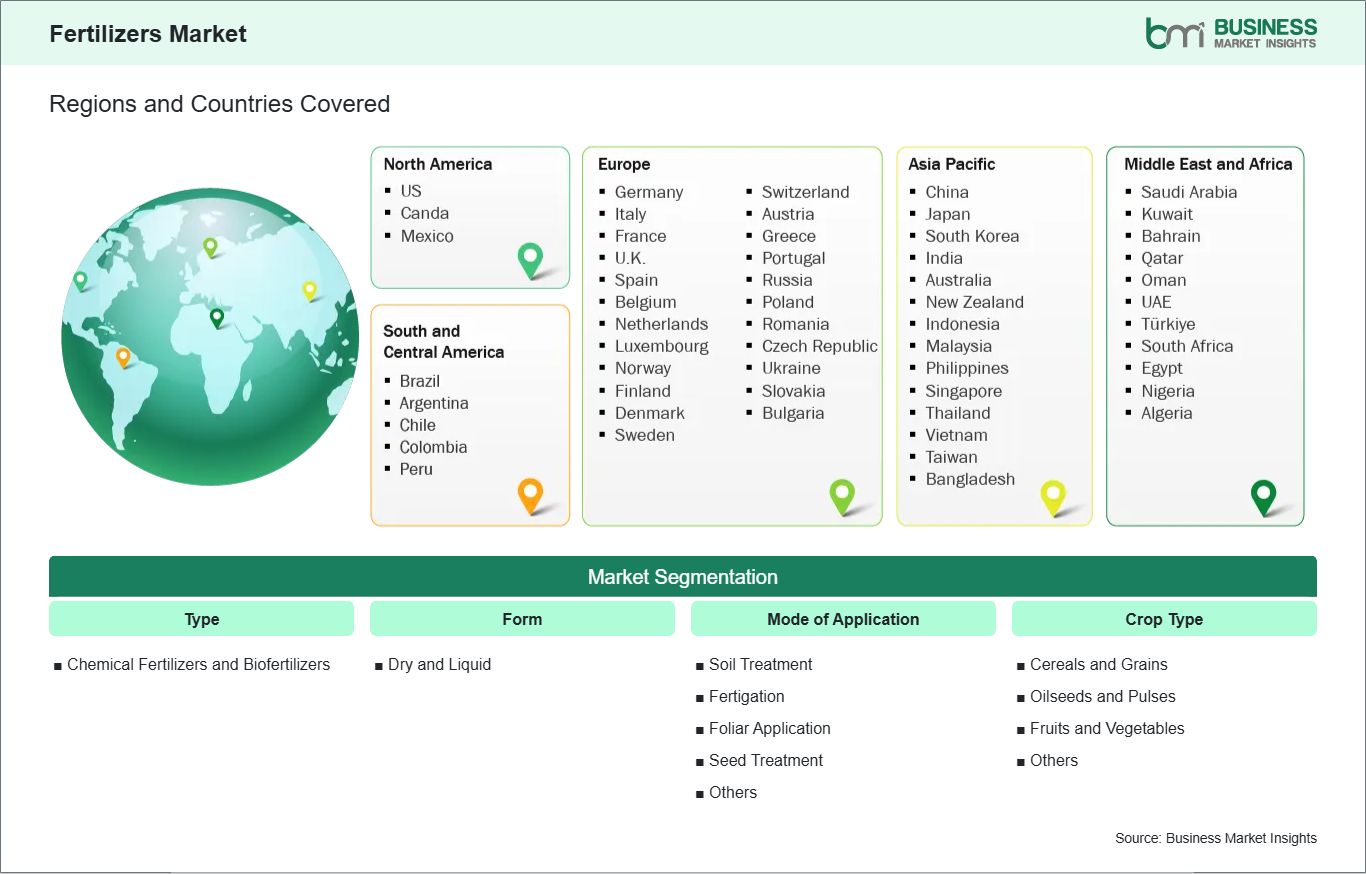
Key segments that contributed to the derivation of the Fertilizers market analysis are type, form, mode of application, and crop type.
Crop farming, horticultural, and greenhouse cultivation are highly applied in the use of fertilizers to provide necessary nutrients to ensure soil fertility and the growth of crops. Critique of fertilizers has been on the rise during recent years because of the ever-increasing world population, the food demand, and the development of large-scale commercial farming in different regions. Fertilizers are vital in augmenting the yield of crops, raising the nutrient proficiency, and sustaining soil fertility. They have a direct effect on the quality of crops, their resistance to various diseases, as well as on the overall productivity of agriculture. Controlled nutrient management, fertilizers are also important in contemporary farming, including precision agriculture, fertigation, and modern farming, including the management of nutrients in order to help farmers maximize crop production and resource management.
One of the most important growth factors in the world fertilizer market is the growing demand for more crop productivity and food security. It is essential to ensure the constant quality and quantity of the crop, particularly when the climatic and soil conditions are different. Other areas like North America and Europe are highly regulated on matters of agriculture, and therefore, they encourage the use of effective and efficient fertilisers. Also, continuous research and development of fertilizers and their application procedures are improving the nutrient delivery and compatibility with the soil. The increasing investment in agriculture, modern technologies in farming production, and the production of crops in large quantities will further boost the demand for fertilizers around the world.
Organic, bio-based, and environmentally friendly sources of more fertilizers are being developed with the advantages of enriching the soil, less dependence on chemicals, and less environmental consequences. These fertilizers are sustainable, lessen water and soil contamination, and meet the international environment and regulation criteria.
Sustainable agriculture and production of organic foods have been the emerging trend, and this has made farmers and agribusinesses embrace the use of eco-friendly fertilizers in crop, fruit, vegetable, and turf management. The organic fertilizers assist in upholding regulatory compliance, besides enhancing the performance and health of the soil. The move towards green agriculture, incentives by the government, and increasing awareness among consumers towards environmentally friendly produce are more reasons why they are being adopted. The most popular reasons that increase the pace of the onset of the use of organic and bio-based fertilizers in the world market are better soil restoration, environmental protection, and long-term sustainability benefits.

| Report Attribute | Details |
|---|---|
| Market size in 2025 | US$ 300.29 Billion |
| Market Size by 2033 | US$ 438.29 Billion |
| Global CAGR (2026 - 2033) | 4.90% |
| Historical Data | 2022 - 2024 |
| Forecast period | 2026-2033 |
| Segments Covered | By Type
|
| Regions and Countries Covered | North America
|
| Market leaders and key company profiles |
|
The Fertilizers Market Size and Forecast (2022-2033) report provides a detailed analysis of the market covering below areas:
The geographical scope of the Fertilizers market report is divided into five regions: North America, Asia Pacific, Europe, Middle East & Africa, and South & Central America. The fertilizer market in the Asia Pacific is expected to grow significantly during the forecast period.
The Asia-Pacific Fertilizers market is segmented into China, Japan, South Korea, India, Australia, New Zealand, Indonesia, Malaysia, the Philippines, Singapore, Thailand, Vietnam, Taiwan, Bangladesh, and the Rest of Asia. Asia Pacific is one of the new markets that is experiencing high growth in the consumption of fertilizers due to the rising demand for fertilisers in agriculture, horticulture, and plantation industries. Other major markets include countries such as China and India because they are experiencing a fast population growth, increased food demands, and increased commercial farming. The industry of fertilizer production is well established in the area, as the production is cost-effective and the domestic demand is growing. Policies that are favorable to agricultural development, better infrastructure, and domestic fertilizers industries are also being encouraged by governments in the Asian pacific region to enhance agricultural development.
The Indian government has initiated programs to empower the agricultural sector in terms of productivity, sustainability, and soil health. In the same light, the Government of Japan has come up with programs to promote the use of eco-friendly and nutrient-efficient fertilizers, such as bio-based and specialty formulations. The increased agricultural production, the growing attention to food security, and the favorable governmental policies toward sustainable agriculture and soil development are the main sources of the increased popularity of high-performance and compliant fertilizers in the area.

The Fertilizers market is evaluated by gathering qualitative and quantitative data post-primary and secondary research, which includes important corporate publications, association data, and databases. A few of the key developments in the fertilizers market are:
The Fertilizers Market is valued at US$ 300.29 Billion in 2025, it is projected to reach US$ 438.29 Billion by 2033.
As per our report Fertilizers Market, the market size is valued at US$ 300.29 Billion in 2025, projecting it to reach US$ 438.29 Billion by 2033. This translates to a CAGR of approximately 4.90% during the forecast period.
The Fertilizers Market report typically cover these key segments-
The historic period, base year, and forecast period can vary slightly depending on the specific market research report. However, for the Fertilizers Market report:
The Fertilizers Market is populated by several key players, each contributing to its growth and innovation. Some of the major players include:
The Fertilizers Market report is valuable for diverse stakeholders, including:
Essentially, anyone involved in or considering involvement in the Fertilizers Market value chain can benefit from the information contained in a comprehensive market report.
Please tell us your area of interest
(Market Segments/ Regions and Countries/ Companies)