Organic Fertilizers Market Outlook (2022-2033)

Historic Data: 2022 - 2024   |   Base Year: 2025   |   Forecast Period: 2026-2033
Report Content: Market Scope, Market Segmentation, Market Dynamics, and Competitive Analysis

Report Coverage:
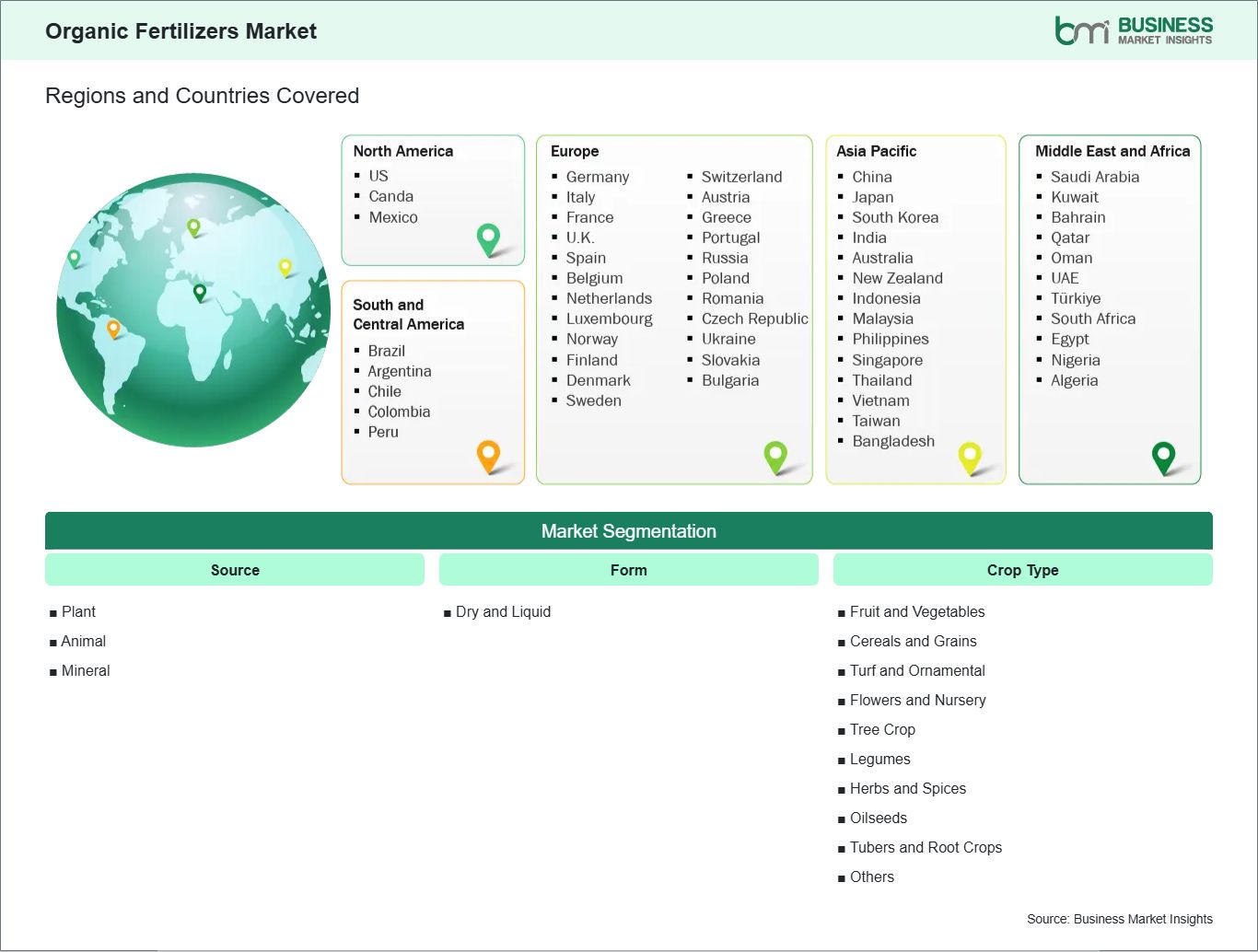
  • Source (Plant, Animal, and Mineral)
  • Form (Dry and Liquid)
  • Crop Type (Fruit and Vegetables, Cereals and Grains, Turf and Ornamental, Flowers and Nursery, Tree Crop, Legumes, Herbs and Spices, Oilseeds, Tubers and Root Crops, and Others)

No. of Pages: 400
Report Code: BMIPUB00032521
Category: Chemicals and Materials
Organic Fertilizers Market
Buy Now

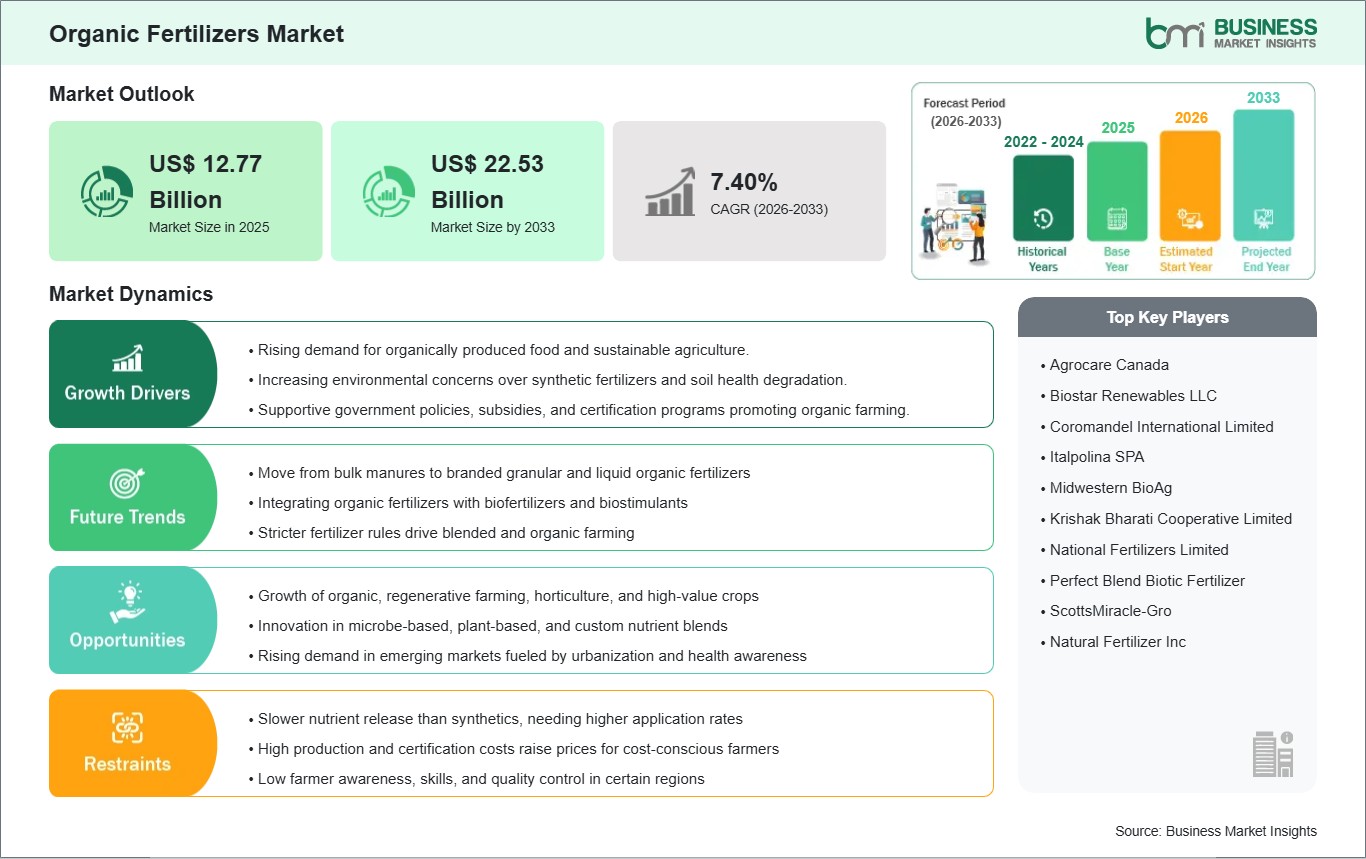
The Organic Fertilizers market size is expected to reach US$ 22.53 billion by 2033 from US$ 12.77 billion in 2025. The market is estimated to record a CAGR of 7.4% from 2026 to 2033.

Executive Summary and Global Market Analysis:

Organic fertilizers are useful for crops in the horticulture and agricultural sectors because they assist in enhancing soil fertility, increasing microbial activities, and ensuring sustainable production of crops. They are widely used in agriculture, gardening, and landscaping, among other agrarian activities. The following are the advantages of organic fertilizers: they enhance soil structure, improve water retention, are environmental friendly, and can be used on diverse crop varieties. The market is being driven by the rising demand for organic food products in the world market, the growth of sustainable farming, and the creation of awareness of soil health and environmental safety. Also, the accessibility of bio-based raw materials, environmentally friendly manufacturing techniques, and advancement in composting and nutrient management technologies make them more adopted and accepted.

However, market growth may also be constrained by changes in the availability of raw materials, increased prices relative to chemical fertilizers, and stringent certification. The issues of the industry concern the preservation of a steady nutrient content, the slower release of nutrients, and regional differences in regulations and agricultural work. Nevertheless, the market remains promising as investments in organic farming, the rise in the demand for sustainable agro inputs, and the rise in consumer awareness about food safety and environmental impact are growing. Government support, research and development, and a shift to sustainable agriculture are likely to lead to innovation and generate new markets and long-term growth in the world organic fertilizers market.

Organic Fertilizers Market - Strategic Insights:

global-market-strategic-framework
Get more information on this report

Organic Fertilizers Market Segmentation Analysis:

Key segments that contributed to the derivation of the Organic Fertilizers market analysis are source, form, and crop type.

  • By source, the organic fertilizers market is segmented into plant, animal, and mineral. The plant segment dominated the market in 2025.
  • By form, the market is categorized into dry and liquid. The dry segment held the largest share of the market in 2025.
  • By crop type, the market is segmented into fruit and vegetables, cereals and grains, turf and ornamental, flowers and nursery, tree crop, legumes, herbs and spices, oilseeds, tubers and root crops, and others. The oilseeds segment held the largest share of the market in 2025.

Organic Fertilizers Market Drivers and Opportunities:

Increase in Organic Farmland Area

The organic farmland is growing constantly across the globe as farmers and policymakers are migrating towards sustainable agricultural production against the backdrop of increased consumer demand for healthier and environmental friendly foods. Europe, North America, and Asia have been reported to experience remarkable growth in organic farming, whereas the emerging markets in Africa and South America have been shaping their organic farming foundation. The developing nations such as India, the United States, and Australia are also taking advantage of organic farming to take advantage of increasing domestic demand, export prospects, and government subsidies. There are distinct environmental benefits associated with organic agriculture, including better soil health, biodiversity, minimised contamination of water, and reduced greenhouse gases as opposed to conventional agriculture.

The World of Organic Agriculture by the Research Institute of Organic Agriculture (FiBL) and IFOAM -Organics International reports that organic farmland in the world was estimated at around 98.9 million hectares in 2023, and 96.4 million hectares in 2022. It is an increment of 2.6 percent, which translates to approximate 2.5 million hectares annually. Organic agricultural land constituted approximately 2.1 percent of the total agricultural land in the world. Oceania still remained on the top with approximately 53.2 million hectares, then Europe (19.5 million hectares), Latin America (10.3 million hectares), Asia (9.1 million) and Africa (3.4 million), and North America (3.3 million). Australia was the global leader in having approximately 53 million hectares, then India and Argentina. It was estimated that there were around 4.3 million organic producers all over the world in 2023.

The growth of organic farms is highly encouraging the demand for biological and friendly agricultural inputs, especially organic manure. This synergy is promoting nutrient management innovation, the increased use of sustainable inputs, and is transforming farming in both organic and conventional systems.

Strategic Initiatives by Fertilizer Companies

Fertilizer firms are becoming more engaged in strategic plans to widen their market base and get in line with sustainability objectives. These projects entail investment in research and development, product innovation, alliances, certification, and acquisitions. Traditionally, major companies concentrated on synthetic fertilizers, which include Bayer AG and Syngenta are investigating organic-friendly fertilizers and soil health solutions.

However, in March 2023, Windfall Bio raised USD 9 million in seed funding to come up with technology that transforms methane emissions into organic fertilizers. New products will continue to be a part of the growth strategies: in 2024, Yara released the YaraSuna line of organic-based fertilizers for regenerative agriculture, and in January 2025, Crown Farms rolled out an organic fertilizer to facilitate sustainable farming in the UAE. Also, the 2023 acquisition of Agribios Italiana by the Organic fertilizer business Yara indicates the increasing focus on the potent markets, which will move the entire global organic fertilizers market.

Organic Fertilizers Market Size and Share Analysis:

  • By source, the organic fertilizers market is segmented into plant, animal, and mineral. The plant segment dominated the market in 2025. Organic fertilizers made out of crop residues, compost, and green manures are in place and consist of plant materials; therefore, they play a significant role in the total market demand. Their close association with organic farming methods and increased demand for natural soil inputs have supported their dominance in the market.
  • By form, the market is categorized into dry and liquid. The dry segment held the largest share of the market in 2025. The use of dry organic fertilizers is prevalent and readily available because of their extended shelf life, storage, and cost-effectiveness; thus, they have a considerable part of the total consumption. Their high ability to be compatible with traditional farming tools and the growing use of them in large-scale farming practices have strengthened their leading status in the market.
  • By crop type, the market is segmented into fruit and vegetables, cereals and grains, turf and ornamental, flowers and nursery, tree crops, legumes, herbs and spices, oilseeds, tubers and root crops, and others. The oilseeds segment held the largest share of the market in 2025. Oilseed farming greatly relies on organic fertilizers to enhance the soil of increased fertility and increase its oil production and quality; therefore, they boost the total market demand. The close relationship with their growing oilseed farming industry and the emergence of demand for organic edible oils have enhanced their dominance in the market.

Organic Fertilizers Market Report Highlights:

Report Attribute Details
Market size in 2025 US$ 12.77 Billion
Market Size by 2033 US$ 22.53 Billion
Global CAGR (2026 - 2033)7.40%
Historical Data 2022 - 2024
Forecast period 2026-2033
Segments Covered By Source
  • Plant
  • Animal
  • Mineral
By Form
  • Dry and Liquid
By Crop Type
  • Fruit and Vegetables
  • Cereals and Grains
  • Turf and Ornamental
  • Flowers and Nursery
  • Tree Crop
  • Legumes
  • Herbs and Spices
  • Oilseeds
  • Tubers and Root Crops
  • Others
Regions and Countries Covered North America
  • US
  • Canada
  • Mexico
Europe
  • Belgium
  • Austria
  • Finland
  • Denmark
  • Greece
  • Poland
  • Romania
  • Russia
  • Ukraine
  • Czech Republic
  • Slovakia
  • Bulgaria
  • Italy
  • Luxembourg
  • Germany
  • Switzerland
  • France
  • Netherlands
  • Norway
  • Portugal
  • Spain
  • Sweden
  • United Kingdom
Asia-Pacific
  • Australia
  • China
  • India
  • Japan
  • South Korea
  • Indonesia
  • Malaysia
  • Philippines
  • Singapore
  • Thailand
  • Vietnam
  • Bangladesh
  • New Zealand
  • Taiwan
South and Central America
  • Brazil
  • Argentina
  • Peru
  • Chile
  • Colombia
Middle East and Africa
  • Bahrain
  • Kuwait
  • Oman
  • Qatar
  • Saudi Arabia
  • United Arab Emirates
  • Turkiye
  • South Africa
  • Egypt
  • Algeria
  • Nigeria
Market leaders and key company profiles
  • Agrocare Canada
  • Biostar Renewables LLC
  • Coromandel International Limited
  • Italpolina SPA
  • Midwestern BioAg
  • Krishak Bharati Cooperative Limited
  • National Fertilizers Limited
  • Perfect Blend Biotic Fertilizer
  • ScottsMiracle-Gro
  • Natural Fertilizer Inc
Get more information on this report

Organic Fertilizers Market Report Coverage and Deliverables:

The Organic Fertilizers Market Size and Forecast (2022-2033) report provides a detailed analysis of the market covering below areas:

  • Organic fertilizers market size and forecast at global, regional, and country levels for all the key market segments covered under the scope
  • Organic fertilizers market trends, as well as market dynamics such as drivers, restraints, and key opportunities
  • Organic fertilizers market analysis covering key market trends, global and regional framework, major players, regulations, and recent market developments
  • Industry landscape and competition analysis covering market concentration, heat map analysis, prominent players, and recent developments for the organic fertilizers market
  • Detailed company profiles, including SWOT analysis

Organic Fertilizers Market Geographic Insights:

The geographical scope of the Organic Fertilizers market report is divided into five regions: North America, Asia Pacific, Europe, Middle East & Africa, and South & Central America. The Organic Fertilizers market in the Asia Pacific is expected to grow significantly during the forecast period.

The Asia-Pacific Organic Fertilizers market is segmented into China, Japan, South Korea, India, Australia, New Zealand, Indonesia, Malaysia, the Philippines, Singapore, Thailand, Vietnam, Taiwan, Bangladesh, and the Rest of Asia. Asia Pacific is also among the areas where consumption of organic fertilizers is growing very high because of the growth in production of oilseeds and environmentally friendly agriculture. China and India possess some of the biggest markets in the production of soybeans, rapeseed, and sunflowers. The governments are also encouraging the use of organic farming by putting up conducive policies and programs.

The Indian government has come up with programs to promote organic farming by prioritizing soil health, quality of crop, and environmental sustainability. On the same note, the Government of Japan has put in place initiatives that encourage environmentally friendly farming activities and the use of bio-based fertilizers. The production of oilseeds with increasing demand for organic fertilizers is supported by the growing interest in the natural and high-quality production of crops, as well as due to the positive governmental policies to guarantee the long-term soil fertility, crop production, and sustainability.

global-market-geography
Get more information on this report

Organic Fertilizers Market Research Report Guidance:

  • The report includes qualitative and quantitative data in the Organic Fertilizers market across source, form, crop type, and geography.
  • The report starts with the key takeaways (chapter 2), highlighting the key trends and outlook of the Organic Fertilizers market.
  • Chapter 3 includes the research methodology of the study.
  • Chapter 4 further includes ecosystem analysis.
  • Chapter 5 highlights the major industry dynamics in the Organic Fertilizers market, including factors that are driving the market, prevailing deterrents, potential opportunities, as well as future trends. Impact analysis of these drivers and restraints is also covered in this section.
  • Chapter 6 discusses the Organic Fertilizers market scenario, in terms of historical market revenues, and forecast till the year 2033.
  • Chapters 7 to 10 cover the Organic Fertilizers market segments by source, form, crop type, and geography across North America, Europe, Asia Pacific, Middle East and Africa, and South and Central America. They cover the market volume, revenue forecast, and factors driving the market.
  • Chapter 11 describes the competitive analysis along with the heat map analysis for the key players operating in the market.
  • Chapter 12 describes the industry landscape analysis. It provides detailed descriptions of business activities such as market initiatives, new developments, mergers, and joint ventures globally, along with a competitive landscape.
  • Chapter 13 provides detailed profiles of the major companies operating in the Organic Fertilizers market. Companies have been profiled on the basis of their key facts, business descriptions, products and services, financial overview, SWOT analysis, and key developments.
  • Chapter 14, i.e., the appendix is inclusive of a brief overview of the company, a list of abbreviations, and a disclaimer.

Organic Fertilizers Market News and Key Development:

The Organic Fertilizers market is evaluated by gathering qualitative and quantitative data post-primary and secondary research, which includes important corporate publications, association data, and databases. A few of the key developments in the organic fertilizers market are:

  • In Feb 2025, Coromandel International inaugurated an advanced Soil and Leaf Testing Laboratory at its plant in Kakinada, India. Equipped with state-of-the-art technologies, this facility is designed to provide precise soil and plant nutrient analysis, helping farmers across India better understand their soil and its nutrient composition.
  • In Jan 2025, Innovafeed, a company specializing in insect-based agricultural products, and Agryco, a platform of natural farm inputs, entered into a commercial partnership to distribute Hilucia Frass. This agreement enables Innovafeed to expand access to its organic fertilizer while Agryco integrates Hilucia Frass into its agricultural product offerings.

Key Sources Referred:

  • World Bank – Global Trade Indicators
  • European Chemicals Agency
  • International Council of Chemical Associations
  • (International Monetary Fund )IMF
  • World Trade Organization (WTO)
  • International Trade Administration (ITA)
  • Company website
  • Company annual reports
  • Company investor presentations

The List of Companies - Organic Fertilizers Market

  • Agrocare Canada
  • Biostar Renewables LLC
  • Coromandel International Limited
  • Italpolina SPA
  • Midwestern BioAg
  • Krishak Bharati Cooperative Limited
  • National Fertilizers Limited
  • Perfect Blend Biotic Fertilizer
  • ScottsMiracle-Gro
  • Natural Fertilizer Inc
Frequently Asked Questions
How big is the Organic Fertilizers Market?

The Organic Fertilizers Market is valued at US$ 12.77 Billion in 2025, it is projected to reach US$ 22.53 Billion by 2033.

What is the CAGR for Organic Fertilizers Market by (2026 - 2033)?

As per our report Organic Fertilizers Market, the market size is valued at US$ 12.77 Billion in 2025, projecting it to reach US$ 22.53 Billion by 2033. This translates to a CAGR of approximately 7.40% during the forecast period.

What segments are covered in this report?

The Organic Fertilizers Market report typically cover these key segments-

  • Source (Plant, Animal, and Mineral)
  • Form (Dry and Liquid)
  • Crop Type (Fruit and Vegetables, Cereals and Grains, Turf and Ornamental, Flowers and Nursery, Tree Crop, Legumes, Herbs and Spices, Oilseeds, Tubers and Root Crops, and Others)

What is the historic period, base year, and forecast period taken for Organic Fertilizers Market?

The historic period, base year, and forecast period can vary slightly depending on the specific market research report. However, for the Organic Fertilizers Market report:

  • Historic Period : 2022 - 2024
  • Base Year : 2025
  • Forecast Period : 2026-2033
  • Who are the major players in Organic Fertilizers Market?

    The Organic Fertilizers Market is populated by several key players, each contributing to its growth and innovation. Some of the major players include:

  • Agrocare Canada
  • Biostar Renewables LLC
  • Coromandel International Limited
  • Italpolina SPA
  • Midwestern BioAg
  • Krishak Bharati Cooperative Limited
  • National Fertilizers Limited
  • Perfect Blend Biotic Fertilizer
  • ScottsMiracle-Gro
  • Natural Fertilizer Inc
  • Who should buy this report?

    The Organic Fertilizers Market report is valuable for diverse stakeholders, including:

    • Investors: Provides insights for investment decisions pertaining to market growth, companies, or industry insights. Helps assess market attractiveness and potential returns.
    • Industry Players: Offers competitive intelligence, market sizing, and trend analysis to inform strategic planning, product development, and sales strategies.
    • Suppliers and Manufacturers: Helps understand market demand for components, materials, and services related to concerned industry.
    • Researchers and Consultants: Provides data and analysis for academic research, consulting projects, and market studies.
    • Financial Institutions: Helps assess risks and opportunities associated with financing or investing in the concerned market.

    Essentially, anyone involved in or considering involvement in the Organic Fertilizers Market value chain can benefit from the information contained in a comprehensive market report.

    Available Report Formats

    pdf-format excel-format pptx-format
    Buy Now

    Customization Form

    Please tell us your area of interest
    (Market Segments/ Regions and Countries/ Companies)