Market Summary
Executive Summary and Global Market Analysis
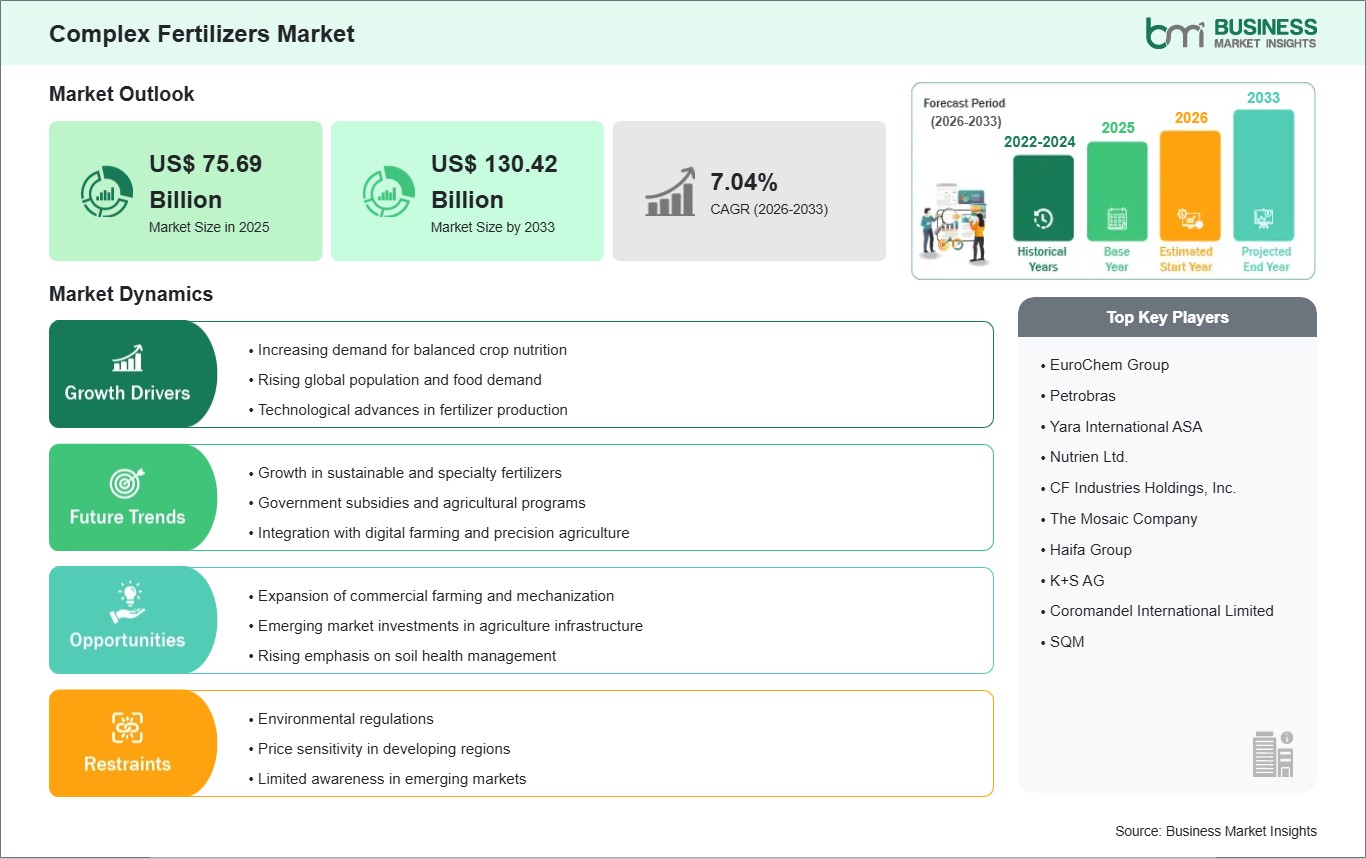
The global complex fertilizers market is experiencing steady growth driven by the increasing demand for balanced crop nutrition and improved agricultural productivity. Complex fertilizers, which contain multiple essential nutrients such as nitrogen, phosphorus, and potassium in a single formulation, play a critical role in modern farming by ensuring uniform nutrient distribution and efficient crop uptake. As agricultural systems shift toward higher efficiency and sustainability, the adoption of complex fertilizers continues to expand across both developed and developing regions.
One of the key factors supporting market growth is the rising global population, which is intensifying pressure on agricultural systems to produce more food with limited arable land. Farmers are increasingly adopting nutrient-rich fertilizers to enhance crop yield and quality, particularly in staple crops such as cereals and grains. Additionally, the depletion of soil nutrients due to continuous cultivation has increased the need for fertilizers that can restore soil fertility and maintain long-term productivity.
Technological advancements in fertilizer production, including controlled-release formulations and precision nutrient delivery systems, are further strengthening market expansion. These innovations help minimize nutrient losses, reduce environmental impact, and improve fertilizer efficiency. Governments across various countries are also supporting fertilizer consumption through subsidies and agricultural development programs, particularly in emerging economies.
Furthermore, the growing emphasis on sustainable agriculture is encouraging the development of eco-friendly and specialty fertilizers. Manufacturers are increasingly focusing on producing fertilizers that align with environmental regulations and reduce greenhouse gas emissions. The integration of digital farming and precision agriculture technologies is also contributing to optimized fertilizer usage, ensuring that nutrients are applied in the right quantity and at the right time.
Segment Analysis
Complex Fertilizers Market Segmentation
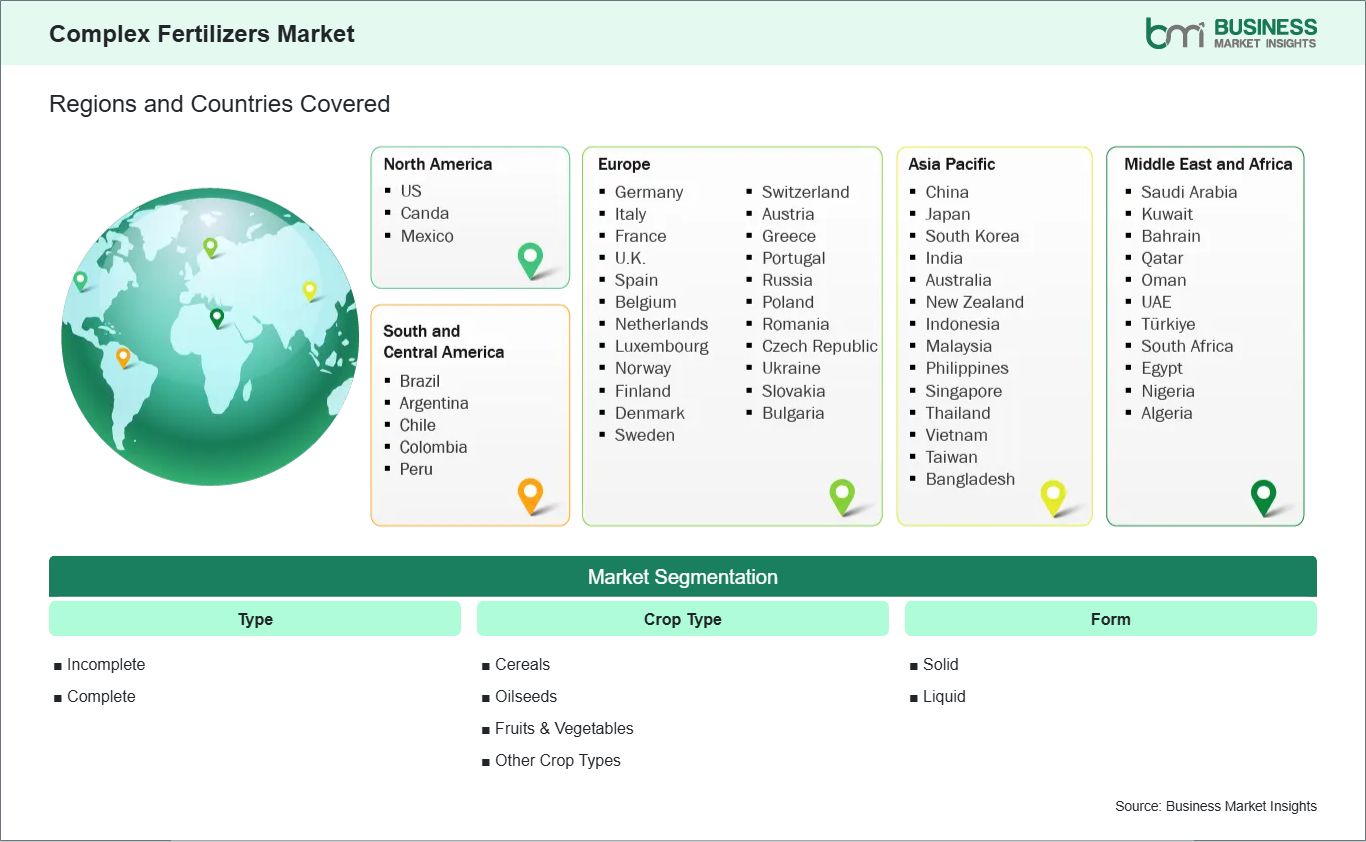
Key segments that contributed to the derivation of the complex fertilizers market analysis are type, crop type, and form.
- By type, the complex fertilizers market is segmented into incomplete and complete. The complete segment dominated the market in 2025.
- By crop type, the complex fertilizers market is segmented into cereals, oilseeds, fruits & vegetables, and other crop types. The cereals segment dominated the market in 2025.
- By form, the complex fertilizers market is segmented into solid and liquid. The solid segment dominated the market in 2025.
Market Forces
Complex Fertilizers Market Drivers and Opportunities
Growing Demand for Enhanced Agricultural Productivity
Food production is growing at a very fast pace due to the global population continuously increasing with more and more demand for food creation. Therefore, farmers need to increase the productivity of their farms by maximising the number of crops grown, however due to limited agricultural land this can be difficult. Complex fertilisers will help crop growers efficiently grow their crops and achieve maximum yield because the complex fertiliser has balanced nutrients available to the crops. Therefore complex fertilisers are the preferred type of fertiliser to use by those farmers who want to be able to increase their productivity and make more money from crop production.
Cereal crop production accounts for a very large portion of the amount of food produced globally, and cereal crops, wheat, rice and maize, require nutrients from the ground all through the grow cycle. Complex fertilisers are able to deliver nutrients to crops by providing multiple nutrients to the plants at once so the plant will grow well. Also the increase in commercial farming and the mechanisation of agriculture is helping to increase the number of advanced fertilisers that are being used.
Governments of many countries such as India, China and Brazil are currently offering government programs & subsidies to help farmers have access to fertilisers and be able to grow food by ensuring that they can obtain fertilisers that are both affordable and accessible. This is being done by the government in order to help to support farmers through the food security program. In addition, the ability to manage and understand how to improve the health of the soil is increasing the number of farmers that are willing to use fertiliser that will help to improve the quality of the soil in the long term.
Rising Adoption of Sustainable and Specialty Fertilizers
Increasing demand for products that reduce environmental impact while providing efficacious performance is leading manufacturers to invest in the development of controlled-release fertilizers and water-soluble fertilizers that provide improved nutrient efficiency. In addition to this, the increasing prevalence of precision agriculture technology allows farmers greater precision in applying fertilizers, resulting in improved crop productivity and decreased waste.
As more consumers demand higher-quality products, particularly fresh produce, the adoption of specialty and liquid fertilizers will continue to increase due to the need for precise nutrient application in order to achieve optimum yield and quality.
In developing regions such as Asia/Pacific and Latin America, government investments in agriculture, infrastructure development, and farming operations modernization create excellent opportunities for future growth in vegetable, sugarcane, fruit, and nut farming operations.
Size and Share Analysis
Complex Fertilizers Market Size and Share Analysis
The Complex Fertilizers Market demonstrates steady growth, with size and share analysis highlighting evolving trends and competitive dynamics among key players. The report examines subsegments categorized within type, crop type, and form, offering insights into their contribution to overall market performance.
By product, the complete subsegment dominated the market in 2025, driven by its ability to provide balanced nutrient composition and improve crop yield efficiency.
By crop type, the cereals subsegment dominated the market in 2025, driven by extensive global cultivation and high consumption demand.
By form, the solid subsegment dominated the market in 2025, driven by ease of storage, transportation, and longer shelf life.
Report Coverage
Complex Fertilizers Market Report Coverage and Deliverables
The "Complex Fertilizers Market Size and Forecast (2022 - 2033)" report provides a detailed analysis of the market covering below areas:
- Complex Fertilizers Market size and forecast at global, regional, and country levels for all the key market segments covered under the scope
- Complex Fertilizers Market trends, as well as drivers, restraints, and opportunities
- Complex Fertilizers Market analysis covering key trends, global and regional framework, major players, regulations, and recent developments
- Industry landscape and competition analysis covering market concentration, heat map analysis, prominent players, and recent developments for the Complex Fertilizers Market
- Detailed company profiles, including SWOT analysis
Geographic Insights
Complex Fertilizers Market Geographic Insights
The geographical scope of the Complex Fertilizers Market report is divided into North America, Asia Pacific, Europe, Middle East & Africa, and South & Central America. North America held the largest share in 2025.
North America dominates the global complex fertilizers market, supported by advanced agricultural infrastructure, high adoption of precision farming technologies, and strong presence of leading fertilizer manufacturers. The United States and Canada are key contributors, with farmers increasingly adopting high-efficiency fertilizers to improve crop productivity and sustainability. The region also benefits from strong research and development capabilities, enabling continuous innovation in fertilizer formulations and application technologies.
The increasing emphasis on sustainable agriculture and environmental protection is encouraging the use of controlled-release and environmentally friendly fertilizers in North America. Regulatory frameworks and government support programs are promoting responsible fertilizer usage, ensuring minimal environmental impact while maintaining agricultural output. Additionally, the growing demand for bio-based and specialty fertilizers is shaping the market landscape in the region.
Europe represents a significant market, driven by stringent environmental regulations and strong focus on sustainable farming practices. Countries such as Germany, France, and the UK are adopting advanced fertilizers that comply with regulatory standards while improving crop yield and soil health. The region is also witnessing increased adoption of precision agriculture technologies.
Asia Pacific is the fastest-growing region, driven by expanding agricultural activities, rising population, and increasing food demand. Countries such as China and India are major contributors, supported by government subsidies and initiatives aimed at improving agricultural productivity. The region’s large agricultural base and ongoing modernization efforts are fueling demand for complex fertilizers.
The Middle East & Africa and South & Central America are emerging markets with growing agricultural investments and increasing adoption of modern farming techniques. While these regions offer significant growth potential, challenges such as pricing sensitivity and limited awareness may impact market penetration. Overall, innovation in sustainable fertilizers and efficient nutrient management will remain key growth drivers across all regions.
Industry Activity
Recent Developments
The Complex Fertilizers Market is evaluated by gathering qualitative and quantitative data post primary and secondary research, which includes important corporate publications, association data, and databases. A few of the key developments in the complex fertilizers market are:
- In March 2024, EuroChem Group inaugurated a large-scale phosphate fertilizer production plant in Brazil to strengthen domestic supply and reduce import dependency.
- In October 2025, Petrobras announced plans to expand nitrogen fertilizer production capacity to meet up to 20% of Brazil’s domestic demand by 2026 through the restart and development of multiple plants.
Trust & Transparency
Research Methodology
The market analysis combines proprietary research with secondary data from government agencies, company disclosures, regulatory filings, industry databases and expert interviews. Market estimates are validated through data triangulation, cross-market benchmarking and analyst
review.
View Full Research Methodology
Key Sources Referred:
Food and Agriculture Organization (FAO)International Fertilizer Association (IFA)Fertilizer Association of India (FAI)United States Department of Agriculture (USDA)Fertilizers EuropeInternational Trade Administration