Catalyst Fertilizers Market Outlook (2022-2033)

Historic Data: 2022-2024   |   Base Year: 2025   |   Forecast Period: 2026-2033
Report Content: Market Scope, Market Segmentation, Market Dynamics, and Competitive Analysis

Report Coverage:
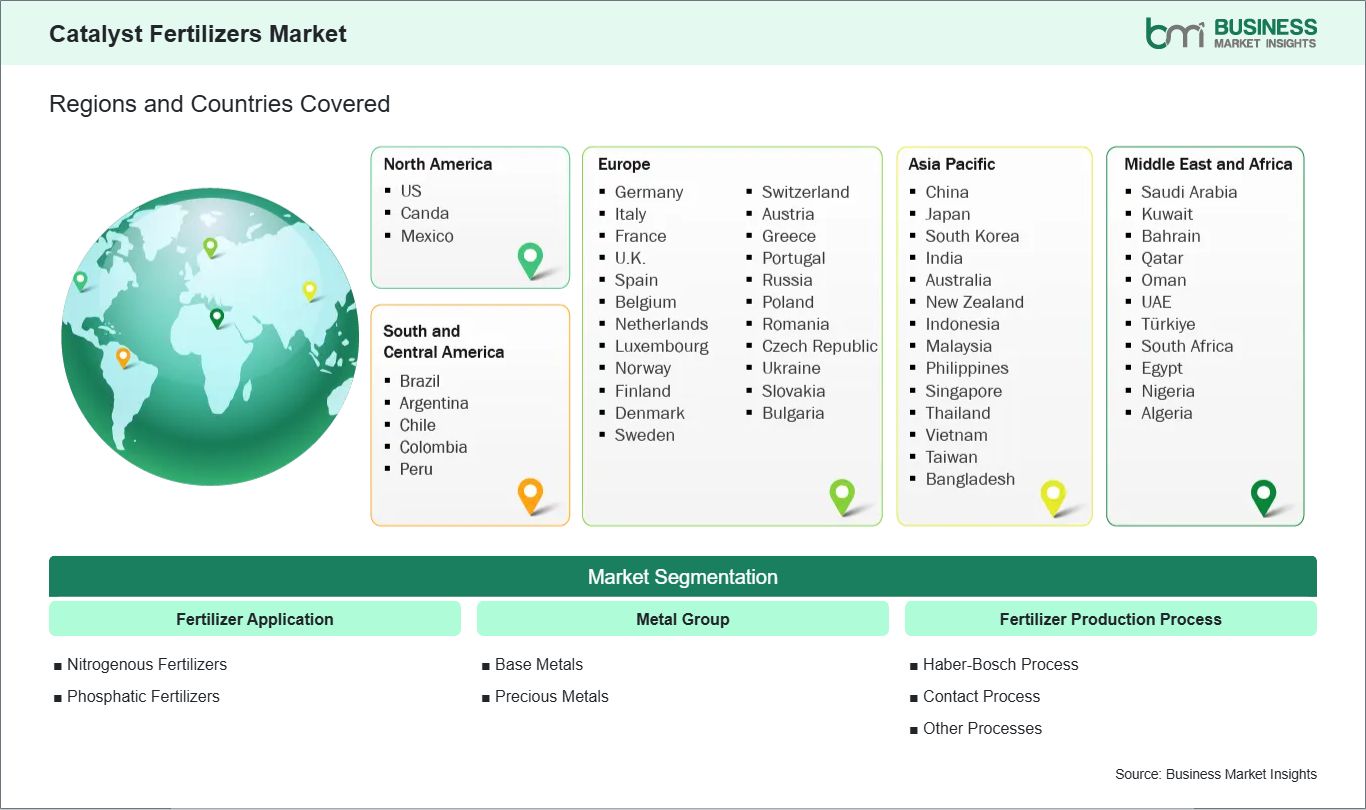
  • Fertilizer Application (Nitrogenous Fertilizers, Phosphatic Fertilizers)
  • Metal Group (Base Metals, Precious Metals)
  • Fertilizer Production Process (Haber-Bosch Process, Contact Process, Other Processes)

No. of Pages: 400
Report Code: BMIPUB00033815
Category: Chemicals and Materials
Catalyst Fertilizers Market

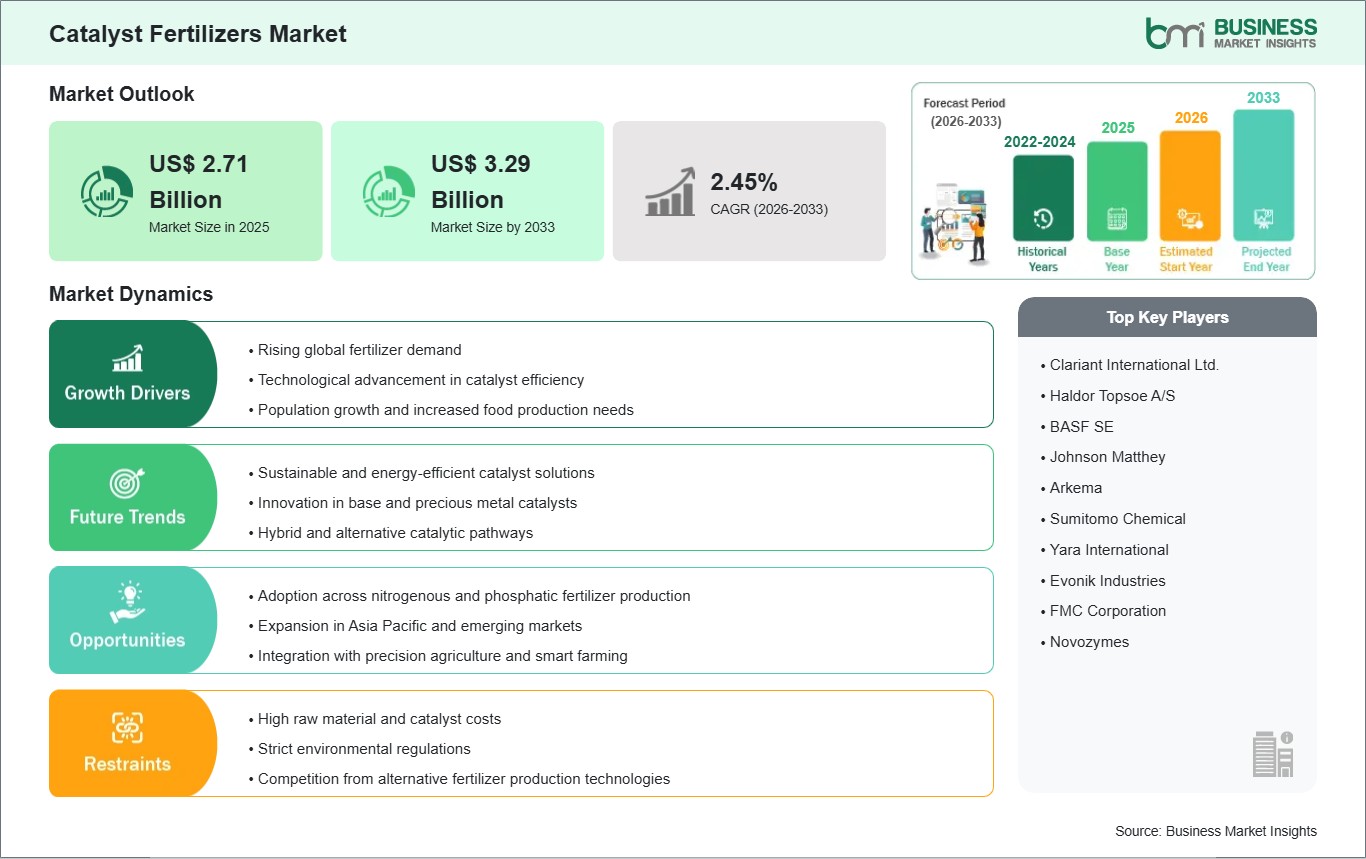
The Catalyst Fertilizers Market size is expected to reach US$ 3.29 Billion by 2033 from US$ 2.71 Billion in 2025. The market is estimated to record a CAGR of 2.45% from 2026 to 2033.

Executive Summary and Global Market Analysis:

The global Catalyst Fertilizers Market is defined by increasing global fertilizer production and ongoing technological advancements in catalysts used in key fertilizer production pathways. Catalyst fertilizers enhance chemical reactions in fertilizer manufacturing (particularly ammonia and phosphatic fertilizers), thus improving yield, reducing energy consumption, and lowering environmental impact. The catalyst fertilizers market plays a pivotal role in the broader fertilizer production industry by improving the efficiency of chemical synthesis routes such as ammonia formation via the Haber‑Bosch process and sulfuric acid production via the Contact process, which are integral to nitrogenous and phosphatic fertilizer manufacturing.

Rising global food demand, driven by population growth and changing dietary patterns, continues to exert pressure on agricultural production systems to increase yields. This, in turn, fuels demand for nitrogenous and phosphatic fertilizers, which rely heavily on catalysts to optimize production processes.

Catalyst technology innovations—such as improved base metal catalyst formulations and precious metal catalysts with higher activity and selectivity—are contributing to enhanced process efficiencies, reduced emissions, and lower operational costs. Additionally, emerging alternative and hybrid catalytic pathways are gaining traction as manufacturers seek to reduce energy intensity and environmental footprint.

Catalyst Fertilizers Market - Strategic Insights:

global-market-strategic-framework
Get more information on this report

Catalyst Fertilizers Market Segmentation Analysis:

Key segments that contributed to the derivation of the catalyst fertilizers market analysis are fertilizer application, metal group, and fertilizer production process.

  • By fertilizer application, the catalyst fertilizers market is segmented into nitrogenous fertilizers and phosphatic fertilizers. The nitrogenous fertilizers segment dominated the market in 2025.
  • By metal group, the catalyst fertilizers market is segmented into base metals and precious metals. The base metals segment dominated the market in 2025.
  • In terms of fertilizer production process, the catalyst fertilizers market is segmented into Haber‑Bosch process, Contact process, and other processes. The Haber‑Bosch process segment dominated the market in 2025.

Catalyst Fertilizers Market Drivers and Opportunities:

Boost in Global Fertilizer Demand and Agricultural Production

A key contributor to the global fertilizer catalyst market is the unbroken pattern of rising fertilizer consumption globally, driven by an increasing population and the resulting demand for food security. Nitrogenous fertilizers—i.e., ammonia and urea—play an important role in increasing soil fertility and improving crop yields. Catalysts used in various processes (e.g., Haber-Bosch reactor for ammonia synthesis) are critical to efficient fertilizer production as they enable producers to optimize energy use and achieve higher yields. With the increase in agricultural intensification, especially in developing parts of the world such as in the Asia Pacific region, Africa and Latin America, demand for nitrogenous fertilizers continues to rise. This in turn leads to an increased demand for catalyst solutions that improve conversion efficiency and decrease production time and costs. Similarly, phosphatic fertilizers—the primary types of fertilizers used for stimulating root growth and early crop establishment—are dependent on catalysts utilized in producing both sulfuric acid and phosphoric acid, further increasing the demand for fertilizer catalysts.

In addition to the above drivers, environmental and regulatory pressures related to greenhouse gas emissions and energy use highlight the critical importance of catalyst optimization. By improving catalyst system efficiencies, producers can increase their respective conversion rates and reduce the energy required to carry out chemical reactions in the fertilizer production process to contribute to greater sustainability as well as meeting compliance with emissions laws.

The increased mechanization and technological advancement of agricultural processes being seen in many of the largest farming economies in the world, including China, India and the United States has also added to the overall demand for catalysts.

Technological Advancements and Sustainable Production Practices

Continuous innovation in catalyst technology presents compelling growth opportunities within the catalyst fertilizers market. Research efforts focused on developing high‑performance catalysts—both base metal and precious metal based—aim to improve reaction kinetics, increase selectivity, and reduce energy consumption in core production routes such as ammonia synthesis and sulfuric acid generation.

Advanced catalysts with better thermal stability, longer operational life, and higher activity can reduce the frequency of catalyst replacement, lower overall production costs, and improve plant productivity. These improvements are particularly valuable for energy‑intensive processes like the Haber‑Bosch method, which remains the dominant pathway for industrial ammonia production.

The push toward greener production methods also expands opportunities for innovative catalytic processes. Emerging methods—such as catalytic reforming of organic waste, plasma catalysis, and hybrid pathways—offer potential for more sustainable fertilizer production, aligning with global efforts to reduce carbon footprints and energy usage. These approaches support diversification of feedstocks and material inputs, creating new market avenues.

As precision agriculture and smart farming gain momentum, demand for specialized catalyst solutions that can tailor reaction pathways and drive efficient fertilizer production is expected to rise, presenting long‑term growth potential for market participants.

Catalyst Fertilizers Market Size and Share Analysis:

The Catalyst Fertilizers Market demonstrates steady growth, with size and share analysis highlighting evolving trends and competitive dynamics among key players. The report examines subsegments categorized within fertilizer application, metal group, and fertilizer production process, offering insights into their contribution to overall market performance.

By fertilizer application, the nitrogenous fertilizers subsegment dominated the market in 2025, driven by its critical role in global food crop production and the extensive use of ammonia‑based fertilizers.

By metal group, the base metals subsegment dominated the market in 2025, supported by widespread adoption of iron, nickel, and vanadium catalysts for large‑scale production.

In terms of fertilizer production process, the Haber‑Bosch process subsegment dominated the market in 2025, reflecting its pivotal role in synthesizing ammonia as part of nitrogenous fertilizer manufacturing.

Catalyst Fertilizers Market Report Highlights:

Report Attribute Details
Market size in 2025 US$ 2.71 Billion
Market Size by 2033 US$ 3.29 Billion
Global CAGR (2026 - 2033)2.45%
Historical Data 2022-2024
Forecast period 2026-2033
Segments Covered By Fertilizer Application
  • Nitrogenous Fertilizers
  • Phosphatic Fertilizers
By Metal Group
  • Base Metals
  • Precious Metals
By Fertilizer Production Process
  • Haber-Bosch Process
  • Contact Process
  • Other Processes
Regions and Countries Covered
North America US, Canada, Mexico
Europe Belgium, Austria, Finland, Denmark, Greece, Poland, Romania, Russia, Ukraine, Czech Republic, Slovakia, Bulgaria, Italy, Luxembourg, Germany, Switzerland, France, Netherlands, Norway, Portugal, Spain, Sweden, United Kingdom
Asia-Pacific Australia, China, India, Japan, South Korea, Indonesia, Malaysia, Philippines, Singapore, Thailand, Vietnam, Bangladesh, New Zealand, Taiwan
South and Central America Brazil, Argentina, Peru, Chile, Colombia
Middle East and Africa Bahrain, Kuwait, Oman, Qatar, Saudi Arabia, United Arab Emirates, Turkiye, South Africa, Egypt, Algeria, Nigeria
Market leaders and key company profiles
  • Clariant International Ltd.
  • Haldor Topsoe A/S
  • BASF SE
  • Johnson Matthey
  • Arkema
  • Sumitomo Chemical
  • Yara International
  • Evonik Industries
  • FMC Corporation
  • Novozymes
Get more information on this report

Catalyst Fertilizers Market Report Coverage and Deliverables:

The "Catalyst Fertilizers Market Size and Forecast (2022 - 2033)" report provides a detailed analysis of the market covering below areas:

  • Catalyst Fertilizers Market size and forecast at global, regional, and country levels for all the key market segments covered under the scope
  • Catalyst Fertilizers Market trends, as well as drivers, restraints, and opportunities
  • Catalyst Fertilizers Market analysis covering key trends, global and regional framework, major players, regulations, and recent developments
  • Industry landscape and competition analysis covering market concentration, heat map analysis, prominent players, and recent developments for the Catalyst Fertilizers Market
  • Detailed company profiles, including SWOT analysis

Catalyst Fertilizers Market Geographic Insights:

The geographical scope of the Catalyst Fertilizers Market report is divided into North America, Asia Pacific, Europe, Middle East & Africa, and South & Central America. North America held the largest share in 2025.

North America exhibits steady catalyst fertilizers demand, supported by advanced fertilizer production technologies and high emphasis on production efficiency and sustainable operations. The United States and Canada have significant ammonia and nitrogen fertilizer manufacturing infrastructures, which drive demand for base metal and precious metal catalysts.

Europe’s market reflects robust adoption of catalyst technologies in fertilizer production to meet stringent environmental regulations and reduce emissions associated with high‑temperature synthesis processes. Regions such as Western Europe have well‑developed industrial capacities for fertilizer manufacturing, which provide stable demand for catalyst solutions.

Asia Pacific is expected to grow at significant rate by 2033, driven by extensive fertilizer production capacity and large agricultural economies in countries such as China and India. These nations are major producers of ammonia and phosphatic fertilizers, with catalyst usage intrinsic to large‑scale production operations.

Rapid population growth and expanding food demand across Asia support continued fertilizer usage and investment in catalytic technologies to optimize production efficiency. In addition, substantial government subsidies and initiatives to enhance agricultural outputs in countries across Southeast Asia and South Asia further bolster market growth.

In the Middle East & Africa and South & Central America, catalyst fertilizers usage is growing gradually as agricultural activity expands and infrastructure investment increases. However, these regions currently represent smaller shares compared to Asia Pacific, North America, and Europe due to varying levels of industrialization and fertilizer production capacities.

global-market-geography
Get more information on this report

Catalyst Fertilizers Market Research Report Guidance:

  • The report includes qualitative and quantitative data in the Catalyst Fertilizers Market across fertilizer application, metal group, fertilizer production process, and geography.
  • The report starts with the key takeaways (chapter 2), highlighting key trends and outlook of the Catalyst Fertilizers Market.
  • Chapter 3 focuses on the research methodology of the study.
  • Chapter 4 includes ecosystem analysis.
  • Chapter 5 highlights the major industry dynamics in the Catalyst Fertilizers Market, including factors that are driving the market, prevailing deterrents, potential opportunities, as well as future trends. Impact analysis of these drivers and restraints is also covered in this section.
  • Chapter 6 discusses the Catalyst Fertilizers Market scenario, in terms of historical market revenues, and forecast till the year 2033.
  • Chapters 7 to 10 cover Catalyst Fertilizers Market segments by fertilizer application, metal group, fertilizer production process, and geography across North America, Asia Pacific, Europe, Middle East & Africa, and South & Central America. They cover the market revenue forecast and factors driving the market.
  • Chapter 11 describes the competitive analysis along with the heat map analysis for the key players operating in the market.
  • Chapter 12 describes the industry landscape analysis. It provides detailed descriptions of business activities such as market initiatives, new developments, mergers, and joint ventures globally, along with a competitive landscape.
  • Chapter 13 provides detailed profiles of the major companies operating in the Catalyst Fertilizers Market. Companies have been profiled on the basis of their key facts, business descriptions, products, financial overview, SWOT analysis, and key developments.
  • Chapter 14, i.e., the appendix, is inclusive of a brief overview of the company, a list of abbreviations, and a disclaimer.

Catalyst Fertilizers Market News and Key Development:

The Catalyst Fertilizers Market is evaluated by gathering qualitative and quantitative data post primary and secondary research, which includes important corporate publications, association data, and databases. A few of the key developments in the catalyst fertilizers market are:

  • In March 2025, Clariant International Ltd. announced expanded catalyst solutions for fertilizer production processes, focusing on advanced base metal catalysts designed to improve ammonia synthesis efficiencies at large industrial facilities.
  • In June 2025, Haldor Topsoe A/S unveiled new catalyst formulations intended to reduce greenhouse gas intensity in Haber‑Bosch based ammonia production, aligning with emerging sustainability requirements across key fertilizer producing regions.

Key Sources Referred:

  • Food and Agriculture Organization
  • United States Environmental Protection Agency
  • European Chemicals Agency
  • International Fertilizer Association
  • Ministry of Agriculture and Farmers Welfare
  • International Trade Administration
The List of Companies - Catalyst Fertilizers Market
  • Clariant International Ltd.
  • Haldor Topsoe A/S
  • BASF SE
  • Johnson Matthey
  • Arkema
  • Sumitomo Chemical
  • Yara International
  • Evonik Industries
  • FMC Corporation
  • Novozymes
Frequently Asked Questions
How big is the Catalyst Fertilizers Market?

The Catalyst Fertilizers Market is valued at US$ 2.71 Billion in 2025, it is projected to reach US$ 3.29 Billion by 2033.

What is the CAGR for Catalyst Fertilizers Market by (2026 - 2033)?

As per our report Catalyst Fertilizers Market, the market size is valued at US$ 2.71 Billion in 2025, projecting it to reach US$ 3.29 Billion by 2033. This translates to a CAGR of approximately 2.45% during the forecast period.

What segments are covered in this report?

The Catalyst Fertilizers Market report typically cover these key segments-

  • Fertilizer Application (Nitrogenous Fertilizers, Phosphatic Fertilizers)
  • Metal Group (Base Metals, Precious Metals)
  • Fertilizer Production Process (Haber-Bosch Process, Contact Process, Other Processes)

What is the historic period, base year, and forecast period taken for Catalyst Fertilizers Market?

The historic period, base year, and forecast period can vary slightly depending on the specific market research report. However, for the Catalyst Fertilizers Market report:

  • Historic Period : 2022-2024
  • Base Year : 2025
  • Forecast Period : 2026-2033
  • Who are the major players in Catalyst Fertilizers Market?

    The Catalyst Fertilizers Market is populated by several key players, each contributing to its growth and innovation. Some of the major players include:

  • Clariant International Ltd.
  • Haldor Topsoe A/S
  • BASF SE
  • Johnson Matthey
  • Arkema
  • Sumitomo Chemical
  • Yara International
  • Evonik Industries
  • FMC Corporation
  • Novozymes
  • Who should buy this report?

    The Catalyst Fertilizers Market report is valuable for diverse stakeholders, including:

    • Investors: Provides insights for investment decisions pertaining to market growth, companies, or industry insights. Helps assess market attractiveness and potential returns.
    • Industry Players: Offers competitive intelligence, market sizing, and trend analysis to inform strategic planning, product development, and sales strategies.
    • Suppliers and Manufacturers: Helps understand market demand for components, materials, and services related to concerned industry.
    • Researchers and Consultants: Provides data and analysis for academic research, consulting projects, and market studies.
    • Financial Institutions: Helps assess risks and opportunities associated with financing or investing in the concerned market.

    Essentially, anyone involved in or considering involvement in the Catalyst Fertilizers Market value chain can benefit from the information contained in a comprehensive market report.

    Available Report Formats

    pdf-format excel-format pptx-format
    Buy Now
    Sales Assistance
    +1 646 791 7070 (US & UK)
    Customization Form

    Please tell us your area of interest
    (Market Segments/ Regions and Countries/ Companies)