Market Summary
Executive Summary and Global Market Analysis
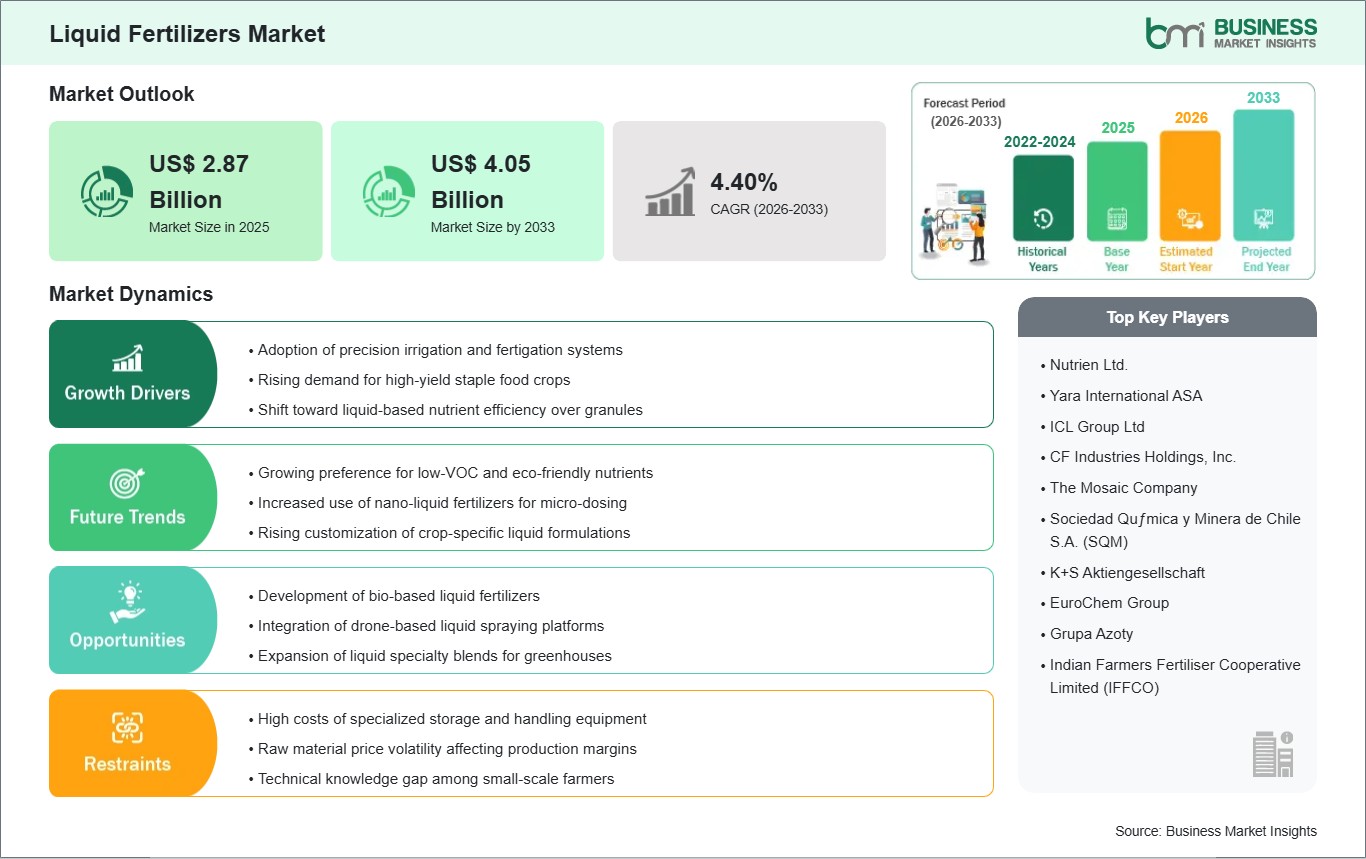
The market for liquid fertilizers is an essential part of the world's quest for food security using precision farming. This is because of their nutrient-efficient nature and ease of application using machinery. This market is currently dominated by the popularity of fertigation and the growing demand for basic food items like cereals. These crops have huge nutrient requirements that can only be met using this type of fertilizer. Although this market faces problems like storage costs and fluctuations in raw materials, stability is being ensured through the introduction of nano-fertilizers and bio-resins.
The strategic focus is moving towards sustainable and targeted nutrition, moving away from broad spectrum towards prescription fertilization. This is enabled by the introduction of technology and automated dispensation systems that can make real-time changes to crop feeding. This shift towards liquid fertilizer is not a trend; it is a structural shift in how we manage our soil and water resources. This is because we are moving towards a more data-driven and environmentally governed agricultural landscape. In this context, the market for liquid fertilizers is going to continue to be a cornerstone of high-efficiency and sustainable agriculture.
Segment Analysis
Liquid Fertilizers Market Segmentation
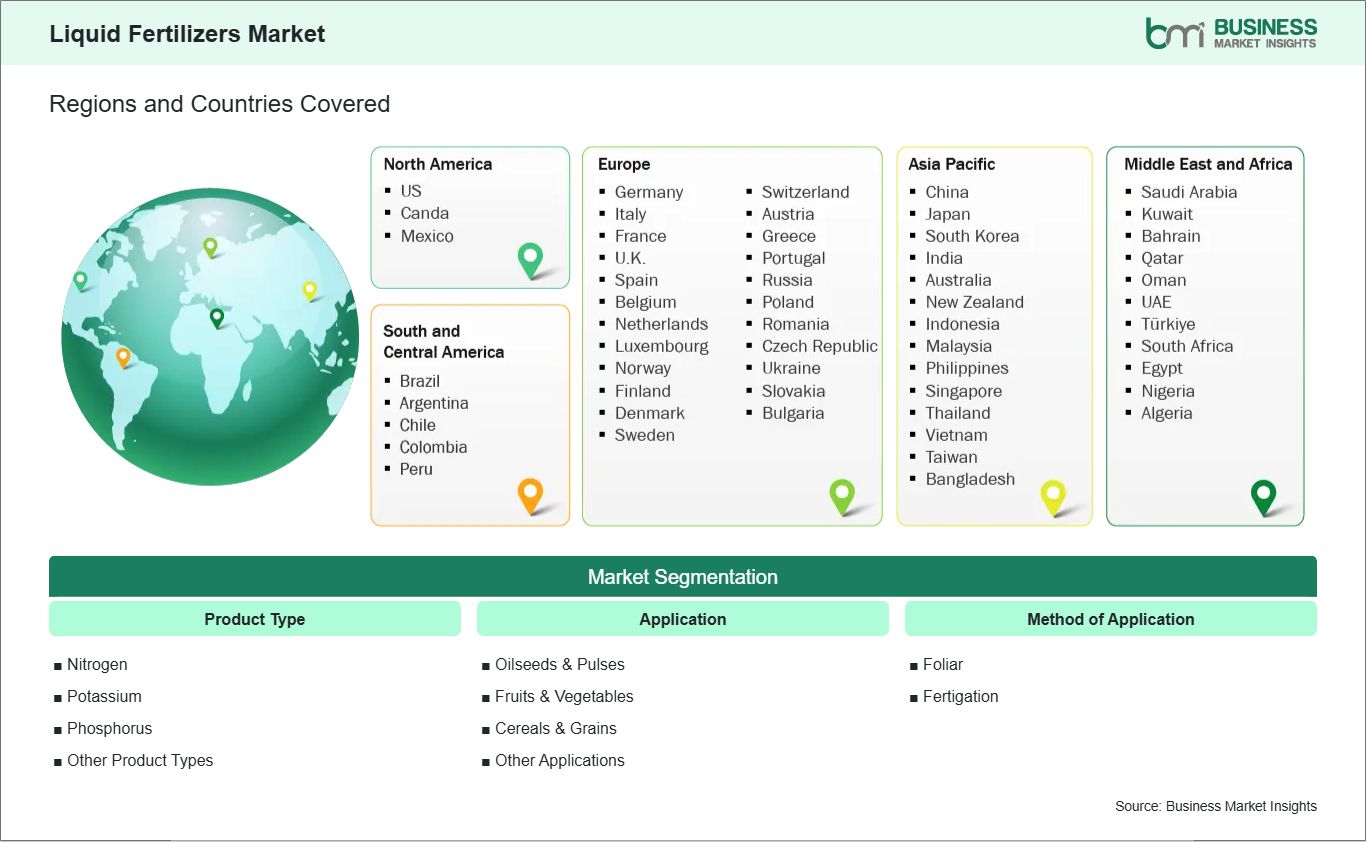
Key segments that contributed to the derivation of the Liquid Fertilizers market analysis are product type, application, and method of application.
- By product type, the liquid fertilizers market is segmented into Nitrogen, Potassium, Phosphorus, and Other Product Types. The Nitrogen segment dominated the market in 2025.
- By application, the liquid fertilizers market is segmented into Oilseeds & Pulses, Fruits & Vegetables, Cereals & Grains, and Other Applications. The Cereals & Grains segment dominated the market in 2025.
- By method of application, the liquid fertilizers market is segmented into Foliar and Fertigation. The Fertigation segment dominated the market in 2025.
Market Forces
Liquid Fertilizers Market Drivers and Opportunities
Adoption of precision irrigation and fertigation systems
The world over, the trend in the agriculture sector is shifting towards the use of automation in irrigation systems to combat water scarcity as well as rising labor costs. Fertigation, the technique of using liquid fertilizers in irrigation water, is the norm in modern farming practices. Fertigation facilitates the "spoon-feeding" of crops, where the required nutrients are supplied in minute quantities as per the plant's immediate requirement. This technique virtually rules out the "feast or famine" cycle in the supply of nutrients, which is the norm in conventional farming practices. As governments in areas such as North America and the Middle East offer subsidies for water-efficient irrigation systems, the market for high-purity liquid fertilizers, which do not clog the emitters or corrode the pipes, is witnessing unprecedented growth.
Moreover, the advent of IoT technology and the inclusion of smart sensors in the overall irrigation system have made the concept of fertigation even more viable. Soil conditions are monitored in real-time, and the automated system ensures that the liquid fertilizers are applied at the exact moment the soil moisture or nutrient levels dip. This is not just a matter of convenience; it is a paradigm shift in the overall agronomic practices that favor Input-Output Efficiency over volume alone. As a result, the overall liquid fertilizer market has started to concentrate on the development of highly concentrated, sediment-free products that can be integrated into the overall system with ease.
Development of bio-based liquid fertilizers
There is a significant and growing opportunity for the development of liquid fertilizers derived from renewable organic sources such as seaweed, compost extracts, and fermentation byproducts. As regulatory pressure on synthetic nitrates increases and consumer demand for organic produce climbs, farmers are seeking green liquid alternatives that provide both macro-nutrients and bio-stimulants. These bio-based liquids do more than just feed the plant; they enhance soil microbial activity and improve the plant's natural resistance to abiotic stresses like drought and salinity. Because these products are in liquid form, they are easier for the plant to absorb than organic solids, providing a faster green-up effect for the crop.
The technological challenge lies in ensuring that bio-based liquids remain stable and do not separate or ferment in storage tanks. Breakthroughs in stabilization chemistry are now allowing manufacturers to produce organic liquids with a shelf life comparable to synthetic versions. For large-scale commercial operations, these products offer a way to meet sustainability targets without sacrificing the convenience of mechanized application. As the circular economy gains traction, the ability to upcycle agricultural waste into high-value liquid nutrients represents a major frontier for market expansion. This trend is particularly strong in high-value horticulture, where the premium on residue-free and organic-certified produce justifies the higher investment in specialized bio-liquid formulations.
Size and Share Analysis
Liquid Fertilizers Market Size and Share Analysis
The global Liquid Fertilizers market is experiencing steady growth, with market size and share analysis reflecting evolving treatment preferences and competitive dynamics among key players. The report evaluates important subsegments categorized within adhesion type, printing technologies, and application, highlighting their respective contributions to overall market performance.
By product type, the Nitrogen subsegment dominated the market in 2025 because nitrogen is the most critical nutrient for rapid vegetative growth and chlorophyll formation. Liquid formulations like Urea-Ammonium Nitrate (UAN) are preferred for their high solubility and immediate availability to plants, ensuring consistent yield across varied soil conditions.
By application, the Cereals & Grains subsegment dominated the market in 2025 due to the massive scale of global staple crop cultivation. Crops like corn, wheat, and rice require high-volume, uniform nutrient distribution which liquid fertilizers provide more efficiently than granules, especially during critical growth stages like tillering and grain filling.
By method of application, the Fertigation subsegment dominated the market in 2025 because of the global surge in precision irrigation. By integrating liquid fertilizers directly into drip and sprinkler systems, farmers can deliver nutrients straight to the root zone, significantly reducing runoff and labor costs while maximizing nutrient-use efficiency.
Report Coverage
Liquid Fertilizers Market Report Coverage and Deliverables
The "Liquid Fertilizers Market Size and Forecast (2022 - 2033)" report provides a detailed analysis of the market covering below areas:
- Liquid Fertilizers market size and forecast at the regional and country levels for segments covered under the scope
- Liquid Fertilizers market trends, as well as drivers, restraints, and opportunities
- Liquid Fertilizers market analysis covering key trends, regional framework, major players, regulations, and recent developments
- Industry landscape and competition analysis covering market concentration, heat map analysis, prominent players, and recent developments for the Liquid Fertilizers market
- Detailed company profiles, including SWOT analysis
Geographic Insights
Liquid Fertilizers Market Geographic Insights
The geographical scope of the Liquid Fertilizers market report is divided into: North America, Asia Pacific, Europe, Middle East & Africa, and South & Central America. North America held the largest share in 2025.
North America maintains a leading position in the liquid fertilizers market, underpinned by an exceptionally high adoption rate of precision farming technologies and large-scale commercial agricultural operations. The United States, in particular, has a mature infrastructure for the storage and transportation of liquid nutrients, such as anhydrous ammonia and UAN solutions. The dominance of the region is further reinforced by the presence of major global players who invest heavily in R&D to create high-performance specialty liquids. Moreover, the North American Corn Belt represents one of the largest concentrated areas of liquid fertilizer consumption in the world, where mechanized side-dressing and fertigation are standard practices.
The regulatory environment in North America also plays a critical role, with strict environmental standards encouraging farmers to move away from high-runoff solid fertilizers in favor of more precise liquid systems. Federal and state-level incentives for water conservation have accelerated the installation of drip and pivot irrigation systems, directly boosting the fertigation segment. While the Asia-Pacific region is a massive consumer by volume, North America leads in market value due to its focus on premium, value-added formulations and advanced delivery methods. The region's well-established distribution network and the rapid integration of AI-driven smart fertilization ensure that North America will remain the primary hub for liquid fertilizer innovation and market leadership through the end of the decade.
Industry Activity
Recent Developments
The Liquid Fertilizers market is evaluated by gathering qualitative and quantitative data post primary and secondary research, which includes important corporate publications, association data, and databases. A few of the key developments in the Liquid Fertilizers market are:
- In February 2026, Nutrien Ltd., announced its full-year 2025 results, highlighting increased fertilizer sales volumes and continued strategic focus on expanding crop nutrient solutions, including liquid fertilizers, supported by strong global demand.
- In November 2025, Yara International, reported higher fertilizer production and deliveries in 2025, reflecting strong demand across key regions and increased supply of crop nutrition solutions, including liquid fertilizers.
- In 2024, ICL Group, announced the expansion of its specialty plant nutrition portfolio, including liquid fertilizers and fertigation solutions, aimed at supporting precision agriculture and high-efficiency crop nutrition.
Trust & Transparency
Research Methodology
The market analysis combines proprietary research with secondary data from government agencies, company disclosures, regulatory filings, industry databases and expert interviews. Market estimates are validated through data triangulation, cross-market benchmarking and analyst
review.
View Full Research Methodology
Key Sources Referred:
International Fertilizer Association (IFA)Fertilizer Institute (TFI, USA)European Fertilizer Manufacturers Association (Fertilizers Europe)Indian Farmers Fertilizer Cooperative Limited (IFFCO, India)Company WebsitesCompany Annual ReportsCompany Investor Presentations