Market Summary
Executive Summary and Global Market Analysis
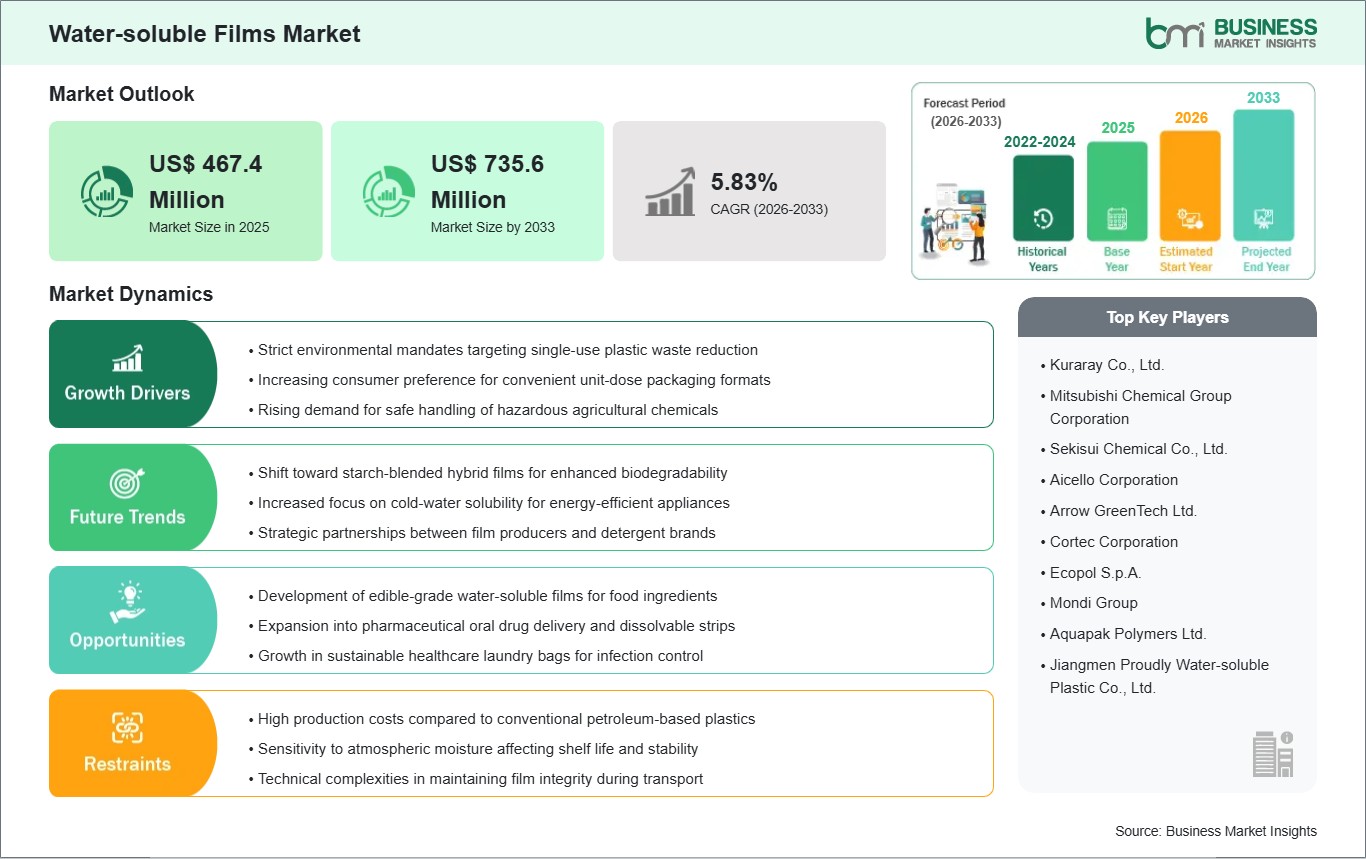
The water-soluble films market is experiencing a transformative growth period, fundamentally driven by the global transition toward sustainable and convenient packaging solutions. As a cornerstone of the circular economy, these films are increasingly replacing traditional plastics in high-volume sectors like household cleaning and agriculture. The market is primarily led by polyvinyl alcohol-based materials due to their unmatched combination of mechanical strength and rapid dissolution. The rise of unit-dose packaging, such as laundry pods and dishwasher capsules, has solidified the dominance of the household cleaning segment, as consumers prioritize time-saving and mess-free products that do not compromise environmental integrity.
Technological advancements are currently focused on enhancing the moisture resistance and storage stability of these films to overcome historical limitations in humid climates. Innovation is also thriving in the development of bio-based alternatives, such as starch-blended films, to meet the rising demand for fully renewable packaging. While high raw material costs remain a challenge, the market is bolstered by stringent government regulations against single-use plastics and a strong corporate push for zero-waste initiatives. Moving forward, the expansion into niche applications like pharmaceutical drug delivery and edible food packaging is expected to diversify the market, creating new value streams and reinforcing the position of water-soluble films as a vital tool for modern, responsible industrial design.
Segment Analysis
Water-soluble Films Market Segmentation
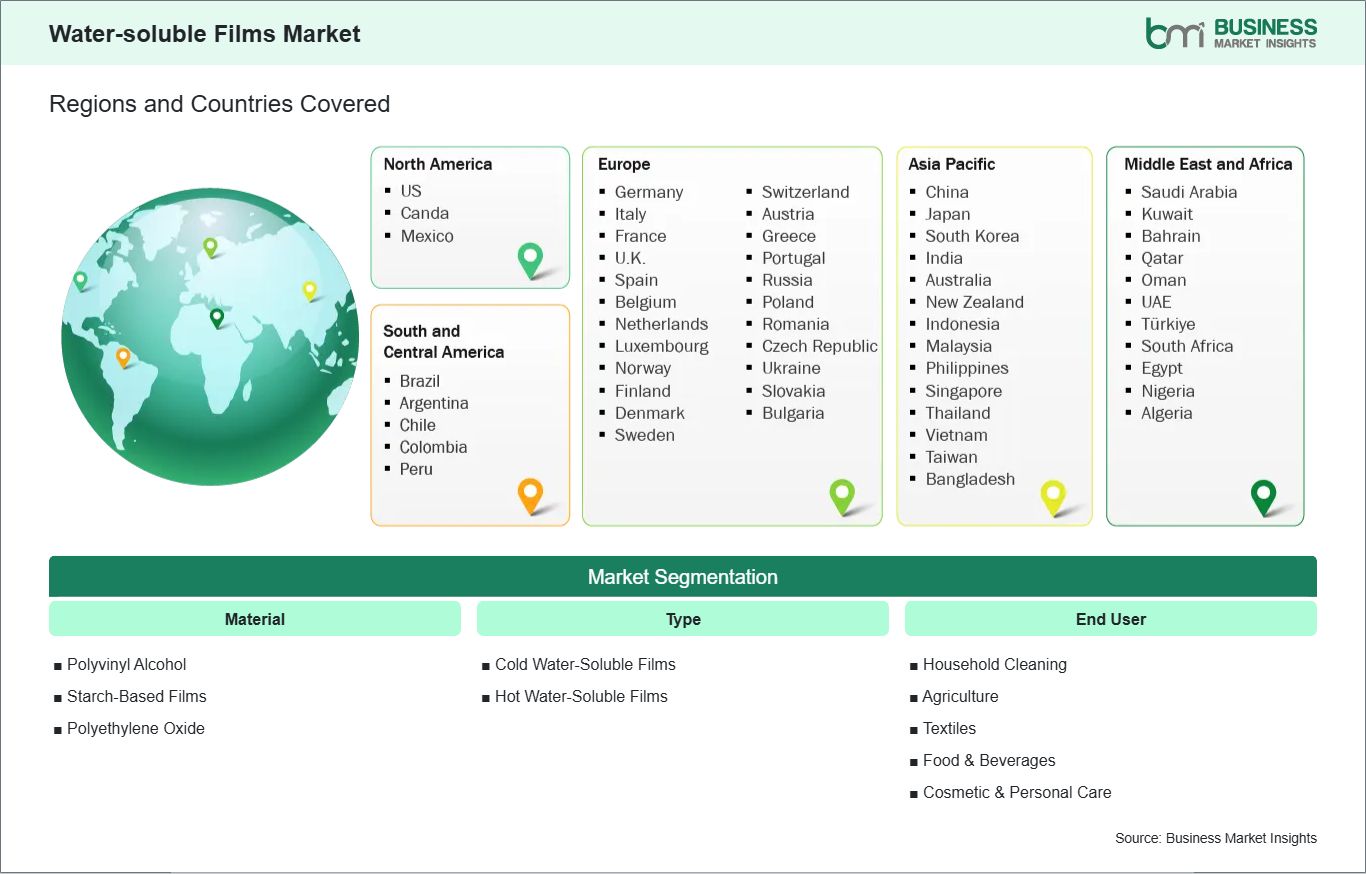
Key segments that contributed to the derivation of the Water-soluble Films market analysis are material, type, and end user.
- By material, the water-soluble films market is segmented into Polyvinyl Alcohol, Starch-Based Films, and Polyethylene Oxide. The Polyvinyl Alcohol segment dominated the market in 2025.
- By type, the water-soluble films market is segmented into Cold Water-Soluble Films and Hot Water-Soluble Films. The Cold Water-Soluble Films segment dominated the market in 2025.
- By end user, the water-soluble films market is segmented into Household Cleaning, Agriculture, Textiles, Food & Beverages, and Cosmetic & Personal Care. The Household Cleaning segment dominated the market in 2025.
Market Forces
Water-soluble Films Market Drivers and Opportunities
Strict environmental mandates targeting single-use plastic waste reduction
The global regulatory environment is one of the biggest drivers of water-soluble films, considering how different industries are being forced to find solutions that will help solve the problem of persistent plastics in the environment. For instance, different governments are adopting extended producer responsibility initiatives that require companies to be financially responsible for their products. In this case, water-soluble films are considered a unique solution since they can dissolve completely in water without any residue or leaching of any chemicals. This is a big advantage for companies that can be able to label their products as being plastic-free or zero-waste.
Moreover, such regulations are also resulting in a massive shift within the flexible packaging industry, which traditionally used multi-layer laminates. This is because traditional plastics are difficult to recycle if they have been contaminated with food or chemicals. Water-soluble plastics offer a far more desirable solution. This is particularly true within the chemical industry, where such plastics can be used to dispose of previously used irritants and pollutants. This shift is also resulting in a constant flow of investment within the production of such films, in order to secure a competitive edge in a world where anti-plastic regulations are only going to tighten.
Development of edible-grade water-soluble films for food ingredients
A significant growth avenue in this market is the innovation of edible-grade soluble films for the food and beverage industry. These films, often composed of high-purity polyvinyl alcohol or modified starches, allow for the precise portioning of ingredients like protein powders, coffee, spices, and food colorants. By encapsulating these items in a film that dissolves and can be safely consumed, manufacturers can offer drop-and-go convenience for consumers. This technology eliminates the need for traditional plastic sachets, thereby reducing the volume of small-format waste that typically ends up in the environment.
Beyond convenience, edible films offer functional benefits such as oxygen and aroma barriers, which help preserve the freshness of volatile ingredients. This is especially valuable for the health and wellness sector, where pre-portioned supplements and meal replacements are in high demand. As material science improves the taste and texture profiles of these films, their application is expected to expand into the bakery and confectionery sectors for internal separation of ingredients. This shift allows food brands to enhance the user experience through simplified preparation while simultaneously achieving ambitious corporate sustainability goals regarding the reduction of non-recyclable packaging materials.
Size and Share Analysis
Water-soluble Films Market Size and Share Analysis
The global Water-soluble Films market is experiencing steady growth, with market size and share analysis reflecting evolving treatment preferences and competitive dynamics among key players. The report evaluates important subsegments categorized within material, type, and end user, highlighting their respective contributions to overall market performance.
By material, the Polyvinyl Alcohol subsegment dominated the market in 2025 due to its superior tensile strength, excellent gas barrier properties, and rapid dissolution at various temperatures. Its non-toxic nature and complete biodegradability make it the primary choice for global consumer product manufacturers.
By type, the Cold Water-Soluble Films subsegment dominated the market in 2025 because of the widespread adoption of unit-dose laundry and dishwasher pods. These films dissolve instantly at ambient temperatures, aligning with the consumer shift toward energy-efficient, low-temperature washing cycles in modern households.
By end user, the Household Cleaning subsegment dominated the market in 2025 due to the massive commercial success of liquid detergent capsules. The convenience of pre-measured doses and the reduced mess associated with soluble packaging have made this the largest volume consumer of water-soluble film technology.
Report Coverage
Water-soluble Films Market Report Coverage and Deliverables
The "Water-soluble Films Market Size and Forecast (2022 - 2033)" report provides a detailed analysis of the market covering below areas:
- Water-soluble Films market size and forecast at the regional and country levels for segments covered under the scope
- Water-soluble Films market trends, as well as drivers, restraints, and opportunities
- Water-soluble Films market analysis covering key trends, regional framework, major players, regulations, and recent developments
- Industry landscape and competition analysis covering market concentration, heat map analysis, prominent players, and recent developments for the Water-soluble Films market
- Detailed company profiles, including SWOT analysis
Geographic Insights
Water-soluble Films Market Geographic Insights
The geographical scope of the Water-soluble Films market report is divided into: North America, Asia Pacific, Europe, Middle East & Africa, and South & Central America. North America held the largest share in 2025.
North America stands as the leading region in the water-soluble films market, a position established by early and aggressive adoption of unit-dose packaging technology. The United States, in particular, has seen a massive market penetration of laundry and automatic dishwashing pods, which has created a robust and consistent demand for high-quality soluble films. This dominance is further supported by a sophisticated chemical and pharmaceutical industry that utilizes water-soluble films for the safe handling of hazardous substances and precise drug delivery. The presence of major global market players and advanced R&D facilities within the region facilitates rapid innovation and the early commercialization of next-generation film formulations.
The regional market is also heavily influenced by proactive environmental awareness among both consumers and regulatory bodies. North American companies are increasingly integrating water-soluble solutions into their product lines to align with sustainability pledges and to comply with state-level mandates aimed at reducing plastic pollution. The agricultural sector in the Midwest also contributes significantly to the regional share, where soluble sachets are the standard for pre-measured pesticides and fertilizers. With a well-developed infrastructure and a high consumer willingness to pay for premium, convenience-oriented products, North America is expected to maintain its leadership, even as other regions like Asia-Pacific show rapid growth in manufacturing capacity.
Industry Activity
Recent Developments
The Water-soluble Films market is evaluated by gathering qualitative and quantitative data post primary and secondary research, which includes important corporate publications, association data, and databases. A few of the key developments in the Water-soluble Films market are:
- In November 2024, Kuraray Co., Ltd., announced that it acquired ISCC PLUS certification across multiple production sites, covering its full value chain from vinyl acetate monomer to PVOH resin and water-soluble films, enabling the supply of certified sustainable film products.
- In 2024, Kuraray Co., Ltd. (through its subsidiary MonoSol), announced plans to establish a new production facility in Poland for PVA water-soluble films to strengthen its global supply chain and meet growing demand in detergent, pharmaceutical, and agrochemical packaging.
- In November 2025, Sekisui Chemical Co., Ltd., announced enforcement of a patent injunction in Germany related to multilayer film technology, highlighting its strategic focus on protecting intellectual property in high-performance film segments, including functional and specialty films.
Trust & Transparency
Research Methodology
The market analysis combines proprietary research with secondary data from government agencies, company disclosures, regulatory filings, industry databases and expert interviews. Market estimates are validated through data triangulation, cross-market benchmarking and analyst
review.
View Full Research Methodology
Key Sources Referred:
American Chemistry Council (ACC)International Council of Chemical Associations (ICCA)European Chemical Industry Council (Cefic)China Petroleum and Chemical Industry Federation (CPCIF)Indian Chemical Council (ICC)Japan Chemical Industry Association (JCIA)Brazilian Chemical Industry Association (ABIQUIM)Gulf Petrochemicals and Chemicals Association (GPCA)Company WebsitesCompany Annual ReportsCompany Investor Presentations