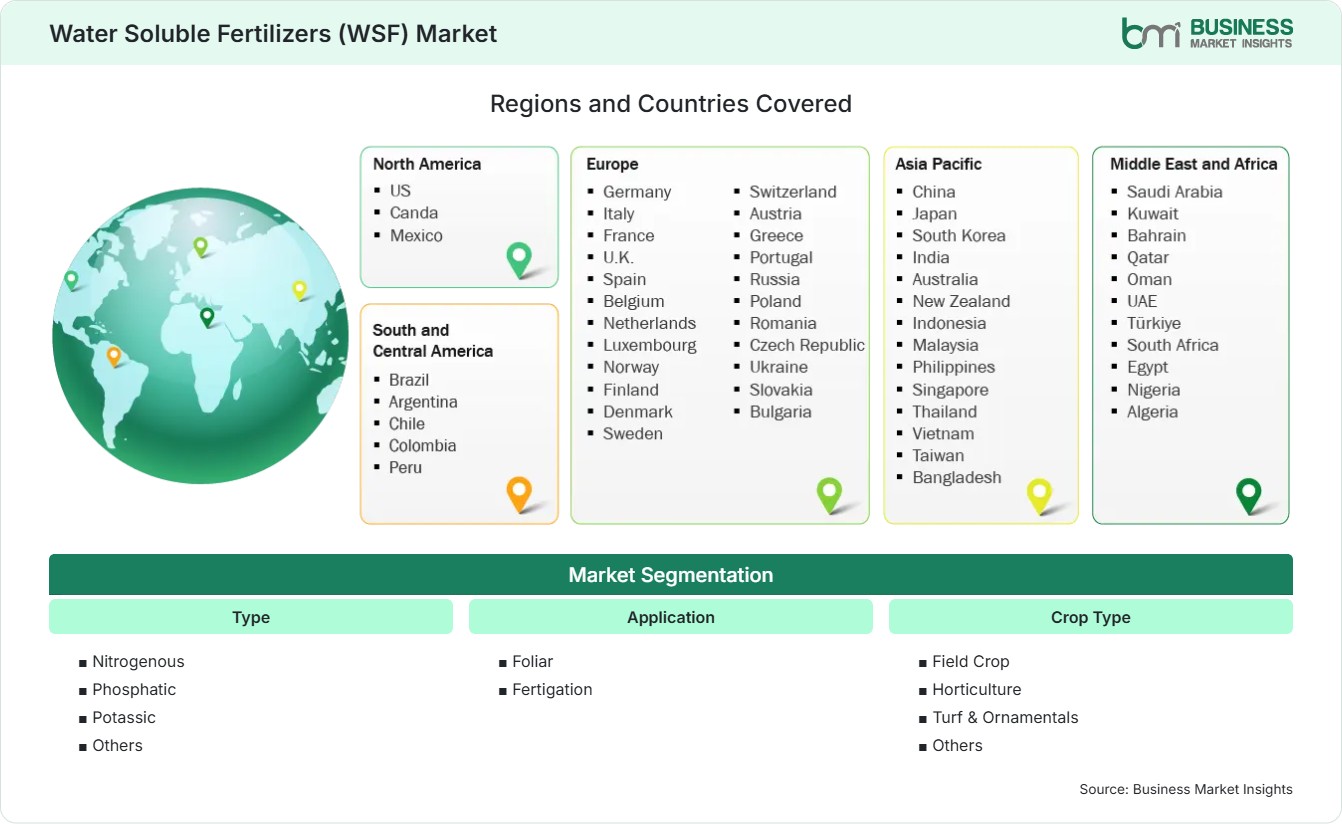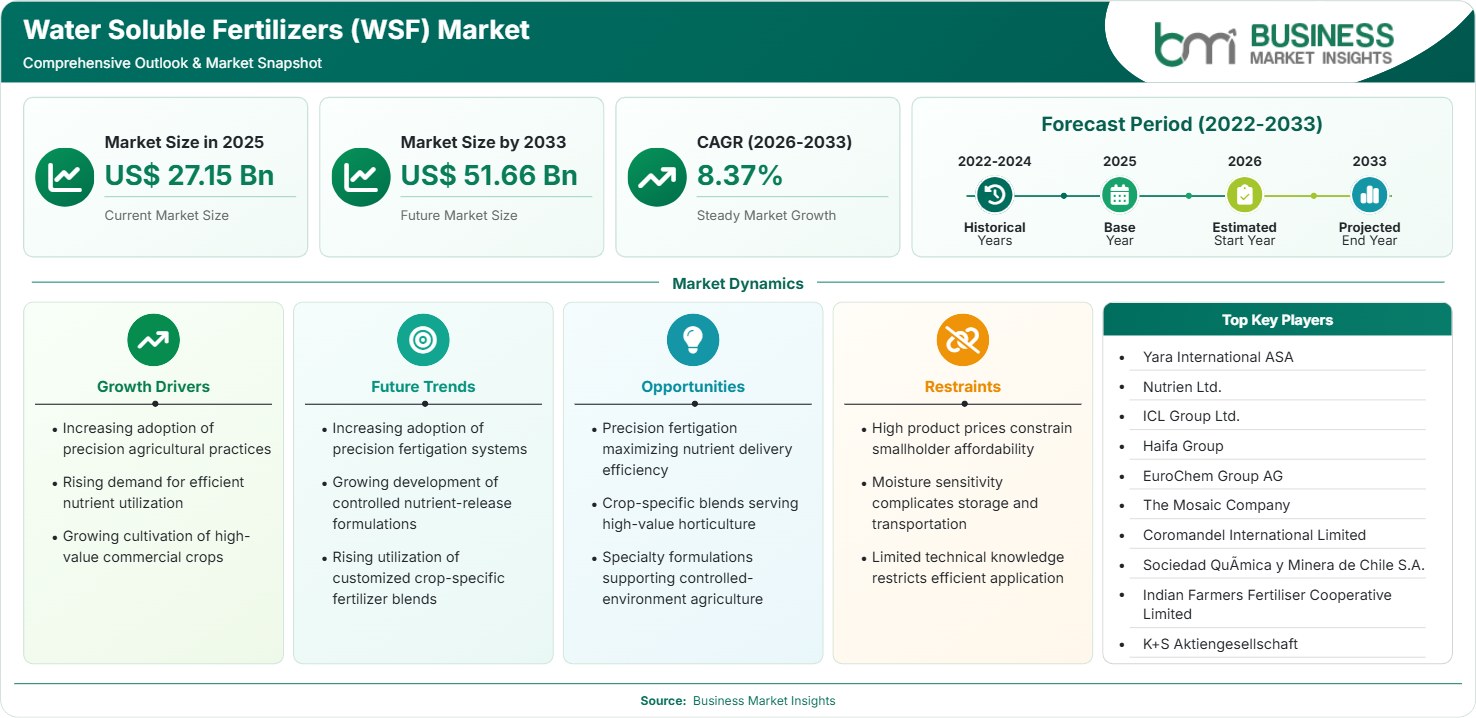
Water Soluble Fertilizers (WSF) Market Regional Highlights
North America Water Soluble Fertilizers Market
North America accounts for 24%–27% of global revenue in 2025 and is projected to expand at 7.2%–8.0% CAGR through 2033. The regional Water Soluble Fertilizers Market share is supported by extensive precision agriculture adoption, advanced irrigation infrastructure, and widespread commercial farming operations. Specialty crops, greenhouse cultivation, and sustainability targets continue to promote adoption. Strong research capabilities and technology-driven nutrient management practices support ongoing demand across the United States and Canada.
- Precision agriculture platforms increasingly integrate nutrient recommendations with irrigation scheduling.
- Specialty fruit and vegetable growers prioritize efficiency and yield quality improvements.
- Sustainability standards encourage reduction of nutrient losses and runoff.
- Investments in greenhouse and protected cultivation strengthen product demand.
US Water Soluble Fertilizers Market
The United States represents 72%–76% of North America's WSF Market share and advances at 7.5%–8.2% CAGR. Demand is driven by specialty agriculture, commercial horticulture, and precision irrigation deployment. Producers increasingly adopt digital nutrient-management systems integrated with field monitoring technologies. High-value crop cultivation and labor-efficiency priorities support long-term utilization of soluble nutrient solutions.
- California remains a leading consumption hub due to intensive horticultural production.
- Smart fertigation technologies gain traction among commercial farms.
- Greenhouse and controlled-environment agriculture continue expanding.
- Sustainability targets encourage precise nutrient application methods.
Europe Water Soluble Fertilizers Market
Europe holds a 21%–24% share in 2025 and grows at 7.4%–8.2% CAGR. Regulatory emphasis on sustainable nutrient management and environmental compliance supports adoption. Spain and Italy remain leading markets due to horticulture intensity, while Eastern European countries demonstrate stronger expansion rates. The region increasingly favors precision nutrient delivery solutions compatible with modern irrigation systems.
- Spain leads regional consumption through advanced greenhouse agriculture.
- Italy maintains strong demand from fruit and vegetable cultivation.
- Poland records one of the fastest regional growth trajectories.
- Environmental regulations encourage efficient fertilizer utilization.
- Precision farming technologies improve nutrient-use efficiency outcomes.
Asia Pacific Water Soluble Fertilizers Market
The Asia Pacific region holds a 39%–43% market share in 2025 and is growing at a faster rate, with a 9.2%–10.0% CAGR. Agricultural modernization, government initiatives, and irrigation improvements account for continued growth. The leading demand in the region comes from China, and India is showing remarkable growth. Growth in protected cultivation, horticulture, and micro-irrigation systems improves future market opportunities.
- China remains the largest regional consumer through intensive agricultural production.
- India demonstrates robust adoption supported by fertigation expansion.
- Protected cultivation investments accelerate demand across Southeast Asia.
- Water-efficiency policies encourage precision nutrient management.
- Horticulture exports support premium fertilizer consumption patterns.
Rest of World Water Soluble Fertilizers Market
The WSF Market in the Rest of World accounts for 11%-14% of market share and is forecast to grow at an 8.0%-8.8% CAGR. Brazil dominates South & Central America due to the commercial agricultural activities in the region, while Saudi Arabia and South Africa are important participants from the Middle East & Africa. Water scarcity, irrigation expansion, and export-focused crop production stimulate adoption across both regions.
- Brazil remains the largest regional opportunity due to large-scale farming.
- Mexico experiences growing demand from horticultural exports.
- Gulf countries prioritize water-efficient nutrient management systems.
- South Africa strengthens adoption through high-value crop cultivation.
- Agricultural modernization initiatives improve long-term regional prospects.