
Water Treatment Polymers Market Outlook: Size, Share, Trends, Growth Analysis, Competitive Landscape & Forecast, 2026-2033

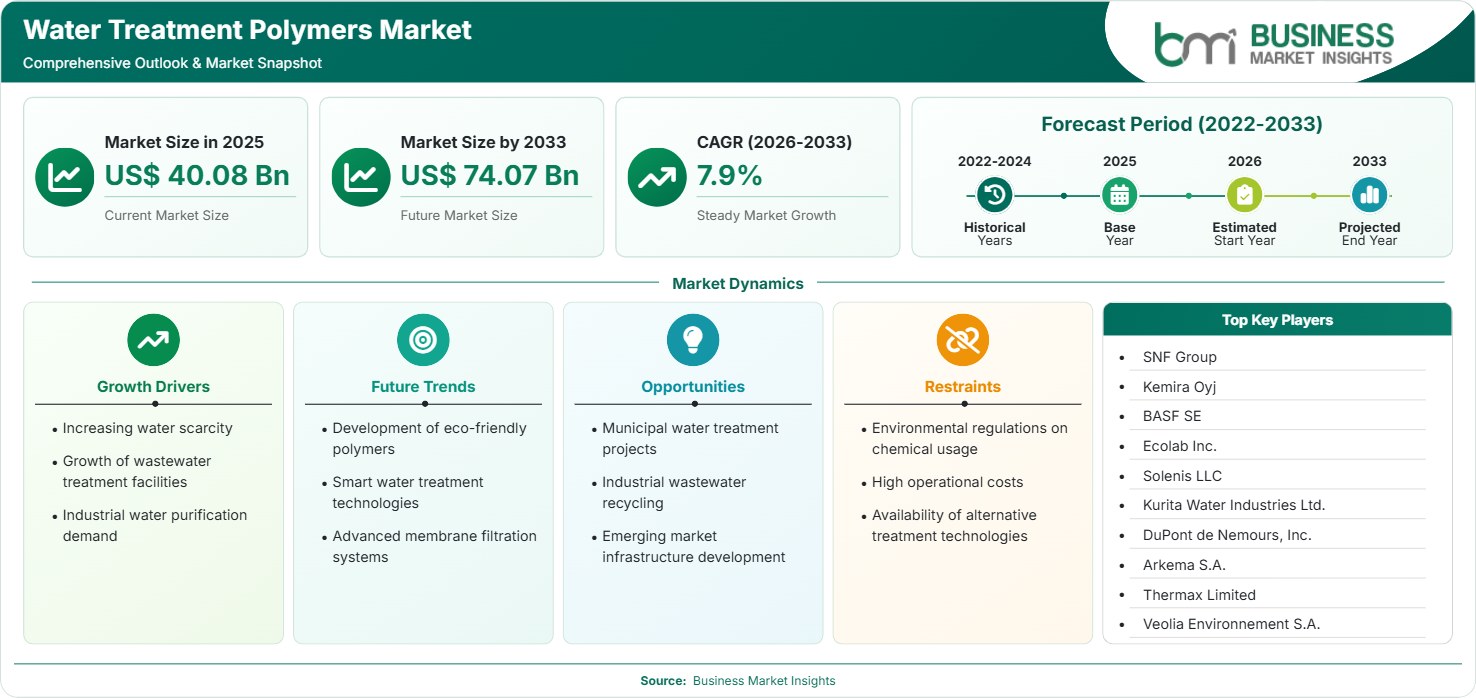
The water treatment polymers market size was valued at US$ 40.08 Billion in 2025 and is projected to reach US$ 74.07 Billion by 2033, growing at a CAGR of 7.9% during 2026–2033. Rising water scarcity, expansion of wastewater treatment infrastructure, and increasing industrial water purification requirements are driving demand, while investments in municipal water treatment projects and industrial water recycling continue creating long-term growth opportunities.

Report Coverage
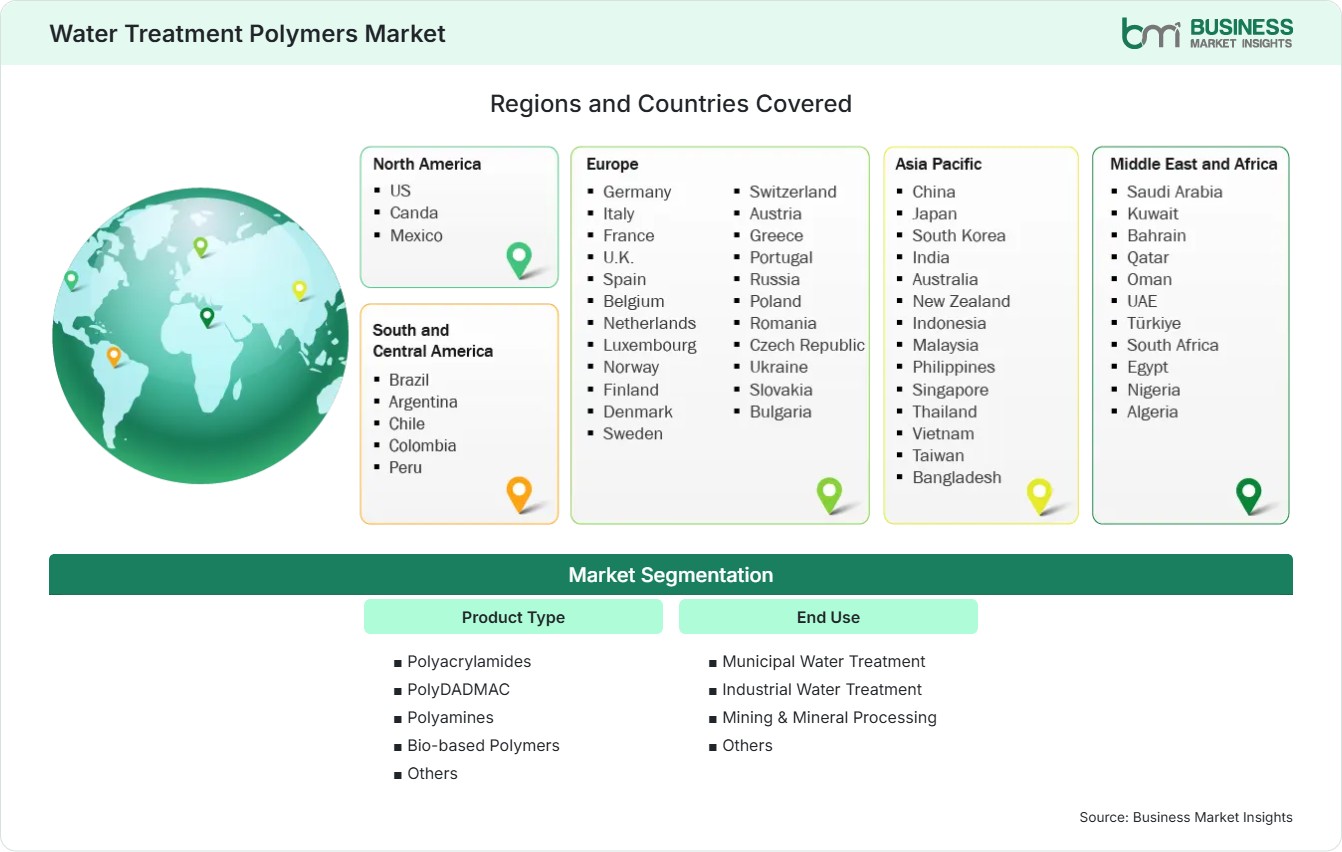
  • Product Type: Polyacrylamides, PolyDADMAC, Polyamines, Bio-based Polymers, Others
  • End Use: Municipal Water Treatment, Industrial Water Treatment, Mining & Mineral Processing, Others
US$ 40.08 Bn Market size in 2025
US$ 74.07 Bn Market Size by 2033
7.9% CAGR, 2026 - 2033
2026-2033 Forecast Period

AI Overview

Water Treatment Polymers Market Summary

North America Region: North America holds a Water Treatment Polymers market share of 33%–36% in 2025, growing with a CAGR of 7.3%–7.8% during 2026–2033, supported by stringent wastewater discharge regulations, industrial water reuse initiatives, and modernization of municipal treatment infrastructure. The United States remains the regional leader due to advanced industrial water management and infrastructure investments, registering a CAGR of 7.4%–7.9%.

Fastest Growing Region: Asia Pacific accounts for a market share of 28%–31% in 2025 and is projected to expand at a CAGR of 8.8%–9.4% during 2026–2033, driven by rapid industrialization, urban population growth, expanding municipal water treatment capacity, and increasing investment in wastewater recycling infrastructure.

Leading Segment: Polyacrylamides represent the leading segment with a 41%–44% market share in 2025 and are expected to grow at a CAGR of 8.1%–8.6% during 2026–2033. High efficiency in coagulation, flocculation, sludge dewatering, and industrial wastewater treatment continues supporting widespread adoption.

High Growth Segment: Industrial Water Treatment emerges as the fastest-growing end-use segment, accounting for 37%–40% of the Water Treatment Polymers market share in 2025 while advancing at a CAGR of 8.5%–9.1% during 2026–2033. Increasing water reuse requirements, stricter environmental compliance, and industrial sustainability initiatives continue strengthening demand across manufacturing sectors.

Key Market Opportunity: Growing investments in municipal water infrastructure, industrial wastewater recycling, and sustainable treatment technologies are encouraging adoption of advanced polymer formulations that improve treatment efficiency while reducing operational costs and environmental impact.

Major Market Players: SNF Group, Kemira Oyj, BASF SE, Ecolab Inc., Solenis LLC, Kurita Water Industries Ltd., DuPont de Nemours, Inc., Arkema S.A., Thermax Limited, and Veolia Environnement S.A.

Strategic Insights

Water Treatment Polymers Market: Strategic Insights

Water Treatment Polymers Market Strategic Framework
FREE PDF
Request your free sample
Request free sample
Stakeholder View

Key Takeaways

  • The market value chain is evolving toward integrated chemical solutions, where polymer manufacturers collaborate with engineering firms, municipal utilities, and industrial operators to improve treatment efficiency while reducing lifecycle operating costs.
  • Industrial water treatment presents the strongest commercial opportunity as manufacturers invest in water reuse, zero-liquid discharge systems, and advanced wastewater treatment technologies to comply with increasingly stringent environmental regulations.
  • Innovation is shifting toward high-performance and bio-based polymer formulations that improve flocculation efficiency, reduce sludge generation, enhance biodegradability, and support sustainability objectives across municipal and industrial treatment applications.
  • Asia Pacific offers the most attractive long-term investment potential owing to expanding urban populations, increasing industrialization, government-led water infrastructure development, and rising investments in wastewater recycling facilities.
  • Strategic acquisitions, technology licensing agreements, and collaborative research initiatives continue reshaping the competitive landscape as companies expand specialty polymer portfolios and strengthen regional manufacturing capabilities.
  • Increasing adoption of digital water management, process automation, and real-time monitoring technologies is expected to enhance polymer dosing efficiency, optimize operational performance, and improve regulatory compliance across treatment facilities.
Geographic Outlook

Water Treatment Polymers Market Regional Highlights

North America Water Treatment Polymers Market

North America accounted for approximately 33%–36% of the water treatment polymers market share in 2025 and is projected to expand at a CAGR of 7.3%–7.8% during 2026–2033. The region benefits from stringent environmental regulations, aging water infrastructure replacement programs, increasing industrial wastewater reuse, and strong investment in advanced treatment technologies. Growing adoption of specialty polymers for sludge dewatering, coagulation, and flocculation continues supporting market share across municipal and industrial treatment facilities.

  • Municipal utilities continue modernizing wastewater treatment infrastructure through investments in advanced polymer-based treatment solutions that improve contaminant removal efficiency, reduce sludge volume, and optimize operational performance while complying with increasingly stringent environmental standards.
  • Industrial sectors including power generation, chemicals, food processing, and pharmaceuticals continue adopting high-performance treatment polymers to enhance water recycling efficiency, minimize freshwater consumption, and reduce wastewater disposal costs.
  • Regulatory agencies continue strengthening discharge standards, encouraging municipalities and industrial operators to invest in innovative polymer formulations capable of improving treatment effectiveness while reducing chemical consumption and environmental impact.
  • Manufacturers are expanding research and development activities focused on sustainable polymer technologies, bio-based formulations, and improved treatment performance to address evolving customer requirements and environmental objectives.
  • Increasing investments in digital water management platforms enable optimized polymer dosing, predictive maintenance, and real-time process monitoring, improving treatment efficiency and reducing operational expenditure.

US Water Treatment Polymers Market

The United States is the largest market in North America, contributing a 25%-28% share of the worldwide requirement by 2025 and maintaining a CAGR of 7.4%-7.9% from 2026 to 2033. Robust industrial manufacturing processes, municipal infrastructure development projects, and investments in sustainable water management solutions have been driving long-term water treatment polymers market forecasts across end-user sectors.

  • Federal and state investments in wastewater treatment modernization continue accelerating demand for advanced polymer solutions that improve contaminant removal, sludge handling efficiency, and regulatory compliance across municipal facilities.
  • Industrial water reuse initiatives within energy, chemicals, food processing, and semiconductor manufacturing continue driving adoption of specialty polymers designed to improve operational efficiency and reduce freshwater dependence.
  • Technological advancements in polymer formulation and automated dosing systems enable treatment facilities to optimize chemical usage while enhancing treatment consistency and lowering operating costs.
  • Growing emphasis on circular water management and sustainability initiatives encourages utilities and industrial operators to invest in innovative treatment chemicals supporting long-term environmental performance and resource conservation.

Europe Water Treatment Polymers Market

Europe accounted for around 25% to 28% of the overall market share in 2025, and it is estimated to grow at a CAGR of 7.5% to 8.0% between 2026 and 2033. The strict environmental regulations, circular-economy initiatives, and large capital investments in upgrading wastewater treatment processes will further drive demand in the region. Industrial facilities and municipal authorities increasingly adopt advanced polymer formulations to improve treatment efficiency, comply with stringent discharge regulations, and enhance sustainable water resource management, strengthening water treatment polymers market trends across the region.

  • Germany remains the leading regional market, supported by advanced industrial manufacturing, robust municipal infrastructure, and continuous investment in wastewater recycling technologies, registering a CAGR of 7.3%–7.8% during the forecast period.
  • France is among the fastest-growing markets with a CAGR of 7.9%–8.4%, driven by infrastructure modernization, industrial sustainability initiatives, and increasing investments in advanced water treatment technologies.
  • European utilities continue investing in energy-efficient treatment systems and specialty polymers that improve sludge dewatering, reduce chemical consumption, and support circular water economy objectives.
  • Increasing regulatory emphasis on water quality and industrial discharge compliance continues encouraging manufacturers to develop environmentally compatible polymer solutions with enhanced treatment performance.
  • Public-private partnerships supporting municipal infrastructure upgrades continue to generate long-term opportunities for polymer suppliers across drinking water and wastewater treatment applications.

Asia Pacific Water Treatment Polymers Market

Asia Pacific accounted for approximately 28%–31% of the global market in 2025 and is projected to record the fastest CAGR of 8.8%–9.4% during 2026–2033. Rapid industrialization, urbanization, expanding manufacturing capacity, and increasing government investment in municipal water infrastructure continue supporting sustained water treatment polymers market growth. Rising awareness regarding water conservation and industrial wastewater reuse further accelerates regional demand for advanced treatment polymers.

  • China still leads the way as the largest regional market because of mass manufacturing operations across industries, widespread municipal wastewater treatment plants, and rising investment in sustainability, with a CAGR of 8.5% to 9.0%.
  • India will grow faster than any other region, with a CAGR of 9.2% to 9.8%, driven by urbanization, industrialization, government initiatives in sanitation, and expanding sewage treatment capacity.
  • Mining, power generation, chemicals, and textile industries continue increasing consumption of specialty polymers to improve water recovery, treatment efficiency, and environmental compliance.
  • The fast development of desalination plants, industrial recycling plants, and municipal water treatment plants provides significant scope for highly effective flocculants and coagulants.
  • Domestic producers and foreign chemical suppliers continue to expand capacity and form alliances to meet growing regional demand for water treatment chemicals.

Rest of World Water Treatment Polymers Market

The Rest of World region accounted for approximately 11%–13% of the global Water Treatment Polymers market in 2025 and is forecast to expand at a CAGR of 8.0%–8.6% during 2026–2033.

In South & Central America, investment growth is evident in municipal water treatment, mining, and industrial water recycling. Brazil is the leader in terms of demand, with a CAGR of 8.1%–8.6%, driven by developments in environmental infrastructure and industrial modernization programs.

In the Middle East & Africa region, water security continues to develop through desalination, wastewater reuse, and industrial water management programs. In Saudi Arabia, the CAGR is 8.4%–8.9%, driven by large-scale infrastructure investments and growing demand for sustainable water treatment technologies.

  • Governments continue investing in expanding municipal water supplies and wastewater treatment plants to improve public health, environmental sustainability, and water security in the long run.
  • Mining companies tend to use innovative polymer technology more often to improve solid-liquid separation, increase water recovery, and decrease negative impacts on the environment throughout the mineral processing process.
  • Desalination plants continue to proliferate in areas facing water shortages, thereby creating an ongoing need for specialty polymers.
  • The development of industries in developing countries promotes the use of innovative wastewater treatment chemicals because of environmental legislation.
  • Strategic collaborations among international polymer manufacturers, engineering companies, and regional utilities continue to accelerate technology transfer and expand market access in developing economies.
Global Market Geography
FREE PDF
Request your free sample
Request free sample
Segment Analysis

Water Treatment Polymers Market Segmentation

Product Type

The product type segment is driven by rising demand for advanced treatment chemicals that enhance coagulation, flocculation, sludge dewatering, and suspended solids removal. Polyacrylamides have contributed significantly towards revenue generation and hold a market share of around 41%–44% in 2025. The product type is expected to grow at a CAGR of 8.1%–8.6% over the forecast period. Innovation in specialty polymers is enhancing the Water Treatment Polymers Market scope across diverse water treatment applications.

  • Polyacrylamides: Polyacrylamides retain their reputation as the choice treatment polymers due to higher flocculation efficiencies, excellent sludge dewatering properties, and wide applications in municipal wastewater treatment, industrial treatment processes, mining activities, and the pulp and paper industry.
  • PolyDADMAC: PolyDADMAC has been widely used in primary coagulation, clarification, and drinking water treatment due to its high charge density, stable performance, and broad compatibility across treatment processes.
  • Polyamines: Polyamines have been increasingly used in industrial wastewater treatment processes due to high coagulation efficiencies, low sludge production, and suspended solids removal.
  • Bio-based Polymers: Bio-based polymers have been increasingly studied as sustainable products due to their biodegradability, less environmental impact, and suitability with changing sustainability goals.

End Use

The end-use segment reflects growing investment in sustainable water management and advanced treatment infrastructure across municipal and industrial sectors. Industrial Water Treatment accounts for approximately 37%–40% of the Water Treatment Polymers market in 2025 and is expected to register the fastest CAGR of 8.5%–9.1% through 2033. Increasing regulatory compliance, water reuse initiatives, and industrial sustainability programs continue supporting long-term market expansion across major end-use industries.

  • Municipal Water Treatment: Municipal water companies are turning to more advanced treatment polymers to improve drinking water quality, manage sludge, reduce operating costs, and meet strict environmental and health standards.
  • Industrial Water Treatment: Industrial plants are increasingly using polymers to improve the quality of recycled water, protect equipment from corrosion, meet regulations, and serve other purposes.
  • Mining & Mineral Processing: Mining companies have been using more advanced polymers for solid-liquid separation, tailings handling, improved mineral recovery efficiency, and reduced operating costs.
Market Forces

Water Treatment Polymers Market Dynamics

Key Market Drivers

Increasing Water Scarcity

Growing water shortages have led to rising demand for water treatment polymers that deliver better performance. The rise in urbanization and population, along with freshwater shortages, is prompting companies and authorities to adopt new water treatment techniques. Water treatment polymers offer enhanced performance in coagulation, flocculation, dewatering, and contaminant removal, helping recover more water. With an increasing focus on sustainable management and the use of water resources, there is a trend towards the use of specialized polymers in water treatment facilities worldwide.

Growth of Wastewater Treatment Facilities

The constant growth of wastewater treatment plants is resulting in a rise in the use of water treatment polymers. Municipal wastewater treatment plants have been undergoing upgrades and construction due to increasingly strict environmental standards and rising urban water demand. Industrial wastewater treatment facilities are also expanding to comply with discharge standards and improve water reuse capabilities. This means the demand for effective polymers to enhance the efficiency of treatment processes is constantly rising.

Industrial Water Purification Demand

Rapidly increasing industrial demand for water purification has contributed significantly to the Water Treatment Polymers market growth across sectors such as manufacturing, mining, power plants, chemicals, food and beverages, and the pharma industry. There is an increase in company investments in adopting advanced water treatment techniques to improve process water quality, reduce freshwater use, and comply with environmental regulations. Water treatment polymers play an important role in enhancing contaminant removal and wastewater recycling.

Key Market Opportunities

Municipal Water Treatment Projects

Increased investment in urban water treatment initiatives offers many opportunities for water treatment polymer companies. Governments around the world are upgrading aging water infrastructure, increasing the capacity of wastewater treatment facilities, and providing their people with access to clean water. Advanced polymer technology is needed for these initiatives to increase coagulation, flocculation, and sludge management efficiencies. Higher government investments in sustainable water infrastructure will create many opportunities for water treatment polymers in the coming years.

Industrial Wastewater Recycling

The adoption of wastewater recycling in industry is presenting many avenues for growth as industries seek to reduce freshwater use and improve their sustainability metrics. Water treatment polymers enable improved contaminant removal, water recovery, and recycling efficiency in industrial operations. Regulatory push, company commitments to sustainability, and increased funding for circular water management continue to drive demand for polymer technologies.

Emerging Market Infrastructure Development

The growth in infrastructure construction in developing countries creates more opportunities for the production of water-treatment polymers. The ongoing trends of urbanization and industrialization, combined with the government’s initiatives to build water treatment facilities, have driven the growing demand for high-quality treatment chemicals. The development of new projects in municipalities, industries, and environmental protection is continually generating a constant demand for specialty polymers.

Market Restraints and Challenges

Environmental Regulations on Chemical Usage

Stringent environmental regulations governing the production, application, and disposal of treatment chemicals present a significant challenge for market participants. Manufacturers must invest in environmentally compliant formulations, sustainable production technologies, and extensive regulatory testing to meet evolving standards. These requirements increase research and development expenditure, product approval timelines, and compliance costs while encouraging the development of environmentally friendly polymer alternatives.

High Operational Costs

High operational costs remain a major restraint for the widespread adoption of advanced water treatment polymers, particularly among budget-constrained municipalities and small industrial facilities. Expenses related to specialty chemicals, treatment equipment, energy consumption, maintenance, and skilled workforce requirements increase the overall cost of water treatment operations. In addition, fluctuations in raw material prices and logistics costs can affect profitability for manufacturers and increase treatment costs for end users.

Company Analysis

Competitive Landscape

The trends in the competition arena have been characterized by the continuous introduction of innovations in specialty polymers, capacity growth, and collaboration with municipal utilities and industrial consumers. According to the water treatment polymers market analysis, leading players in the industry focus on producing eco-friendly polymers, developing innovative flocculation techniques, and expanding production across different geographic locations.

Company Name

Overview

Products and Services Relevant to this Market

SNF Group

Global specialty chemical manufacturer recognized for its extensive portfolio of water-soluble polymers serving municipal and industrial water treatment markets.

Polyacrylamides, flocculants, coagulants, sludge dewatering polymers, wastewater treatment chemicals, mining process chemicals, and technical support services.

Kemira Oyj

Finland-based chemical company specializing in sustainable water treatment solutions for municipalities and industrial customers worldwide.

Water treatment polymers, coagulants, retention aids, process chemicals, wastewater treatment solutions, and performance optimization services.

BASF SE

Global chemical manufacturer offering specialty polymers and performance chemicals for water treatment and industrial processing applications.

Flocculants, dispersants, performance polymers, industrial water treatment chemicals, wastewater treatment additives, and process optimization solutions.

Ecolab Inc.

Global sustainability and water management company providing integrated treatment technologies and chemical solutions for industrial customers.

Water treatment chemicals, polymer solutions, digital monitoring platforms, wastewater management, process optimization, and industrial water services.

Solenis LLC

Specialty chemical company delivering advanced water treatment technologies for municipal and industrial applications worldwide.

Flocculants, coagulants, sludge conditioning chemicals, process treatment solutions, wastewater management, and technical consulting services.

Kurita Water Industries Ltd.

Japan-based provider of comprehensive water treatment technologies serving industrial facilities and municipal utilities globally.

Water treatment polymers, membrane treatment chemicals, process chemicals, wastewater treatment solutions, and plant optimization services.

DuPont de Nemours, Inc.

Global technology company providing advanced materials and water treatment solutions for industrial and municipal markets.

Water purification technologies, specialty polymers, membrane technologies, industrial treatment solutions, and process efficiency products.

Arkema S.A.

Specialty materials manufacturer producing advanced polymer technologies for industrial water treatment and environmental applications.

Specialty polymers, water treatment additives, performance chemicals, industrial process solutions, and sustainable polymer technologies.

Thermax Limited

Engineering and energy solutions company offering integrated water and wastewater treatment systems for industrial customers.

Water treatment chemicals, wastewater treatment systems, specialty polymers, process optimization, and industrial water management solutions.

Veolia Environnement S.A.

Global environmental services company delivering integrated water, wastewater, and resource management solutions worldwide.

Municipal water treatment, industrial water services, wastewater treatment chemicals, operational management, and sustainable water solutions.

Industry Activity

Recent Developments

September 2025

Kemira announced that it had signed an agreement to acquire Water Engineering, Inc., a U.S.-based industrial water treatment services company, expanding its Water Solutions business into industrial water treatment services and enhancing its portfolio of water treatment chemistries and related solutions.

July 2025

Kemira announced a €20 million investment to expand its Tarragona, Spain manufacturing site with a new Aluminium Chloro Hydrate (ACH) production line to strengthen its drinking water treatment portfolio and support growing demand for advanced water treatment chemicals.

June 2025

Solenis announced that it had entered into a definitive agreement to acquire 100% of NCH Corporation, creating a more diversified global provider of water and hygiene solutions with expanded water treatment technologies and specialty chemical capabilities.

February 2025

Kemira announced the completion of its acquisition of Thatcher Group's iron sulfate coagulant business in the U.S. East Coast region, strengthening its water treatment chemicals portfolio and expanding its offerings for municipal and industrial water treatment applications.

Trust & Transparency

Research Methodology

The market analysis combines proprietary research with secondary data from government agencies, company disclosures, regulatory filings, industry databases and expert interviews. Market estimates are validated through data triangulation, cross-market benchmarking and analyst review.

View Full Research Methodology

Questions Answered

Frequently Asked Questions

What does the Water Treatment Polymers Market Report help stakeholders evaluate?

The Market Report provides comprehensive insights into market size, regional performance, competitive landscape, segmentation, technology trends, investment opportunities, regulatory developments, and strategic growth prospects, enabling informed business and investment decisions.

What factors are driving demand for water treatment polymers?

Key growth drivers include increasing water scarcity, expansion of wastewater treatment facilities, rising industrial water purification demand, stricter environmental regulations, and greater investment in water reuse and sustainable infrastructure projects.

Which region is expected to experience the fastest growth?

Asia Pacific is projected to register the highest growth during the forecast period, supported by rapid industrialization, urbanization, expanding municipal water infrastructure, increasing wastewater treatment investments, and growing emphasis on sustainable water resource management.

Which product type holds the largest market share?

Polyacrylamides dominate the market owing to their excellent flocculation efficiency, broad compatibility with treatment processes, superior sludge dewatering capability, and extensive use in municipal, industrial, and mining wastewater treatment applications.

What are the primary applications of water treatment polymers?

Water treatment polymers are widely used for coagulation, flocculation, sludge dewatering, suspended solids removal, wastewater recycling, drinking water purification, and industrial process water treatment across municipal and industrial facilities.

Access the Full Water Treatment Polymers Market Report

Get segment-level forecasts, regional estimates, competitive benchmarking, company profiles and downloadable Excel datasets.

Access the full Water Treatment Polymers Market Report
350 pages PDF & Excel | 2026-08-03