
Water Clarifiers Market Outlook: Size, Share, Trends, Growth Analysis, Competitive Landscape & Forecast, 2026-2033

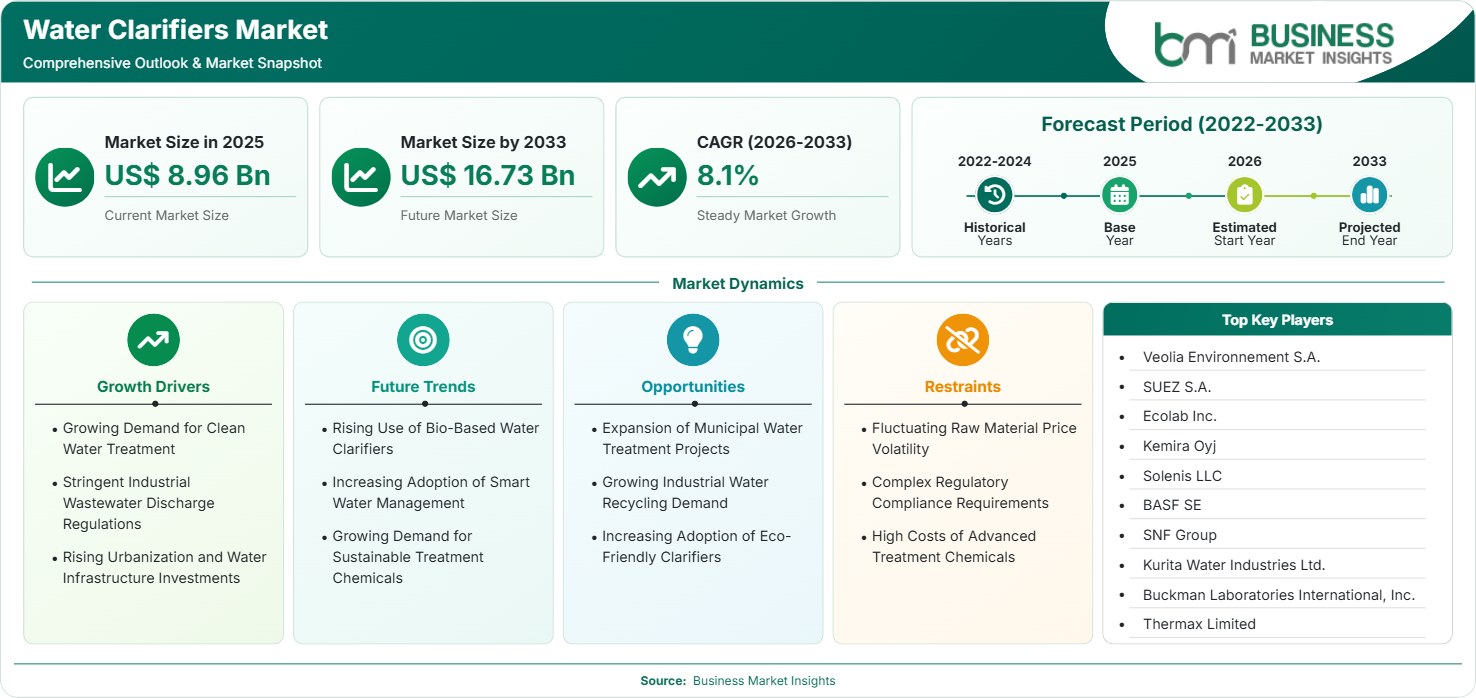
The Water Clarifiers Market size was valued at USD 8.96 Billion in 2025 and is projected to reach USD 16.73 Billion by 2033, growing at a CAGR of 8.1% during 2026–2033. Growth is supported by tightening wastewater regulations, rising municipal treatment investments, industrial recycling demand, and increasing adoption of advanced coagulation and flocculation technologies.

Report Coverage
  • Type: Flocculants, Organic Coagulants, Inorganic Coagulants, Ph Stabilizers
  • Application: Municipal, Pulp & Paper, Textiles, Petrochemicals, Metals & Mining, Others
US$ 8.96 Bn Market size in 2025
US$ 16.73 Bn Market Size by 2033
8.1% CAGR, 2026 - 2033
2026-2033 Forecast Period

AI Overview

Water Clarifiers Market Summary

  • North America Region: North America holds a market share of 34%–36% in 2025 and is projected to grow at a CAGR of 7.4%–7.8% during 2026–2033. Growth is supported by strict wastewater regulations, aging municipal infrastructure upgrades, and industrial water recycling investments. The US market accounts for 27%–29% share in 2025 and is expected to expand at a CAGR of 7.2%–7.6% through 2033.
  • Fastest Growing Region: Asia Pacific holds a market share of 29%–31% in 2025 and is projected to grow at a CAGR of 9.1%–9.6% during 2026–2033. Growth is driven by urbanization, industrial wastewater treatment demand, and expanding municipal water infrastructure.
  • Leading Segment: Municipal application holds a market share of 39%–42% in 2025 and is projected to grow at a CAGR of 8.0%–8.4% during 2026–2033. Demand is supported by government water treatment projects and public health initiatives.
  • High Growth Segment: Organic coagulants hold a market share of 22%–24% in 2025 and are projected to grow at a CAGR of 8.8%–9.2% during 2026–2033. Adoption is increasing due to eco-friendly treatment requirements and improved sludge reduction.
  • Key Market Opportunity: Expansion of municipal water treatment projects and industrial water reuse initiatives offers strong long-term opportunities for advanced clarifier chemicals and integrated treatment solutions.
  • Major Market Players: Veolia Environnement S.A., SUEZ S.A., Ecolab Inc., Kemira Oyj, Solenis LLC, BASF SE, SNF Group, Kurita Water Industries Ltd., Buckman Laboratories International, Inc., and Thermax Limited.
Strategic Insights

Water Clarifiers Market: Strategic Insights

Water Clarifiers Market Strategic Framework
FREE PDF
Request your free sample
Request free sample
Stakeholder View

Key Takeaways

  • Market structure insight: The value chain is increasingly integrated, with chemical manufacturers, equipment providers, and water treatment operators collaborating to deliver end-to-end clarification solutions.
  • Growth opportunity insight: Municipal water treatment remains the largest application, while industrial water recycling in petrochemicals, textiles, and mining offers high-growth potential.
  • Innovation trend: Development of eco-friendly organic coagulants, advanced polymer flocculants, and automated dosing systems is improving treatment efficiency and sustainability.
  • Regional opportunity: Asia Pacific presents the strongest investment case due to rapid urbanization, industrial expansion, and government spending on wastewater infrastructure.
  • Investment / M&A trend: Leading companies are expanding through partnerships, acquisitions, and capacity investments to strengthen their water treatment chemicals portfolios.
  • Strategic insight: Companies with integrated solutions combining clarifier chemicals, process monitoring, and wastewater reuse capabilities are better positioned for long-term growth.
Geographic Outlook

Water Clarifiers Market Regional Highlights

North America Water Clarifiers Market

North America accounted for 34%–36% of the Water Clarifiers Market share in 2025 and is projected to grow at a CAGR of 7.4%–7.8% during 2026–2033. Demand is supported by stringent wastewater discharge regulations, modernization of municipal treatment facilities, and rising industrial water recycling investments.

  • Stringent EPA wastewater regulations are driving upgrades in municipal and industrial treatment plants.
  • Aging water infrastructure in the US and Canada is increasing demand for clarifier chemicals and treatment systems.
  • Industrial sectors such as petrochemicals, pulp and paper, and mining are adopting advanced clarification solutions.
  • Growing focus on water reuse and sustainability is supporting long-term market expansion.

US Water Clarifiers Market

The US held 27%–29% share of the Water Clarifiers Market in 2025 and is expected to expand at a CAGR of 7.2%–7.6% through 2033. Investments in municipal wastewater treatment, industrial compliance, and water reuse programs are key growth drivers.

  • Federal infrastructure funding is accelerating upgrades of aging wastewater treatment plants.
  • Industrial wastewater discharge standards are increasing adoption of coagulants and flocculants.
  • Water scarcity concerns in several states are promoting wastewater recycling initiatives.
  • Advanced treatment technologies and digital monitoring systems are improving operational efficiency.

Europe Water Clarifiers Market

Europe represented 24%–26% of the market in 2025 and is forecast to grow at a CAGR of 7.6%–8.0% during 2026–2033. The region benefits from strong environmental regulations, industrial wastewater treatment investments, and adoption of sustainable water management practices.

  • EU water directives are driving demand for advanced wastewater clarification technologies.
  • Germany leads the regional market due to its strong industrial base and wastewater treatment standards.
  • France is a key market supported by municipal water treatment modernization projects.
  • The UK is witnessing growth in industrial water recycling and environmental compliance initiatives.
  • Eco-friendly organic coagulants are gaining traction across European treatment facilities.

Asia Pacific Water Clarifiers Market

Asia Pacific accounted for 29%–31% of the market in 2025 and is projected to grow at a CAGR of 9.1%–9.6% through 2033, making it the fastest-growing regional market. Rapid urbanization, industrialization, and government investments in water infrastructure are key growth drivers.

  • China leads the regional market with large-scale municipal and industrial wastewater treatment investments.
  • India is the fastest-growing country market due to urban water supply and sanitation programs.
  • Japan and South Korea are adopting advanced clarification chemicals for industrial water recycling.
  • Textile, petrochemical, and mining industries are major consumers of water clarifiers in the region.
  • Government initiatives for clean water access are supporting long-term market expansion.

Rest of World Water Clarifiers Market

The Rest of World region, including South & Central America and the Middle East & Africa, accounted for 9%–11% of the market in 2025 and is projected to grow at a CAGR of 8.2%–8.7% during 2026–2033.

  • Brazil leads South & Central America, supported by municipal water treatment and industrial wastewater projects.
  • Mexico is witnessing growth in water infrastructure modernization and industrial compliance initiatives.
  • Saudi Arabia and the UAE are investing heavily in desalination and wastewater reuse facilities.
  • South Africa is expanding wastewater treatment capacity to address water scarcity challenges.
  • Mining, oil and gas, and municipal sectors are driving demand for clarifier solutions across the region.
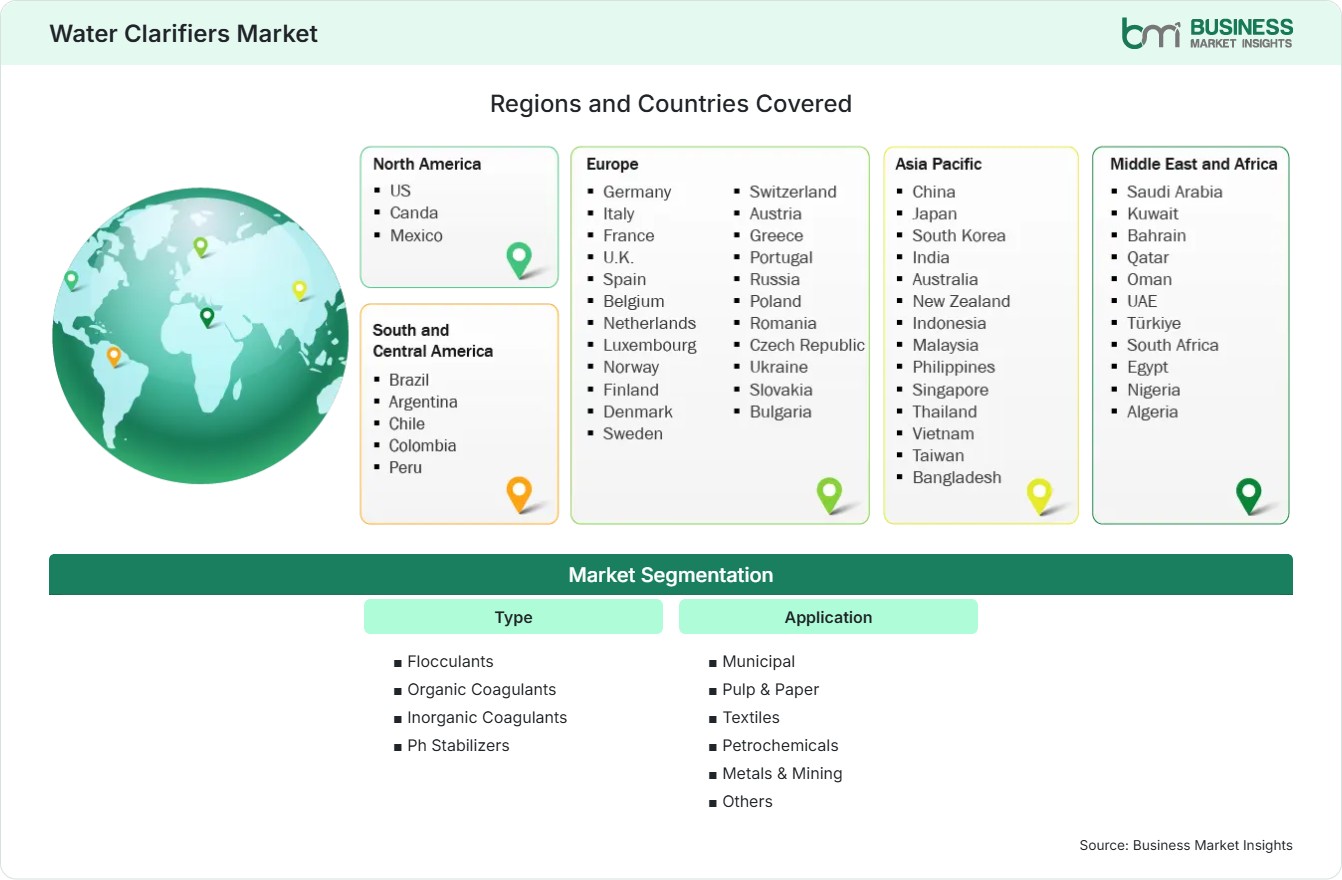
Global Market Geography
FREE PDF
Request your free sample
Request free sample
Segment Analysis

Water Clarifiers Market Segmentation

Type

The Type segment accounted for approximately 100% of the overall market and is projected to expand at a CAGR of 8.1% during 2026–2033. Product innovation is increasingly focused on improving clarification efficiency while reducing sludge generation and chemical consumption. Growing adoption across municipal and industrial treatment facilities is encouraging manufacturers to develop sustainable formulations. The Water Clarifiers Market scope continues to broaden as industries prioritize water reuse, regulatory compliance, and operational cost optimization through advanced clarification chemicals.

  • Flocculants: Widely used to aggregate suspended particles into larger flocs, improving sedimentation efficiency. Demand is rising across municipal, mining, and pulp & paper applications due to higher treatment capacity requirements.
  • Organic Coagulants: Bio-based and synthetic organic formulations are witnessing increasing adoption because they reduce sludge volume, improve treatment efficiency, and support sustainable wastewater management initiatives across industrial and municipal facilities.
  • Inorganic Coagulants: Aluminum- and iron-based coagulants remain extensively utilized owing to their cost-effectiveness, rapid clarification performance, and broad compatibility with municipal drinking water and industrial wastewater treatment operations.
  • pH Stabilizers: These chemicals maintain optimum treatment conditions by regulating acidity and alkalinity during clarification. Growing adoption is supported by increasing process automation and stringent discharge quality requirements across industries.

Application

The Application segment reflects diverse end-use demand across municipal and industrial sectors. Municipal treatment accounted for the largest Water Clarifiers Market share at 39%–42% in 2025 and is projected to register a CAGR of 8.0%–8.4% through 2033. Expanding wastewater treatment capacity, industrial recycling initiatives, and stricter environmental regulations continue to increase clarifier consumption across both developed and emerging economies, while digital dosing technologies further improve operational efficiency and treatment consistency.

  • Municipal: Government investments in drinking water treatment, sewage infrastructure modernization, and wastewater recycling continue to strengthen demand for high-performance clarification chemicals that improve sedimentation efficiency and regulatory compliance.
  • Pulp & Paper: Manufacturers increasingly deploy advanced clarifier formulations to reduce suspended solids, recover process water, minimize chemical consumption, and comply with stringent wastewater discharge regulations while improving production sustainability.
  • Textiles: Textile processing facilities rely on clarification chemicals to remove dyes, suspended solids, and organic contaminants, supporting water recycling initiatives and compliance with increasingly strict environmental discharge requirements.
  • Petrochemicals: Refining and petrochemical facilities utilize clarifiers to separate oil, suspended particles, and process contaminants, enabling wastewater reuse, lower operating costs, and enhanced environmental performance.
  • Metals & Mining: Mining operations increasingly adopt advanced clarification systems to improve tailings management, recover process water, reduce freshwater withdrawal, and meet tightening environmental compliance standards.
Market Forces

Water Clarifiers Market Dynamics

Key Market Drivers

Growing Demand for Clean Water Treatment

Increasing demand and challenges related to water availability coupled with concerns over the quality of water have been driving investments into the process of clarification of water. According to WHO statistics, billions of people around the world still lack access to adequate drinking water services, thus stimulating the efforts to upgrade the treatment facilities and provide more access to clean water. Water clarifiers are of utmost importance in terms of providing purification of the water through removal of solid particles and improved filtration processes, and thus are becoming an important part of any water treatment facility. Water Clarifiers Market growth is also driven by growing initiatives related to the reuse of water in industrial applications, and stricter regulations for drinking water quality.

Stringent Industrial Wastewater Discharge Regulations

Governments in North America, Europe, and the Asia-Pacific region have been increasingly strict about imposing industrial wastewater discharge guidelines so as to prevent environmental pollution and conserve fresh water ecosystems. The regulatory bodies mandate petrochemicals, textile industry, pulp and paper manufacturing, and the mining industry to observe stringent discharge standards concerning the amount of suspended solids, heavy metals, and chemical substances before discharge. This factor is contributing to increased demand for advanced clarification chemicals and treatment processes. The manufacturers are working on innovative formulations to enhance the effectiveness of the chemicals used for settling while using minimal dosage of the chemicals.

Rising Urbanization and Water Infrastructure Investments

Urban population explosion is leading to higher demand for drinking water and wastewater infrastructure globally. As per the UN report, around 68% of the total world population would be living in cities by 2050, putting increased burden on municipal water management systems. Huge investments are being made in building treatment plants, upgrading networks, and in wastewater treatment recycling technologies in order to fulfill the increasing demands. Such investments are fueling the demand for innovative chemicals that enhance efficiency and reliability of treatment operations. Moreover, water clarifiers market trends reveal that automation of dosing technology and monitoring of processes digitally is also gaining importance in the market to reduce consumption of chemicals.

Key Market Opportunities

Expansion of Municipal Water Treatment Projects

The construction of large-scale public infrastructure projects related to municipal drinking water and sewage treatment plants is providing substantial possibilities for manufacturers of clarification chemicals. Growing population, urbanization and aging of infrastructure systems are resulting in greater demands for plant upgrades both in developed and emerging countries. The focus on developing water infrastructure that can handle increased volumes and provide higher efficiency in terms of environment-friendliness is evident. Water Clarifiers Market Forecast indicate that companies that can offer an integrated range of chemicals and technology solutions for dosing will find it easier to capitalize on infrastructure investment programs.

Growing Industrial Water Recycling Demand

The industrial sectors are progressively incorporating closed water cycles to minimize freshwater usage and meet regulatory requirements. Industries like mining, petrochemicals, power generation, food processing, and pulp and paper are increasingly implementing water recycling programs for sustainability and cost savings. Clarification chemicals play an important role in the removal of suspended solids prior to any re-cycling and/or treatment process. The companies which will be able to provide customized products that can increase water recycling efficiency at lower cost of sludge removal will have competitive edge. Environmental consciousness and sustainability policies are going to drive the market forward.

Increasing Adoption of Eco-Friendly Clarifiers

The increasing focus on the sustainability of water treatment processes has been prompting the use of environmentally friendly clarifier formulations that have low toxicity and high biodegradability. The preference of municipal water utilities and industries for formulations that generate minimum sludge but provide maximum efficiency during the process is increasing day by day. Progress in the development of bio-polymers and innovative organic coagulants is helping in achieving this objective. R&D activities in companies are producing products having potential to enhance the efficiency of the process and also decrease their environmental impacts throughout their life cycles.

Market Restraints and Challenges

Fluctuating Raw Material Price Volatility

Factor: Prices of aluminum compounds, iron salts, specialty polymers, and other chemical feedstocks remain vulnerable to fluctuations in energy costs, supply chain disruptions, and global trade conditions. Manufacturers face increasing production cost uncertainty, limiting pricing flexibility and compressing profit margins. End users may postpone procurement or seek lower-cost alternatives during periods of elevated raw material prices. Impact: Smaller suppliers are affected because limited purchasing scale reduces their ability to absorb cost increases, creating challenges in maintaining consistent product quality, competitive pricing, and long-term supply agreements across diverse industrial markets.

Complex Regulatory Compliance Requirements

Factor: Water treatment chemicals must comply with multiple national and regional regulations governing environmental safety, chemical registration, product performance, and wastewater discharge standards. Meeting evolving compliance requirements increases research, testing, documentation, and certification expenses for manufacturers. Impact: Product development timelines may extend as regulatory approvals become more rigorous across different jurisdictions. Companies operating internationally must continuously adapt formulations and quality management systems to satisfy diverse regulatory frameworks, increasing operational complexity while raising barriers to entry for new participants in the global water clarification industry.

Company Analysis

Competitive Landscape

The Water Clarifiers Market analysis indicates that leading companies are strengthening their positions through acquisitions, capacity expansions, long-term municipal contracts, and integrated water treatment solutions. Established multinational suppliers leverage extensive distribution networks and technical expertise, while regional specialists focus on customized formulations tailored to specific industrial applications.

Company Name

Overview

Products and Services Relevant to this Market

Veolia Environnement S.A.

Global provider of water, waste, and environmental management solutions serving municipal and industrial customers.

Water clarification chemicals, wastewater treatment solutions, sludge management, process optimization, and water recycling services.

SUEZ S.A.

International environmental services company specializing in sustainable water resource management and treatment technologies.

Coagulants, flocculants, clarification systems, industrial water treatment, and municipal wastewater solutions.

Ecolab Inc.

Global leader in water, hygiene, and infection prevention technologies across industrial sectors.

Water treatment chemicals, clarification programs, digital monitoring, industrial process optimization, and wastewater management.

Kemira Oyj

Finnish chemical company focused on sustainable chemistry for water-intensive industries.

Coagulants, flocculants, polymer technologies, sludge conditioning chemicals, and municipal water treatment solutions.

Solenis LLC

Specialty chemical manufacturer serving industrial water treatment and process industries worldwide.

Water clarification chemicals, process additives, wastewater treatment solutions, and digital water management technologies.

BASF SE

Global chemical manufacturer offering specialty chemicals for industrial and municipal water treatment.

Performance polymers, coagulants, flocculants, water treatment additives, and sustainable chemical solutions.

SNF Group

Leading producer of water-soluble polymers serving municipal and industrial wastewater treatment applications.

Polyacrylamide flocculants, coagulants, sludge dewatering chemicals, and clarification solutions.

Kurita Water Industries Ltd.

Japanese water treatment specialist providing integrated chemical and engineering solutions.

Clarification chemicals, industrial water treatment, membrane support chemicals, and wastewater recycling solutions.

Buckman Laboratories International, Inc.

Specialty chemical company serving industrial water treatment and process industries globally.

Coagulants, flocculants, process optimization chemicals, wastewater treatment, and technical consulting services.

Thermax Limited

Indian engineering company providing energy and environmental solutions across industrial sectors.

Water treatment plants, clarification chemicals, wastewater recycling systems, and industrial utility solutions.

Industry Activity

Recent Developments

May 2025

Smith & Loveless Australia Pty. Ltd. announced the asset acquisition of CST Wastewater Solutions Pty. Ltd., Roseville, NSW. CST Wastewater Solutions P/L (CST Wastewater) brings decades of expertise from designing a comprehensive range of specialised wastewater screening technologies.

June, 2026: Kemira. completed the acquisition of the business and related assets of Clear Water Technologies, LLC. The transaction strengthens Kemira’s position in North America and supports its growth in industrial water treatment services.

October, 2024: AUC Group announced the acquisition of key assets of WAWCON, Inc. This strategic acquisition strengthens AUC’s design expertise and broadens the company’s capacity to meet the increasing demand for larger, customized water and wastewater treatment plants, supporting the expansion of its Water-as-a-Service solutions.

February, 2024: Kemira expands its renewable products portfolio by launching two new ISCC PLUS certified biomass balanced polymers for the papermaking industry, wet strength resins and polyamines.

Trust & Transparency

Research Methodology

The market analysis combines proprietary research with secondary data from government agencies, company disclosures, regulatory filings, industry databases and expert interviews. Market estimates are validated through data triangulation, cross-market benchmarking and analyst review.

View Full Research Methodology

Questions Answered

Frequently Asked Questions

What does the Market Report cover?

The Water Clarifiers Market Report provides detailed analysis of market size, growth drivers, segmentation, regional outlook, competitive landscape, emerging opportunities, recent developments, and strategic insights supporting business planning and investment decisions through 2033.

Which companies are leading the competitive landscape?

Leading participants include Veolia Environnement S.A., SUEZ S.A., Ecolab Inc., Kemira Oyj, Solenis LLC, BASF SE, SNF Group, Kurita Water Industries Ltd., Buckman Laboratories International, Inc., and Thermax Limited, all investing in sustainable treatment technologies and product innovation.

Which region offers the highest growth potential?

Asia Pacific is expected to register the fastest growth owing to rapid industrialization, expanding urban populations, government investments in water infrastructure, and increasing adoption of industrial wastewater recycling across major manufacturing economies.

Which application segment accounts for the largest market share?

Municipal water treatment remains the leading application due to continuous investments in drinking water infrastructure, wastewater treatment upgrades, population growth, and stricter public health and environmental standards worldwide.

What factors are driving demand for water clarifiers?

Demand is primarily driven by stricter wastewater discharge regulations, increasing municipal water treatment investments, industrial water recycling initiatives, growing freshwater scarcity, and the adoption of sustainable clarification technologies that improve treatment efficiency while reducing sludge generation.

Access the Full Water Clarifiers Market Report

Get segment-level forecasts, regional estimates, competitive benchmarking, company profiles and downloadable Excel datasets.

Access the full Water Clarifiers Market Report
350 pages PDF & Excel | 2026-08-03
Similar Research

Related Market Reports