
Nanocomposites Market Outlook: Size, Share, Trends, Growth Analysis, Competitive Landscape & Forecast, 2026-2033

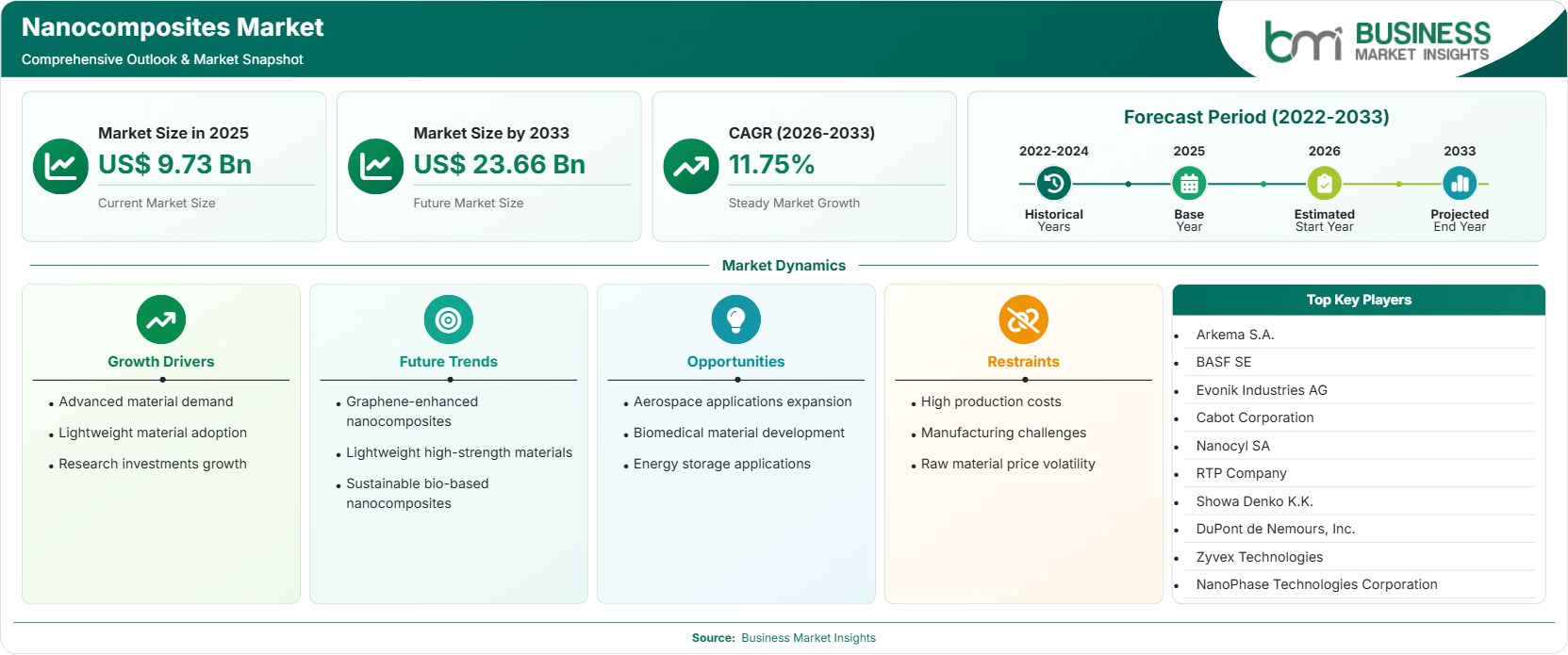
The Nanocomposites Market size was valued at US$ 9.73 billion in 2025 and is projected to reach US$ 23.66 billion by 2033, growing at a CAGR of 11.75% during 2026–2033. Increasing demand for high-performance materials, lightweight solutions, advanced manufacturing technologies, and investments in nanotechnology research are accelerating adoption across automotive, aerospace, electronics, packaging, energy, and biomedical applications.

Report Coverage
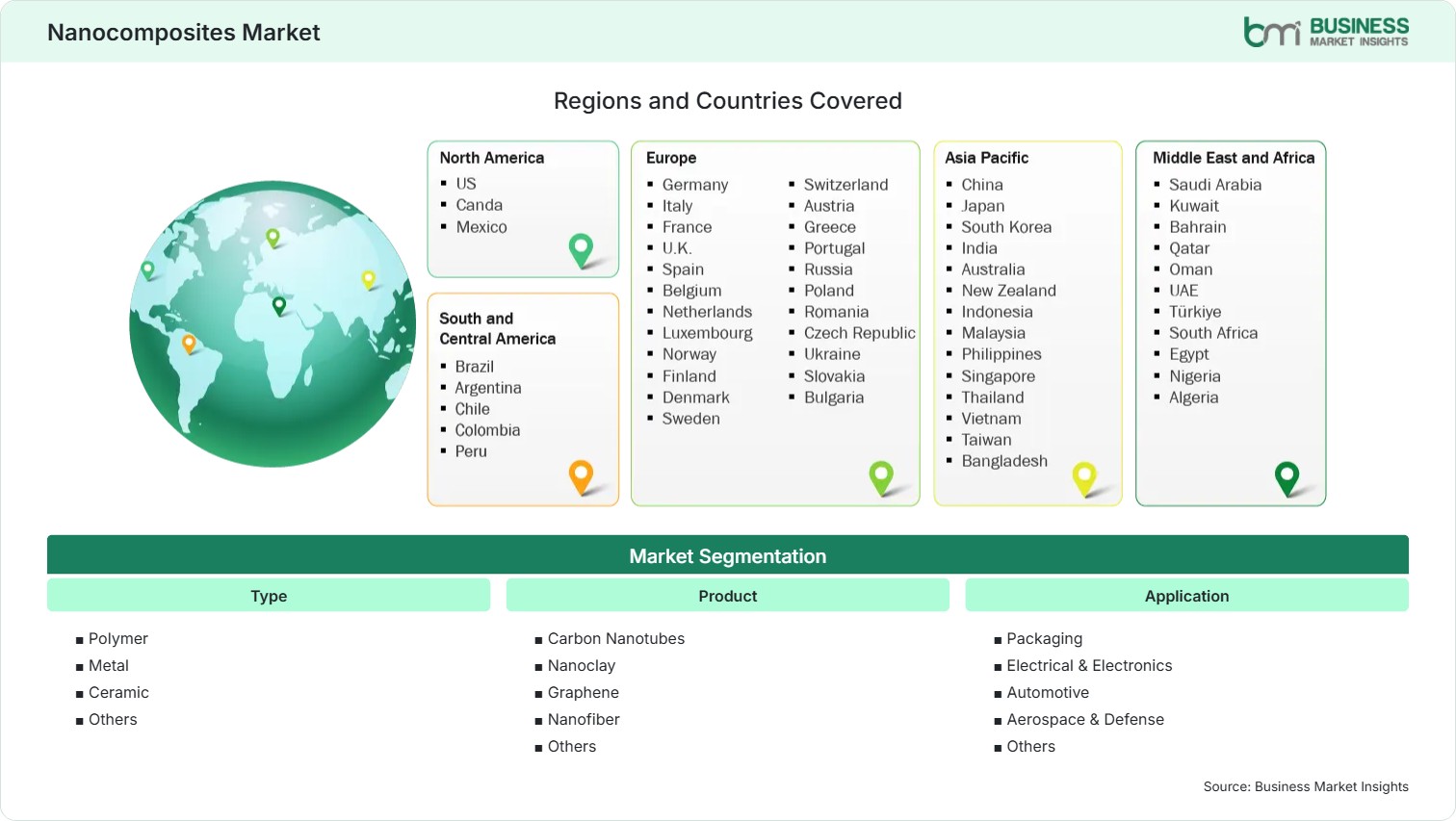
  • Type: Polymer, Metal, Ceramic, Others
  • Product: Carbon Nanotubes, Nanoclay, Graphene, Nanofiber, Others
  • Application: Packaging, Electrical & Electronics, Automotive, Aerospace & Defense, Others
US$ 9.73 Bn Market size in 2025
US$ 23.66 Bn Market Size by 2033
11.75% CAGR, 2026 - 2033
2026-2033 Forecast Period

01 AI Overview

Nanocomposites Market Summary

  • North America Region: North America accounts for approximately 33%–36% market share in 2025 and is projected to grow at a CAGR of 11.2%–11.7% during 2026–2033. The region benefits from strong nanotechnology research capabilities, aerospace innovation, advanced manufacturing infrastructure, and increasing demand for lightweight composite materials. The United States represents the leading contributor due to defense applications, automotive material innovation, and extensive research investments, with an estimated 11.3%–11.8% CAGR through 2033.
  • Fastest Growing Region: Asia Pacific represents nearly 36%–39% market share in 2025 and is expected to expand at a CAGR of 12.3%–12.8% during 2026–2033. Growth is driven by expanding manufacturing industries, electric vehicle production, electronics demand, government-supported nanotechnology programs, and increasing investments in advanced materials across China, Japan, South Korea, and India.
  • Leading Segment: Polymer nanocomposites account for approximately 58%–62% market share in 2025 and are forecast to grow at a CAGR of 11.6%–12.0% during 2026–2033. Demand is supported by lightweight automotive components, improved mechanical performance, packaging innovations, and enhanced material durability across industrial applications.
  • High Growth Segment: Graphene-based nanocomposites represent approximately 14%–17% market share in 2025 and are projected to expand at a CAGR of 13.0%–13.6% during the forecast period. Superior electrical conductivity, mechanical strength, thermal properties, and potential applications in electronics and energy storage are driving commercialization.
  • Key Market Opportunity: Growing integration of nanocomposite materials in aerospace structures, biomedical devices, next-generation batteries, and advanced electronic components is creating significant opportunities for material developers and manufacturers investing in high-performance solutions.
  • Major Market Players: Arkema S.A., BASF SE, Evonik Industries AG, Cabot Corporation, Nanocyl SA, RTP Company, Showa Denko K.K., DuPont de Nemours, Inc., Zyvex Technologies, and NanoPhase Technologies Corporation.
02 Strategic Insights

Nanocomposites Market: Strategic Insights

nanocomposites-market-market-strategic-framework
FREE PDF
Request your free sample
Request free sample
03 Stakeholder View

Key Takeaways

  • The market ecosystem is evolving through collaboration between nanomaterial producers, polymer manufacturers, research institutions, and end-user industries seeking improved performance characteristics and sustainable material alternatives.
  • Automotive, aerospace, and electronics industries provide strong growth opportunities as manufacturers increasingly replace conventional materials with lightweight nanocomposites offering enhanced strength, durability, and functional properties.
  • Technology development is shifting toward graphene-based materials, carbon nanotube integration, advanced polymer formulations, and scalable manufacturing processes that improve material performance while reducing production complexity.
  • Asia Pacific presents significant investment opportunities due to expanding manufacturing capacity, electric vehicle production, electronics development, and increasing government support for nanotechnology research programs.
  • Strategic partnerships, research collaborations, technology licensing, and investments in nanomaterial production facilities are shaping competitive positioning as companies pursue commercialization of advanced material applications.
  • Energy storage, biomedical technologies, and aerospace applications are emerging as important demand areas, expanding nanocomposite adoption beyond traditional industrial uses and creating new revenue opportunities.
04 Geographic Outlook

Nanocomposites Market Regional Highlights

North America Nanocomposites Market

North America accounted for approximately 33%–36% of the global market in 2025 and is projected to expand at a CAGR of 11.2%–11.7% through 2033. The Nanocomposites Market share in the region is supported by advanced material research, aerospace manufacturing, defense modernization, electric vehicle development, and strong academic-industry collaborations. The United States remains the dominant contributor due to extensive nanotechnology investments, established composite manufacturing capabilities, and increasing demand for lightweight high-performance materials.

  • Aerospace manufacturers are increasing adoption of nanocomposite materials to reduce structural weight, improve fuel efficiency, and enhance durability across commercial and defense aircraft platforms.
  • Automotive companies are integrating lightweight nanocomposites into vehicle components to improve performance, reduce emissions, and support the transition toward electric mobility.
  • Government-funded nanotechnology research programs are accelerating development of advanced materials for energy storage, electronics, healthcare, and industrial applications.
  • Strong semiconductor and electronics industries are creating demand for nanocomposites with improved thermal management, conductivity, and miniaturization capabilities.
  • Collaboration between universities, research organizations, and manufacturers supports commercialization of innovative nanocomposite formulations and scalable production technologies.

US Nanocomposites Market

The United States represented approximately 28%–31% of global revenue in 2025 and is expected to grow at a CAGR of 11.3%–11.8% during 2026–2033. The country maintains a strong position due to advanced research infrastructure, defense applications, aerospace innovation, and increasing adoption of lightweight materials across industrial sectors. Investments in electric vehicles, renewable energy technologies, and advanced manufacturing continue supporting market expansion.

  • Defense and aerospace programs are increasing demand for high-strength nanocomposites that improve structural performance while reducing component weight.
  • Automotive manufacturers are adopting nanocomposite materials for interior components, structural parts, battery systems, and lightweight vehicle designs.
  • Research institutions and material companies are expanding nanotechnology development programs focused on graphene, carbon nanotubes, and advanced polymer composites.
  • Industrial manufacturers are investing in advanced materials to improve product durability, thermal performance, and operational efficiency.

Europe Nanocomposites Market

Europe held approximately 24%–27% market share in 2025 and is projected to register a CAGR of 10.8%–11.3% through 2033. Regional demand is supported by automotive innovation, aerospace manufacturing, sustainability initiatives, and advanced material research. Germany leads regional adoption, while France and the Netherlands demonstrate strong growth due to aerospace capabilities, industrial technology development, and nanotechnology research programs.

  • Automotive manufacturers are increasingly adopting nanocomposites to develop lightweight vehicles that improve fuel efficiency and support electrification goals.
  • Aerospace companies are investing in advanced composite materials to enhance aircraft performance, reduce weight, and improve structural reliability.
  • European research programs are supporting nanomaterial innovation through collaborations between universities, technology companies, and industrial users.
  • Sustainable packaging initiatives are increasing interest in nanocomposites that improve barrier properties and material performance.
  • Industrial manufacturers are exploring nanocomposite solutions for improved durability, corrosion resistance, and energy efficiency.

Asia Pacific Nanocomposites Market

Asia Pacific accounted for approximately 36%–39% of global market share in 2025 and is expected to achieve the fastest growth with a CAGR of 12.3%–12.8% between 2026 and 2033. The region benefits from large manufacturing bases, expanding electronics production, electric vehicle adoption, and increasing investments in nanotechnology research. China represents the largest market, while India and South Korea demonstrate strong growth potential due to industrial expansion and advanced material initiatives.

  • Electronics manufacturers are increasing adoption of nanocomposites for semiconductor packaging, thermal management, displays, and miniaturized electronic components.
  • Electric vehicle production growth is creating demand for lightweight structural materials, battery components, and high-performance composite solutions.
  • Government initiatives in China, Japan, South Korea, and India are supporting nanotechnology research and domestic advanced material development.
  • Packaging industries are adopting nanocomposite materials to improve barrier properties, durability, and product shelf life.
  • Expanding aerospace manufacturing capabilities are increasing demand for lightweight materials with enhanced mechanical and thermal performance.

Rest of World Nanocomposites Market

The Rest of World region accounted for approximately 6%–9% market share in 2025 and is forecast to expand at a CAGR of 10.9%–11.5% through 2033. South America, the Middle East, and Africa are gradually adopting nanocomposite technologies through industrial modernization, infrastructure development, aerospace initiatives, and energy sector investments. Growing demand for advanced materials is creating opportunities across automotive, construction, packaging, and industrial applications.

South America is benefiting from automotive production and industrial development, while Middle Eastern economies are investing in advanced manufacturing, energy technologies, and aerospace-related materials. Africa is witnessing emerging opportunities through industrial growth and research initiatives.

  • Brazil represents a key regional market due to automotive manufacturing, industrial applications, and increasing interest in advanced materials.
  • Middle Eastern countries are exploring nanocomposites for aerospace, energy, construction, and high-performance industrial applications.
  • African markets are gradually adopting advanced materials through infrastructure development, manufacturing growth, and technology partnerships.
  • Increasing investment in renewable energy projects is creating demand for advanced materials with improved durability and performance.
  • International collaborations are improving access to nanotechnology expertise and supporting regional commercialization of advanced composite solutions.
global-market-geography
FREE PDF
Request your free sample
Request free sample
05 Segment Analysis

Nanocomposites Market Segmentation

Type

The Type segment represents the fundamental material categories used in nanocomposite production, including polymer, metal, ceramic, and other specialized formulations. The segment accounted for approximately 100% of market revenue in 2025 and is projected to grow at a CAGR of 11.4%–11.9% during 2026–2033. Increasing demand for lightweight structures, enhanced mechanical performance, electrical conductivity, and thermal stability is encouraging industries to adopt customized nanocomposite materials across automotive, aerospace, electronics, and industrial applications.

  • Polymer: Polymer nanocomposites dominate adoption due to lightweight characteristics, improved mechanical strength, enhanced barrier properties, and compatibility with automotive, packaging, electronics, and consumer product applications.
  • Metal: Metal nanocomposites are gaining attention for superior electrical conductivity, strength enhancement, thermal performance, and applications requiring improved durability in aerospace, electronics, and industrial components.
  • Ceramic: Ceramic nanocomposites provide high-temperature resistance, hardness, chemical stability, and wear resistance, supporting applications in aerospace, healthcare, energy, and specialized industrial environments.
  • Others: Other nanocomposite types include hybrid materials and specialized formulations designed for niche applications requiring customized performance, multifunctionality, and advanced material characteristics.

Product

The Product segment covers various nanomaterial reinforcements used to improve composite performance across multiple industries. The segment accounted for approximately 100% of market revenue in 2025 and is expected to expand at a CAGR of 11.6%–12.1% through 2033. Increasing research activity, commercialization of advanced nanomaterials, and demand for enhanced electrical, mechanical, and thermal properties are driving adoption. The Nanocomposites Market scope continues expanding as manufacturers develop application-specific materials for high-value industries.

  • Carbon Nanotubes: Carbon nanotube-based nanocomposites provide exceptional strength, electrical conductivity, and thermal properties, supporting applications in electronics, energy storage, aerospace structures, and advanced industrial materials.
  • Nanoclay: Nanoclay materials improve barrier properties, mechanical strength, flame resistance, and durability, making them valuable for packaging, automotive components, coatings, and polymer-based applications.
  • Graphene: Graphene-based nanocomposites offer outstanding conductivity, lightweight characteristics, mechanical strength, and thermal performance, supporting emerging applications in batteries, electronics, sensors, and advanced materials.
  • Nanofiber: Nanofiber-based composites provide high surface area, reinforcement capability, and filtration performance, supporting applications in healthcare, energy systems, protective materials, and industrial technologies.
  • Others: Other nanocomposite products include specialized nanomaterials developed for customized applications requiring improved functionality, enhanced performance, and application-specific material properties.

Application

The Application segment includes packaging, electrical and electronics, automotive, aerospace and defense, and other industrial uses where enhanced material properties provide competitive advantages. The segment accounted for approximately 100% of market revenue in 2025 and is forecast to grow at a CAGR of 11.7%–12.2% during 2026–2033. Rising demand for lightweight, durable, conductive, and multifunctional materials is increasing adoption across advanced manufacturing sectors.

  • Packaging: Packaging applications are expanding through demand for improved barrier properties, durability, lightweight structures, and extended product protection across food, pharmaceutical, and consumer goods industries.
  • Electrical & Electronics: Electronics industries utilize nanocomposites for thermal management, conductive materials, semiconductor components, sensors, and miniaturized devices requiring improved performance and reliability.
  • Automotive: Automotive manufacturers are adopting nanocomposites for lightweight components, battery-related applications, improved fuel efficiency, enhanced durability, and electric vehicle development.
  • Aerospace & Defense: Aerospace and defense sectors use nanocomposites for high-strength lightweight structures, thermal protection systems, advanced coatings, and components requiring superior performance under demanding conditions.
  • Others: Other applications include healthcare, energy, construction, coatings, and industrial products where nanocomposites provide improved strength, functionality, and resistance characteristics.
06 Market Forces

Nanocomposites Market Dynamics

Key Market Drivers

Growing demand for advanced high-performance materials

The increasing need for materials with superior mechanical strength, thermal stability, electrical conductivity, and lightweight characteristics is accelerating adoption of nanocomposites across multiple industries. Automotive, aerospace, electronics, packaging, and energy sectors are replacing conventional materials with advanced composite solutions to improve performance and efficiency. The Nanocomposites Market growth is driven by the increasing need for robust materials that will drive product innovation and decrease total system weight. Companies are focusing on developing better dispersal processes for nanomaterials, large-scale production processes, and customized products for various applications as per industrial demands. Innovations in carbon nanotubes, graphene, and polymeric nanocomposites are contributing towards commercialization and engineering materials.

Increasing adoption of lightweight materials across industries

The shift toward lightweight materials is becoming a major factor influencing material selection in transportation, electronics, and industrial manufacturing. Nanocomposites provide improved strength-to-weight ratios compared with traditional materials, enabling manufacturers to reduce component weight while maintaining durability and functionality. The automotive industry is using nanocomposite components to increase fuel efficiency and for the development of electric vehicles, while the aviation industry uses nanocomposites to enhance the performance of its airplanes. Energy efficiency and sustainability are the major driving forces pushing various industries towards the use of new materials which provide superior performance with lower consumption of resources. This trend is strengthening demand for innovative nanocomposite solutions across high-value applications, supporting the Nanocomposites Market Forecasts.

Rising research investments and nanotechnology development

Growing funding for studies related to nanotechnology, material science, and industrial innovation is making nanocomposites faster to be commercialized. New nanocomposite formulations are being designed by universities, government organizations, and corporations. The Nanocomposites Market trends indicate increasing collaboration between research organizations and manufacturers to overcome production limitations and expand commercial adoption.

Key Market Opportunities

Expansion of aerospace and defense material applications

The aerospace and defense sectors present significant opportunities for nanocomposite manufacturers due to increasing demand for lightweight, high-strength, and durable materials. The manufacturers of aircrafts and defense companies have shown interest in developing advanced material which will offer better fuel efficiency, better structural performance, and ability to withstand harsh environmental conditions. Nanocomposites offer improved mechanical strength, thermal stability, and anti-corrosion properties over the conventional composites.

Development of biomedical and healthcare nanocomposite materials

Biomedical applications are emerging as an important opportunity area as researchers explore nanocomposites for implants, drug delivery systems, medical devices, tissue engineering, and diagnostic technologies. Advanced nanomaterials can provide improved biocompatibility, mechanical strength, antimicrobial properties, and controlled functionality for healthcare applications. Increasing healthcare innovation, aging populations, and demand for advanced medical solutions are supporting research into nanocomposite-based technologies. Material developers are focusing on creating safe, reliable, and scalable biomedical solutions that meet regulatory requirements.

Increasing demand for energy storage applications

The growing transition toward renewable energy and electric mobility is creating opportunities for nanocomposites in batteries, supercapacitors, and energy storage systems. Nanocomposite materials can improve electrode performance, energy density, charging efficiency, and durability in advanced storage technologies. Rising electric vehicle production and renewable energy integration are increasing demand for materials that support efficient energy management.

Market Restraints and Challenges

High production costs limiting commercial scalability

Factor: Nanocomposite manufacturing often requires expensive nanomaterials, specialized processing equipment, advanced quality control systems, and complex production techniques.

Impact: High production costs can restrict widespread adoption, particularly among small and medium-sized manufacturers seeking cost-effective material alternatives. The expense associated with producing high-quality graphene, carbon nanotubes, and other nanomaterials affects overall product pricing and limits competitiveness against conventional materials.

Manufacturing complexity and material integration challenges

Factor: Nanocomposite production requires precise control over nanoparticle dispersion, compatibility between materials, processing conditions, and consistent quality standards.

Impact: Manufacturing challenges can affect product reliability, increase development timelines, and create difficulties in achieving large-scale production consistency. Poor dispersion of nanomaterials may reduce expected performance improvements and create quality variations across applications.

07 Company Analysis

Competitive Landscape

The competitive environment includes global chemical companies, nanomaterial specialists, advanced composite manufacturers, and technology developers focusing on material innovation, production scalability, and application-specific solutions. The Nanocomposites Market analysis indicates that companies are strengthening capabilities through research collaborations, expanded nanomaterial production capacity, strategic partnerships, and development of customized solutions for automotive, aerospace, electronics, energy storage, and industrial applications.

Company Name

Overview

Products and Services relevant to this market

Arkema S.A.

Global specialty materials company developing advanced polymers and high-performance material solutions.

Carbon nanotubes, advanced polymer materials, composite solutions, specialty additives, and lightweight material technologies.

BASF SE

Chemical industry leader providing innovative materials for automotive, industrial, and consumer applications.

Polymer nanocomposites, engineered plastics, functional materials, additives, and advanced composite solutions.

Evonik Industries AG

Specialty chemicals company focused on high-performance materials and nanotechnology-enabled solutions.

Nanomaterials, specialty polymers, additives, composite technologies, and advanced material formulations.

Cabot Corporation

Global specialty chemicals company specializing in carbon-based materials and performance additives.

Carbon nanotubes, conductive additives, nanomaterials, reinforcing agents, and composite enhancement solutions.

Nanocyl SA

Nanotechnology company focused on carbon nanotube manufacturing and composite material applications.

Multiwall carbon nanotubes, conductive compounds, polymer nanocomposites, and advanced material solutions.

RTP Company

Custom compounder producing engineered thermoplastics and specialty composite materials.

Conductive compounds, reinforced polymers, nanocomposite materials, and customized thermoplastic solutions.

Showa Denko K.K.

Japanese chemical manufacturer providing advanced carbon materials and industrial solutions.

Carbon materials, conductive additives, specialty chemicals, and composite-related technologies.

DuPont de Nemours, Inc.

Global science and technology company developing advanced material solutions for industrial applications.

High-performance polymers, composite materials, specialty materials, and engineering solutions.

Zyvex Technologies

Advanced materials company specializing in nanotechnology-enabled composite enhancements.

Nanocomposite technologies, carbon nanotube solutions, advanced materials, and lightweight composite systems.

NanoPhase Technologies Corporation

Nanomaterials company developing specialized nanoparticle technologies for industrial applications.

Nanomaterials, functional nanoparticles, coating technologies, and advanced composite material solutions.

08 Industry Activity

Recent Developments

June 2026

NAWAH opened its first North American vertically aligned carbon nanotube (VACNT) manufacturing facility in Englewood, Ohio. The $10 million, 38,000-square-foot plant will produce NAWAH-Stitch Film for composite applications in aerospace, defense, and sports equipment, with full commercial production capacity of 400,000 square meters/year expected by summer 2026.

June 2026

Bioneer announced it will showcase CNT-metal nanocomposite powders, magnetic nanoparticles, and AccuPaste CNT heating paste at NANO KOREA 2026 (July 8-10). The CNT-metal nanocomposite utilizes KAIST-licensed source technology to achieve uniform carbon nanotube dispersion within metal powders and can synthesize composites with cobalt, copper, nickel, titanium, and silver at customer-specified ratios.

April 2026

National Institute of Technology (NIT) Rourkela developed an advanced aluminum-based hybrid nanocomposite for aircraft landing gear applications, incorporating carbon nanotubes, graphite nanoplatelets, and hexagonal boron nitride. The material, produced via spark plasma sintering, offers 40–60% cost-effectiveness improvement compared to ultra-high-strength steels and conventional aluminium alloys, with a patent already filed for the technology.

January 2026

Skoltech (Skolkovo Institute of Science and Technology) patented a new non-invasive material monitoring technique using aligned fiber-like structures of single-walled carbon nanotubes for polymer composites and nanocomposites. The technology enables "smart" parts with built-in self-diagnosis capability to detect material changes during manufacturing and deformation or damage during application, without requiring external sensors.

10 Trust & Transparency

Research Methodology

The market analysis combines proprietary research with secondary data from government agencies, company disclosures, regulatory filings, industry databases and expert interviews. Market estimates are validated through data triangulation, cross-market benchmarking and analyst review.

View Full Research Methodology

11 Questions Answered

Frequently Asked Questions

What challenges affect the wider adoption of nanocomposites?

The Nanocomposites Market report highlights challenges affecting the market, including High production costs, manufacturing complexity, limited scalability, material integration challenges, and the need for standardized processing methods, which continue to influence adoption across commercial applications.

How are electric vehicles influencing demand?

Electric vehicle development is increasing demand for lightweight structural materials, improved battery components, and advanced thermal management solutions where nanocomposites can enhance performance and efficiency.

Why are graphene-based nanocomposites gaining attention?

Graphene-based nanocomposites are gaining attention because of their exceptional electrical conductivity, mechanical strength, thermal properties, and potential applications in electronics, energy storage, sensors, and advanced manufacturing.

Which type of nanocomposite dominates market adoption?

Polymer nanocomposites represent the leading type due to their lightweight characteristics, cost advantages, processing flexibility, and extensive use in automotive components, packaging materials, and industrial applications.

What is driving the growth of the Nanocomposites Market?

Growth is driven by increasing demand for lightweight materials, advanced engineering solutions, improved material performance, rising research investments, and expanding applications across automotive, aerospace, electronics, packaging, and energy sectors.

Access the Full Nanocomposites Market Report

Get segment-level forecasts, regional estimates, competitive benchmarking, company profiles and downloadable Excel datasets.

Access the full Nanocomposites Market Report
350 pages PDF & Excel | 2026-07-29