
Insecticides Market Outlook: Size, Share, Trends, Growth Analysis, Competitive Landscape & Forecast, 2026-2033

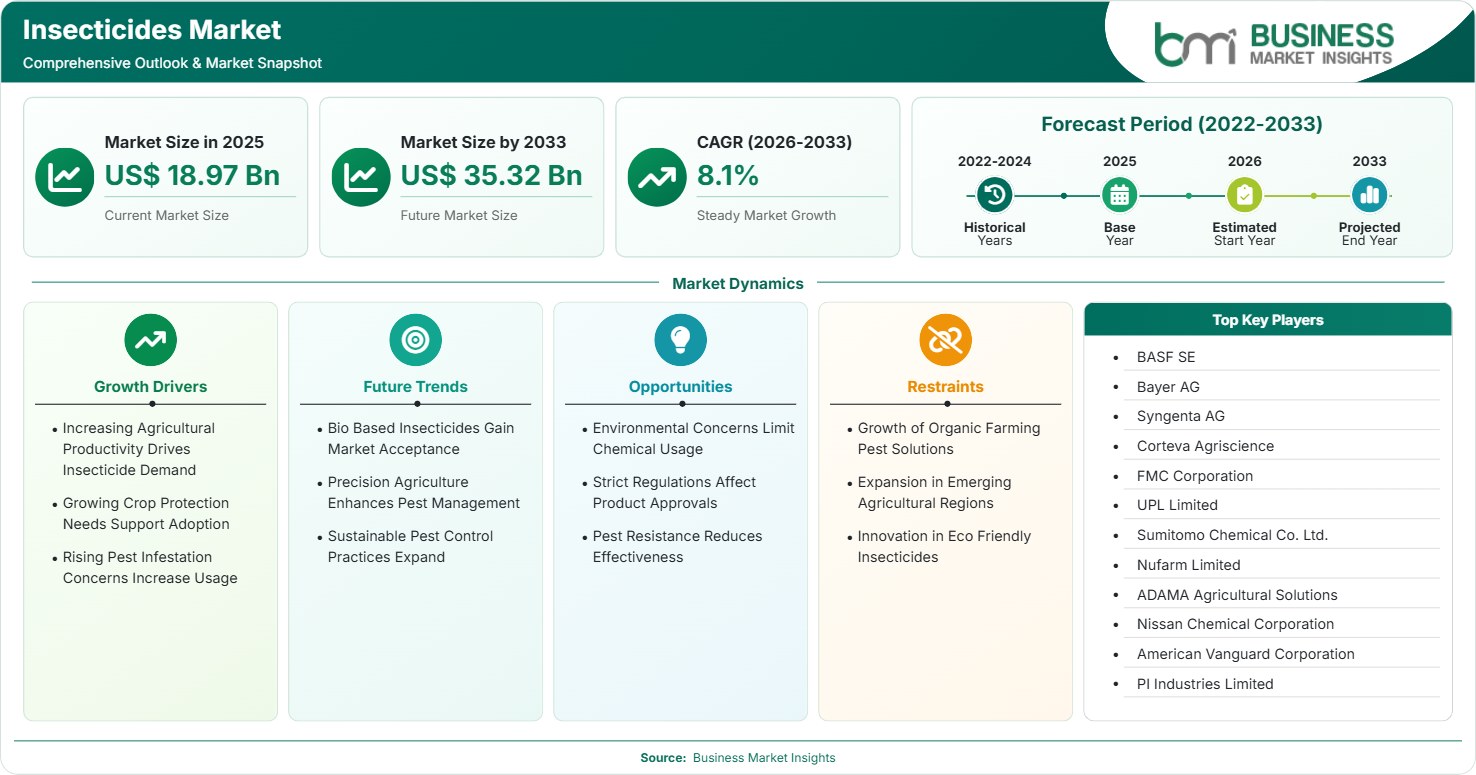
The Insecticides Market size was valued at US$ 18.97 billion in 2025 and is projected to reach US$ 35.32 billion by 2033, growing at a CAGR of 8.1% during 2026–2033, driven by increasing crop protection requirements, rising pest resistance, agricultural productivity enhancement, integrated pest management adoption, and expansion of sustainable biological solutions.

Report Coverage
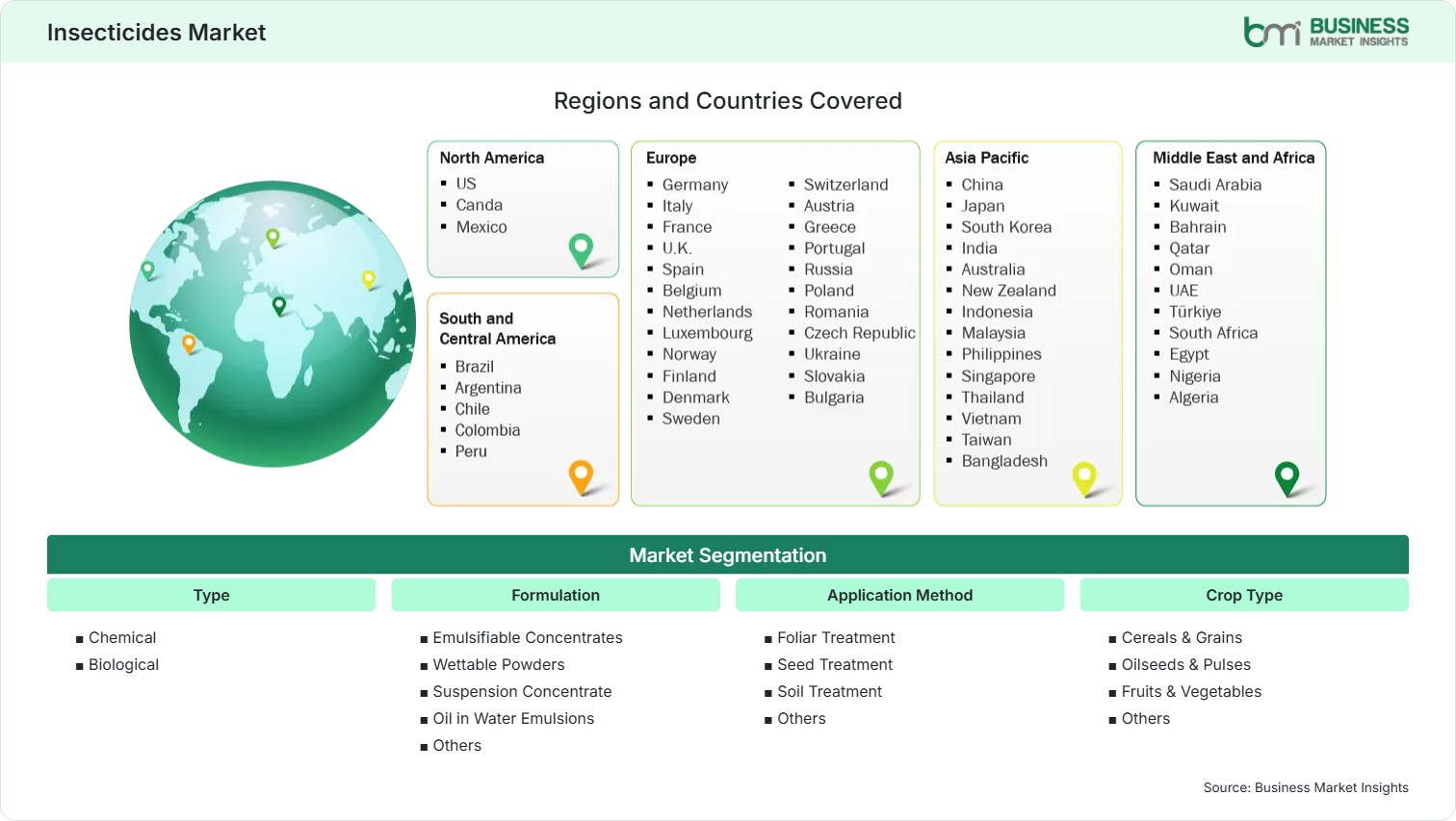
  • Type: Chemical, Biological
  • Formulation: Emulsifiable Concentrates (EC), Wettable Powders (WP), Suspension Concentrate (SC), Oil in Water Emulsions (EW), Others
  • Application Method: Foliar Treatment, Seed Treatment, Soil Treatment, Others
  • Crop Type: Cereals & Grains, Oilseeds & Pulses, Fruits & Vegetables, Others
US$ 18.97 Bn Market size in 2025
US$ 35.32 Bn Market Size by 2033
8.1% CAGR, 2026 - 2033
2026-2033 Forecast Period

01 AI Overview

Insecticides Market Summary

  • North America Region: North America holds a market share of 22%–25% in 2025 and is projected to expand at a CAGR of 7.4%–8.1% during 2026–2033, supported by advanced agricultural practices, precision farming adoption, regulatory-approved crop protection solutions, and demand for high-value crop protection. The United States leads regional demand with a CAGR of 7.6%–8.3% due to large-scale commercial farming.
  • Fastest Growing Region: Asia Pacific accounts for 38%–41% of the global market in 2025 and is expected to grow at a CAGR of 8.8%–9.6% during 2026–2033, driven by increasing food production requirements, expanding agricultural land productivity initiatives, rising farmer awareness, and adoption of modern pest management practices.
  • Leading Segment: Chemical insecticides hold a market share of 78%–81% in 2025 and are projected to register a CAGR of 7.5%–8.2% during 2026–2033, supported by broad-spectrum effectiveness, established distribution networks, rapid pest control performance, and extensive agricultural application.
  • High Growth Segment: Biological insecticides represent 19%–22% of market demand in 2025 and are anticipated to expand at a CAGR of 10.5%–11.5% during 2026–2033, supported by sustainable agriculture practices, regulatory support, reduced chemical residue concerns, and increasing demand for environmentally friendly crop protection.
  • Key Market Opportunity: Rising adoption of precision agriculture, expansion of biological crop protection solutions, increasing demand for residue-free food production, and development of advanced insecticide formulations create opportunities for manufacturers across global agricultural markets.
  • Major Market Players: BASF SE; Bayer AG; Syngenta AG; Corteva Agriscience Inc.; FMC Corporation; UPL Limited; Sumitomo Chemical Co., Ltd.; Nufarm Limited; ADAMA Agricultural Solutions Ltd.; Nissan Chemical Corporation; American Vanguard Corporation; PI Industries Limited; Gharda Chemicals Limited; Arysta LifeScience Corporation; Dhanuka Agritech Limited.
02 Strategic Insights

Insecticides Market: Strategic Insights

Insecticides Market Strategic Framework
FREE PDF
Request your free sample
Request free sample
03 Stakeholder View

Key Takeaways

  • The insecticide value chain integrates active ingredient manufacturers, formulation developers, agricultural distributors, farmers, research organizations, and regulatory bodies supporting global crop protection systems.
  • Biological insecticides and advanced formulations provide significant growth opportunities as farmers increasingly seek sustainable pest control methods with lower environmental impact and improved crop safety.
  • Innovation is shifting toward precision application technologies, microbial insecticides, targeted delivery systems, and resistance management solutions to improve treatment efficiency.
  • Asia Pacific presents strong investment potential due to expanding agricultural production, food security initiatives, rising farmer awareness, and increasing adoption of modern farming practices.
  • Leading companies are strengthening market positions through product launches, strategic collaborations, regional expansion, and investments in sustainable crop protection technologies.
  • Increasing regulatory focus on chemical safety and environmental sustainability is encouraging manufacturers to develop safer, more efficient, and biologically based insecticide alternatives.
04 Geographic Outlook

Insecticides Market Regional Highlights

North America Insecticides Market

North America represents 22%-25% of the Insecticides Market share in 2025 and is growing at CAGR of 7.4%-8.1% during 2026-2033. The regional demand is driven by advanced farming techniques, higher productivity needs, usage of precision agriculture and robust presence of key players operating in crop protection industry.

  • The United States remains the largest contributor due to extensive commercial farming, advanced crop protection practices, and strong agricultural technology adoption.
  • Farmers are increasingly adopting integrated pest management programs combining chemical and biological insecticide solutions for improved efficiency.
  • Precision agriculture technologies are improving insecticide application accuracy, reducing input waste, and supporting sustainable farming practices.
  • Regulatory emphasis on safer agricultural chemicals is encouraging manufacturers to develop innovative formulations with improved environmental profiles.
  • Canada continues adopting advanced crop protection solutions for cereals, oilseeds, and specialty agricultural production.

US Insecticides Market

The United States represents the largest North American Insecticides market, accounting for 18%–20% of global revenue in 2025 while growing at a CAGR of 7.6%–8.3% during 2026–2033. Strong agricultural infrastructure, extensive row crop production, and increasing adoption of precision farming technologies continue supporting insecticide demand across commercial farming operations.

  • Large-scale cultivation of corn, soybean, cotton, and specialty crops supports consistent demand for insecticide applications.
  • Farmers are adopting digital agriculture tools to optimize pest monitoring and improve treatment effectiveness.
  • Biological insecticides are gaining attention as growers seek sustainable alternatives and resistance management solutions.
  • Crop protection companies continue introducing advanced formulations designed for targeted pest control and improved application efficiency.

Europe Insecticides Market

Europe accounts for 19% to 22% of worldwide revenues by 2025, recording a CAGR of 6.9% to 7.7% from 2026 through 2033. The development of the Insecticides Market is affected by factors like sustainable agriculture practices, stringent chemical regulations, integrated pest management, and biological solutions. Germany and France hold prominent positions in the market, whereas Spain is the fastest-growing country.

  • Germany leads regional demand through advanced farming practices, crop protection innovation, and strong agricultural research capabilities.
  • Spain records faster growth with a CAGR of 8.0%–8.8% supported by fruit, vegetable, and specialty crop production.
  • France continues investing in sustainable crop protection technologies and reduced chemical dependency farming practices.
  • European regulations are encouraging development of environmentally compatible insecticide formulations and biological alternatives.
  • Farmers are increasingly adopting precision application systems to improve efficiency and reduce chemical usage.

Asia Pacific Insecticides Market

Asia Pacific represents 38%–41% of global revenue in 2025 and records the fastest CAGR of 8.8%–9.6% during 2026–2033. Regional growth is driven by increasing food demand, expanding agricultural production, rising pest challenges, and modernization of farming practices. China remains the largest Insecticides market, while India demonstrates strong growth potential.

  • China dominates regional demand through extensive agricultural production, crop protection requirements, and domestic manufacturing capabilities.
  • India is expected to grow at a CAGR of 9.8%–10.6% due to agricultural modernization, increasing farmer awareness, and expanding crop productivity initiatives.
  • Southeast Asian countries are adopting insecticides to improve yields across rice, fruits, vegetables, and plantation crops.
  • Biological insecticides are gaining popularity due to sustainability initiatives and increasing demand for residue-free agricultural products.
  • Regional manufacturers are expanding production capacity to meet rising domestic and export requirements.

Rest of World Insecticides Market

The Rest of World region accounts for 12%–15% of global revenue in 2025 while expanding at a CAGR of 7.8%–8.6% through 2026–2033. Latin America benefits from large-scale agriculture and export-oriented farming, while the Middle East & Africa experience increasing demand due to food security initiatives and agricultural productivity improvement programs.

  • Brazil remains the leading Latin American market, while Argentina records faster growth with a CAGR of 8.6%–9.4% supported by commercial farming expansion.
  • Latin American farmers increasingly adopt crop protection technologies for soybean, corn, and specialty crop production.
  • Middle Eastern countries are investing in agricultural productivity solutions to improve food security under limited water availability.
  • African markets present opportunities through expanding agricultural modernization programs and improved access to crop protection products.
  • International companies are strengthening distribution networks to reach emerging farming communities across developing regions.
Global Market Geography
FREE PDF
Request your free sample
Request free sample
05 Segment Analysis

Insecticides Market Segmentation

Type

Type segmentation defines market adoption based on chemical and biological crop protection approaches used across agricultural applications. The segment accounted for 100% of demand in 2025 and is projected to expand at a CAGR of 8.1% during 2026–2033. Increasing pest resistance management, sustainability initiatives, and demand for efficient crop protection solutions continue influencing Insecticides Market trends across global farming systems.

  • Chemical: Chemical insecticides dominate due to rapid pest control effectiveness, extensive agricultural usage, established distribution networks, and availability of diverse active ingredients for multiple crop protection applications.
    • Pyrethroids: Pyrethroids remain widely adopted due to broad-spectrum insect control, fast action, affordability, and extensive application across cereals, vegetables, fruits, and commercial crops.
    • Organophosphorus: Organophosphorus insecticides continue serving agricultural applications due to effective pest management capabilities, compatibility with multiple crops, and established farmer familiarity.
    • Carbamates: Carbamates support pest control requirements through targeted insect management, moderate persistence, and application across various agricultural and horticultural crops.
  • Biological: Biological insecticides are gaining momentum due to sustainable farming practices, reduced residue concerns, regulatory support, and increasing demand for environmentally compatible pest management solutions.

Formulation

Formulation segmentation affects efficiency in application, stability in storage, ease of handling, and compatibility with farm machinery. This segment accounted for 100% of the demand in the Insecticides market in 2025 and is expected to expand at a CAGR of 8.1% during 2026–2033. Manufacturers are constantly improving formulations to increase efficiency and minimize the environmental footprint.

  • Emulsifiable Concentrates (EC): EC formulations remain popular due to effective active ingredient delivery, easy mixing capabilities, and broad application across agricultural spraying operations.
  • Wettable Powders (WP): WP formulations maintain adoption because of storage stability, cost effectiveness, and suitability for farmers requiring flexible crop protection solutions.
  • Suspension Concentrate (SC): SC formulations are expanding due to improved particle dispersion, enhanced biological performance, and reduced solvent requirements compared with traditional formulations.
  • Oil in Water Emulsions (EW): EW formulations support sustainable application by improving active ingredient delivery while reducing environmental concerns associated with solvent-based products.

Application Method

Application Method Segmentation is based on changing agricultural techniques, advancements in agricultural equipment, and requirements of pest management. This segment held 100% of the market share in 2025 and is estimated to grow at a CAGR of 8.1% from 2026 to 2033. Advancements in precision application methods and pest management techniques have improved insecticide effectiveness.

  • Foliar Treatment: Foliar treatment remains the leading application method due to rapid pest control, direct plant coverage, and widespread use across field crops and horticultural applications.
  • Seed Treatment: Seed treatment adoption is increasing due to early-stage pest protection, improved crop establishment, reduced chemical usage, and enhanced yield potential.
  • Soil Treatment: Soil treatment supports long-term pest management by targeting soil-borne insects and improving protection during critical crop development stages.

Crop Type

Crop type segmentation demonstrates varied insecticide requirements across food crops, commercial crops, and horticultural production systems. The segment represented 100% of demand in 2025 and is expected to expand at a CAGR of 8.1% during 2026–2033. Increasing food demand and crop productivity goals continue expanding insecticide applications globally.

  • Cereals & Grains: Cereals and grains represent a major application area due to extensive cultivation, pest pressure, and the need to protect staple food production.
  • Oilseeds & Pulses: Oilseeds and pulses require insecticide solutions to reduce yield losses from insect attacks and improve productivity across commercial farming operations.
  • Fruits & Vegetables: Fruits and vegetables demonstrate strong demand for insecticides due to high-value crop protection requirements and increasing consumer expectations for quality produce.
06 Market Forces

Insecticides Market Dynamics

Key Market Drivers

Increasing Agricultural Productivity Drives Insecticide Demand

The demands for global agricultural productivity have been on the rise as farmers try to get more productivity from the limited arable land available to meet growing food demands. Insecticides are important in protecting the crops against any insects that can cause reduced productivity. The Food and Agriculture Organization (FAO) has stated that crop productivity is only possible through sustainable farming practices and proper pest management. Increased commercial farming and use of high-yielding plant varieties is increasing the demand for insecticides. Insecticides Market growth is further supported by farmers adopting integrated approaches that combine chemical and biological products to improve productivity and manage resistance.

Growing Crop Protection Needs Support Adoption

Increasing crop protection requirements are encouraging farmers to adopt insecticides as part of comprehensive agricultural management practices. Climate variability, changing pest patterns, and expansion of intensive farming systems are increasing the need for reliable pest control solutions. Farmers are investing in insecticides in order to save their crops from loss and retain quality standards. The companies producing crop protection materials have developed selective insecticide formulations and effective delivery systems as well as insecticides which cater to particular pest situations. The increasing awareness regarding the importance of preventative management of pests is contributing to increased usage.

Rising Pest Infestation Concerns Increase Usage

Increasing pest infestation concerns are driving demand for effective insecticide solutions across agricultural regions. Alterations in climatic conditions, trade operations around the globe, and behavioral changes in pests are leading to the spread of insects, which impact the productivity of crops. There is an increase in the use of pest management techniques by farmers in order to prevent crop losses and sustain their productivity levels. Efficient monitoring techniques and pest management programs are enabling farmers to determine risks of infestation and determine appropriate timings of treatments. Such techniques have promoted the use of innovative insecticides.

Key Market Opportunities

Growth of Organic Farming Pest Solutions

There is a growth in biological insecticides because there is an increase in organic farming. The increasing demand by consumers for foods that have no chemical residues in addition to the encouragement of environmental-friendly farming through regulations creates an avenue for the growth of biological insecticides. The growth of biological insecticides provides chances for manufacturers to produce safe and effective alternatives to the chemical-based insecticides. Companies investing in research, product registration, and farmer education can benefit from the growing adoption of organic and sustainable farming systems across developed and emerging agricultural markets, while Insecticides Market forecast estimates indicate increasing demand for biological crop protection products.

Expansion in Emerging Agricultural Regions

Emerging agricultural regions present huge opportunities owing to the rise in need for food production, larger areas being cultivated, and technological advancement in agriculture. Nations in the Asian Pacific, Latin American, and African regions have made investments to improve agricultural output to ensure food security and high output. Improved availability of crop protection products, enhanced awareness among farmers, and growing distribution channels are contributing to increased adoption of insecticides. Companies that concentrate on developing cost-effective products, build partnerships in the region, and offer localized solutions to insect pests can leverage growth opportunities in agriculture.

Innovation in Eco Friendly Insecticides

The development of environmentally friendly insecticides is opening new avenues for growth as the agricultural sector focuses on sustainability. Firms are developing biologically active ingredients, delivery mechanisms, and insecticides that are sufficiently selective to conserve beneficial insects while killing pest species. Regulations encouraging the use of safer agricultural products are driving the development of low-toxicity formulations and innovative ways to protect crops. Those firms that develop efficient environmental insecticides with performance attributes have an opportunity to meet the increasing demand for sustainable farming practices.

Market Restraints and Challenges

Environmental Concerns Limit Chemical Usage

Factor: Increasing concerns regarding chemical residues, biodiversity impact, soil health, and environmental contamination are influencing agricultural practices and product acceptance.

Impact: These concerns are promoting more stringent testing of traditional pesticides and greater pressure on the companies to come up with better pesticide alternatives. This has resulted in increased research costs for companies trying to develop pesticides that are more environment-friendly and sustainable products in terms of technology. Constraints on the use of some of the chemical components of the pesticides may have an impact on their marketing and distribution.

Strict Regulations Affect Product Approvals

Factor: Regulatory authorities are implementing stricter approval processes related to insecticide safety, environmental impact, residue levels, and application standards.

Impact: Extended registration timelines, more testing, and higher compliance costs will delay product commercialization and add to the cost structure of the manufacturing company. Extensive research will be required by companies along with scientific evidence to receive regulatory approval. Such a hurdle could impede innovation as well as pose entry barriers for manufacturers in crop protection markets.

07 Company Analysis

Competitive Landscape

The competitive landscape consists of global crop protection players, agrochemical manufacturers, biologically based solution providers, and regional formulators. The Insecticides Market analysis suggests that companies are increasingly engaged in the development of selective products, biological solutions, resistant management, and specific crop products to improve their positions in global agricultural markets.

Company Name

Overview

Products and Services Relevant to this Market

BASF SE

Global chemical company providing agricultural solutions and crop protection technologies.

Chemical insecticides, biological crop protection products, pest management solutions, agricultural formulations.

Bayer AG

Life science company offering integrated agricultural and crop protection solutions.

Insecticides, seed treatment products, crop protection technologies, digital farming solutions.

Syngenta AG

Agricultural technology company specializing in crop protection and sustainable farming solutions.

Insecticides, biological solutions, seed treatments, integrated pest management products.

Corteva Agriscience Inc.

Agricultural company focused on crop protection, seeds, and farming technologies.

Insecticides, pest control solutions, crop protection formulations, agricultural technologies.

FMC Corporation

Agricultural sciences company specializing in crop protection innovation.

Insecticides, biological products, crop protection formulations, pest management solutions.

UPL Limited

Global agricultural solutions provider serving farmers worldwide.

Insecticides, biosolutions, crop protection products, integrated agricultural solutions.

Sumitomo Chemical Co., Ltd.

Chemical manufacturer developing agricultural and environmental solutions.

Insecticides, crop protection chemicals, biological products, agricultural formulations.

Nufarm Limited

Crop protection company supplying agricultural products globally.

Insecticides, herbicides, fungicides, specialty crop protection solutions.

ADAMA Agricultural Solutions Ltd.

Crop protection company offering formulation-based agricultural products.

Insecticides, generic crop protection products, pest management solutions.

Nissan Chemical Corporation

Chemical company producing agricultural and specialty products.

Insecticides, agrochemical formulations, crop protection technologies.

American Vanguard Corporation

Agricultural chemical company focused on crop protection solutions.

Insecticides, soil treatments, agricultural chemicals, pest management products.

PI Industries Limited

Indian agricultural solutions company specializing in agrochemicals.

Insecticides, contract manufacturing, crop protection products, specialty chemicals.

Gharda Chemicals Limited

Chemical manufacturer producing agricultural and industrial solutions.

Insecticides, active ingredients, agrochemical formulations, crop protection products.

Arysta LifeScience Corporation

Agricultural company providing crop protection solutions globally.

Insecticides, seed treatments, specialty crop protection products.

Dhanuka Agritech Limited

Indian agrochemical company serving farming communities.

Insecticides, crop protection products, integrated pest management solutions.

08 Industry Activity

Recent Developments

December, 2025

UPL Limited launched Boxadon 360 SC insecticide, a new formulation based on the active ingredient spirotetramat, expanding UPL’s insecticide portfolio with a flexible solution for controlling sucking pests across specialty crops including citrus, grapes, vegetables, potatoes, and tree nuts. The product is designed to support integrated pest management (IPM) programs and resistance management strategies.

August, 2025

Bayer AG launched CAMALUS insecticide in India, a new pest management solution designed for horticulture crops with dual modes of action to control both chewing and sucking pests. The product expands Bayer’s insecticide portfolio by addressing key pest challenges faced by vegetable growers and supporting more sustainable pest management practices.

April, 2025

FMC Corporation expanded its sustainable pest management portfolio by receiving the first product registration in Brazil for Sofero Fall pheromone, a novel pheromone-based insect control solution targeting fall armyworm. The technology provides growers with an alternative pest management tool to complement traditional insecticides and support resistance management strategies in row crops.

February, 2025

BASF SE expanded its insecticide portfolio by initiating registrations for Prexio Active, a novel insecticide active ingredient developed for rice cultivation, providing effective control of all major rice hopper species while supporting insect resistance management in Asia-Pacific markets.

10 Trust & Transparency

Research Methodology

The market analysis combines proprietary research with secondary data from government agencies, company disclosures, regulatory filings, industry databases and expert interviews. Market estimates are validated through data triangulation, cross-market benchmarking and analyst review.

View Full Research Methodology

11 Questions Answered

Frequently Asked Questions

What does the Insecticides Market Report provide?

The Insecticides Report provides comprehensive insights into market size, market share, growth drivers, competitive landscape, regional analysis, segmentation, emerging trends, future forecast, opportunities, challenges, and industry developments across global markets.

How is technology influencing insecticide application?

Technology is improving insecticide efficiency through precision agriculture, pest monitoring systems, digital farming platforms, targeted application methods, and data-driven crop protection decisions.

Why are biological insecticides gaining importance?

Biological insecticides are gaining importance because of sustainable farming trends, regulatory support, reduced environmental impact, consumer preference for residue-free food, and increasing resistance concerns.

Which insecticide type is currently dominant?

Chemical insecticides dominate due to their established effectiveness, broad application range, rapid pest control capabilities, extensive availability, and familiarity among farmers globally.

What factors are increasing demand in the Insecticides Market?

Demand is increasing due to rising food production requirements, expanding commercial agriculture, growing pest infestation concerns, climate-related pest challenges, and adoption of advanced crop protection practices.

Access the Full Insecticides Market Report

Get segment-level forecasts, regional estimates, competitive benchmarking, company profiles and downloadable Excel datasets.

Access the full Insecticides Market Report
350 pages PDF & Excel | 2026-07-27