
Lithium Market Outlook: Size, Share, Trends, Growth Analysis, Competitive Landscape & Forecast, 2026-2033

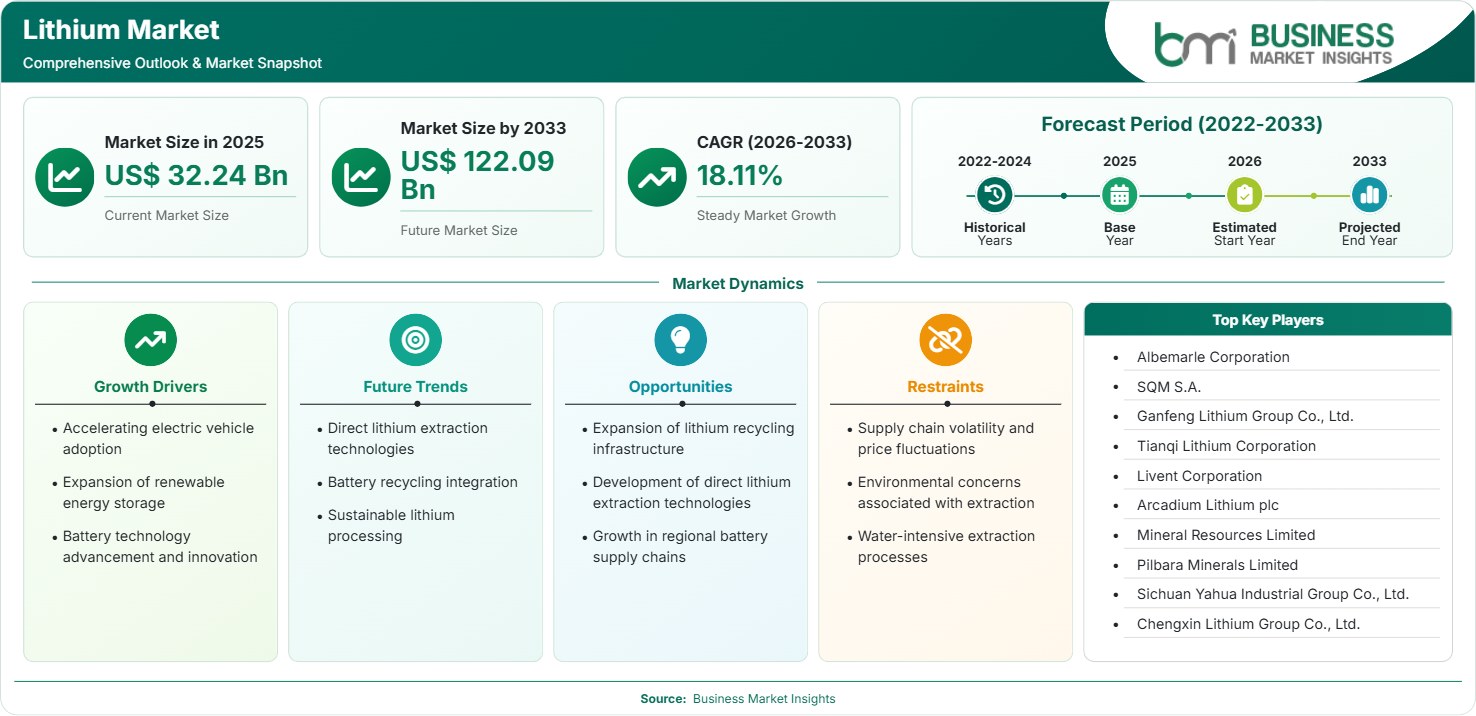
The Lithium Market size was valued at US$ 32.24 billion in 2025 and is projected to reach US$ 122.09 billion by 2033, growing at a CAGR of 18.11% during 2026–2033, driven by rising electric vehicle adoption, battery storage expansion, renewable energy integration, and lithium processing investments are accelerating demand across automotive, electronics, and energy applications.

Report Coverage
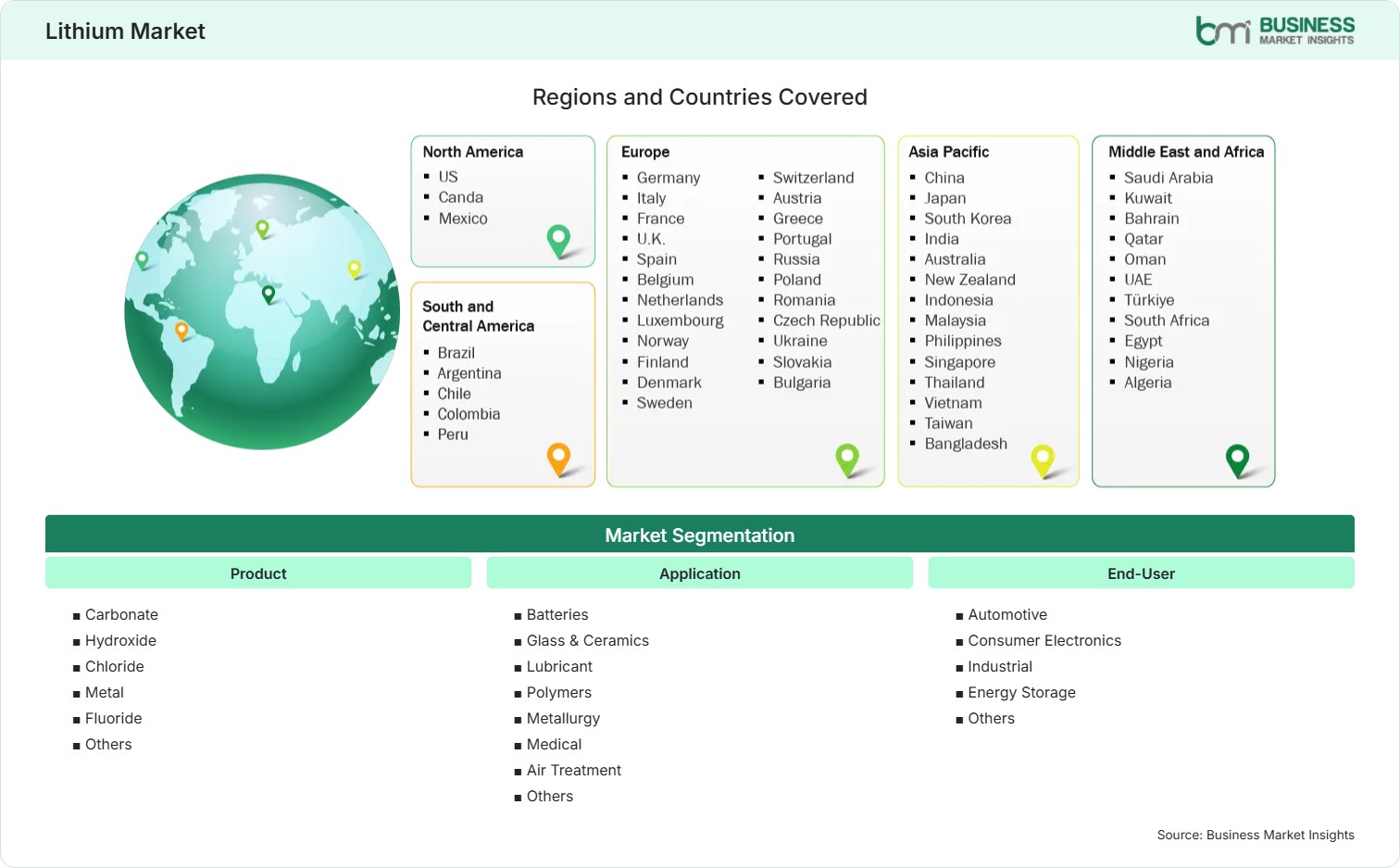
  • Product: Carbonate, Hydroxide, Chloride, Metal, Fluoride, and Others
  • Application: Batteries, Glass & Ceramics, Lubricant, Polymers, Metallurgy, Medical, Air Treatment, and Others
  • End-User: Automotive, Consumer Electronics, Industrial, Energy Storage, and Others
US$ 32.24 Bn Market size in 2025
US$ 122.09 Bn Market Size by 2033
18.11% CAGR, 2026 - 2033
2026-2033 Forecast Period

01 AI Overview

Lithium Market Summary

  • North America Region: North America holds market share of 25%–28% in 2025, growing with a CAGR of 17%–19% influenced by battery manufacturing expansion, electric vehicle investments, domestic mineral development, and clean energy initiatives. The US market demonstrates strong momentum with a CAGR of 18%–20% through 2033, supported by battery supply chain localization and energy storage deployment.
  • Fastest Growing Region: Asia Pacific maintains market share of 55%–58% in 2025, expanding at a CAGR of 19%–21% due to electric vehicle manufacturing growth, battery production leadership, renewable energy storage projects, and lithium refining capacity expansion across major economies.
  • Leading Segment: Batteries hold market share of 72%–75% in 2025, growing at a CAGR of 20%–22% driven by electric mobility adoption, grid-scale storage requirements, consumer electronics demand, and continuous lithium-ion battery technology advancement.
  • High Growth Segment: Energy Storage represents market share of 10%–13% in 2025, advancing at a CAGR of 21%–23% due to renewable integration, grid reliability requirements, utility-scale projects, and increasing deployment of stationary battery systems.
  • Key Market Opportunity: Expanding lithium recycling, direct lithium extraction technologies, regional refining facilities, and sustainable mining practices create opportunities for suppliers seeking resilient supply chains and environmentally responsible production models.
  • Major Market Players: Albemarle Corporation, SQM S.A., Ganfeng Lithium Group Co., Ltd., Tianqi Lithium Corporation, Livent Corporation, Arcadium Lithium plc, Mineral Resources Limited, Pilbara Minerals Limited, Sichuan Yahua Industrial Group Co., Ltd., Chengxin Lithium Group Co., Ltd.
02 Strategic Insights

Lithium Market: Strategic Insights

lithium-market-market-strategic-framework
FREE PDF
Request your free sample
Request free sample
03 Stakeholder View

Key Takeaways

  • The lithium value chain is evolving from conventional mining operations toward integrated ecosystems combining extraction, refining, cathode material production, battery manufacturing, and recycling capabilities.
  • Battery applications represent the primary growth opportunity as automotive electrification, consumer electronics demand, and renewable energy storage systems increase lithium consumption across global markets.
  • Technology advancement is shifting toward direct lithium extraction, improved processing efficiency, solid-state battery compatibility, and recycling methods designed to enhance resource utilization.
  • Asia Pacific provides the strongest expansion opportunity due to established battery manufacturing networks, electric vehicle production capacity, and large-scale investments in lithium refining infrastructure.
  • Strategic investments, partnerships, and acquisitions are increasing as companies seek access to mineral resources, processing technologies, and secure supply chains amid rising demand volatility.
  • Sustainability initiatives are influencing project development decisions as producers adopt lower-emission extraction methods and improve environmental performance across lithium operations.
04 Geographic Outlook

Lithium Market Regional Highlights

North America Lithium Market

North America accounted for 25%–28% share in 2025 and is projected to expand at a CAGR of 17%–19% from 2026 to 2033. The region benefits from battery manufacturing investments, electric vehicle adoption, government incentives, and domestic resource development programs. Lithium Market share is supported by expanding processing facilities, mining projects, and partnerships between automakers and material suppliers across the United States and Canada.

  • Domestic lithium extraction projects are advancing as companies seek reduced dependence on international supply chains and stronger battery material security.
  • Government incentives are supporting battery manufacturing facilities through funding programs aimed at strengthening clean energy industrial infrastructure.
  • Automotive manufacturers are establishing regional battery partnerships to secure lithium supplies for expanding electric vehicle production.
  • Recycling initiatives are gaining importance as battery volumes increase and companies pursue circular resource management strategies.

US Lithium Market

The United States represented 22%–25% share in 2025 and is forecast to grow at a CAGR of 18%–20% during 2026–2033. The country maintains a strategic position due to battery manufacturing expansion, electric vehicle investments, clean energy policies, and increasing focus on domestic mineral supply chains.

  • Federal incentives are encouraging lithium processing investments and supporting domestic battery manufacturing ecosystem development.
  • Automotive companies are expanding electric vehicle production, increasing demand for locally sourced lithium materials.
  • Energy storage projects are increasing as utilities integrate renewable power sources and require reliable battery systems.
  • Mining companies are developing new extraction technologies to improve domestic lithium resource utilization.

Europe Lithium Market

Europe accounted for 15%–18% share in 2025 and is expected to grow at a CAGR of 16%–18% through 2033. The region is expanding through battery gigafactory development, electric mobility adoption, and strategic raw material initiatives. Germany, France, and the United Kingdom remain important markets due to automotive manufacturing strength and clean energy transition strategies.

  • Germany is strengthening lithium demand through electric vehicle production and battery manufacturing investments across automotive supply chains.
  • France is supporting lithium development through industrial policies focused on battery independence and renewable energy expansion.
  • The United Kingdom is increasing battery material investments through electric mobility programs and advanced manufacturing initiatives.
  • European companies are developing recycling capabilities to improve lithium availability and reduce raw material dependency.
  • Regional manufacturers are prioritizing sustainable sourcing practices to meet environmental compliance requirements.

Asia Pacific Lithium Market

Asia Pacific held 55%–58% share in 2025 and is projected to register a CAGR of 19%–21% between 2026 and 2033. The region leads global lithium consumption due to battery manufacturing dominance, electric vehicle production, and extensive refining capacity. China, Japan, South Korea, and India remain significant contributors through investments in battery technology and energy storage infrastructure.

  • China maintains leadership through large-scale lithium refining, battery manufacturing capacity, and electric vehicle ecosystem development.
  • India is expanding lithium demand through electric mobility initiatives, renewable energy projects, and battery manufacturing investments.
  • Japan continues advancing lithium applications through battery innovation and consumer electronics expertise.
  • South Korea is strengthening its position through major battery producers and advanced cathode material manufacturing.
  • Regional companies are increasing recycling investments to improve long-term lithium resource availability.

Rest of World Lithium Market

Rest of World accounted for 5%–8% share in 2025 and is expected to grow at a CAGR of 15%–17% during 2026–2033. South America, Middle East, and Africa are expanding through mineral exploration, renewable energy projects, and industrial development. Chile, Argentina, and Australia remain important contributors due to significant lithium reserves and growing extraction capabilities.

South American countries are strengthening lithium production through brine projects and international partnerships. Middle Eastern and African markets are exploring mineral opportunities while developing renewable energy storage infrastructure.

  • Chile continues supporting lithium production through established brine resources and export-oriented mining capabilities.
  • Argentina is attracting international investment through expanding lithium projects across major resource regions.
  • Australia remains a leading hard-rock lithium producer with strong mining infrastructure and processing potential.
  • African countries are developing mineral strategies to attract investment in battery material supply chains.
  • Middle Eastern economies are exploring lithium opportunities linked with renewable energy and industrial diversification programs.
global-market-geography
FREE PDF
Request your free sample
Request free sample
05 Segment Analysis

Lithium Market Segmentation

Product

The Product segment accounted for a major portion of the Market in 2025, with a market share of 85%–88% and a CAGR of 17%–19% between 2026–2034. Product demand is influenced by battery-grade material requirements, industrial applications, and expanding chemical processing capabilities. The Lithium Market scope is shaped by carbonate and hydroxide consumption for energy storage, automotive batteries, and advanced manufacturing.

  • Carbonate: Lithium carbonate remains widely used in lithium-ion battery cathodes, supporting electric vehicle applications, energy storage systems, and electronics manufacturing with established processing infrastructure.
  • Hydroxide: Lithium hydroxide demand is increasing due to high-nickel battery chemistries requiring enhanced energy density, particularly for premium electric vehicles and advanced mobility applications.
  • Chloride: Lithium chloride supports specialized chemical processes, metal production, and lithium extraction workflows requiring efficient conversion and processing applications.
  • Metal: Lithium metal applications are advancing through research into next-generation batteries, particularly technologies requiring higher energy density and improved storage performance.
  • Fluoride: Lithium fluoride serves specialized industrial applications, including metallurgy and optical materials, where chemical stability and performance characteristics support targeted demand.

Application

The Application segment represented substantial demand within the Market, accounting for 75%–78% share in 2025 and expanding at a CAGR of 18%–20% from 2026–2034. Battery applications dominate consumption due to electric mobility and renewable storage requirements. Diverse industrial uses continue supporting lithium adoption across manufacturing, healthcare, polymers, and specialized chemical applications while strengthening Lithium Market trends.

  • Batteries: Battery applications represent the largest consumption area, driven by electric vehicles, consumer electronics, grid storage systems, and continuous lithium-ion technology improvements.
  • Glass & Ceramics: Lithium compounds enhance thermal resistance, durability, and processing efficiency in specialty glass and ceramic manufacturing applications.
  • Lubricant: Lithium-based greases provide high-temperature stability and mechanical performance, supporting industrial equipment, automotive systems, and machinery maintenance applications.
  • Polymers: Lithium compounds contribute to polymer processing, specialty materials, and manufacturing applications requiring enhanced chemical and physical properties.
  • Metallurgy: Lithium is used in alloy production and metal processing to improve strength, lightweight characteristics, and manufacturing efficiency.
  • Medical: Medical applications utilize lithium compounds in pharmaceutical formulations, requiring controlled production standards and specialized supply management.
  • Air Treatment: Lithium compounds support air treatment technologies through moisture control applications in industrial and commercial environments.

End-User

The End-User segment accounted for significant Lithium Market demand in 2025, with a share of 80%–83% and CAGR of 19%–21% through 2034. Automotive remains the largest contributor due to electrification trends, while industrial and energy storage applications continue expanding. Growing deployment of lithium-based systems across transportation and power infrastructure is creating diversified consumption patterns.

  • Automotive: Automotive users drive lithium consumption through electric vehicle production, battery integration, and global transportation electrification strategies.
  • Consumer Electronics: Consumer electronics applications continue requiring lithium batteries for smartphones, laptops, wearable devices, and portable electronic equipment.
  • Industrial: Industrial users adopt lithium solutions for equipment, manufacturing processes, and specialized applications requiring reliable energy storage systems.
  • Energy Storage: Energy storage applications are expanding through renewable power integration, grid balancing requirements, and utility-scale battery deployment.
06 Market Forces

Lithium Market Dynamics

Key Market Drivers

Accelerating Electric Vehicle Adoption

Electric vehicle expansion remains a primary driver of Lithium Market growth as automotive manufacturers increase battery-powered vehicle production worldwide. According to the International Energy Agency, over 17 million electric cars were sold across the world in 2024, which has increased the need for lithium-ion batteries. The trend in the market shows that there are greater investments being made in battery logistics, cathode material, and processes. There are long-term deals being made by automakers with lithium producers. There is growth in commercial electric cars and fleets electrification.

Expansion of Renewable Energy Storage

Growing renewable energy deployment is increasing demand for lithium-based energy storage systems used in grid balancing and power management. The use of solar and wind power needs reliable energy storage solutions due to the intermittent nature of power generation. According to the International Energy Agency, battery storage is one of the important factors that will contribute to the successful transition towards green energy. Large utility scale projects, distributed battery storage systems, and commercial applications are contributing towards increased demand for lithium.

Battery Technology Advancement and Innovation

Advancements in lithium battery chemistry are increasing material requirements and encouraging investment in improved production technologies. Developments include the creation of energy-dense batteries, better charging performance, and increased safety. Trends in the market are shaped by studies on cathodes of high nickel content, lithium metal batteries, and lithium recycling methods. Processing advancements are taking place in order to produce more purity levels of lithium for use in specialized applications.

Key Market Opportunities

Expansion of Lithium Recycling Infrastructure

The recycling of lithium offers a strategically advantageous move, as more batteries mean more needs for recycled raw material. Such recycling technology allows recovery of lithium, cobalt, nickel, and other components that make up the batteries. This would decrease the need to use fresh materials. More companies are moving towards building closed-loop systems, which would help increase their sustainable performances. Lithium Market Forecasts indicate that recycling will become increasingly important as retired electric vehicle batteries enter commercial recovery streams.

Development of Direct Lithium Extraction Technologies

Direct lithium extraction technologies are creating opportunities to improve resource recovery efficiency and access previously challenging reserves. The processes will result in shortened processing times, reduced impact on the environment, and an increased production of lithium from brines. Firms have been spending money on the latest extraction processes to mitigate the constraints in supply. There are some ongoing projects in North America and South America considering the use of direct extraction processes for improving supply security.

Growth in Regional Battery Supply Chains

Regional battery ecosystem development is creating investment opportunities across mining, refining, and manufacturing stages. North American and European governments are investing in local supply chains to decrease their reliance on production clusters. Refineries, cathode factories, and battery fabrication clusters have attracted collaboration between mining firms and technology companies. There is an increase in the need for locally sourced materials that is leading to infrastructure investment. Integrated firms stand a good chance of benefitting at several points in the lithium supply chain.

Market Restraints and Challenges

Supply Chain Volatility and Price Fluctuations

Factor: The fluctuations in the cost of lithium due to uncertain demand, production cycle increase, and changes in the raw materials market may have an impact on the planning and profitability of investments.

Impact: Producers and batteries producers are expected to encounter margin compression, delays in projects, and challenges in achieving stable pricing negotiations. Market participants are acting based on long-term deals, diversification, and investments in recycling technologies. There are increases in lithium production, but a balance in production and demand in the market is key to sustained industry growth.

Environmental Concerns Associated with Extraction

Factor: Lithium mining activities may generate environmental issues because of water use, impact on the ecosystem, and resource management.

Impact: Regulatory reviews and local resistance may add time and increase operating costs in meeting requirements for project approvals. Better extraction methods, water management systems, and sustainable processes have been implemented by companies to mitigate their environmental impact. Environmental responsibility is becoming more important due to increased pressure from governments and consumers.

07 Company Analysis

Competitive Landscape

Lithium Market analysis shows that competition is shaped by resource ownership, refining capabilities, battery-grade material production, and strategic partnerships with downstream industries.

Company Name

Overview

Products and Services relevant to this market

Albemarle Corporation

Global lithium producer serving automotive and industrial markets with extensive processing capabilities.

Lithium carbonate, lithium hydroxide, specialty lithium compounds, and battery materials.

SQM S.A.

Chile-based chemical producer with major lithium resource operations and global distribution networks.

Lithium carbonate, lithium hydroxide, and specialty chemical products for batteries.

Ganfeng Lithium Group Co., Ltd.

Integrated lithium company operating mining, refining, and battery material businesses worldwide.

Lithium compounds, battery materials, lithium recycling, and resource development services.

Tianqi Lithium Corporation

Major lithium supplier with global mining assets and processing expertise.

Lithium concentrates, carbonate, hydroxide, and battery-grade lithium products.

Livent Corporation

Lithium technology company specializing in advanced lithium compounds and materials.

Lithium hydroxide, lithium carbonate, and specialty lithium applications.

Arcadium Lithium plc

Global lithium producer formed through lithium asset consolidation and expansion strategies.

Lithium chemicals, extraction operations, and battery material solutions.

Mineral Resources Limited

Australian mining company involved in lithium extraction and processing activities.

Lithium spodumene concentrates and mining services.

Pilbara Minerals Limited

Australia-based lithium producer operating major hard-rock lithium assets.

Lithium spodumene concentrate production and supply solutions.

Sichuan Yahua Industrial Group Co., Ltd.

Chemical manufacturer focused on lithium products and battery material supply.

Lithium hydroxide, lithium carbonate, and chemical processing services.

Chengxin Lithium Group Co., Ltd.

Lithium materials company supplying battery manufacturers globally.

Lithium compounds, processing services, and resource development solutions.

08 Industry Activity

Recent Developments

June 2026

CATL secured the necessary safety permit to restart production at its Jianxiawo lithium mine, easing concerns over lithium supply availability after an extended suspension. The restart is expected to strengthen lithium raw material availability for battery manufacturers and support broader EV supply chains.

February 2026

Lithium Americas provided an update on its Thacker Pass lithium project in Nevada, confirming continued construction progress and outlining 2026 capital expenditure plans. The company stated that Phase 1 construction is advancing, supporting development of a large-scale domestic lithium supply chain in North America.

March 2025

Rio Tinto completed its $6.7 billion acquisition of Arcadium Lithium, establishing Rio Tinto Lithium as a major global lithium business. The acquisition significantly expands Rio Tinto’s lithium resource base and strengthens its position in supplying materials for electric vehicle batteries and energy storage applications.

June 2024

ExxonMobil signed a non-binding memorandum of understanding (MOU) with SK On, a global leading electric vehicle (EV) battery developer, that opens the door to secure a multiyear offtake agreement of up to 100,000 metric tons of MobilTM Lithium from the company’s first planned project in Arkansas.

10 Trust & Transparency

Research Methodology

The market analysis combines proprietary research with secondary data from government agencies, company disclosures, regulatory filings, industry databases and expert interviews. Market estimates are validated through data triangulation, cross-market benchmarking and analyst review.

View Full Research Methodology

11 Questions Answered

Frequently Asked Questions

What role will be recycling play in future lithium supply?

Lithium recycling will become increasingly important by recovering valuable battery materials, reducing dependency on mining operations, improving resource efficiency, and supporting circular economy models for future battery ecosystems.

What technologies are improving lithium production efficiency?

Direct lithium extraction, advanced processing systems, recycling technologies, and automated resource management solutions are improving production efficiency while supporting more sustainable lithium supply chains.

Which lithium application segment has the strongest growth potential?

Battery applications demonstrate the strongest growth potential due to rising electric vehicle production, grid-scale storage requirements, and increasing adoption of lithium-ion technologies across transportation and energy sectors.

How is the Lithium Market Report useful for industry participants?

The Market Report provides insights into production trends, competitive positioning, application opportunities, regional developments, supply chain dynamics, and investment areas across lithium mining, processing, and end-use industries.

What factors are influencing lithium demand through 2033?

Lithium demand is primarily influenced by electric vehicle adoption, renewable energy storage expansion, battery technology improvements, and government policies supporting clean energy transitions. Automotive electrification remains the largest demand contributor.

Access the Full Lithium Market Report

Get segment-level forecasts, regional estimates, competitive benchmarking, company profiles and downloadable Excel datasets.

Access the full Lithium Market Report
350 pages PDF & Excel | 2026-07-27