
Acetaldehyde Market Outlook: Size, Share, Trends, Growth Analysis, Competitive Landscape & Forecast, 2026-2033

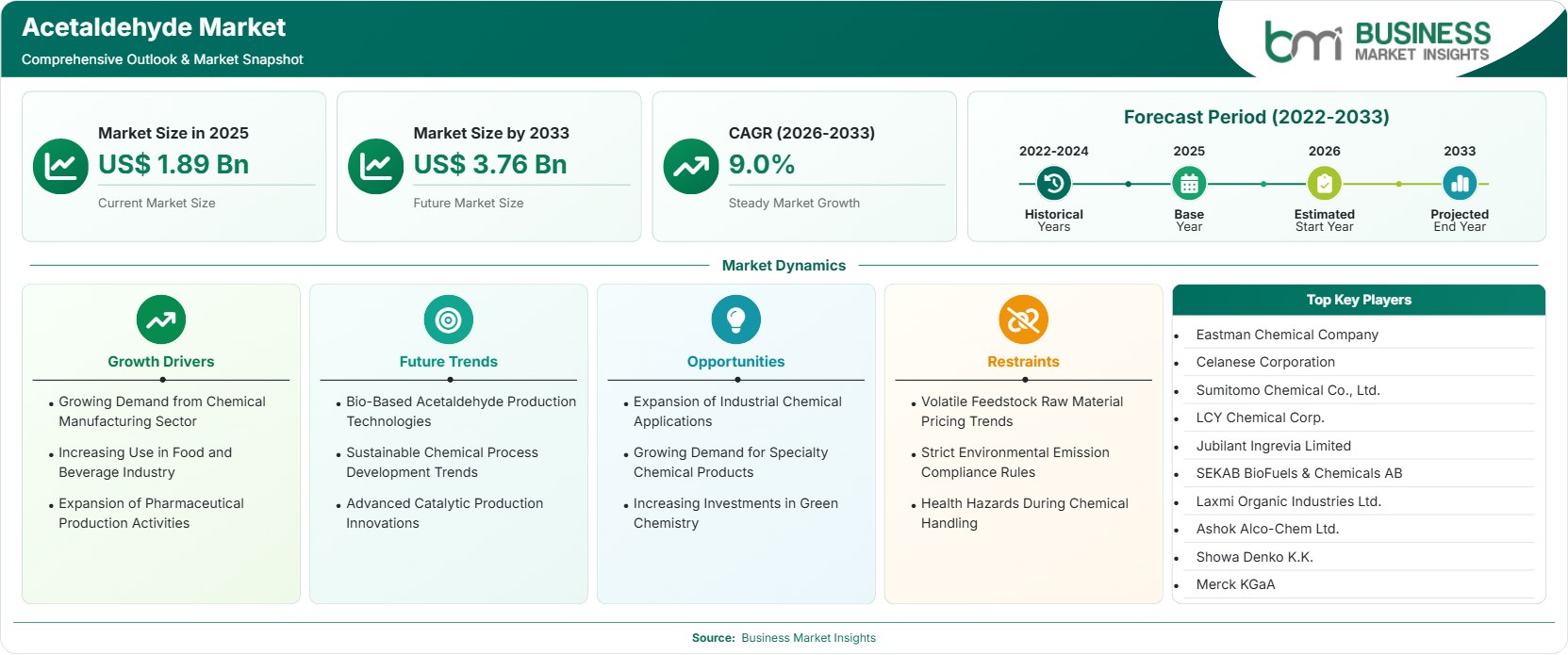
The Acetaldehyde Market size was valued at US$ 1.89 Billion in 2025 and is projected to reach US$ 3.76 Billion by 2033, growing at a CAGR of 9.0% during 2026–2033, driven by expanding chemical manufacturing applications, rising demand from food and beverage processing, pharmaceutical production growth, specialty chemical development, and increasing investments in sustainable production technologies.

Report Coverage
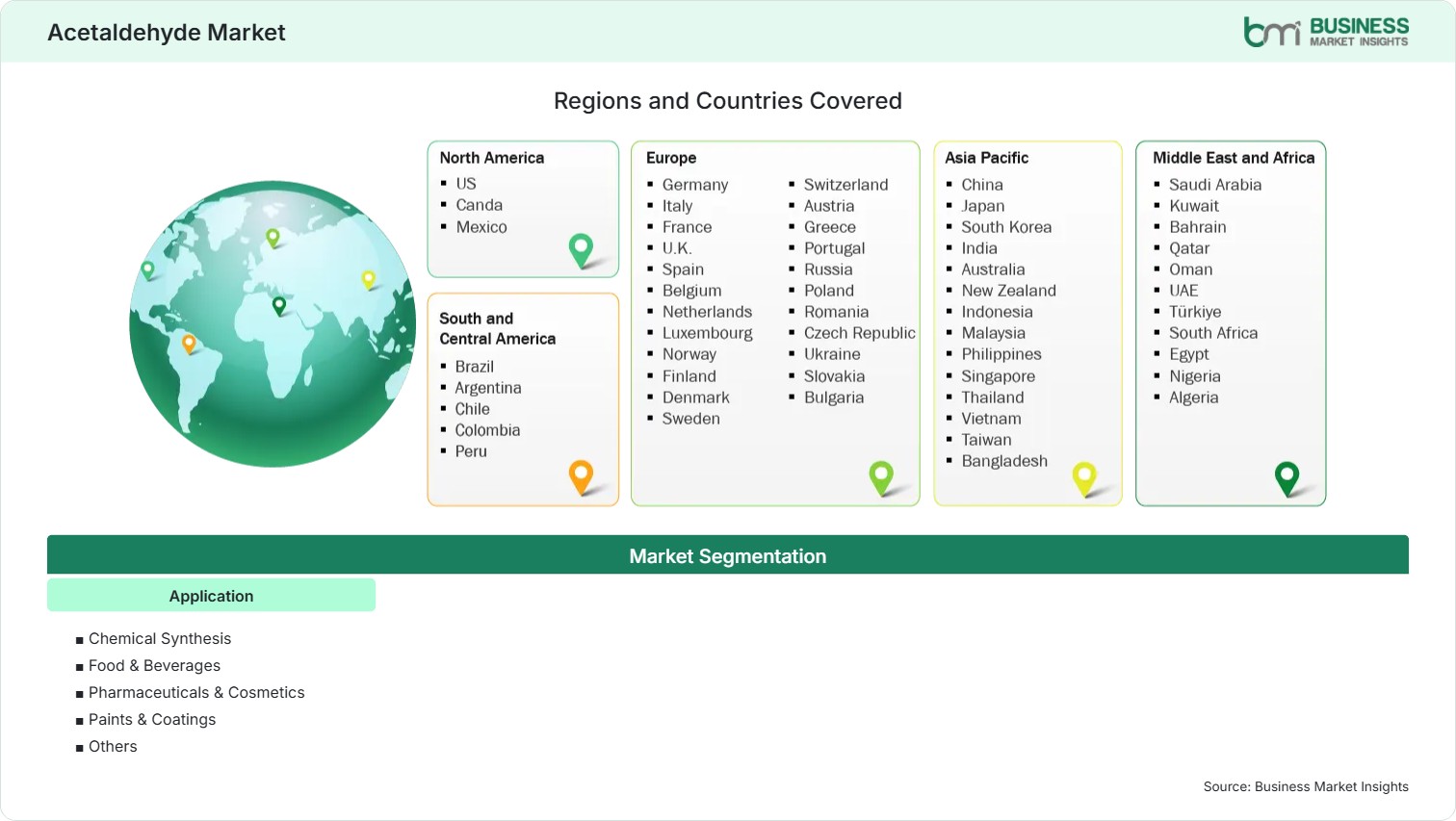
  • Application: Chemical Synthesis, Food & Beverages, Pharmaceuticals & Cosmetics, Paints & Coatings, Others
US$ 1.89 Bn Market size in 2025
US$ 3.76 Bn Market Size by 2033
9.0% CAGR, 2026 - 2033
2026-2033 Forecast Period

AI Overview

Acetaldehyde Market Summary

  • North America Region: North America holds 26%–29% market share in 2025, growing with a CAGR of 8.2%–8.7% during 2026–2033, supported by chemical manufacturing expansion, specialty chemical demand, pharmaceutical production, and advanced industrial applications. The United States remains the major contributor due to established chemical infrastructure and is expanding at a CAGR of 8.3%–8.8%.
  • Fastest Growing Region: Asia Pacific accounts for 42%–45% of the Acetaldehyde market share in 2025 and is projected to grow at a CAGR of 9.8%–10.3% during 2026–2033, driven by expanding chemical industries, increasing manufacturing activities, rising pharmaceutical production, and growing demand for industrial intermediates across developing economies.
  • Leading Segment: Chemical Synthesis represents the leading application segment with 48%–51% market share in 2025 and is expected to grow at a CAGR of 8.8%–9.2%, supported by broad industrial usage, intermediate production requirements, and demand from chemical derivative manufacturing.
  • High Growth Segment: Pharmaceuticals & Cosmetics represents the high-growth segment with 14%–17% market share in 2025 and is projected to expand at a CAGR of 10.2%–10.7%, supported by pharmaceutical manufacturing growth, specialty formulations, and increasing demand for chemical intermediates.
  • Key Market Opportunity: Increasing adoption of bio-based acetaldehyde production technologies and expansion of specialty chemical applications create opportunities for manufacturers to develop sustainable solutions aligned with evolving industrial and environmental requirements.
  • Major Market Players: Eastman Chemical Company, Celanese Corporation, Sumitomo Chemical Co., Ltd., LCY Chemical Corp., Jubilant Ingrevia Limited, SEKAB BioFuels & Chemicals AB, Laxmi Organic Industries Ltd., Ashok Alco-Chem Ltd., Showa Denko K.K., Merck KGaA.
Strategic Insights

Acetaldehyde Market: Strategic Insights

Acetaldehyde Market Strategic Framework
FREE PDF
Request your free sample
Request free sample
Stakeholder View

Key Takeaways

  • The market value chain is supported by integrated chemical producers, raw material suppliers, downstream manufacturers, and specialty chemical users. Companies with efficient production networks and diversified application portfolios are gaining competitive advantages by supplying acetaldehyde derivatives to chemical, pharmaceutical, food, and industrial sectors.
  • Chemical synthesis applications remain the primary demand contributor, while pharmaceutical and specialty chemical applications provide attractive expansion opportunities. Stakeholders investing in high-purity acetaldehyde production, customized formulations, and application-specific solutions can capture emerging demand across regulated and high-value industries.
  • Sustainable production technologies are becoming an important innovation focus as manufacturers explore bio-based feedstocks, energy-efficient processes, and reduced-emission manufacturing approaches. Green chemistry investments are encouraging the development of environmentally responsible alternatives while maintaining industrial performance requirements.
  • Asia Pacific offers the strongest regional investment potential due to expanding chemical manufacturing capacity, growing pharmaceutical production, increasing industrialization, and rising consumption of specialty chemicals. China, India, Japan, and Southeast Asian economies continue strengthening their chemical industry ecosystems.
  • Strategic partnerships, capacity expansions, and technology collaborations are shaping competitive dynamics as companies seek to improve production efficiency, secure feedstock availability, and strengthen downstream integration. Chemical manufacturers are increasingly focusing on sustainable operations and higher-value applications.
  • Growing demand for specialty chemicals, pharmaceutical intermediates, and advanced material applications is encouraging producers to diversify acetaldehyde utilization beyond traditional chemical synthesis markets.
Geographic Outlook

Acetaldehyde Market Regional Highlights

North America Acetaldehyde Market

North America accounted for 26%–29% of the global market share in 2025 and is projected to grow at a CAGR of 8.2%–8.7% during 2026–2033. The region benefits from established chemical manufacturing infrastructure, advanced production technologies, pharmaceutical sector expansion, and strong demand for specialty chemicals. The Acetaldehyde Market share is supported by integrated chemical companies, reliable industrial supply chains, and increasing focus on efficient and sustainable chemical production practices across the United States and Canada.

  • The United States represents the largest regional contributor due to strong chemical production capabilities, established downstream industries, and increasing demand for acetaldehyde-based intermediates.
  • Growing pharmaceutical and specialty chemical manufacturing activities are supporting demand for high-purity acetaldehyde used in advanced industrial and healthcare-related applications.
  • Chemical producers are investing in process optimization and sustainable manufacturing methods to improve efficiency while meeting increasingly strict environmental requirements.
  • Expanding demand from coatings, plastics, and industrial chemical applications continues supporting steady consumption across multiple end-use industries.

US Acetaldehyde Market

The United States accounted for 22%–25% of the global market share in 2025 and is expected to grow at a CAGR of 8.3%–8.8% through 2033. The market is supported by mature chemical manufacturing infrastructure, strong pharmaceutical production capabilities, and demand from specialty chemical industries. Domestic producers are focusing on operational efficiency, sustainable production methods, and application diversification to strengthen their competitive positioning.

  • Increasing pharmaceutical manufacturing activities are supporting demand for acetaldehyde as a chemical intermediate in various production processes.
  • Advanced chemical processing facilities and established industrial networks enable efficient production and distribution across domestic and international markets.
  • Growing emphasis on sustainable chemistry is encouraging companies to invest in cleaner production technologies and improved resource efficiency.
  • Strong demand from coatings, adhesives, and chemical derivative applications continues supporting acetaldehyde consumption across industrial sectors.

Europe Acetaldehyde Market

The European region accounted for 21%- 24% market share in 2025, and the market is expected to grow at a compound annual growth rate (CAGR) of 8.0%–8.5% during the forecast period of 2026–2033. The European market has an advantage with advanced facilities for chemical manufacturing and specialization in the chemicals industry, pharmaceuticals, and sustainable chemical processes. Some important countries in the region include Germany, France, the UK, Italy, and the Netherlands, showing strong growth due to established chemical clusters and industrial innovation capabilities.

  • Germany remains a leading contributor due to its advanced chemical industry, integrated manufacturing networks, and strong demand for industrial intermediates used across multiple applications.
  • The Netherlands supports market development through its strategic chemical manufacturing infrastructure, port connectivity, and presence of major industrial production facilities.
  • France and the United Kingdom are witnessing increasing demand from pharmaceutical, cosmetics, and specialty chemical industries requiring high-quality chemical intermediates.
  • European manufacturers are focusing on sustainable production practices, emission reduction technologies, and improved process efficiency to comply with environmental regulations.
  • Increasing investments in green chemistry initiatives are encouraging the development of alternative production methods and supporting long-term industry transformation.

Asia Pacific Acetaldehyde Market

Asia-Pacific accounted for around 42%-45% of the global Acetaldehyde market in 2025 and is anticipated to show the fastest growth rate, at 9.8%-10.3%, from 2026-2033. Asia-Pacific is a leading market owing to an extensive chemical manufacturing sector, rising industrial production, pharmaceutical industry development, and growing demand for specialty chemicals. China, India, Japan, and South Korea are considered major countries of the Asia-Pacific market due to strong manufacturing ecosystems, investment in chemical infrastructure, and increasing downstream application demand.

  • China continues to be the leading regional contributor owing to its high chemical manufacturing capacity, large-scale industrial manufacturing, and high demand for acetaldehyde derivatives.
  • India is witnessing increasing demand owing to growth in pharmaceutical production and chemical manufacturing, as well as investments in local chemical infrastructure.
  • Japan drives the market forward with its advanced chemical technologies, valuable specialties, and manufacturing efficiency.
  • South Korea is strengthening its position through chemical industry expansion, industrial innovation, and growing demand for advanced materials and pharmaceuticals.
  • Southeast Asian countries are creating new opportunities through industrial development, increasing chemical investments, and expanding manufacturing capabilities across emerging economies.

Rest of World Acetaldehyde Market

The Rest of World region accounted for 8%–11% of the global market share in 2025 and is estimated to grow at a CAGR of 8.8%–9.3% during 2026–2033. Growth across Latin America, the Middle East, and Africa is supported by industrial expansion, increasing chemical consumption, pharmaceutical development, and improving manufacturing capabilities. Brazil, Mexico, Saudi Arabia, and South Africa represent important markets due to rising industrial investments and expanding downstream chemical applications.

The demand for Latin American acetaldehyde is growing owing to its use in chemical processing, food products, and manufacturing industries. There are moves by Middle Eastern nations to develop their chemical base and diversify into manufacturing capabilities beyond traditional industries.

  • Brazil remains a key regional market owing to growth in the chemical industry, rising industrial production, and higher demand for chemical intermediates.
  • Mexico has been boosting growth through industrial development, increased manufacturing, and greater integration with the regional chemical value chain.
  • Saudi Arabia is enhancing downstream chemical manufacturing capabilities through industrial diversification and the manufacturing of petrochemicals and specialty chemicals.
  • South Africa is slowly boosting its chemical manufacturing capabilities through industrial development and increasing demands from the pharmaceutical and industrial sectors.
  • Regional chemical investments and improving infrastructure are expected to create additional opportunities for acetaldehyde producers across developing markets.
Global Market Geography
FREE PDF
Request your free sample
Request free sample
Segment Analysis

Acetaldehyde Market Segmentation

Application

The Application segment presents the overall demand for acetaldehyde across its application areas, including Chemical Synthesis, Food and Beverages, Pharmaceuticals & Cosmetics, Paints and Coatings, and other industries. The market share of Chemical Synthesis in 2025 was 48%–51%, and the expected CAGR from 2026 to 2033 will be 8.8%–9.2%. This growth will be attributed to the widespread use of acetaldehyde as an intermediate in the production of derivatives, solvents, resins, and industrial chemicals. The Acetaldehyde Market scope continues to expand as manufacturers diversify applications across specialty chemicals, pharmaceuticals, and sustainable chemical solutions.

  • Chemical Synthesis: Chemical synthesis remains the dominant application due to extensive use of acetaldehyde as an intermediate in producing chemicals, resins, solvents, and industrial derivatives.
  • Food & Beverages: Food and beverage applications utilize acetaldehyde for flavor-related purposes and processing requirements, supported by increasing consumption of processed foods and beverage products.
  • Pharmaceuticals & Cosmetics: Pharmaceutical and cosmetic industries use acetaldehyde derivatives in specialized formulations, chemical intermediates, and manufacturing processes supporting healthcare and personal care product development.
  • Paints & Coatings: Paints and coatings applications benefit from acetaldehyde-derived chemicals used in resin production, improving material performance, durability, and industrial coating characteristics.
  • Others: Other applications include agricultural chemicals, plastics, rubber processing, and specialty industrial uses requiring acetaldehyde-based chemical intermediates and formulations.
Market Forces

Acetaldehyde Market Dynamics

Key Market Drivers

Growing Demand from Chemical Manufacturing Sector

The expanding chemical manufacturing sector is a major driver of acetaldehyde consumption, given its role as an intermediate in the production of numerous industrial chemicals and derivatives. Growth in demand for specialty chemicals, solvents, resins, and performance materials will lead to enhanced use of acetaldehyde across various manufacturing industries. The market's growth is attributed to growth in the chemical industry, infrastructure development, and the production of downstream products that require input derived from acetaldehyde. Manufacturers are improving production efficiency and integrating their chemical production processes to meet increased industrial needs. Acetaldehyde Market trends reflect the industry's ongoing need for chemical synthesis, using acetaldehyde as an intermediate in the production of high-end products.

Increasing Use in Food and Beverage Industry

Growing consumption of processed foods, beverages, and flavor-enhanced products is increasing demand for acetaldehyde applications within the food and beverage industry. Acetaldehyde is used in flavor-related processes and is an important compound in beverage and food manufacturing. The increase in consumer preference for processed foods, dietary shifts, and the growth of the food processing industry are fueling market growth. It is important to focus on product quality and compliance with food safety regulations. Growth in food processing activity in emerging countries is providing more market opportunities. The growth of the global food and beverage processing network is contributing to the use of acetaldehyde in authorized applications.

Expansion of Pharmaceutical Production Activities

The expansion of pharmaceutical production is driving increased demand for acetaldehyde, which serves as a chemical intermediate in various manufacturing processes. Healthcare demands, increased pharmaceutical investment, and higher production of active ingredients are driving usage in the pharmaceutical industry. Suppliers are producing high-quality chemicals to meet the strict standards of the pharmaceutical industry and improve production efficiency. Capacity expansion in the pharmaceutical industry across Asia Pacific and other developing regions is creating more opportunities for acetaldehyde suppliers. Growth in demand for special medicines and healthcare access will drive demand for chemical intermediaries used in pharmaceuticals.

Key Market Opportunities

Expansion of Industrial Chemical Applications

Expanding industrial uses of chemicals are presenting fresh growth opportunities, as acetaldehyde continues to serve as a versatile intermediate in many chemical processes. The increasing demand for specialty chemicals, polymers, solvents, and other industrial products is prompting companies to expand manufacturing capacity and improve product quality. Companies are trying to find new ways to use their products to reduce their dependence on old markets and earn from diversified sources. Industrialization in developing nations is driving up chemical consumption, thereby creating opportunities for acetaldehyde manufacturers. Investments in advanced manufacturing facilities and integrated chemical production systems are expected to enhance supply capabilities while supporting demand from evolving industrial applications.

Growing Demand for Specialty Chemical Products

Growing demand for specialty chemical products is creating opportunities for acetaldehyde producers to develop higher-value solutions for advanced applications. Specialty chemicals are increasingly required in industries including pharmaceuticals, coatings, agriculture, materials, and electronics. The companies are focusing on customization, quality improvement, and formulations tailored to their use. The move towards performance-based chemicals is encouraging research and development. Organizations capable of providing quality, technology, and sustainable alternatives will benefit from increased demand. Specialty chemical markets that are growing in Asia Pacific region and elsewhere present ample opportunities for acetaldehyde use.

Increasing Investments in Green Chemistry

With more investment in green chemistry, there will be increased opportunities for sustainable production of acetaldehyde from renewable sources, more energy-efficient processes, and lower environmental impact. Chemical producers are investigating bio-based production processes and improved technologies to meet global sustainability goals. With greater emphasis on reducing emissions and increasing resource efficiency, there will be opportunities to rethink the production process. The green chemistry program also offers opportunities for innovation in chemical production and use. This is because firms investing in sustainable technologies can enhance efficiency while addressing environmental concerns. These developments are expected to influence future production strategies across the acetaldehyde market forecasts.

Market Restraints and Challenges

Volatile Feedstock Raw Material Pricing Trends

Factor: Fluctuations in feedstock prices, including ethanol and petrochemical-derived raw materials used in acetaldehyde production, create uncertainty in manufacturing costs and operational planning. Impact: Rising raw material expenses can reduce producer margins, increase product pricing pressure, and affect competitiveness across downstream industries. Global commodity market changes, energy cost variations, and supply chain disruptions influence feedstock availability and production economics. Manufacturers are focusing on supply chain diversification, process optimization, and alternative raw material sourcing strategies to manage cost volatility. However, maintaining stable production economics remains a challenge as producers balance raw material expenses with customer pricing expectations across chemical, pharmaceutical, and industrial applications.

Strict Environmental Emission Compliance Rules

Factor: Increasingly stringent environmental regulations related to chemical emissions, workplace safety, and industrial production standards require manufacturers to invest in advanced control systems and cleaner technologies. Impact: Compliance requirements can increase capital expenditure, operational costs, and production complexity for acetaldehyde manufacturers. Regulatory authorities worldwide are implementing stricter standards for volatile organic compounds, emissions management, and chemical handling practices. Companies must upgrade production facilities, adopt monitoring systems, and improve environmental management processes to maintain compliance. While these measures support sustainable chemical manufacturing, they may create challenges for smaller producers due to higher investment requirements and technical implementation costs.

Company Analysis

Competitive Landscape

The Acetaldehyde Market analysis is marked by a competitive landscape created due to the presence of integrated chemical companies, specialty chemical companies, and sustainable manufacturing technology-based firms. The dominant firms in the market are consolidating their dominance through capacity additions, product innovation, process optimization, and application innovation for acetaldehyde across chemical synthesis, pharmaceuticals, food processing, and industrial sectors.

Company Name

Overview

Products and Services relevant to this market

Eastman Chemical Company

Global specialty materials company producing advanced chemical solutions across multiple industries.

Acetaldehyde products, chemical intermediates, specialty chemicals, and industrial formulations.

Celanese Corporation

Global chemical company focused on engineered materials and acetyl-based chemistry solutions.

Acetaldehyde, acetyl derivatives, chemical intermediates, and specialty chemical products.

Sumitomo Chemical Co., Ltd.

Japanese chemical manufacturer providing diverse industrial and specialty chemical solutions.

Chemical intermediates, acetaldehyde-related products, advanced materials, and industrial chemicals.

LCY Chemical Corp.

Taiwanese chemical producer specializing in petrochemical and specialty chemical manufacturing.

Acetaldehyde derivatives, chemical intermediates, and industrial chemical solutions.

Jubilant Ingrevia Limited

Integrated chemical manufacturer serving pharmaceutical, nutrition, and specialty chemical industries.

Acetaldehyde, specialty chemicals, fine chemicals, and pharmaceutical intermediates.

SEKAB BioFuels & Chemicals AB

Swedish company focused on renewable chemical solutions and sustainable production technologies.

Bio-based acetaldehyde solutions, renewable chemicals, and green chemistry applications.

Laxmi Organic Industries Ltd.

Indian specialty chemical manufacturer producing intermediates and solvents.

Acetaldehyde derivatives, specialty intermediates, and industrial chemical products.

Ashok Alco-Chem Ltd.

Indian chemical producer specializing in industrial chemicals and intermediates.

Acetaldehyde, ethanol-based chemicals, and industrial chemical solutions.

Showa Denko K.K.

Japanese chemical company developing advanced materials and chemical products.

Chemical intermediates, industrial chemicals, and specialty material solutions.

Merck KGaA

Global science and technology company providing chemical and pharmaceutical solutions.

High-purity chemicals, research-grade acetaldehyde, and specialty chemical applications.

Industry Activity

Recent Developments

June 2026

Celanese Corporation announced a collaboration with Siegwerk Druckfarben AG & Co. KGaA to develop more sustainable printing ink solutions using bio-based ethyl acetate produced from its acetyl chain. The development strengthens Celanese’s downstream acetaldehyde/acetic acid value chain by expanding renewable acetyl derivatives for industrial applications.

February 2026

Celanese Corporation announced price increases for acetic acid, vinyl acetate monomer (VAM), acetic anhydride, and esters across the Western Hemisphere. The update reflects strategic management of its integrated acetyl chain, of which acetaldehyde is an important intermediate and related product family.

June 2025

Eastman Chemical Company introduced Esmeri CC1N10, a new cosmetic ingredient platform manufactured using Eastman’s specialty chemistry capabilities. The launch demonstrates the company’s continued investment in oxygenated chemical technologies and specialty derivatives supported by its integrated acetyls business, which includes acetaldehyde-related production infrastructure.

April 2024

Jubilant Ingrevia Limited commissioned a new multipurpose Agro Active & Intermediate plant at Bharuch and a Diketene Derivatives plant at Gajraula, strengthening its integrated specialty chemicals and acetyl intermediates value chain.

Trust & Transparency

Research Methodology

The market analysis combines proprietary research with secondary data from government agencies, company disclosures, regulatory filings, industry databases and expert interviews. Market estimates are validated through data triangulation, cross-market benchmarking and analyst review.

View Full Research Methodology

Questions Answered

Frequently Asked Questions

What insights are covered in the Acetaldehyde Market Report?

The Market Report provides analysis of market size, application trends, regional dynamics, competitive developments, growth opportunities, challenges, and strategic factors influencing global acetaldehyde industry expansion.

Which regions offer major growth opportunities for acetaldehyde producers?

Asia Pacific offers significant opportunities due to expanding chemical manufacturing capacity, pharmaceutical production growth, industrialization, and increasing demand for specialty chemicals across emerging economies.

How is sustainability influencing acetaldehyde production?

Sustainability is encouraging manufacturers to explore renewable feedstocks, cleaner production methods, improved energy efficiency, and emission reduction technologies to align with evolving environmental requirements.

Which application segment dominates acetaldehyde consumption?

Chemical synthesis represents the leading application segment due to extensive usage of acetaldehyde as an intermediate for producing acetic acid, solvents, resins, polymers, pharmaceuticals, and other industrial chemicals.

What factors are driving the Acetaldehyde Market growth?

The market is driven by increasing demand from chemical synthesis applications, expanding pharmaceutical production, rising food and beverage processing activities, specialty chemical development, and investments in sustainable chemical manufacturing technologies.

Access the Full Acetaldehyde Market Report

Get segment-level forecasts, regional estimates, competitive benchmarking, company profiles and downloadable Excel datasets.

Access the full Acetaldehyde Market Report
350 pages PDF & Excel | 2026-07-29