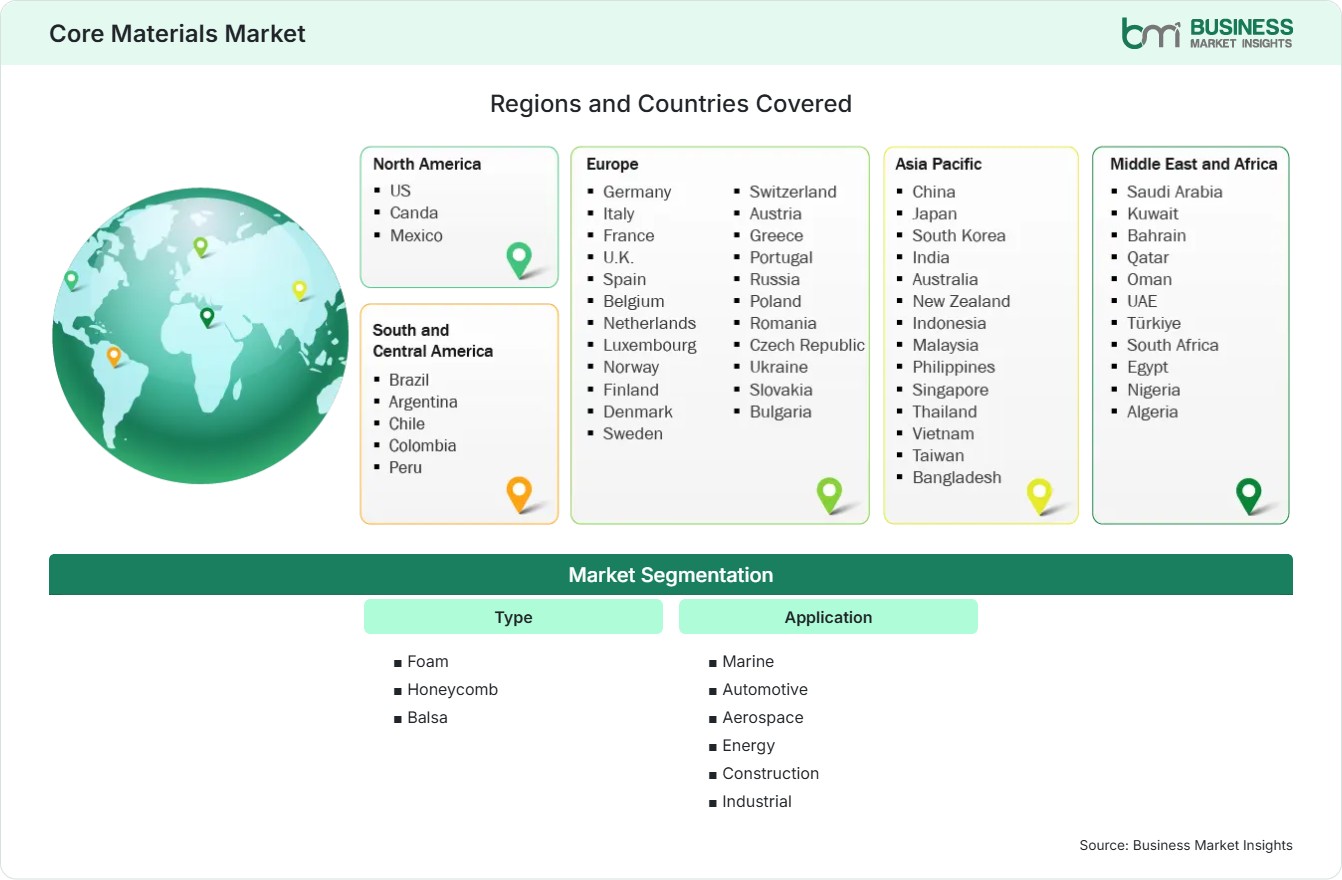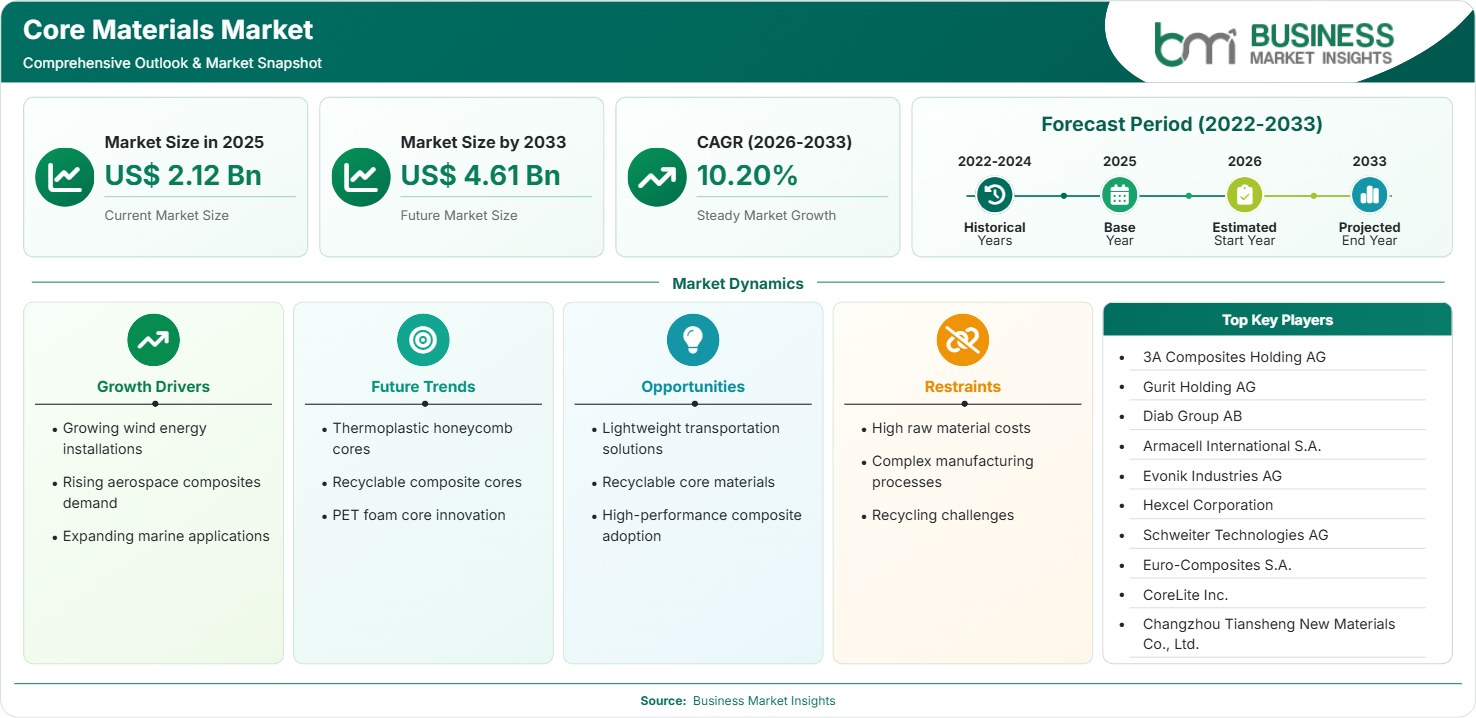
Core Materials Market Regional Highlights
North America Core Materials Market
North America represented approximately 32%–36% of the global market in 2025 and is projected to expand at a CAGR of 9.8%–10.3% during 2026–2033. The region benefits from advanced aerospace manufacturing, renewable energy investments, marine industries, and established composite technology capabilities. The Core Materials market share remains significant due to strong demand for lightweight structures, defense applications, and high-performance composite solutions across multiple industries.
- The United States remains the largest contributor due to aerospace composite manufacturing, wind energy development, and advanced material research.
- Canada supports regional growth through renewable energy projects, marine applications, and sustainable composite material adoption.
- Aerospace manufacturers are increasing composite usage to improve aircraft efficiency and reduce structural weight.
- Wind energy investments continue creating demand for durable and lightweight blade materials.
US Core Materials Market
The United States accounted for approximately 28%–32% of global revenue in 2025 and is expected to register a CAGR of 9.9%–10.5% through 2033. The country remains a key market due to strong aerospace production, renewable energy expansion, and composite manufacturing capabilities. The Core Materials market growth is influenced by lightweight material adoption, advanced engineering applications, and increasing demand for efficient industrial structures.
- Aerospace applications remain a major demand driver due to increasing composite component utilization.
- Wind energy development is supporting demand for lightweight and durable turbine blade materials.
- Automotive manufacturers are exploring composite solutions for vehicle weight reduction and efficiency improvements.
Europe Core Materials Market
Europe held an estimated 26%–30% share in 2025 and is forecast to grow at a CAGR of 9.5%–10.1% between 2026 and 2033. The region benefits from strong renewable energy commitments, aerospace capabilities, marine industries, and sustainability-focused manufacturing policies. Germany, France, the United Kingdom, Italy, and Spain represent important markets due to composite innovation and industrial production capabilities.
- Germany remains a major market due to automotive engineering, wind energy projects, and advanced composite manufacturing.
- France supports demand through aerospace production and marine composite applications.
- The United Kingdom demonstrates growth through renewable energy investments and lightweight engineering solutions.
- European manufacturers are focusing on recyclable composites and sustainable material development.
Asia Pacific Core Materials Market
Asia Pacific accounted for approximately 30%–34% of the market in 2025 and is expected to achieve the fastest growth with a CAGR of 10.8%–11.5% through 2033. Industrial expansion, renewable energy installations, automotive production, and infrastructure development are supporting regional demand. China, Japan, India, South Korea, and Southeast Asian economies represent key growth markets for composite material adoption.
- China leads regional demand through large-scale wind energy installations, manufacturing capacity, and composite production.
- India represents strong potential through renewable energy expansion and growing industrial applications.
- Japan supports adoption through aerospace technologies and advanced manufacturing capabilities.
- South Korea demonstrates increasing demand from marine, automotive, and industrial composite applications.
Rest of World Core Materials Market
The Rest of World region accounted for approximately 8%–12% share in 2025 and is projected to grow at a CAGR of 10.0%–10.8% during the forecast period. Latin America, the Middle East, and Africa are witnessing increasing composite adoption due to renewable energy projects, industrial development, and infrastructure modernization. Expanding wind installations and marine activities are creating additional opportunities.
- Brazil represents a growing market due to renewable energy expansion and industrial composite applications.
- Mexico supports demand through automotive manufacturing and lightweight material adoption.
- Middle Eastern countries are investing in renewable energy infrastructure requiring advanced composite materials.
- African markets are developing opportunities through wind energy projects and industrial modernization.
- Regional manufacturers are increasing focus on cost-effective composite solutions for emerging applications.