
Superalloys Market Outlook: Size, Share, Trends, Growth Analysis, Competitive Landscape & Forecast, 2026-2033

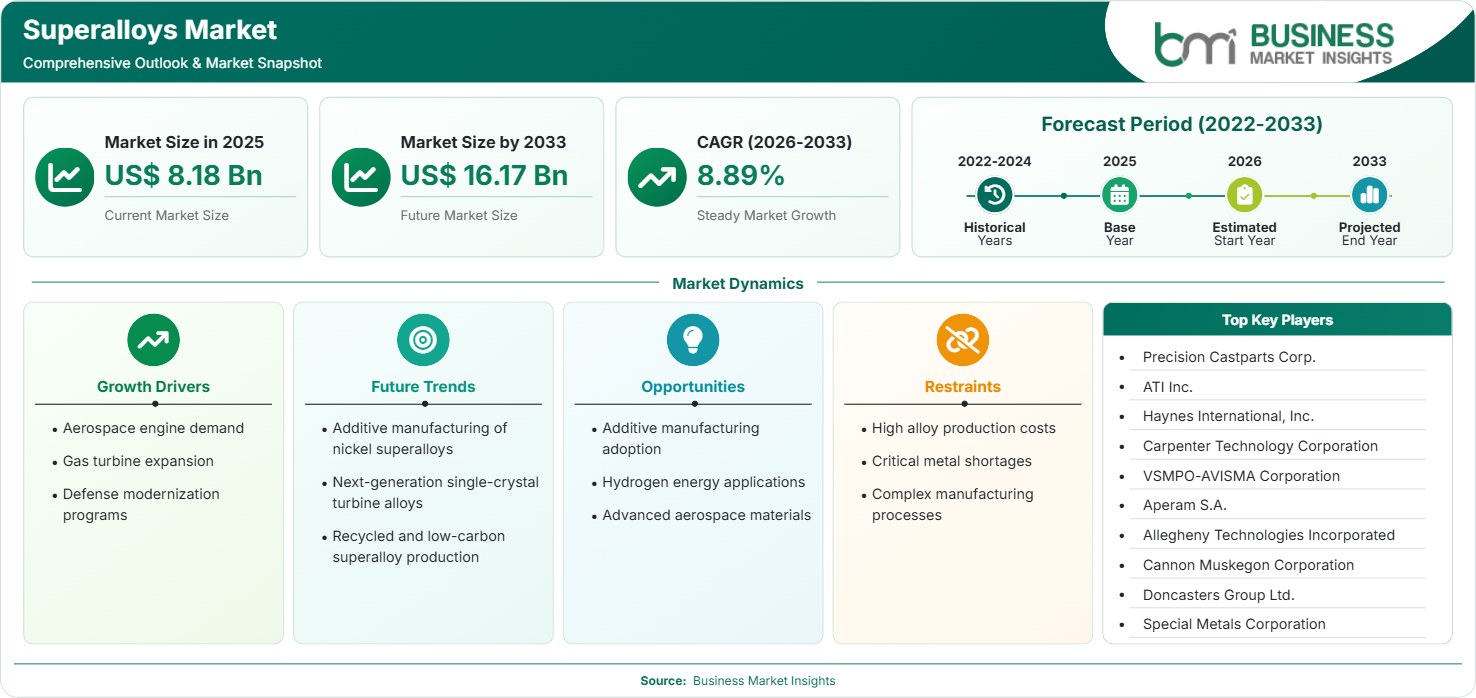
The Superalloys Market size was valued at US$ 8.18 billion in 2025 and is projected to reach US$ 16.17 billion by 2033, growing at a CAGR of 8.89% during 2026–2033. Growth is driven by aerospace engine demand, gas turbine expansion, defense modernization programs, and the rising adoption of advanced high-temperature materials across critical industrial applications.

Report Coverage
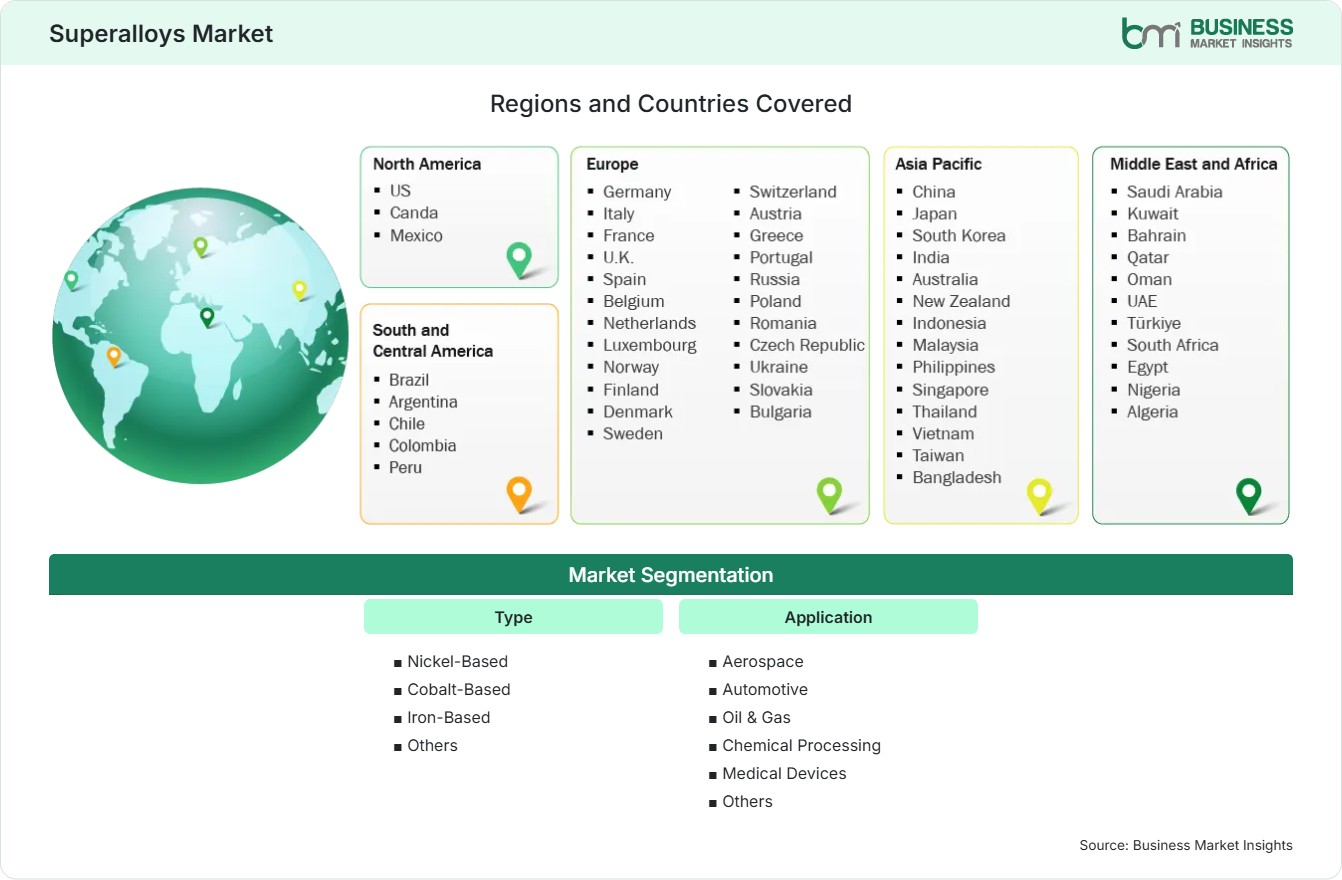
  • Type: Nickel-Based, Cobalt-Based, Iron-Based, Others
  • Application: Aerospace, Automotive, Oil & Gas, Chemical Processing, Medical Devices, Others
US$ 8.18 Bn Market size in 2025
US$ 16.17 Bn Market Size by 2033
8.89% CAGR, 2026 - 2033
2026-2033 Forecast Period

01 AI Overview

Superalloys Market Summary

  • North America Region: North America holds an estimated 38%–42% superalloys market share in 2025, growing at 8.1%–8.7% CAGR during 2026–2033. Aerospace manufacturing, defense investments, advanced turbine development, and energy infrastructure modernization support regional demand. The US market remains the largest contributor, expanding at an estimated 8.3%–8.9% CAGR through 2033 due to aircraft engine production, military programs, and industrial gas turbine applications.
  • Fastest Growing Region: Asia Pacific represents an estimated 29%–33% share in 2025, expanding at a 9.5%–10.2% CAGR during 2026–2033. Commercial aviation expansion, defense manufacturing, power generation investments, and industrial development across China, India, Japan, and South Korea accelerate superalloy consumption.
  • Leading Segment: Nickel-Based superalloys account for an estimated 58%–62% share in 2025, growing at 8.7%–9.3% CAGR during 2026–2033. Superior temperature resistance, mechanical strength, oxidation resistance, and extensive use in turbine engines maintain dominance across aerospace and energy applications.
  • High Growth Segment: Medical Devices applications represent an estimated 8%–11% share in 2025, expanding at a 10.0%–10.8% CAGR during 2026–2033. Growing demand for corrosion-resistant implants, surgical instruments, and advanced medical components supports increasing adoption of specialized superalloy materials.
  • Key Market Opportunity: Additive manufacturing adoption, hydrogen energy systems, next-generation aircraft development, and advanced aerospace material requirements are creating opportunities for manufacturers developing lightweight, durable, and high-temperature-resistant alloy solutions.
  • Major Market Players: Precision Castparts Corp., ATI Inc., Haynes International, Inc., Carpenter Technology Corporation, VSMPO-AVISMA Corporation, Aperam S.A., Allegheny Technologies Incorporated, Cannon Muskegon Corporation, Doncasters Group Ltd., Special Metals Corporation.
02 Strategic Insights

Superalloys Market: Strategic Insights

Superalloys Market Strategic Framework
FREE PDF
Request your free sample
Request free sample
03 Stakeholder View

Key Takeaways

1. The superalloy value chain involves specialty metal producers, alloy developers, powder manufacturers, casting companies, machining providers, aerospace suppliers, and end-use manufacturers, with material quality and certification requirements shaping competitive positioning.

2. Aerospace propulsion remains the strongest demand generator, while gas turbines, defense systems, medical devices, and advanced energy technologies provide additional growth opportunities for specialized alloy producers.

3. Material innovation is increasingly focused on additive manufacturing-compatible powders, improved creep resistance, oxidation-resistant compositions, and lightweight alloy development for next-generation aerospace and industrial applications.

4. Asia Pacific represents a strategic expansion opportunity due to commercial aircraft production growth, defense capability development, industrial turbine demand, and increasing investment in advanced manufacturing infrastructure.

5. Industry consolidation and strategic partnerships are increasing as companies seek access to advanced metallurgy capabilities, specialized processing technologies, and supply chain security for critical alloy materials.

04 Geographic Outlook

Superalloys Market Regional Highlights

North America Superalloys Market

North America maintains leadership with an estimated 38%–42% market share in 2025, supported by aerospace engine manufacturing, defense programs, advanced turbine production, and established specialty metals capabilities. The region is projected to grow at an 8.1%–8.7% CAGR during 2026–2033 as aircraft production, military modernization, and energy infrastructure investments continue driving demand for high-performance materials.

  • The United States dominates regional consumption through aerospace engine manufacturing, defense applications, and advanced industrial turbine production.
  • Aerospace manufacturers continue increasing demand for nickel-based superalloys due to their ability to withstand extreme temperatures and mechanical stress.
  • Defense modernization programs support adoption of advanced materials for aircraft engines, missile systems, and military equipment.
  • Industrial gas turbine development creates additional demand for high-temperature-resistant alloy solutions.

US Superalloys Market

The US market accounts for an estimated 82%–86% share of North America's market in 2025 and is expected to expand at an 8.3%–8.9% CAGR through 2033. Strong aerospace manufacturing capabilities, defense spending, and specialty metal production infrastructure continue supporting market expansion. Increasing focus on domestic supply chains for strategic materials further strengthens demand.

  • Aircraft engine production remains a major application area requiring certified high-performance alloy materials.
  • Defense investments are increasing demand for advanced materials supporting next-generation military platforms.
  • Energy sector modernization continues encouraging adoption of superalloys in industrial turbine applications.

Europe Superalloys Market

Europe represents an estimated 24%–27% share in 2025, growing at an 8.0%–8.6% CAGR during 2026–2033. The region benefits from strong aerospace manufacturing capabilities, industrial engineering expertise, and advanced material research. Germany, France, and the United Kingdom remain key contributors due to aircraft manufacturing, turbine development, and defense technology investments during superalloys market forecasts.

  • Germany maintains strong demand through industrial engineering, aerospace production, and advanced manufacturing capabilities.
  • France benefits from aerospace engine manufacturing and commercial aviation supply chain strength.
  • The United Kingdom continues investing in aerospace materials and defense technology applications.
  • European energy transition initiatives support research into high-performance materials for future turbine technologies.

Asia Pacific Superalloys Market

Asia Pacific represents an estimated 29%–33% share in 2025 and records the fastest expansion at a 9.5%–10.2% CAGR during 2026–2033. Rising aircraft production, defense modernization, industrial turbine installations, and manufacturing expansion are supporting regional growth. China, Japan, India, and South Korea are strengthening domestic capabilities in advanced alloy production and aerospace manufacturing, promoting superalloys market growth.

  • China leads regional demand through aerospace development, industrial production, and power generation investments.
  • India is increasing superalloy consumption through aviation expansion, defense manufacturing, and energy infrastructure development.
  • Japan continues supporting demand through precision manufacturing and advanced materials expertise.
  • South Korea's aerospace and industrial technology sectors create additional opportunities for specialty alloys.
  • Regional additive manufacturing investments are encouraging new superalloy processing capabilities.

Rest of World Superalloys Market

Latin America, the Middle East, and Africa collectively represent an estimated 7%–10% share in 2025, expanding at an 8.6%–9.4% CAGR through 2033. Growth is supported by energy infrastructure investments, aviation expansion, defense procurement, and industrial development. Middle Eastern countries are increasing investments in advanced energy systems, while Latin America benefits from aerospace and industrial modernization as per superalloys market analysis.

  • Gulf countries are investing in advanced energy infrastructure requiring high-temperature-resistant materials.
  • Brazil supports regional demand through aerospace manufacturing and industrial applications.
  • Oil and gas projects continue requiring durable materials for extreme operating conditions.
  • Aviation sector expansion creates additional demand for certified superalloy components.
  • Industrial modernization initiatives are gradually increasing adoption across emerging markets.
Global Market Geography
FREE PDF
Request your free sample
Request free sample
05 Segment Analysis

Superalloys Market Segmentation

Type

The Type segment represents the core foundation of the Superalloys Market, accounting for an estimated 88%–92% share in 2025 and expanding at a 8.6%–9.2% CAGR during 2026–2033. Demand is concentrated around alloys capable of maintaining mechanical strength, corrosion resistance, and structural stability under extreme temperature conditions. Aerospace engines, gas turbines, defense systems, and industrial equipment manufacturers increasingly prioritize advanced alloy compositions that improve efficiency, durability, and operational performance. Material innovation, including powder metallurgy and additive manufacturing-compatible alloys, continues influencing product development strategies.

  • Nickel-Based: Nickel-based superalloys dominate demand due to exceptional high-temperature strength, oxidation resistance, and creep performance, making them essential for aircraft engines, gas turbines, and advanced energy systems.
  • Cobalt-Based: Cobalt-based superalloys are valued for wear resistance, thermal stability, and corrosion performance, supporting applications in aerospace components, industrial turbines, medical devices, and specialized engineering systems.
  • Iron-Based: Iron-based superalloys provide cost-effective performance with balanced mechanical properties, supporting applications requiring moderate temperature resistance, durability, and economical material solutions across industrial sectors.

Application

The Application segment accounts for an estimated 92%–96% share in 2025 and is projected to grow at a 8.8%–9.4% CAGR through 2033. Aerospace remains the dominant consumption area due to increasing aircraft production and engine efficiency requirements. However, demand diversification across energy, healthcare, automotive, and chemical industries is expanding the market. The Superalloys Market trends indicate increasing adoption of specialized materials for applications requiring extreme durability, thermal resistance, and long service life.

  • Aerospace: Aerospace remains the largest application segment as aircraft engines require superalloys capable of maintaining strength, creep resistance, and reliability under extreme operating temperatures.
  • Automotive: Automotive adoption is increasing through high-performance engines, turbocharger components, electric vehicle thermal management systems, and specialized applications requiring durable temperature-resistant materials.
  • Oil & Gas: Oil and gas industries utilize superalloys in turbines, drilling equipment, and processing systems requiring resistance against corrosion, pressure, and challenging operating environments.
  • Chemical Processing: Chemical processing facilities adopt superalloys for equipment exposed to aggressive chemicals, elevated temperatures, and corrosive operating conditions requiring extended service reliability.
  • Medical Devices: Medical device manufacturers increasingly use superalloys for implants, surgical tools, and precision components requiring biocompatibility, corrosion resistance, and mechanical durability.
06 Market Forces

Superalloys Market Dynamics

Key Market Drivers

Aerospace engine demand increases high-performance alloy consumption

The increase in commercial aviation sector growth, the replacement of aircraft fleet by more advanced planes, and increasing needs to increase engine efficiency have increased the need for advanced superalloys. Modern turbine engines are run at very high pressure and temperatures, necessitating the need for advanced materials that offer high creep and oxidation resistance and mechanical strength. Manufacturers of aircraft and engines keep on developing lightweight materials to increase their fuel efficiency and minimize their emission levels. Growth in the Superalloys Market is highly associated with the production process and technological development in the aerospace industry and growing demand for advanced engines. Nickel superalloys are vital since they offer the necessary properties of the engines.

Gas turbine expansion supports industrial alloy demand

Increased electricity demands, energy infrastructure developments, and upgrades in power generating equipment led to higher demand for gas turbines that have high-quality superalloys incorporated into their design. Turbines in industry need to be built of materials that can work constantly under very high temperatures, high stress levels, and harsh environmental conditions. Generation of electricity from natural gas, development of combined cycle plants, and introduction of turbines that can use hydrogen also open up new possibilities for alloy makers. Superalloys provide better turbine performance due to the ability to operate at higher temperatures.

Defense modernization programs strengthen material requirements

Military establishments all over the world are stepping up their investments in next-generation aircrafts, engines, and military equipment that require special high-performance materials. Superalloys are critical for use in engines of fighter jets, missiles, marine propulsion devices, and defense aerospace equipment due to their capability of enduring severe operating conditions. The modernization efforts are motivating defense contractors to go for better-performing materials that are more durable, have greater thermal stability, and are more reliable. There is an increasing demand for certified specialty alloys as countries focus on strategic capabilities and defense manufacturing.

Key Market Opportunities

Additive manufacturing adoption enables advanced alloy applications

Additive manufacturing has opened up several avenues for superalloys manufacturers, as it allows for the creation of complicated shapes and lighter weight constructions and optimized component design that were previously impossible to make using traditional techniques. Manufacturers of aerospace and industrial equipment are now considering the possibility of using metal additive manufacturing in making turbine parts and heat-resistant materials, among others. Powdered superalloys capable of being used in advanced manufacturing processes are becoming more relevant as firms look for ways to increase material efficiency and minimize waste during production.

Hydrogen energy applications create new material demand

The move toward the use of hydrogen-based energy sources globally provides new business opportunities for the producers of superalloys producing materials that will be able to function in hydrogen-rich conditions. The hydrogen turbines, hydrogen energy storage facilities, and equipment for energy transformation will need parts that will withstand thermal, oxidative, and corrosive effects. As companies in the energy industry make investments into carbon-free energy production solutions, there might be an increased demand for special alloys for their future energy infrastructure.

Advanced aerospace materials support next-generation aircraft

The design of next-generation aircraft platforms is driving an increased need for lightweight and high-strength materials with the ability to resist high temperatures. The aerospace industry is investing in innovative alloy formulas, process innovations, and mixed manufacturing methods in order to improve engine performance and minimize pollution. Superalloys continue to be important for engine components where traditional alloys would not be able to function in the operational environment. Thermal barrier innovations, powder metallurgy, and improved casting technology are creating more business opportunities for those companies that are qualified in the aerospace market.

Market Restraints and Challenges

High alloy production costs impact adoption and margins

Factor: The manufacturing of superalloys is costly due to the expensive nature of raw materials used, specific techniques of melting, controlled manufacturing environment, and sophisticated processing techniques used.

Impact: Costly manufacturing results in difficulty in use in cost sensitive applications as well as creating costs pressures along the entire supply chain. Certification requirements for aerospace products will further increase costs of developing such alloys.

Critical metal shortages create supply chain risks

Factor: The manufacture of superalloys is reliant on critical materials such as nickel, cobalt, and chromium, among others, which are subject to supply shortages because of various geopolitical issues, mining challenges, and unpredictable demand.

Impact: A shortage of raw materials may drive up procurement expenses, prolong manufacturing periods, and introduce uncertainties for manufacturers relying on predictable supplies of raw materials. Manufacturers are looking more into recycling, substitutes, and strategic sourcing to lower risks of critical material shortages.

07 Company Analysis

Competitive Landscape

The Superalloys Market competitive environment is shaped by specialty metal producers, aerospace material suppliers, advanced manufacturing companies, and vertically integrated alloy manufacturers. Leading companies compete through metallurgical expertise, aerospace certifications, production capacity expansion, additive manufacturing capabilities, and customized alloy development. The industry is increasingly focused on strengthening supply chain reliability, improving material performance, and supporting next-generation aerospace, energy, and defense applications.

Company Name

Overview

Products and Services Relevant to this Market

Precision Castparts Corp.

Aerospace-focused manufacturer providing complex metal components and advanced materials for critical applications.

Nickel-based superalloys, investment castings, aerospace engine components, precision metal solutions.

ATI Inc.

Specialty materials producer supplying advanced alloys for aerospace, energy, and industrial applications.

Nickel-based alloys, titanium alloys, specialty metals, forged components, powder metallurgy products.

Haynes International, Inc.

High-performance alloy manufacturer specializing in corrosion-resistant and heat-resistant materials.

Nickel-based superalloys, cobalt-based alloys, sheet products, aerospace and industrial components.

Carpenter Technology Corporation

Specialty alloy producer supporting aerospace, defense, medical, and industrial applications.

Premium alloys, powder metals, corrosion-resistant alloys, engineered material solutions.

VSMPO-AVISMA Corporation

Titanium and specialty materials producer serving aerospace and industrial customers globally.

Aerospace alloys, titanium products, specialty metal materials, engineered components.

Aperam S.A.

Global stainless and specialty alloy producer serving industrial and advanced material markets.

Nickel alloys, specialty steels, high-performance materials, corrosion-resistant products.

Allegheny Technologies Incorporated

Advanced materials manufacturer supplying aerospace, defense, and energy industries.

Nickel-based alloys, superalloys, titanium products, forged components, specialty metals.

Cannon Muskegon Corporation

Specialty metal producer focused on aerospace and industrial alloy applications.

Nickel alloys, cobalt alloys, vacuum melted materials, precision metal products.

Doncasters Group Ltd.

Aerospace manufacturing company specializing in turbine components and advanced metal processing.

Turbine blades, aerospace castings, superalloy components, precision engineering services.

Special Metals Corporation

Specialty alloy manufacturer recognized for nickel-based superalloys and advanced material solutions.

Nickel alloys, high-temperature materials, aerospace alloys, corrosion-resistant alloy products.

08 Industry Activity

Recent Developments

June 2026

DPC Holdings Limited launched its NYSE initial public offering (IPO) under the ticker DPC, seeking to raise approximately US$700 million. The company manufactures precision cast components and nickel- and cobalt-based superalloys for aerospace engines and industrial gas turbines, supplying major OEMs including GE Aerospace, Honeywell, Pratt & Whitney, Rolls-Royce, and Safran through long-term agreements.

June 2026

Airbus and Safran signed a binding agreement to acquire Tikehau Capital's stake in Aubert & Duval, making the two aerospace companies’ equal owners of the French producer of superalloys and specialty metals. The acquisition strengthens the supply chain for critical aerospace materials used in turbine discs, engine hot sections, and landing gear for civil and military aircraft.

June 2026

Mishra Dhatu Nigam Limited (MIDHANI) received CEMILAC airworthiness certification for eight grades and forms of superalloys, along with titanium alloys and specialty steels, enabling series production of critical materials for advanced aero-engine applications and strengthening India's indigenous aerospace materials capabilities.

February 2026

Alloyed developed ABD-1000AM, a nickel-based superalloy engineered for additive manufacturing and capable of maintaining performance at temperatures exceeding 1,000°C. Developed in collaboration with ITP Aero and Cranfield University under the £14 million ATI Programme, the material is intended for next-generation jet engine and industrial gas turbine applications.

10 Trust & Transparency

Research Methodology

The market analysis combines proprietary research with secondary data from government agencies, company disclosures, regulatory filings, industry databases and expert interviews. Market estimates are validated through data triangulation, cross-market benchmarking and analyst review.

View Full Research Methodology

11 Questions Answered

Frequently Asked Questions

What challenges affect the superalloy industry?

The industry faces challenges including high production costs, critical metal availability concerns, complex manufacturing requirements, and the need for specialized processing technologies and certification capabilities.

How is additive manufacturing affecting superalloy production?

Additive manufacturing enables production of complex geometries, reduces material waste, supports lightweight component designs, and expands possibilities for customized aerospace and industrial superalloy applications.

Which application segment has the strongest demand for superalloys?

In superalloys market report, aerospace remains the leading application because aircraft engines require materials capable of maintaining structural integrity under extreme thermal and mechanical conditions.

Why are nickel-based superalloys widely used?

Nickel-based superalloys provide excellent high-temperature strength, oxidation resistance, creep resistance, and durability, making them essential for aircraft engines, industrial turbines, and advanced energy applications.

What factors are driving growth in the Superalloys Market?

Growth is primarily driven by increasing aerospace engine production, gas turbine expansion, defense modernization programs, and rising demand for materials capable of operating under extreme temperatures, pressure conditions, and corrosive environments.

Access the Full Superalloys Market Report

Get segment-level forecasts, regional estimates, competitive benchmarking, company profiles and downloadable Excel datasets.

Access the full Superalloys Market Report
350 pages PDF & Excel | 2026-07-30