
Bioplastics Market Outlook: Size, Share, Trends, Growth Analysis, Competitive Landscape & Forecast, 2026-2033

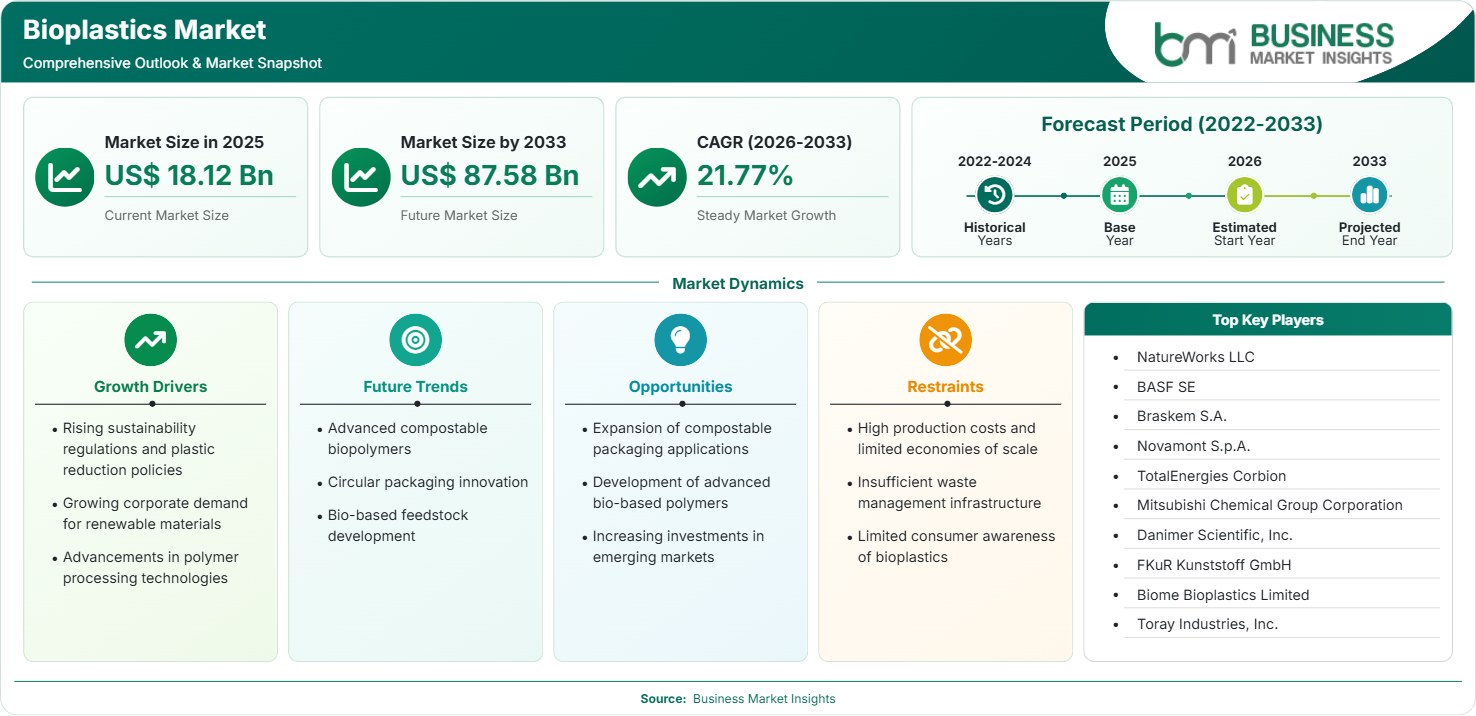
The Bioplastics Market size was valued at US$ 18.12 billion in 2025 and is projected to reach US$ 87.58 billion by 2033, growing at a CAGR of 21.77% during 2026–2033. This market growth will be propelled by the increasing demand for sustainable packaging, pressures on traditional plastic materials, innovations in bio-materials, and investments.

Report Coverage
  • Type: Biodegradable (Starch Blends, Polylactic Acid, Polybutylene Adipate Terephthalate, Polybutylene Succinate), Non-Biodegradable (Bio-Polyethylene Terephthalate, Bio-Polyamide, Bio-Polyethylene, Bio-Polytrimethylene Terephthalate
  • Application: Rigid Packaging (Bottles & Jars, Trays), Flexible Packaging (Pouches, Shopping/Waste Bags), Textiles, Automotive & Transportation
US$ 18.12 Bn Market size in 2025
US$ 87.58 Bn Market Size by 2033
21.77% CAGR, 2026 - 2033
2026-2033 Forecast Period

01 AI Overview

Bioplastics Market Summary

  • North America Region: North America represents 32% to 35% market share in 2025, with a CAGR of 20% to 22%, driven by the adoption of sustainable packaging, organizations' environmental commitments, and the development of biopolymer manufacturing. The market in the US is projected to grow at a CAGR of 21% to 23% between 2026 and 2033.
  • Fastest Growing Region: Asia Pacific accounts for a market share of 28%–31% in 2025, expanding at a CAGR of 23%–25% supported by manufacturing capacity growth, government sustainability programs, rising packaging consumption, and increasing investments in bio-based polymer production infrastructure.
  • Leading Segment: Market share of biodegradable bioplastics is forecast to be somewhere around 68%-72% with a CAGR of 22%-24% as the result of increased use of compostable packaging, restrictions on the use of single-use plastics, and advanced technology in terms of starch and PLA blending.
  • High Growth Segment: Flexible Packaging constitutes a market share of 35%–38%, with a CAGR of 24%–26% from the demand for lighter materials, sustainable food packaging options, recycling efforts, and enhanced barrier performance of bio-based films.
  • Key Market Opportunity: Increased investment in biorefinery technologies, innovative compostable plastics, and packaging systems will provide manufacturers with opportunities to mass-produce their products while improving material quality and meeting market demands.
  • Major Market Players: NatureWorks, BASF, Braskem, Novamont, TotalEnergies Corbion, Mitsubishi Chemical Group, Danimer Scientific, FKuR Kunststoff, Biome Bioplastics, Toray Industries.
02 Strategic Insights

Bioplastics Market: Strategic Insights

Bioplastics Market Strategic Framework
FREE PDF
Request your free sample
Request free sample
03 Stakeholder View

Key Takeaways

  • The market ecosystem is evolving through stronger integration between feedstock suppliers, polymer manufacturers, converters, and end-use industries, creating a more connected sustainable materials value chain.
  • Packaging applications represent the strongest commercial opportunity, particularly flexible formats and food-contact materials where brands are seeking alternatives that meet sustainability targets without compromising performance.
  • Innovation is shifting toward improved biodegradability, enhanced mechanical properties, and next-generation bio-based polymers capable of competing with conventional plastics across demanding applications.
  • Asia Pacific provides a compelling investment landscape due to expanding manufacturing capabilities, government sustainability initiatives, and rising consumption across China, India, Japan, and Southeast Asian economies.
  • Strategic partnerships, capacity expansions, and technology collaborations are increasing as established chemical companies and specialized biopolymer producers compete to strengthen sustainable materials portfolios.
04 Geographic Outlook

Bioplastics Market Regional Highlights

North America Bioplastics Market

North America has a market share of 32%–35% in 2025 and is expected to grow at a CAGR of 20%–22% from 2026 to 2033. North America has several factors supporting its growth, including high research in polymers, commitment to sustainable packaging, and usage of renewable polymers by companies.

  • Sustainable packaging initiatives are accelerating adoption as food, beverage, and retail companies pursue lower-carbon material alternatives and environmentally responsible product strategies.
  • The United States maintains production leadership through biotechnology innovation, established chemical infrastructure, and investments in scalable bio-based polymer manufacturing facilities.
  • Regulatory measures targeting plastic waste reduction are encouraging manufacturers to develop compostable and recyclable material solutions for commercial applications.
  • Corporate sustainability goals are increasing demand for certified bio-based polymers across packaging, automotive, and consumer product industries.

US Bioplastics Market

The US accounted for a market share of 27%–30% in 2025 and is expected to grow at a CAGR of 21%–23% from 2026 to 2033. Excellent research potential, developed packaging industry, and investments in renewable material are some of the factors that would fuel local growth.

  • The US market benefits from biotechnology research networks developing advanced biodegradable polymers and improved production processes.
  • Food packaging companies are adopting bio-based materials to meet consumer expectations for environmentally responsible product offerings.
  • Government sustainability programs and corporate commitments are encouraging investment in domestic biopolymer production capacity.
  • Partnerships between material developers and consumer brands are improving commercialization pathways for innovative solutions.

Europe Bioplastics Market

Europe held a market share of 25%–28% in 2025 and is expected to experience CAGR of 21%-23% from 2026 to 2033. Region holds key position among the sustainability driven markets owing to environmental regulations, policies of circular economy, and adoption in packaging industries.

  • Germany demonstrates strong growth through advanced chemical manufacturing capabilities, research investments, and industrial adoption of sustainable polymers.
  • France is expanding adoption through regulatory support for renewable materials and reduced reliance on conventional plastic packaging.
  • Italy remains important due to established biopolymer producers and strong demand for compostable packaging applications.
  • European Union policies promoting waste reduction and recycling are encouraging manufacturers to invest in bio-based alternatives.
  • Consumer preference for sustainable products continues influencing packaging redesign strategies across multiple industries.

Asia Pacific Bioplastics Market

The Asia Pacific market held a market share of 28%-31% in 2025 and is expected to register growth of 23%-25% during the period from 2025-2033. This region is considered the fastest-growing market owing to increasing manufacturing capabilities, consumption, and sustainability programs by the governments.

  • China is strengthening its position through large-scale chemical manufacturing capabilities and investments in renewable material production infrastructure.
  • India is witnessing increased adoption due to growing packaging demand, sustainability programs, and emerging bio-based material manufacturing projects.
  • Japan supports market development through advanced polymer technology, research expertise, and high-value sustainable material applications.
  • Southeast Asian countries are attracting investment through agricultural feedstock availability and expanding packaging industries.
  • Regional manufacturers are improving production economics through technology upgrades and supply chain localization.

Rest of World Bioplastics Market

Latin America, Middle East, and Africa collectively represented a market share of 8%–10% in 2025 and are expected to grow at a CAGR of 18%–21% between 2026 and 2033. Adoption is supported by renewable feedstock availability, sustainability initiatives, and increasing packaging demand.

The South and Central America markets gain advantages due to their agricultural base for developing biomaterials. At the same time, the Middle Eastern markets are looking into ways to diversify their economies beyond petrochemicals. The Bioplastics Market share is slowly growing in these regions.

  • Mexico benefits from proximity to North American supply chains and growing sustainable packaging requirements.
  • Gulf countries are exploring bio-based materials as part of industrial diversification and sustainability strategies.
  • South Africa is adopting sustainable packaging solutions through environmental initiatives and consumer awareness.
  • Regional manufacturers are developing partnerships to improve access to advanced biopolymer technologies.
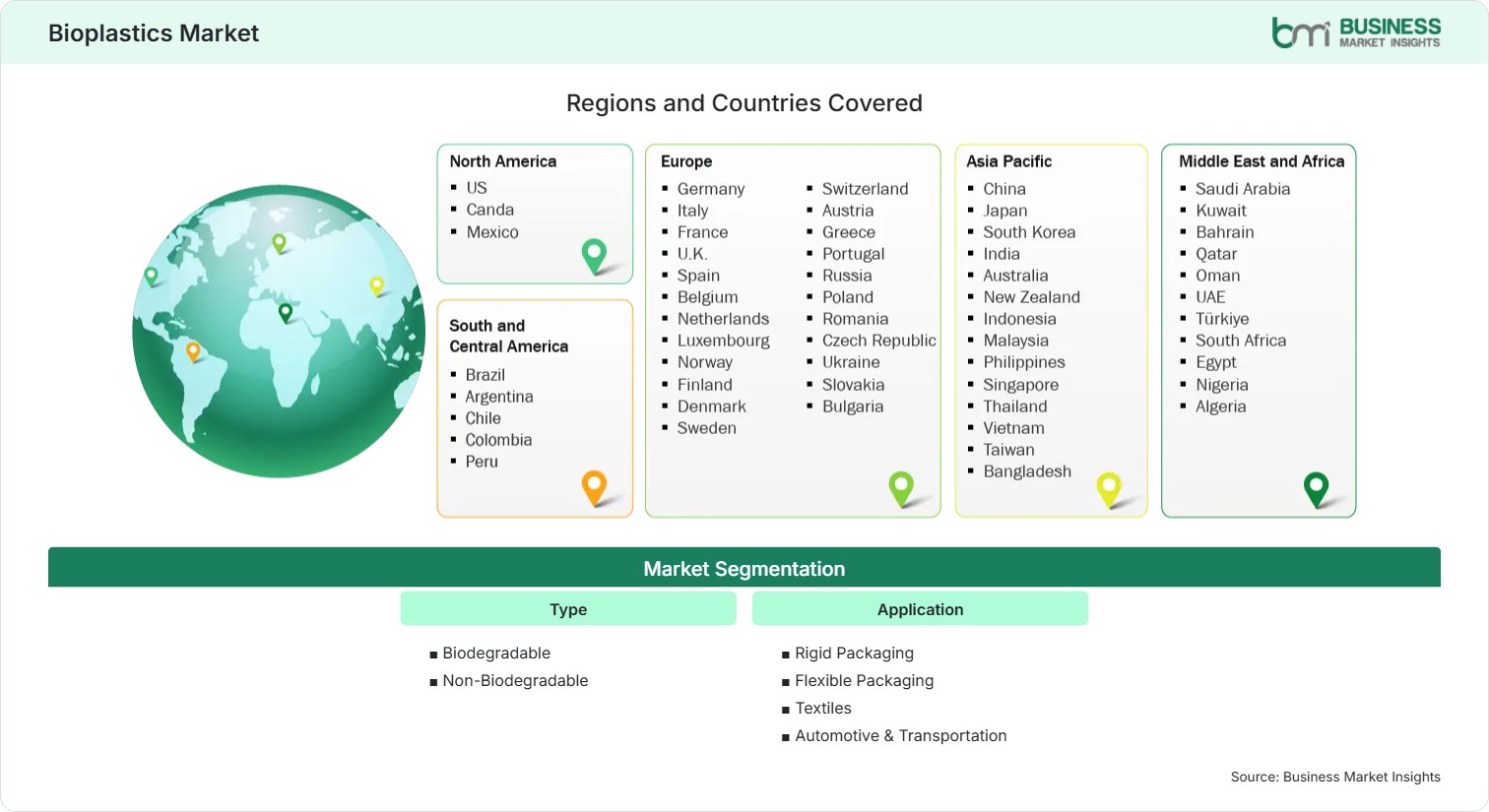
Global Market Geography
FREE PDF
Request your free sample
Request free sample
05 Segment Analysis

Bioplastics Market Segmentation

Type

The Type segment accounted for a market share of 68%–72% in 2025 and is expected to grow at a CAGR of 22%-24% from 2026 to 2034. Growing preference for renewables and compostables, coupled with rising regulations and enhanced polymer performance, is driving adoption rates across packaging, consumer goods, and other industries. The Bioplastics Market's scope remains vast as producers develop new biodegradable and bio-based products.

  • Biodegradable: Biodegradable materials dominate adoption due to environmental benefits, compostability requirements, and growing demand for sustainable packaging solutions. Innovations in polymer blends are improving durability, processing efficiency, and commercial scalability.
  • Starch blends: Starch blends provide cost-effective biodegradable alternatives by combining renewable starch sources with synthetic or natural polymers. Their flexibility supports applications in packaging films, disposable products, and agricultural materials.
  • Polylactic acid: Polylactic acid is widely adopted due to renewable feedstocks, transparency, and suitability for food packaging. Continuous improvements in heat resistance and processing capabilities are expanding its industrial applications.
  • Polybutylene Adipate Terephthalate: Polybutylene Adipate Terephthalate offers flexibility and biodegradability, making it suitable for compostable films, bags, and packaging applications requiring enhanced mechanical properties and environmental performance.
  • Polybutylene Succinate: Polybutylene Succinate adoption is increasing due to biodegradability, thermal stability, and compatibility with existing processing technologies. It supports applications requiring durable and environmentally responsible polymer solutions.
  • Non-Biodegradable: Non-biodegradable bio-based polymers are gaining attention due to reduced fossil dependency and improved lifecycle performance. Their compatibility with existing recycling systems supports adoption in durable applications.
  • Bio- Polyethylene Terephthalate: Bio- Polyethylene Terephthalate provides renewable alternatives for beverage bottles and packaging formats while maintaining performance characteristics similar to conventional polyethylene terephthalate materials.
  • Bio-Polyamide: Bio-Polyamide materials are expanding in automotive and industrial applications due to strength, thermal resistance, and suitability for high-performance components requiring renewable content.
  • Bio-Polyethylene: Bio-Polyethylene adoption is increasing in packaging and consumer goods because it provides similar functionality to conventional polyethylene while reducing dependence on fossil-based feedstocks.
  • Bio-Polytrimethylene Terephthalate: Bio-Polytrimethylene Terephthalate supports textile and automotive applications through enhanced elasticity, durability, and renewable material integration for specialized performance requirements.

Application

The application segment accounted for a market share of 72% to 76% in 2025 and is anticipated to register a CAGR of 21% to 23% during 2026-2034. Packaging continues to be the largest application segment owing to growing commitment to sustainable materials among brands, regulations, and consumer awareness of environmentally friendly products.

  • Rigid Packaging: Rigid packaging applications are expanding through adoption of bio-based bottles, containers, and food packaging formats. Improved barrier properties and material strength support replacement of conventional plastics.
  • Bottles & Jars: Bottles and jars are adopting bio-based polymers due to demand for sustainable beverage and personal care packaging. Manufacturers focus on maintaining clarity, durability, and recyclability performance.
  • Trays: Bio-based trays are gaining traction in food packaging due to compostability requirements, reduced environmental impact, and compatibility with automated packaging systems used by manufacturers.
  • Flexible Packaging: Flexible packaging represents a high-growth application due to lightweight characteristics, reduced material usage, and increasing demand for sustainable films, pouches, and bags across consumer industries.
  • Pouches: Sustainable pouches are expanding through demand for convenient packaging formats with lower material footprints. Bio-based films are improving barrier properties for food and consumer product applications.
  • Shopping/Waste Bags: Bio-based shopping and waste bags are benefiting from restrictions on conventional plastic bags, increasing adoption of compostable alternatives in retail and municipal waste management systems.
  • Textiles: Textile applications are incorporating bio-based fibers to reduce environmental impact. Manufacturers are exploring renewable polymer solutions for apparel, technical fabrics, and performance-oriented textile products.
  • Automotive & Transportation: Automotive applications are adopting bio-based polymers for lightweight components, interior parts, and sustainable design initiatives. Manufacturers are prioritizing materials that reduce lifecycle emissions while maintaining performance.
06 Market Forces

Bioplastics Market Dynamics

Key Market Drivers

Rising Sustainability Regulations and Plastic Reduction Policies

Governments around the world are imposing restrictions on single-use plastics and pushing towards the adoption of renewable materials, which is beneficial for the sustainable polymers industry. Regulations in Europe, North America, and the Asia-Pacific region are guiding firms towards sustainable packaging solutions. This trend is affecting product development processes, certification regulations, and investments within the plastics industry, as seen in the Bioplastics Market analysis. Circular economy trends have driven firms to collaborate to develop innovative solutions for material utilization.

Growing Corporate Demand for Renewable Materials

Large consumer goods companies are increasing their use of sustainable packaging materials to achieve environmental targets and respond to changing consumer expectations. Brand owners are collaborating with biopolymer suppliers to develop customized packaging solutions with renewable content. This demand is accelerating investments in production capacity, technology development, and supply chain partnerships, contributing to the Bioplastics Market growth across multiple industries.

Advancements in Polymer Processing Technologies

Advances in technology are contributing to higher efficiencies in performance, scale, and cost-effectiveness of bio-polymer production. Innovations are being made to develop superior formulations with improved strength, elasticity, heat resistance, and compatibility with current manufacturing machinery. Advances in research on new feedstock and fermentation techniques are leading to greater availability of commercially viable products.

Key Market Opportunities

Expansion of Compostable Packaging Applications

Compostable packaging presents an excellent opportunity as companies look for ways to handle their waste management problems. There is room for growth in the areas of food service, retail, and consumer goods packaging in which compostable products can substitute traditional plastics. Higher certification standards and improvements in waste infrastructure will help. Companies that will be able to provide quality performance and economically viable compostable products will benefit, according to the Bioplastics Market forecast.

Development of Advanced Bio-Based Polymers

Investing in advanced polymers offers opportunities to overcome current drawbacks in durability, melting temperature, and scalability. Research into enhanced formulations, renewable sources, and composite materials is opening up routes for more widespread application. Firms working on bio-based polymers can capitalize on rising demand from the automotive, electronics, and packaging sectors.

Increasing Investments in Emerging Markets

Economies in the development stage have the potential to leverage their manufacturing capacity, agriculture, and sustainability consciousness. Countries in the Asia-Pacific and Latin America are receiving investment to develop biomaterials manufacturing plants. Locating production plants may help address logistics issues and capitalize on rising demand in the region. A strategic alliance with local businesses will speed up commercialization

Market Restraints and Challenges

High Production Costs and Limited Economies of Scale

Factor: Manufacturing costs for bio-plastics are relatively higher when compared to the production of normal plastics; this influences the price competitiveness of the bio-polymers.

Impact: Affordability issues may delay the substitution of conventional plastics due to budget constraints in developing countries.

Insufficient Waste Management Infrastructure

Factor: The absence of industrial composting facilities and special recycling systems makes it difficult to dispose of biodegradable materials effectively.

Impact: Insufficient infrastructure will negate any potential environmental gains the products may offer.

07 Company Analysis

Competitive Landscape

The Bioplastics Market analysis highlights a competitive environment shaped by global chemical companies, specialized polymer manufacturers, and technology-focused innovators. Companies are strengthening their positions through capacity expansion, sustainable material development, strategic partnerships, and investments in renewable feedstocks. The competitive landscape reflects increasing focus on biodegradable polymers, bio-based alternatives, and application-specific solutions for packaging, automotive, textiles, and industrial markets.

Company Name

Overview

Products and Services relevant to this market

NatureWorks

Leading biopolymer producer specializing in renewable materials and sustainable plastics solutions.

Produces Ingeo biopolymer materials used in packaging, food service products, and consumer applications.

BASF

Global chemical company developing sustainable material solutions across multiple industrial sectors.

Offers ecovio biodegradable plastics and bio-based polymer solutions for packaging and agriculture.

Braskem

Major petrochemical producer expanding renewable polymer capabilities globally.

Produces I'm green bio-based polyethylene for packaging and consumer applications.

Novamont

Italian bioplastics specialist focused on biodegradable and compostable materials.

Develops Mater-Bi bioplastics for bags, packaging, agriculture, and consumer products.

TotalEnergies Corbion

Joint venture specializing in advanced polylactic acid solutions.

Manufactures Luminy PLA polymers for packaging, fibers, and industrial applications.

Mitsubishi Chemical Group

Global chemical enterprise investing in sustainable material innovation.

Provides bio-based polymers and specialty materials for packaging and industrial uses.

Danimer Scientific

Biotechnology company developing biodegradable polymer technologies.

Produces PHA-based materials for compostable packaging, films, and disposable products.

FKuR Kunststoff

Specialist manufacturer of sustainable plastic compounds and biopolymer solutions.

Supplies bio-based and biodegradable compounds for packaging and consumer applications.

Biome Bioplastics

UK-based developer of advanced biodegradable polymer technologies.

Develops bio-based polymers for packaging, coatings, and specialty applications.

Toray Industries

Global materials company focused on advanced polymer and fiber technologies.

Provides sustainable materials for textiles, packaging, and high-performance applications.

08 Industry Activity

Recent Developments

July, 2026

Balrampur Chini Mills Limited (BCML) has taken its nationwide outreach initiative, Bioyug on Wheels, to Rajkot, Gujarat, as part of efforts to promote the adoption of bio-based Poly Lactic Acid (PLA) bioplastics.

June, 2026

European Bioplastics (Board members include BASF SE, NatureWorks LLC, Novamont, and Futerro) elected its 2026–2029 Board, EUBP said the new board brought together the experience, diversity and industrial expertise EUBP needed for the next phase and that the appointments reflected the breadth of the European bioplastics value chain uniting expertise in bio-based, biodegradable and compostable materials, packaging, conversion, recycling technologies, sustainability, public affairs, market development and industrial scale-up.

April, 2026

BASF SE expanded its certified compostable ecovio portfolio with new barrier grades for flexible packaging, enabling recyclable and home-compostable packaging solutions for food, personal care, and healthcare applications.

March, 2025

NatureWorks LLC launched Ingeo Extend, a new PLA polymer platform that improves manufacturing efficiency for biaxially oriented PLA (BOPLA) films while enabling faster biodegradability, targeting sustainable flexible packaging applications.

10 Trust & Transparency

Research Methodology

The market analysis combines proprietary research with secondary data from government agencies, company disclosures, regulatory filings, industry databases and expert interviews. Market estimates are validated through data triangulation, cross-market benchmarking and analyst review.

View Full Research Methodology

11 Questions Answered

Frequently Asked Questions

What does the Bioplastics Market Report include?

The market report provides insights into market size, segmentation, regional developments, competitive dynamics, growth opportunities, industry trends, and future expansion strategies.

What role does government regulation play in market development?

Regulations supporting plastic waste reduction, compostable packaging standards, and circular economy initiatives are encouraging companies to invest in sustainable polymer alternatives.

How are manufacturers improving bioplastics performance?

Manufacturers are improving performance through advanced polymer formulations, renewable feedstock innovations, improved processing technologies, and research into biodegradable and bio-based material combinations.

Which application segment provides the strongest growth potential?

Flexible packaging provides strong growth potential due to lightweight designs, increasing demand for sustainable films, and rising replacement of conventional plastic packaging materials.

What factors are influencing bioplastics adoption across industries?

Adoption is influenced by sustainability regulations, corporate carbon reduction goals, consumer preference for environmentally responsible products, and technological improvements that enhance polymer performance.

Access the Full Bioplastics Market Report

Get segment-level forecasts, regional estimates, competitive benchmarking, company profiles and downloadable Excel datasets.

Access the full Bioplastics Market Report
350 pages PDF & Excel | 2026-07-28