
Plastics Market Outlook: Size, Share, Trends, Growth Analysis, Competitive Landscape & Forecast, 2026–2033

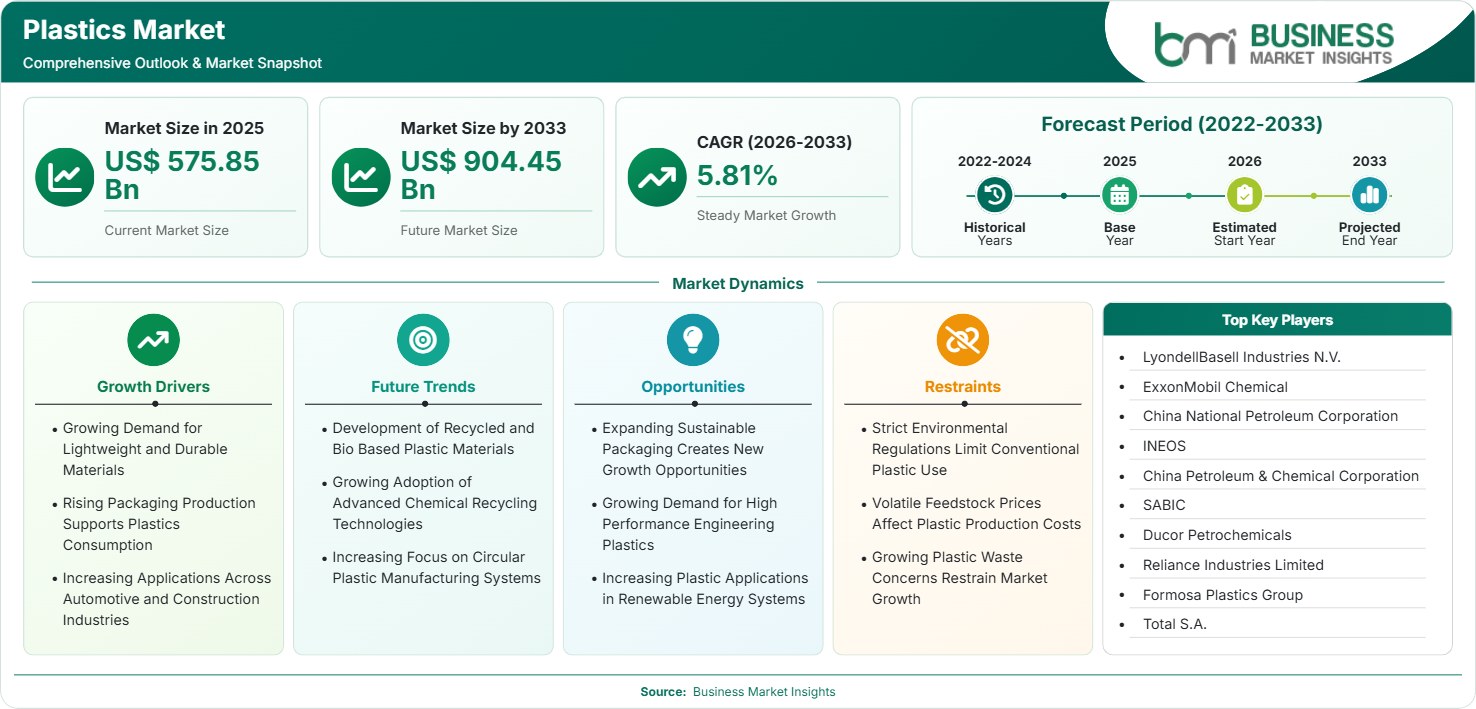
The Plastics Market size was valued at US$ 575.85 Billion in 2025 and is projected to reach US$ 904.45 Billion by 2033, growing at a CAGR of 5.81% during 2026–2033, supported by packaging demand, infrastructure development, automotive lightweighting, healthcare applications, and opportunities in recycling, advanced polymers, and circular material systems.

Report Coverage
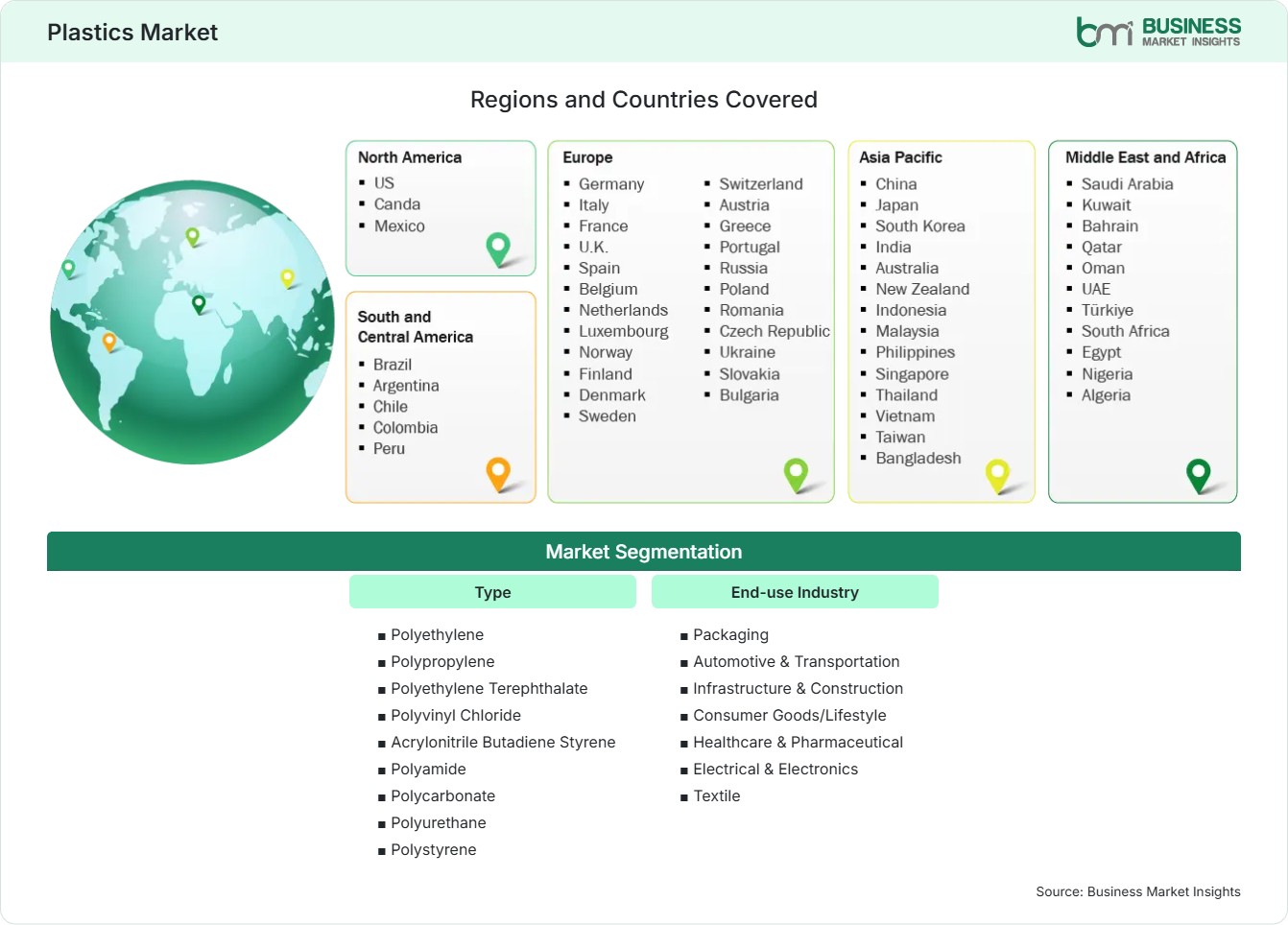
  • Type: Polyethylene, Polypropylene, Polyethylene Terephthalate, Polyvinyl Chloride, Acrylonitrile Butadiene Styrene, Polyamide, Polycarbonate, Polyurethane, Polystyrene
  • End-use Industry: Packaging, Automotive & Transportation, Infrastructure & Construction, Consumer Goods/Lifestyle, Healthcare & Pharmaceutical, Electrical & Electronics, Textile
US$ 575.85 Bn Market size in 2025
US$ 904.45 Bn Market Size by 2033
5.81% CAGR, 2026 - 2033
2026-2033 Forecast Period

AI Overview

Plastics Market Summary

  • North America Region: North America holds a 17%–20% share in 2025 and is projected to grow at a 4.8%–5.5% CAGR during 2026–2033. Packaging innovation, healthcare manufacturing, automotive applications, and advanced recycling investments support demand, while circular production models create opportunities for recycled and high-performance materials.
  • Fastest Growing Region: Asia Pacific holds a 51%–55% share in 2025 and is projected to grow at a 6.4%–7.2% CAGR during 2026–2033. Manufacturing expansion, urban development, packaging consumption, automotive production, and infrastructure investment support demand, creating opportunities for capacity additions and sustainable material technologies.
  • Leading Segment: Polyethylene holds a 27%–31% share in 2025 and is projected to grow at a 5.7%–6.4% CAGR. Broad application versatility, established processing infrastructure, packaging demand, and continued consumption across construction and consumer applications sustain its leading position.
  • High Growth Segment: Electrical & Electronics holds a 11%–14% share in 2025 and is projected to grow at a 6.7%–7.6% CAGR. Demand for electrical insulation, electronic housings, connectors, lightweight components, and advanced materials supports faster expansion across increasingly technology-intensive manufacturing applications.
  • Key Market Opportunity: Circular material systems create opportunities for producers investing in advanced recycling, recycled-content formulations, traceability, chemical recycling, and high-performance polymers that meet evolving regulatory and customer sustainability requirements.
  • Major Market Players: LyondellBasell Industries N.V., ExxonMobil Chemical, China National Petroleum Corporation, INEOS, China Petroleum & Chemical Corporation, SABIC, Ducor Petrochemicals, Reliance Industries Limited, Formosa Plastics Group, and Total S.A.
Strategic Insights

Plastics Market: Strategic Insights

Plastics Market Strategic Framework
FREE PDF
Request your free sample
Request free sample
Stakeholder View

Key Takeaways

  • The industry value chain is becoming more interconnected as feedstock suppliers, polymer producers, compounders, converters, recyclers, brand owners, and waste-management operators increasingly collaborate around material availability and circularity requirements.
  • Packaging remains central to volume consumption, while electrical and electronics applications offer stronger growth potential through rising demand for lightweight, insulating, heat-resistant, and application-specific polymer materials.
  • Product innovation is moving beyond conventional resin production toward recycled-content formulations, bio-based feedstocks, chemical recycling, advanced compounding, and high-performance materials designed for demanding end-use requirements.
  • Asia Pacific presents the strongest investment case because manufacturing expansion, urban development, infrastructure spending, consumer demand, and growing domestic processing capacity support continued material consumption.
  • Investment and partnership activity is increasingly focused on recycling infrastructure, circular feedstock technologies, polymer recovery, specialty materials, and production assets that can improve access to sustainable material streams.
  • Regulatory compliance is becoming a major competitive factor, requiring producers and converters to improve material traceability, recyclability, recycled-content integration, and alignment with evolving waste-management frameworks.
Geographic Outlook

Plastics Market Regional Highlights

North America Plastics Market

North America accounts for a 17%–20% share in 2025 and is projected to expand at a 4.8%–5.5% CAGR during 2026–2033. Demand is supported by packaging, healthcare, automotive, construction, and electrical manufacturing. The Plastics Market share is influenced by established petrochemical infrastructure and growing investment in recycling technologies.

  • Packaging manufacturers are increasing interest in recycled content, lightweighting, and improved barrier properties, encouraging polymer suppliers to develop application-specific formulations.
  • Automotive manufacturers continue using polymer components to support weight reduction, design flexibility, corrosion resistance, and the integration of increasingly complex electrical systems.
  • Advanced recycling investment is creating opportunities for producers capable of securing recovered feedstock and developing commercially viable circular material supply chains.
  • Healthcare manufacturing supports demand for specialized polymers requiring controlled quality, chemical resistance, sterilization compatibility, and reliable processing performance.

US Plastics Market

The US holds a 76%–80% share of the North American market in 2025 and is expected to grow at a 4.9%–5.6% CAGR through 2033. Strong petrochemical capabilities, large-scale packaging production, construction activity, and advanced manufacturing support demand. Investment in recycling, circular production systems, and specialty polymers is reshaping material development priorities across the country.

  • Packaging remains a major source of material consumption, while sustainability requirements are increasing demand for recyclable and recycled-content polymer solutions.
  • Domestic shale-based feedstock availability supports petrochemical production, although producers remain exposed to fluctuations in global demand and trade conditions.
  • Healthcare, electronics, and transportation industries support consumption of higher-value engineering polymers designed for demanding performance requirements.

Europe Plastics Market

Europe represents a 15%–18% share in 2025 and is projected to grow at a 4.6%–5.3% CAGR during 2026–2033. Germany remains the leading regional market, while Central and Eastern Europe provide stronger expansion potential. Germany is projected to grow at a 4.7%–5.4% CAGR, while Poland could expand at a 5.6%–6.4% CAGR. Sustainability regulation, advanced recycling, automotive manufacturing, and demand for high-performance materials shape regional development.

  • Germany's extensive automotive, industrial, and chemical manufacturing base supports consumption of engineering polymers and specialized plastic materials.
  • European circularity requirements are encouraging investments in mechanical recycling, chemical recycling, material traceability, and improved product design for end-of-life recovery.
  • Poland and other Central European economies benefit from manufacturing investment and expanding processing capacity, supporting stronger material consumption growth.
  • Construction and infrastructure applications maintain demand for durable polymer products, including pipes, insulation materials, coatings, and specialized building components.

Asia Pacific Plastics Market

Asia Pacific holds a 51%–55% share in 2025 and is projected to grow at a 6.4%–7.2% CAGR through 2033. China is expected to grow at a 6.2%–7.0% CAGR, while India could advance at a 7.3%–8.2% CAGR. The Plastics Market growth is supported by manufacturing, urban development, packaging, infrastructure investment, and expanding consumer industries.

  • China remains a major center for polymer production and downstream processing, supported by extensive manufacturing supply chains and domestic consumption.
  • India offers substantial potential through infrastructure development, packaging expansion, automotive manufacturing, and rising consumption across consumer applications.
  • Southeast Asian economies are expanding manufacturing capabilities, supporting demand for materials used in packaging, electronics, construction, and consumer goods.
  • Growing environmental requirements are encouraging regional producers to invest in recycling capacity and improve the availability of recovered polymer feedstocks.

Rest of World Plastics Market

Rest of World accounts for a 10%–13% share in 2025 and is expected to grow at a 5.5%–6.3% CAGR through 2033. South and Central America benefits from packaging, agriculture, and construction demand, while Middle Eastern producers leverage integrated petrochemical capacity. Brazil is projected to grow at a 5.7%–6.5% CAGR, while Saudi Arabia could advance at a 6.0%–6.9% CAGR.

South and Central America is expanding consumption through urban development and consumer manufacturing. The Middle East continues investing in downstream processing and diversified polymer production.

  • Brazil supports regional demand through packaging, agriculture, construction, automotive manufacturing, and expanding consumer goods production.
  • Saudi Arabia and neighboring markets benefit from petrochemical investment and strategies focused on expanding higher-value downstream manufacturing activities.
  • Infrastructure projects create demand for pipes, insulation, construction materials, protective products, and other durable polymer-based applications.
  • Recycling infrastructure remains uneven across several markets, creating opportunities for investment in collection, sorting, processing, and recovered-material supply chains.
Global Market Geography
FREE PDF
Request your free sample
Request free sample
Segment Analysis

Plastics Market Segmentation

Type

Polyethylene accounts for a 27%–31% share in 2025 and is projected to grow at a 5.7%–6.4% CAGR during 2026–2033. Its broad processing flexibility and extensive use in packaging, construction, and consumer applications sustain demand. The Plastics Market scope includes increasing development of recyclable and recycled-content grades that address evolving sustainability expectations while maintaining established performance and processing requirements.

  • Polyethylene: Broad application versatility supports continued use in packaging, containers, films, pipes, and consumer products requiring durability, moisture resistance, and efficient processing.
  • Polypropylene: Demand is supported by automotive components, packaging, household products, fibers, and applications requiring a balance of stiffness, chemical resistance, and processing efficiency.
  • Polyethylene Terephthalate: Beverage containers, food packaging, textiles, and other applications support consumption, while established recycling systems strengthen interest in circular material utilization.
  • Polyvinyl Chloride: Construction applications, pipes, fittings, flooring, profiles, and cable products sustain demand because of durability, cost efficiency, and long service life.
  • Acrylonitrile Butadiene Styrene: Electronics housings, appliances, automotive components, and consumer products drive demand for materials offering impact resistance, rigidity, and processing flexibility.
  • Polyamide: Automotive, electrical, industrial, and consumer applications support adoption where strength, thermal resistance, and mechanical performance are important material requirements.
  • Polycarbonate: Optical, electrical, automotive, safety, and industrial applications support demand for materials requiring transparency, impact resistance, and dimensional stability.
  • Polyurethane: Demand is supported by insulation, automotive components, furniture, footwear, coatings, and specialized applications requiring flexible or rigid material properties.
  • Polystyrene: Packaging, foodservice products, insulation, and consumer applications maintain demand, although recycling challenges and sustainability requirements influence future product development.

End-use Industry

Packaging accounts for a 36%–40% share in 2025 and is projected to grow at a 5.9%–6.6% CAGR during 2026–2033. Food, beverage, pharmaceutical, and consumer product requirements support continued consumption. The Plastics Market trends increasingly emphasize lightweight materials, recyclability, recycled content, barrier performance, and packaging designs compatible with developing circular economy requirements.

  • Packaging: Food, beverage, pharmaceutical, and consumer applications drive demand for lightweight, durable, protective materials with evolving recyclability and recycled-content requirements.
  • Automotive & Transportation: Lightweighting, electrification, corrosion resistance, and design flexibility support polymer adoption across interior, exterior, structural, and electrical vehicle components.
  • Infrastructure & Construction: Pipes, insulation, flooring, profiles, membranes, coatings, and other durable applications support long-term material consumption in residential and commercial development.
  • Consumer Goods/Lifestyle: Appliances, furniture, household products, toys, sporting goods, and lifestyle items require versatile polymers supporting cost-effective design and manufacturing.
  • Healthcare & Pharmaceutical: Medical devices, packaging, laboratory products, and healthcare equipment support demand for specialized materials with controlled performance and processing characteristics.
  • Electrical & Electronics: Electronic housings, connectors, insulation, cables, and advanced components support rising demand for polymers with electrical, thermal, and mechanical performance.
  • Textile: Synthetic fibers and technical textile applications support consumption across apparel, industrial fabrics, automotive interiors, and specialized functional material applications.
Market Forces

Plastics Market Dynamics

Key Market Drivers

Expanding Packaging Requirements Across Consumer Industries

There continues to be demand for packaging that drives polymer usage since manufacturers of food, beverages, healthcare products, and consumer goods look for lightweight and protective materials that offer economic value. Growth of the market is also driven by the requirement for films, packages, closures, and special forms of packaging that have barriers and durability features tailored to each application. The producers adjust their materials range according to the new criteria for recyclability and recycled material content, while at the same time retaining good processability. There is also the growing demand from the development of consumer goods in emerging markets. Flexibility of design and ease of transportation offered by the use of polymers in high-volume packaging is still highly valued.

Infrastructure and Construction Activity Supports Material Demand

The construction sector and infrastructural developments help generate demand for resilient polymer materials, which find applications in pipes, insulating materials, flooring systems, membranes, profiles, protection items, and others. Trends in the Plastics Market are shaped by needs for corrosion resistance, resilience, reduced maintenance, and flexible installation capabilities. The growth in urban development and infrastructural development provides avenues for use in residential, commercial, industrial, and public constructions. Polymer companies are also investing in weather-resistant and long-lasting polymer formulations. With the rising focus in construction on energy-efficient solutions and life cycle performance, specialty materials may acquire significance.

Automotive Lightweighting Expands Polymer Applications

The use of polymers in automobiles is gaining momentum because of their ability to lower weight and provide more design freedom in addition to handling complicated electrical and electronic architecture. Growth in the market is fueled by diverse applications, including interior parts, exterior parts, under-hood systems, electrical components, and next-generation mobility parts. Polymers may be used in place of the heavier materials in specific applications to offer advantages such as protection against corrosion and ease of assembly of components. The rise in electrification of vehicles will require specialized insulation and thermal management materials. Producers can improve their bargaining position by manufacturing premium-grade products with performance capabilities that meet various mechanical, thermal, and electrical specifications. The development of automotive technology opens avenues for engineering materials with specific performance properties.

Key Market Opportunities

Advanced Recycling and Circular Material Systems

Opportunities for circular material development abound due to the need for manufacturers and brands for easier access to recycled feedstock and efficient end-of-life management. Opportunities for investments are present in activities such as collecting, sorting, mechanical recycling, chemical recycling, compounding, and certification of materials. The Plastics Market Forecast relies heavily on the capacity of the plastics industry to create circular supply chains that preserve the quality of the material and commercial feasibility. Manufacturers that are able to incorporate recycled materials into application-specific products will be able to solidify their customer base. Traceability systems, which enhance confidence in recycled material sourcing, are one such opportunity area. Recovery infrastructure is an important area that can present new feedstock streams and lessen reliance on virgin material.

Growth of High-Performance and Engineering Polymers

Materials with increased thermal stability, mechanical strength, chemical stability, electrical properties, and longevity are increasingly becoming important in advanced manufacturing sectors. This presents an opportunity for manufacturers to go beyond producing commodity materials and venture into engineering and specialty polymers, which have higher value. Some uses include the healthcare industry, electronics, automotive applications, renewable energy devices, and industrial manufacturing. Compounding and application development investments may help in customizing the material properties according to the needs of customers. Long-term customer relationships may also be promoted through higher performance materials since they may present barriers to substitution.

Expansion of Sustainable Packaging Solutions

In recent times, brand owners have started demanding packaging that is lightweight, recyclable, made from recovered materials, and protects the packaged contents. This provides opportunities for polymer producers, converters, and recyclers to provide specific solutions. Innovation in materials can involve mono-material solutions, greater compatibility with recycling processes, and formulations that would allow them to perform even when recycled materials are used. The trend towards sustainable packaging also involves collaboration along the entire value chain. Polymer producers with both material science knowledge and recycling capability can take advantage of this development.

Market Restraints and Challenges

Environmental Pressure and Waste Management Challenges

Factor: Plastic waste, inadequate collection infrastructure, and concerns regarding environmental leakage continue to increase regulatory and customer pressure on conventional material production and consumption. Impact: Producers face rising compliance costs and must invest in recycling, product redesign, traceability, and alternative feedstock technologies. Restrictions on selected products can also affect demand patterns and increase uncertainty for converters. The transition requires coordination across producers, consumers, waste-management operators, and regulators. Companies unable to demonstrate credible circularity strategies may face reduced market access. Uneven recycling infrastructure further complicates efforts to establish consistent global material recovery systems.

Feedstock and Energy Price Volatility

Factor: Polymer production depends heavily on petrochemical feedstocks and energy-intensive processing, exposing producers to fluctuations in crude oil, natural gas, electricity, and intermediate chemical costs. Impact: Rapid cost changes can pressure margins and create uncertainty across pricing and inventory management. Producers may struggle to transfer higher costs through fragmented downstream supply chains. Regional differences in feedstock availability can also influence global competitiveness and trade flows. Sustained volatility encourages manufacturers to improve operational efficiency and diversify raw-material sourcing. It can also accelerate interest in recycled feedstocks and alternative production pathways.

Company Analysis

Competitive Landscape

The Plastics Market analysis reflects competition between integrated petrochemical producers, diversified materials companies, and regional specialists. Companies compete through feedstock access, production scale, geographic reach, polymer technology, specialty product development, downstream integration, recycling capabilities, and the ability to supply increasingly sustainable materials across diverse industrial applications.

Company Name

Overview

Products and Services relevant to this market

LyondellBasell Industries N.V.

Global chemical and polymer producer with broad manufacturing capabilities and a diversified portfolio serving packaging, automotive, infrastructure, and consumer industries.

Polyolefins, polypropylene, polyethylene, advanced polymer compounds, circular materials, and technology solutions supporting diverse plastics processing applications.

ExxonMobil Chemical

Major integrated chemical producer supplying polymers and specialty chemical products through extensive global manufacturing and feedstock capabilities.

Polyethylene, polypropylene, specialty polymers, performance materials, and polymer solutions for packaging, industrial, automotive, and consumer applications.

China National Petroleum Corporation

Large integrated energy and petrochemical organization with significant refining, chemical production, and downstream materials capabilities.

Petrochemical feedstocks, polyethylene, polypropylene, synthetic materials, chemical intermediates, and industrial products supporting domestic and international manufacturing.

INEOS

Global chemical company with major operations across petrochemicals, olefins, polyolefins, and specialized industrial materials.

Polyethylene, polypropylene, styrenics, specialty polymers, petrochemical intermediates, and materials for packaging, construction, and industrial applications.

China Petroleum & Chemical Corporation

Integrated energy and chemical producer with extensive refining and petrochemical manufacturing operations and broad downstream product capabilities.

Polyethylene, polypropylene, synthetic resins, chemical intermediates, and polymer materials for packaging, automotive, construction, and consumer industries.

SABIC

Global materials company supplying chemicals, commodity polymers, engineering thermoplastics, and specialized materials across major industrial applications.

Polyethylene, polypropylene, polycarbonate, engineering plastics, specialty compounds, and circular material solutions for advanced manufacturing.

Ducor Petrochemicals

European polypropylene producer specializing in homopolymers, copolymers, and tailored polymer solutions for industrial customers.

Polypropylene resins, specialized compounds, customized polymer grades, and application-focused materials supporting packaging, automotive, and technical manufacturing.

Reliance Industries Limited

Integrated Indian conglomerate with extensive refining, petrochemical, polymer manufacturing, and downstream material capabilities.

Polyethylene, polypropylene, polyvinyl chloride, polyester products, petrochemical intermediates, and polymer materials for diverse end-use industries.

Formosa Plastics Group

Major petrochemical and plastics manufacturing group with integrated production capabilities spanning chemicals, resins, and industrial materials.

Polyvinyl chloride, polyethylene, polypropylene, specialty resins, chemical intermediates, and materials for construction, packaging, and industrial applications.

Total S.A.

Integrated energy and chemicals company with petrochemical operations and materials capabilities serving international industrial markets.

Polyethylene, polypropylene, petrochemical intermediates, specialty materials, and circular solutions supporting packaging and industrial applications.

Trust & Transparency

Research Methodology

The market analysis combines proprietary research with secondary data from government agencies, company disclosures, regulatory filings, industry databases and expert interviews. Market estimates are validated through data triangulation, cross-market benchmarking and analyst review.

View Full Research Methodology

Questions Answered

Frequently Asked Questions

What does the Plastics Market Report evaluate?

The report evaluates material types, end-use industries, regional demand patterns, growth opportunities, technology developments, sustainability challenges, competitive positioning, and factors influencing future polymer production and consumption.

What is the main advantage of engineering polymers?

Engineering polymers provide higher levels of thermal resistance, mechanical strength, chemical stability, electrical performance, and durability, enabling use in more demanding automotive, electronics, healthcare, and industrial applications.

How is sustainability changing polymer production?

Producers are expanding mechanical and chemical recycling, increasing recycled-content offerings, developing traceability systems, and exploring alternative feedstocks to address changing regulatory and customer expectations.

Why is electrical and electronics a high-growth application?

Growing demand for electronic devices, electrical infrastructure, connectors, cables, housings, and advanced components is increasing requirements for polymers with specialized electrical, thermal, and mechanical properties.

Which type holds the largest share of the Plastics Market?

Polyethylene holds the leading position because of its extensive use in packaging, films, containers, pipes, consumer products, and other applications requiring durability, moisture resistance, and efficient processing.

Access the Full Plastics Market Report

Get segment-level forecasts, regional estimates, competitive benchmarking, company profiles and downloadable Excel datasets.

Access the full Plastics Market Report
350 pages PDF & Excel | 2026-09-04