
Acetone Market Outlook: Size, Share, Trends, Growth Analysis, Competitive Landscape & Forecast, 2026-2033

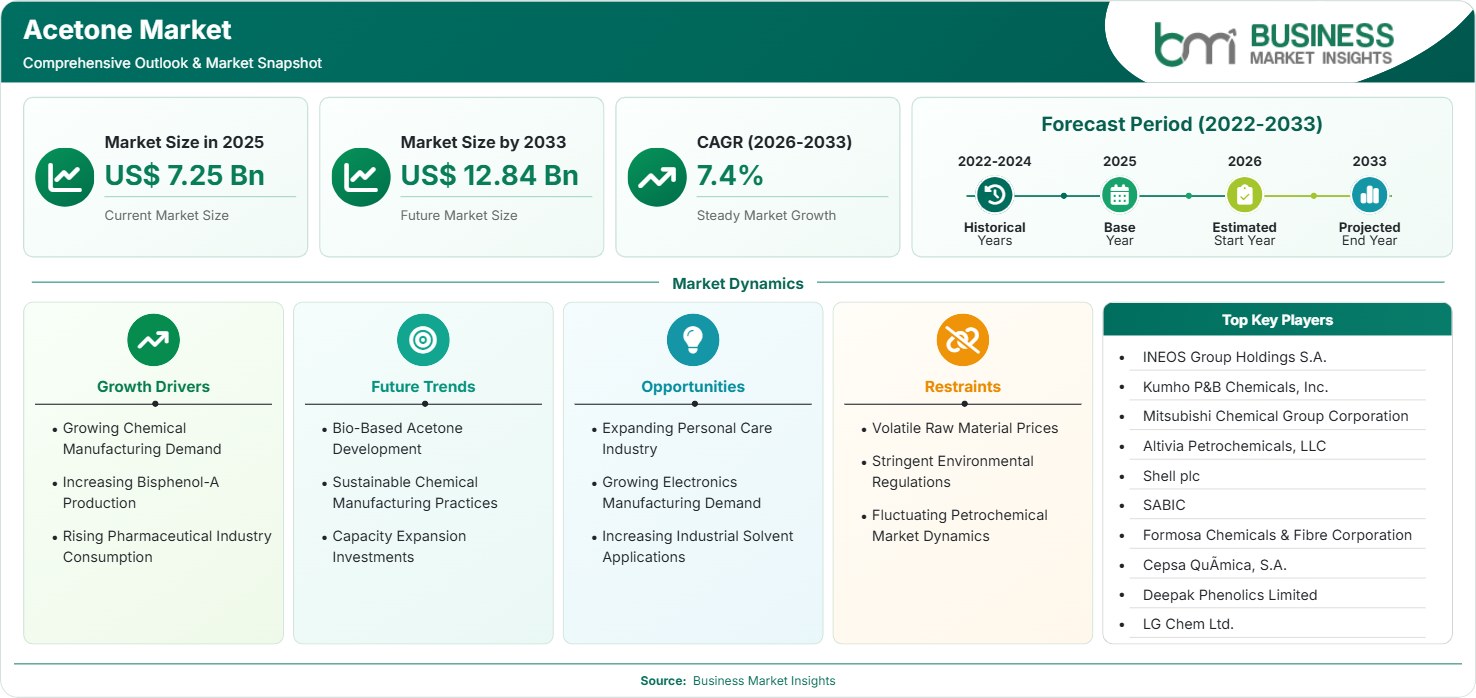
The Acetone Market size was valued at US$ 7.25 billion in 2025 and is projected to reach US$ 12.84 billion by 2033, growing at a CAGR of 7.4% from 2026 to 2033, driven by expanding chemical manufacturing, rising solvent applications, increasing BPA production, and growing demand from pharmaceuticals, coatings, and electronics industries.

Report Coverage
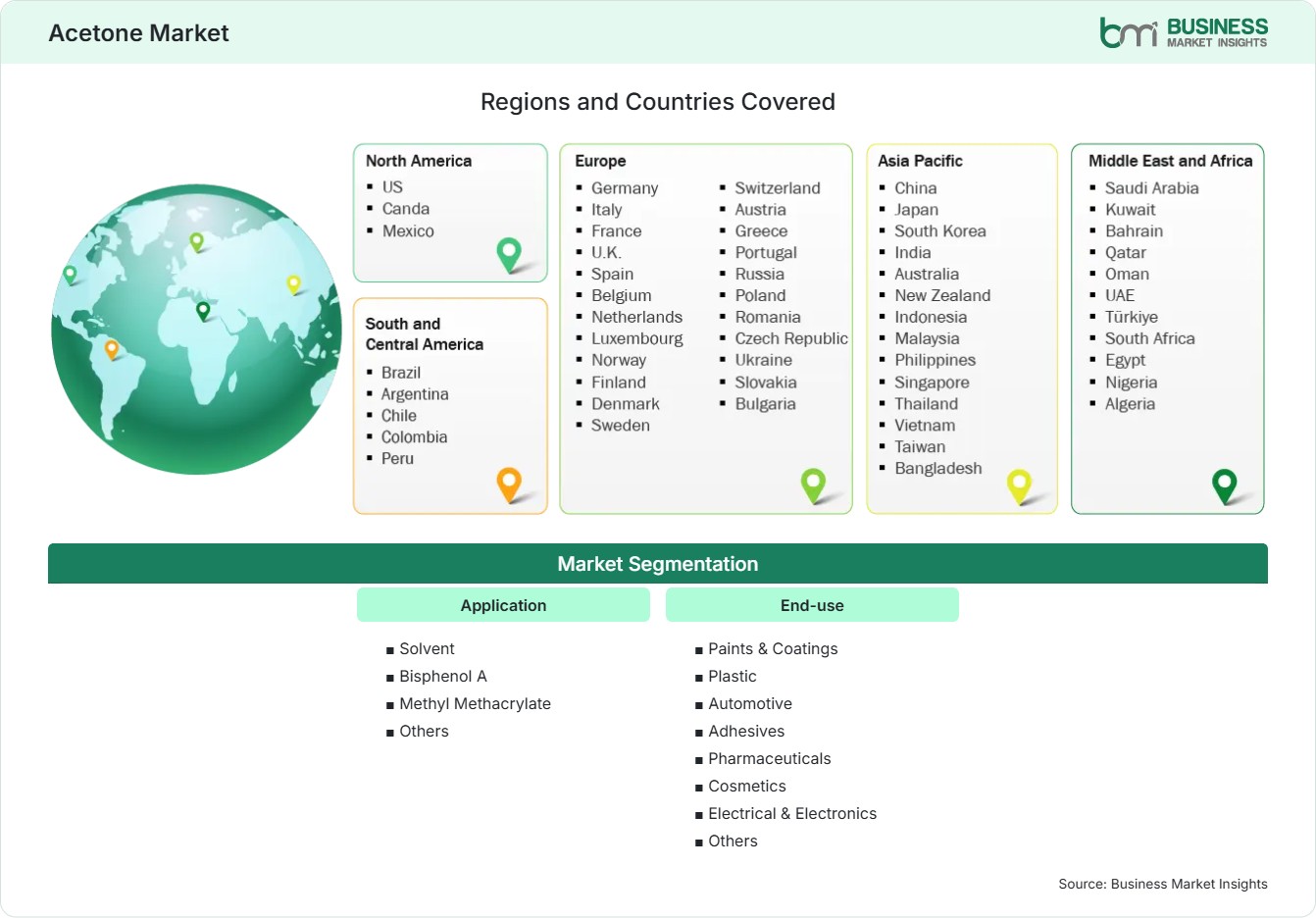
  • Application: Solvent, Bisphenol A, Methyl Methacrylate, Others
  • End-use: Paints & Coatings, Plastic, Automotive, Adhesives, Pharmaceuticals, Cosmetics, Electrical & Electronics, Others
US$ 7.25 Bn Market size in 2025
US$ 12.84 Bn Market Size by 2033
7.4% CAGR, 2026 - 2033
2026-2033 Forecast Period

01 AI Overview

Acetone Market Summary

  • North America Region: North America holds a 24%–27% share in 2025, growing with a CAGR of 6.8%–7.5% influenced by chemical production expansion, pharmaceutical manufacturing, industrial solvent demand, and advanced materials applications. The US market analysis shows steady growth with a CAGR of 7.0%–7.6% from 2026–2033, supported by domestic chemical production, coatings demand, and electronics manufacturing.
  • Fastest Growing Region: Asia Pacific holds a 42%–45% share in 2025, expanding with a CAGR of 8.0%–8.8% due to petrochemical investments, plastics manufacturing growth, pharmaceutical production expansion, and rising consumption of acetone-based intermediates across emerging economies.
  • Leading Segment: Solvent application holds 38%–42% share in 2025, growing with a CAGR of 7.0%–7.8% supported by demand from paints, coatings, adhesives, cleaning formulations, and industrial processing applications.
  • High Growth Segment: Methyl Methacrylate (MMA) application holds 18%–21% share in 2025, expanding with a CAGR of 8.0%–8.7% due to acrylic polymer demand, automotive materials growth, construction applications, and transparent plastics manufacturing.
  • Key Market Opportunity: Increasing adoption of acetone across electronics manufacturing, personal care formulations, pharmaceuticals, and specialty chemical production creates opportunities for producers expanding capacity and developing efficient supply chains.
  • Major Market Players: INEOS Group Holdings S.A., Kumho P&B Chemicals, Inc., Mitsubishi Chemical Group Corporation, Altivia Petrochemicals, LLC, Shell plc, SABIC, Formosa Chemicals & Fibre Corporation, Cepsa Química, S.A., Deepak Phenolics Limited, and LG Chem Ltd.
02 Strategic Insights

Acetone Market: Strategic Insights

acetone-market-market-strategic-framework
FREE PDF
Request your free sample
Request free sample
03 Stakeholder View

Key Takeaways

  • The market ecosystem is supported by integrated petrochemical producers, specialty chemical manufacturers, distributors, and downstream industries requiring reliable solvent and chemical intermediate supply.
  • Growth opportunities are concentrated in MMA production, pharmaceutical manufacturing, electronics applications, and specialty solvent requirements due to increasing industrial diversification.
  • Technology advancements are focused on improving production efficiency, optimizing feedstock utilization, and developing lower-emission chemical manufacturing processes.
  • Asia Pacific provides the strongest regional opportunity due to expanding chemical capacity, growing manufacturing bases, and increasing demand from China, India, South Korea, and Southeast Asian economies.
  • Strategic investments are increasingly focused on production capacity expansion, supply chain integration, and partnerships between chemical producers and downstream users.
  • Future competitiveness will depend on feedstock security, operational efficiency, sustainability compliance, and the ability to serve multiple high-value application segments.
04 Geographic Outlook

Acetone Market Regional Highlights

North America Acetone Market

North America accounted for 24%–27% acetone market share in 2025 and is projected to grow at a CAGR of 6.8%–7.5% from 2026–2033. The region benefits from established petrochemical infrastructure, strong pharmaceutical production, and demand from coatings, adhesives, and electronics industries. The United States remains the leading contributor due to chemical manufacturing capabilities and increasing investments in domestic industrial supply chains.

  • US chemical manufacturers are expanding production capabilities to support rising demand for acetone-based solvents and downstream chemical intermediates.
  • Pharmaceutical and healthcare industries are supporting acetone consumption through increasing requirements for processing solvents and manufacturing applications.
  • Advanced materials production is creating additional demand through applications in plastics, coatings, and specialty chemical formulations.
  • Domestic supply chain development is improving availability and reducing dependency on international acetone imports.

US Acetone Market

The US market accounted for 20%–23% of the market in 2025 and is expected to expand at a CAGR of 7.0%–7.6% from 2026–2033. Growth is supported by chemical industry modernization, pharmaceutical manufacturing expansion, and demand from industrial applications. Strong downstream industries, including automotive coatings, electronics, and specialty chemicals, continue to support domestic acetone consumption.

  • The US coatings industry is increasing its demand through expanding applications in industrial paints, surface treatments, and manufacturing processes.
  • Pharmaceutical production growth is supporting solvent requirements across drug manufacturing and laboratory applications.
  • Electronics manufacturing investments are creating additional demand for high-purity acetone applications in cleaning and processing operations.
  • Chemical producers are focusing on operational efficiency and sustainable production methods to maintain competitiveness.

Europe Acetone Market

The Europe market contributed 20%-23% in 2025 and is forecast to record a CAGR of 6.2%-7.0% during 2026-2033. Europe continues to hold a robust market position owing to its high-quality chemical manufacturing facilities, pharmaceutical production, and rising demand for specialty solvents. The major players in this region, including Germany, France, Italy, and the UK, represent key markets supported by industrial processing, automotive coatings, and electronics manufacturing applications.

  • Germany remains a major European consumer due to its advanced chemical sector, automotive manufacturing base, and demand for industrial solvents across multiple applications.
  • France is supporting acetone consumption through pharmaceutical production, cosmetics manufacturing, and specialty chemical applications requiring high-quality solvent solutions.
  • The United Kingdom is experiencing steady demand from healthcare, coatings, and industrial processing industries adopting acetone-based formulations.
  • European producers are investing in sustainable chemical production technologies to meet environmental requirements while maintaining supply reliability.
  • Italy and other industrial economies continue supporting demand through coatings, adhesives, and manufacturing applications.

Asia Pacific Acetone Market

Asia Pacific represented 42%–45% share in 2025 and is expected to register a CAGR of 8.0%–8.8% during the Acetone Market forecast period 2026–2033, making it the fastest-growing region. The region benefits from large-scale petrochemical capacity, expanding manufacturing activities, and increasing demand from plastics, pharmaceuticals, electronics, and coatings industries. China, India, South Korea, and Japan remain important contributors to regional growth.

  • China leads regional consumption due to extensive chemical production capacity, BPA manufacturing, plastics processing, and industrial solvent applications.
  • India is witnessing increasing acetone demand due to pharmaceutical manufacturing growth, expanding chemical production, and rising industrial applications.
  • South Korea benefits from electronics manufacturing strength and advanced materials production requiring high-purity chemical solvents.
  • Japan continues supporting demand through pharmaceutical, automotive, and specialty chemical manufacturing industries.
  • Southeast Asian economies are attracting chemical investments, creating additional opportunities for acetone production and distribution networks.

Rest of World Acetone Market

Rest of World accounted for 8%–11% share in 2025 and is expected to grow at a CAGR of 6.5%–7.3% from 2026–2033. The region includes Latin America, Middle East, and Africa markets where industrial development, chemical manufacturing expansion, and consumer product production are influencing demand. Brazil, Saudi Arabia, and the United Arab Emirates represent important growth markets due to petrochemical investments.

Latin American markets benefit from increased manufacturing operations, drug manufacturing, and the use of coatings. The Middle Eastern nations benefit from integrated petrochemical schemes to increase downstream chemical manufacturing capacity.

  • Brazil is supporting acetone demand through industrial manufacturing, coatings applications, and pharmaceutical sector development.
  • Saudi Arabia is strengthening chemical production capabilities through petrochemical investments and downstream industry expansion.
  • The United Arab Emirates is increasing chemical manufacturing capacity through industrial diversification initiatives and specialty chemical projects.
  • African markets are gradually increasing consumption through infrastructure development, manufacturing growth, and industrial processing activities.
  • Regional distributors are improving supply networks to support growing demand from smaller industrial and commercial users.
global-market-geography
FREE PDF
Request your free sample
Request free sample
05 Segment Analysis

Acetone Market Segmentation

Application

Application segmentation represents the primary demand structure of the Acetone Market, driven by widespread utilization as a solvent and chemical intermediate. The segment accounted for 65%–68% share in 2025 and is projected to grow at a CAGR of 7.2%–7.8% from 2026–2033. Increasing industrial processing, plastics manufacturing, pharmaceutical production, and specialty chemical applications are supporting consumption across diverse end-user industries.

  • Solvent: Solvent applications dominate due to acetone’s high solvency, fast evaporation characteristics, and broad usage in paints, coatings, adhesives, cleaning agents, and industrial processing operations.
  • Bisphenol A (BPA): BPA applications are supported by demand for polycarbonate plastics and epoxy resins used in automotive components, construction materials, electronics, and consumer goods manufacturing.
  • Methyl Methacrylate (MMA): MMA applications are expanding due to rising acrylic polymer production, growing demand for transparent plastics, increased use in automotive materials, and construction-related applications requiring durable materials.
  • Others: Other applications include laboratory chemicals, specialty formulations, and niche industrial uses where acetone provides effective processing characteristics and compatibility with various chemical systems.

End-use

End-use segmentation is a consequence of extensive industry reliance on acetone across manufacturing, healthcare, consumer goods, and technology. The market share of this segment stood at 32%-35% in 2025 and is forecasted to grow at a CAGR of 7.0%-7.6% during 2026-2033. Increasing manufacturing activity, chemical use, and the expansion of downstream industries continue to fuel its growth.

  • Paints & Coatings: Paints and coatings applications use acetone for formulation, cleaning, and processing due to its effective solvent properties and compatibility with industrial coating systems.
  • Plastic: Plastic manufacturing demand is increasing through BPA and polymer-related applications where acetone supports production of materials used across consumer and industrial markets.
  • Automotive: Automotive applications utilize acetone in coatings, component manufacturing, surface preparation, and production processes supporting vehicle manufacturing and maintenance activities.
  • Adhesives: Adhesive applications benefit from acetone’s solvent properties, enabling improved formulation performance and processing efficiency across industrial bonding applications.
  • Pharmaceuticals: Pharmaceutical industries consume acetone for extraction, purification, synthesis processes, and laboratory applications requiring high-quality chemical solvents.
  • Cosmetics: Cosmetics manufacturers use acetone in nail care products and specialty formulations due to its effective dissolving and cleaning capabilities.
  • Electrical & Electronics: Electronics applications are growing through demand for high-purity acetone used in component cleaning, semiconductor processing, and precision manufacturing environments.
  • Others: Other end-use applications include laboratories, industrial maintenance, and specialty manufacturing processes requiring reliable solvent performance.
06 Market Forces

Acetone Market Dynamics

Key Market Drivers

Growing Chemical Manufacturing Demand

Chemical manufacturing expansion is a major driver for acetone consumption as industries increase production of solvents, intermediates, plastics, and specialty chemicals. The increasing investment in petrochemical plants and downstream processes will boost demand across various industrial sectors. Developing nations are expanding their chemical manufacturing capacity to support increased production, infrastructure development, and exports. The above factor will positively impact the Acetone Market growth through increased demand from different value chains of chemicals. The companies are emphasizing integration in the manufacturing process to enhance supply consistency and production efficiency while serving diverse industrial customers.

Increasing Bisphenol-A Production

Rising Bisphenol-A production is supporting acetone demand because BPA manufacturing requires acetone as a key raw material in the condensation process. Increasing demand for polycarbonate plastics and epoxy resins across automotive, construction, electronics, and consumer product industries is encouraging BPA capacity expansion. The growth of lightweight materials and durable polymer applications is strengthening acetone consumption patterns. Manufacturers are investing in production capabilities to meet growing demands from downstream industries. This development is reinforcing Acetone Market trends toward higher-value chemical applications linked with advanced materials and industrial manufacturing.

Rising Pharmaceutical Industry Consumption

Growing use in the pharmaceutical industry will drive demand for acetone, owing to its applications in pharmaceutical manufacturing, extraction, purification, and laboratory processes. To run their operations efficiently, pharmaceutical companies need solvents. The increase in healthcare facilities, production of medicines, and the increase in the level of research are contributing to growing consumption. High-purity acetone will be affected by the demand in pharmaceutical manufacturing, where chemical purity and quality are essential. This trend is strengthening market opportunities for producers capable of supplying specialized grades for regulated healthcare applications.

Key Market Opportunities

Expanding Personal Care Industry

The expanding personal care industry creates opportunities for acetone producers as demand increases for cosmetic formulations, nail care products, and specialty chemical applications. Rising consumer spending on personal care products in developing economies is supporting increased manufacturing activity. Producers can benefit by developing reliable supply networks and maintaining consistent quality standards for cosmetic applications. Growth in beauty and personal care manufacturing is creating additional downstream demand while encouraging chemical suppliers to serve specialized consumer-oriented markets.

Growing Electronics Manufacturing Demand

Growing demand for electronics manufacturing provides opportunities, driven by increasing requirements for high-purity acetone used in component cleaning, semiconductor processing, and precision manufacturing. Expanding electronics production in Asia Pacific and other manufacturing hubs is increasing demand for specialty chemical solvents. The transition toward advanced electronic devices and higher-performance components requires efficient cleaning and processing solutions. Suppliers capable of meeting quality specifications and supporting semiconductor-related applications are positioned to capture emerging demand from technology manufacturing sectors.

Increasing Industrial Solvent Applications

Increasing industrial solvent applications create growth opportunities, as manufacturers across the coatings, adhesives, automotive, and general industrial sectors continue to require effective processing chemicals. Acetone’s rapid evaporation, compatibility, and solvent properties support broad industrial adoption. Rising manufacturing activities and increasing maintenance requirements are contributing to continued solvent consumption. Companies investing in efficient distribution networks and application-specific solutions can strengthen their position as industrial users seek reliable chemical suppliers.

Market Restraints and Challenges

Volatile Raw Material Prices

Factor: Volatile raw material prices remain a significant challenge due to acetone production dependence on petrochemical feedstocks and fluctuations in energy markets. Changes in crude oil prices, propylene availability, and production costs directly influence the economics of acetone manufacturing. Impact: Cost volatility can reduce profit margins, create pricing uncertainty, and affect supply planning for producers and downstream users. Companies are addressing this challenge through integrated production models, supply diversification, and operational efficiency improvements to manage exposure to raw material fluctuations.

Stringent Environmental Regulations

Factor: Stringent environmental regulations pose challenges, as chemical producers face increasing requirements for emissions control, waste management, and sustainable manufacturing practices. Regulatory frameworks governing volatile organic compounds, chemical safety, and industrial emissions require producers to invest in compliance technologies. Impact: Higher compliance costs can increase operational expenses and influence production strategies across the value chain. Manufacturers are responding by adopting cleaner technologies, improving process efficiency, and pursuing sustainability initiatives to remain competitive while meeting evolving environmental standards.

07 Company Analysis

Competitive Landscape

The Acetone Market analysis highlights a competitive ecosystem consisting of integrated chemical manufacturers, petrochemical companies, and specialty chemical producers. Leading companies are focusing on production capacity expansion, feedstock integration, supply chain optimization, and sustainable manufacturing processes to strengthen their market position. Competitive differentiation is influenced by production efficiency, regional manufacturing presence, product quality, and the ability to serve high-growth applications including pharmaceuticals, electronics, coatings, plastics, and specialty chemicals.

Company Name

Overview

Products and Services relevant to this market

INEOS Group Holdings S.A.

Global chemical producer with integrated petrochemical operations and strong solvent manufacturing capabilities.

Acetone production, chemical intermediates, solvents, petrochemical products, and industrial chemical solutions.

Kumho P&B Chemicals, Inc.

South Korean chemical manufacturer specializing in phenol derivatives and downstream chemical products.

Acetone, phenol products, BPA-related chemicals, and specialty chemical intermediates.

Mitsubishi Chemical Group Corporation

Japanese chemical company providing advanced materials and chemical solutions globally.

Acetone, MMA-related materials, specialty chemicals, and performance products.

Altivia Petrochemicals, LLC

US chemical producer focused on acetone, phenol, and downstream chemical manufacturing.

Acetone production, phenolic products, and industrial chemical solutions.

Shell plc

Global energy and chemicals company operating integrated refining and chemical businesses.

Acetone-related chemical products, petrochemical intermediates, and industrial solutions.

SABIC

Saudi Arabian chemical company producing diversified petrochemical and specialty products.

Chemical intermediates, plastics-related products, and industrial chemical solutions.

Formosa Chemicals & Fibre Corporation

Taiwan-based chemical manufacturer with petrochemical and polymer production capabilities.

Acetone, phenolic chemicals, polymers, and industrial chemical products.

Cepsa Química, S.A.

Spanish chemical producer specializing in aromatic chemicals and industrial intermediates.

Acetone production, chemical intermediates, and specialty chemical applications.

Deepak Phenolics Limited

Indian chemical manufacturer producing phenol and acetone through integrated facilities.

Acetone, phenol, downstream chemical products, and industrial applications.

LG Chem Ltd.

South Korean chemical company producing advanced materials and industrial chemicals.

Chemical intermediates, specialty materials, and industrial chemical solutions.

08 Industry Activity

Recent Developments

May 2026

Deepak Chem Tech Limited entered into long-term agreement with Praxair (a Linde company) to build a HyCO plant to manufacture key raw materials for DCTL’s upcoming polycarbonate manufacturing facility at Padariya.

March 2026

INEOS Group Holdings S.A. strengthens European commitment by signing new distribution agreements with Omya Performance Polymer Distribution and Snetor that complement its existing partnership with Biesterfel.

June 2025

INEOS Phenol announced its intention to permanently close the Gladbeck, Germany phenol and acetone production site following a strategic review, consolidating production at other facilities. The Gladbeck site is one of the world's largest phenol and acetone manufacturing plants.

April 2025

Deepak Phenolics Limited continued strengthening its integrated phenol-acetone production capabilities in India, supporting domestic chemical supply chains and reducing dependency on imported acetone.

10 Trust & Transparency

Research Methodology

The market analysis combines proprietary research with secondary data from government agencies, company disclosures, regulatory filings, industry databases and expert interviews. Market estimates are validated through data triangulation, cross-market benchmarking and analyst review.

View Full Research Methodology

11 Questions Answered

Frequently Asked Questions

What does the Market Report provide for stakeholders?

The Acetone Market Report provides insights into market size, segmentation, regional trends, competitive developments, growth drivers, opportunities, restraints, and strategic industry developments through 2033.

How are environmental regulations affecting acetone producers?

Environmental regulations are encouraging producers to adopt cleaner manufacturing processes, improve emissions management, and invest in sustainable technologies while increasing compliance requirements and operational costs.

Why is Asia Pacific the fastest-growing region for acetone?

Asia Pacific growth is supported by expanding petrochemical capacity, increasing manufacturing activity, pharmaceutical production, electronics manufacturing, and rising consumption of chemical intermediates.

Which application segment dominates acetone consumption?

Solvent applications represent the leading segment due to widespread usage in paints, coatings, adhesives, cleaning products, and industrial processing activities across multiple manufacturing sectors.

What is driving Acetone Market growth during 2026–2033?

The market growth is driven by increasing chemical manufacturing demand, rising BPA production, expanding pharmaceutical consumption, and growing applications in coatings, plastics, electronics, and industrial solvents.

Access the Full Acetone Market Report

Get segment-level forecasts, regional estimates, competitive benchmarking, company profiles and downloadable Excel datasets.

Access the full Acetone Market Report
350 pages PDF & Excel | 2026-07-30