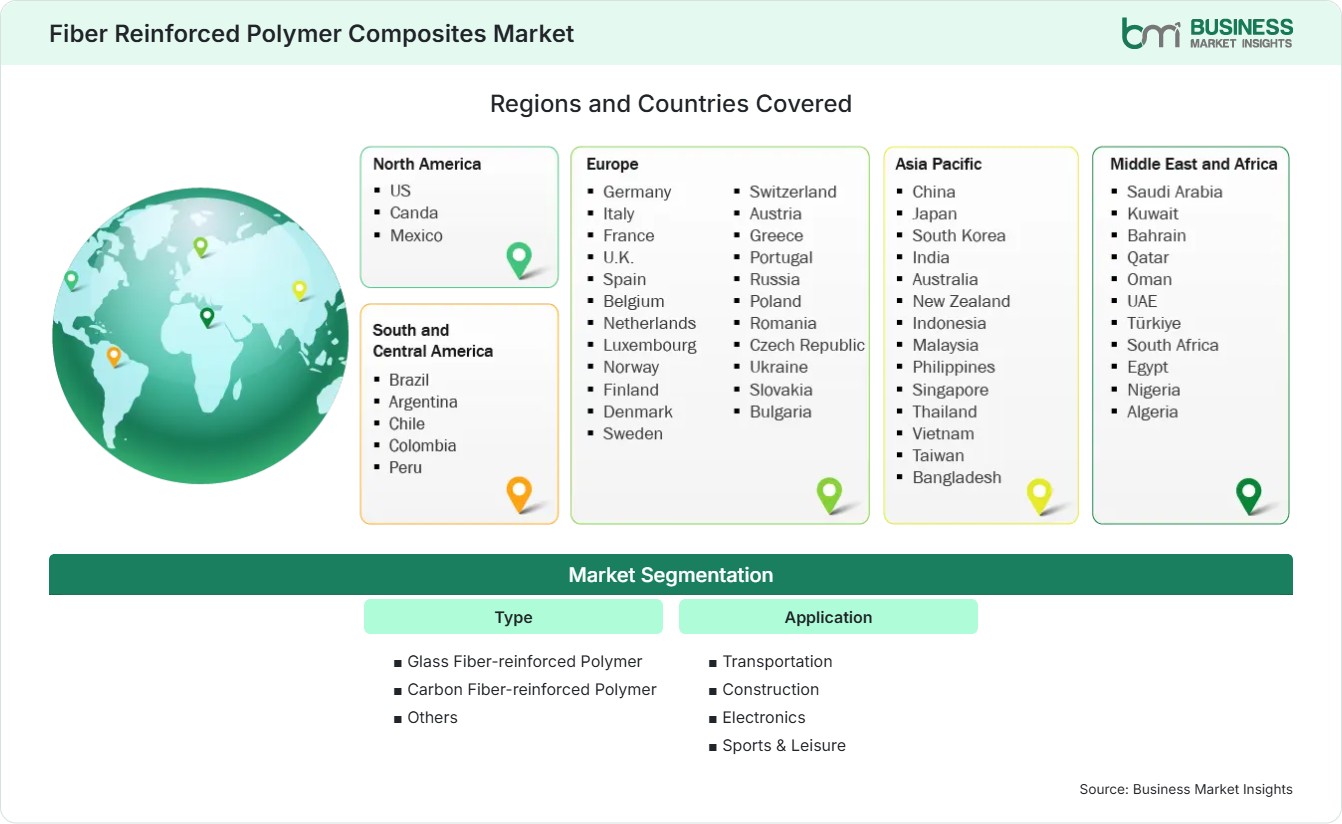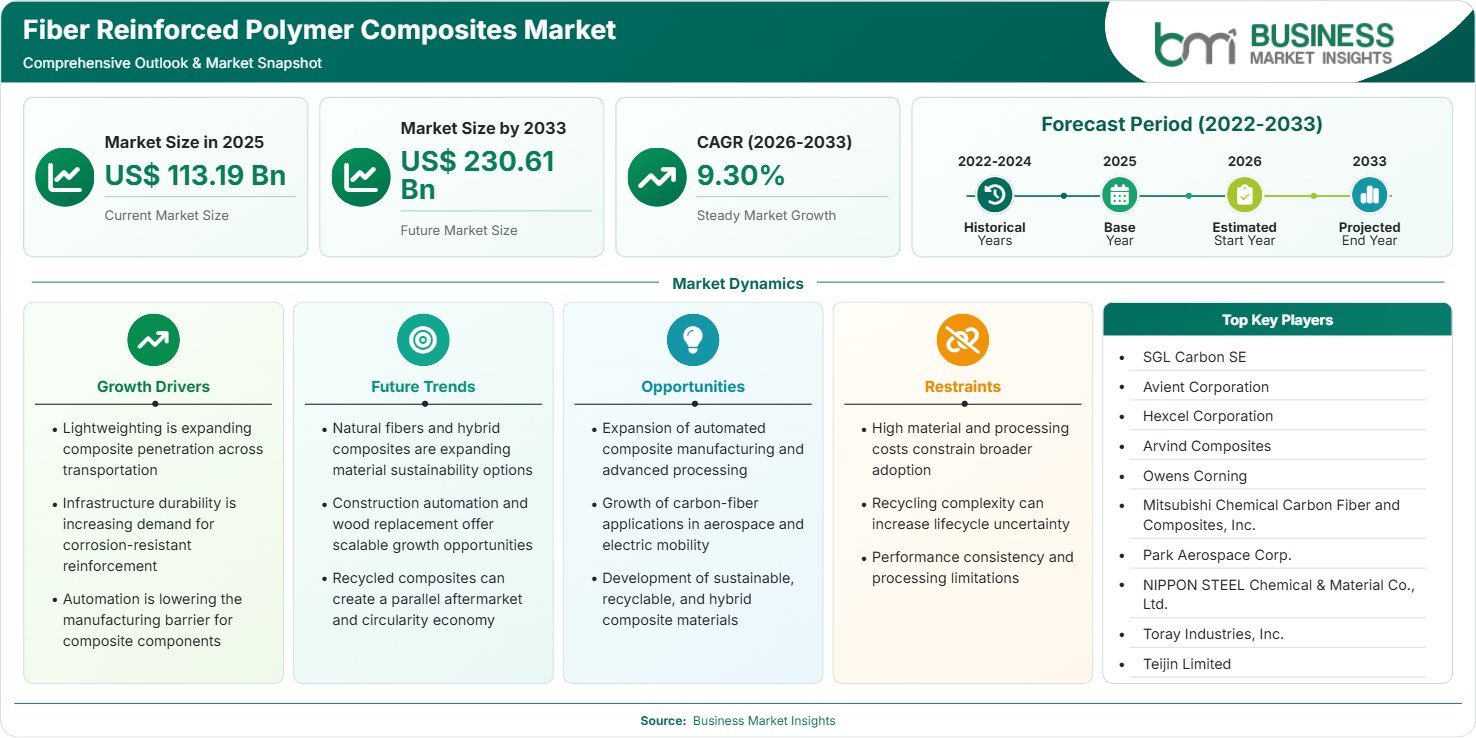
Fiber Reinforced Polymer Composites Market Regional Highlights
North America Fiber Reinforced Polymer Composites Market
North America holds a 23%–26% Fiber Reinforced Polymer Composites Market share in 2025 and grows at an 8.1%–8.8% CAGR through 2033. The region benefits from aerospace production, defense programs, infrastructure rehabilitation, renewable-energy systems, automotive lightweighting, and industrial automation. The US dominates regional demand through advanced composite manufacturing, engineering expertise, aircraft production, and established transportation supply chains, while Canada contributes through infrastructure, wind-energy, and industrial applications.
- Aerospace remains a major demand center as manufacturers expand qualified carbon-fiber material systems for primary structures, propulsion-related components, and next-generation aircraft platforms.
- Infrastructure renewal is increasing use of glass-fiber reinforcement because corrosion resistance can extend service life in bridges, decks, tunnels, utilities, and marine environments.
- Electric mobility is broadening demand for lightweight battery enclosures, structural components, pressure vessels, and composite body systems where mass reduction directly improves efficiency.
- North American manufacturers are emphasizing domestic sourcing and production automation to reduce dependency on overseas intermediate materials and improve supply resilience.
US Fiber Reinforced Polymer Composites Market
The US accounts for a 19%–22% share of the regional Fiber Reinforced Polymer Composites Market in 2025 and records an 8.0%–8.7% CAGR through 2033. Aerospace and defense remain strategically important, while construction, electric mobility, renewable energy, electronics, and industrial equipment broaden the application base. The country also retains a strong research, qualification, and engineering ecosystem supporting high-performance composite commercialization and advanced manufacturing.
- Advanced aerospace programs continue to support demand for prepregs, carbon fiber, structural panels, assemblies, and high-temperature composite systems.
- Construction applications increasingly use FRP reinforcement for corrosion-prone infrastructure, where reduced maintenance and longer service intervals improve lifecycle economics.
- Electric-vehicle and battery applications are creating demand for lightweight, insulated, impact-resistant structures and composite enclosures with increasingly integrated functional requirements.
Europe Fiber Reinforced Polymer Composites Market
Europe represents an 18%–21% Fiber Reinforced Polymer Composites Market share in 2025 and expands at a 7.4%–8.2% CAGR through 2033. Germany, France, the United Kingdom, Italy, and the Nordic economies provide strong engineering and manufacturing capabilities. Automotive lightweighting, aerospace, wind energy, rail, construction, and industrial equipment remain important. Sustainability requirements increasingly influence material selection, recycling strategies, renewable feedstocks, energy efficiency, and lifecycle assessment.
- Germany remains a leading composite manufacturing center with deep automotive, industrial, aerospace, and machinery expertise supporting complex structural applications.
- France benefits from aerospace production and advanced manufacturing programs requiring certified carbon-fiber systems, prepregs, and high-performance structural components.
- The United Kingdom continues to support aerospace, automotive, marine, and sports applications where lightweight structures and design flexibility justify composite adoption.
- European producers increasingly emphasize recycling, traceability, carbon accounting, and lower-impact raw materials as customers incorporate lifecycle performance into procurement decisions.
Asia Pacific Fiber Reinforced Polymer Composites Market
Asia Pacific commands a 42%–46% Fiber Reinforced Polymer Composites Market share in 2025 and advances at a 9.8%–10.7% CAGR, making it the largest regional contributor and the fastest-growing major geography. China, Japan, South Korea, and India combine manufacturing scale with strong automotive, electronics, construction, aerospace, and renewable-energy demand. Expanding local capacity improves access to fibers, intermediates, tooling, and composite fabrication services.
- China combines large automotive and infrastructure markets with expanding carbon-fiber, glass-fiber, resin, intermediate-material, and composite-component production capabilities.
- Japan maintains strong positions in advanced fibers, aerospace materials, automotive applications, electronics, and high-performance industrial composites through sophisticated materials engineering.
- India is building a broader composite ecosystem through infrastructure modernization, transportation development, wind-energy deployment, aerospace localization, and increasing domestic manufacturing capabilities.
- South Korea and Southeast Asia provide additional growth through electronics, shipbuilding, automotive components, wind-energy equipment, and industrial manufacturing.
Rest of World Fiber Reinforced Polymer Composites Market
Rest of World accounts for a 9%–13% Fiber Reinforced Polymer Composites Market share in 2025 and grows at a 9.1%–10.0% CAGR. Latin America is supported by infrastructure rehabilitation, transportation, energy, and industrial investment, with Brazil and Mexico providing the strongest scale. The Middle East and Africa create opportunities through construction, oil and gas infrastructure, utilities, renewable energy, and desalination-related installations.
Brazil offers expanding use in civil infrastructure, transportation, wind-energy systems, and industrial equipment as asset owners seek lighter, corrosion-resistant alternatives. Mexico benefits from manufacturing integration with North American automotive, aerospace, electronics, and industrial supply chains, supporting composite-component localization and regional exports.
- Middle Eastern infrastructure projects increasingly value corrosion resistance, low maintenance, and rapid installation, creating opportunities for FRP piping, reinforcement, structures, and utility applications.
- Brazil provides a broad platform for glass-fiber composites in infrastructure, energy, transportation, and industrial manufacturing where durability is a major procurement criterion.
- Mexico benefits from nearshoring-related manufacturing investment, increasing opportunities for composite components used in vehicles, electronics, industrial machinery, and aerospace supply chains.
- South Africa and selected African markets offer gradual adoption in mining, infrastructure, utilities, renewable energy, and corrosion-sensitive industrial applications.