Market Summary
Executive Summary and Global Market Analysis
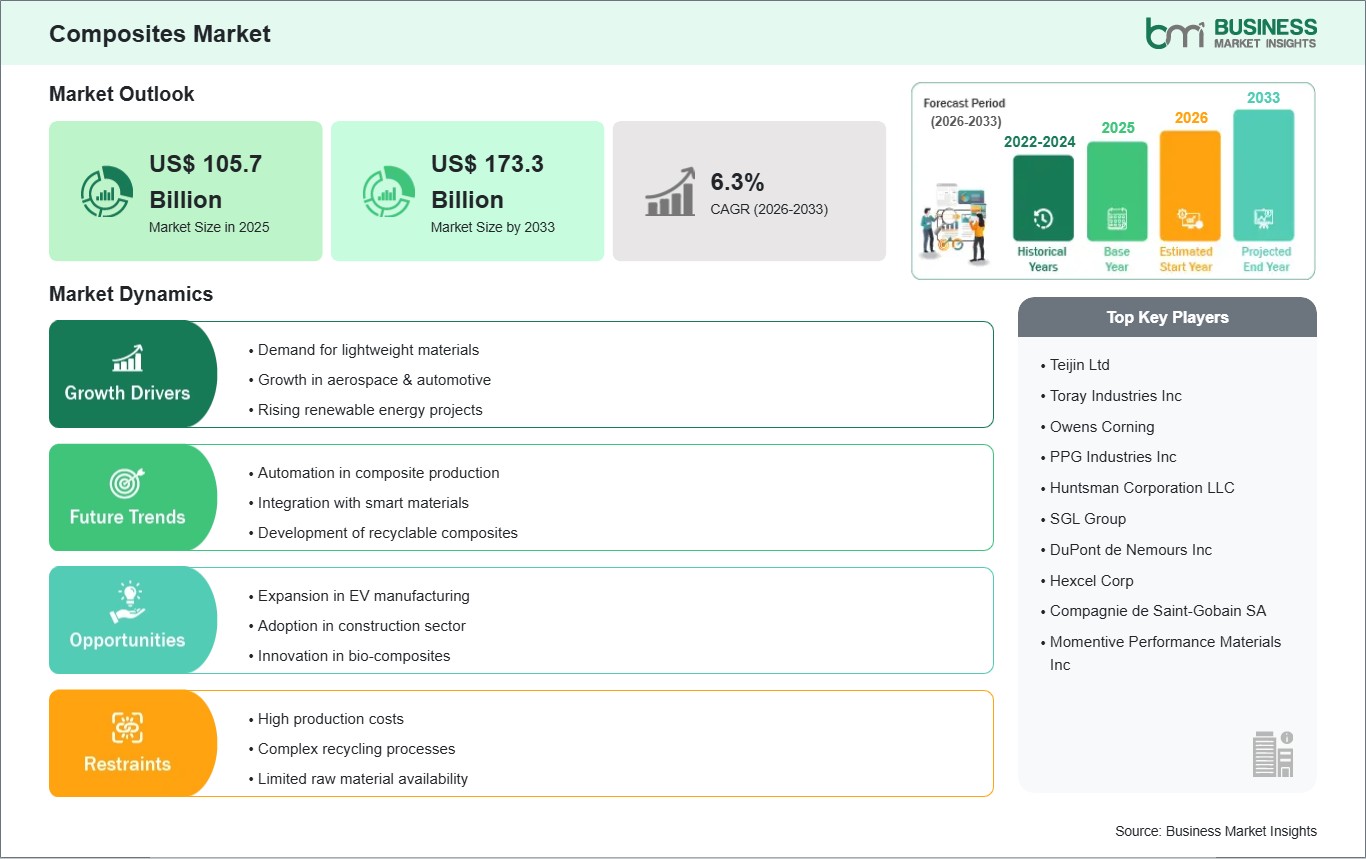
Composites are engineered materials formed by combining two or more distinct components to achieve superior properties compared to individual materials. Their high strength-to-weight ratio, corrosion resistance, and design flexibility make them indispensable in industries where lightweight and durability are critical, such as aerospace, automotive, and renewable energy.
However, the market faces notable challenges. High initial processing costs, particularly for advanced composites like carbon fiber, remain a significant barrier. Recycling complexities and the absence of standardized practices further constrain adoption. These factors can slow penetration in cost-sensitive sectors and complicate sustainability efforts.
Despite these restraints, the composites market presents compelling opportunities. Rising demand for lightweight and fuel-efficient solutions in the aerospace and automotive sectors, coupled with the rapid growth of electric vehicles and urban air mobility, is driving innovation. Additionally, wind energy expansion and infrastructure modernization in emerging economies are creating new avenues for corrosion-resistant materials. Advances in thermoplastic composites, bio-based resins, and automated manufacturing technologies promise cost reductions and improved recyclability, aligning with global sustainability goals—strategic collaborations and investments in circular economy solutions further position composites as a cornerstone of next-generation engineering.
Segment Analysis
Composites Market Segmentation
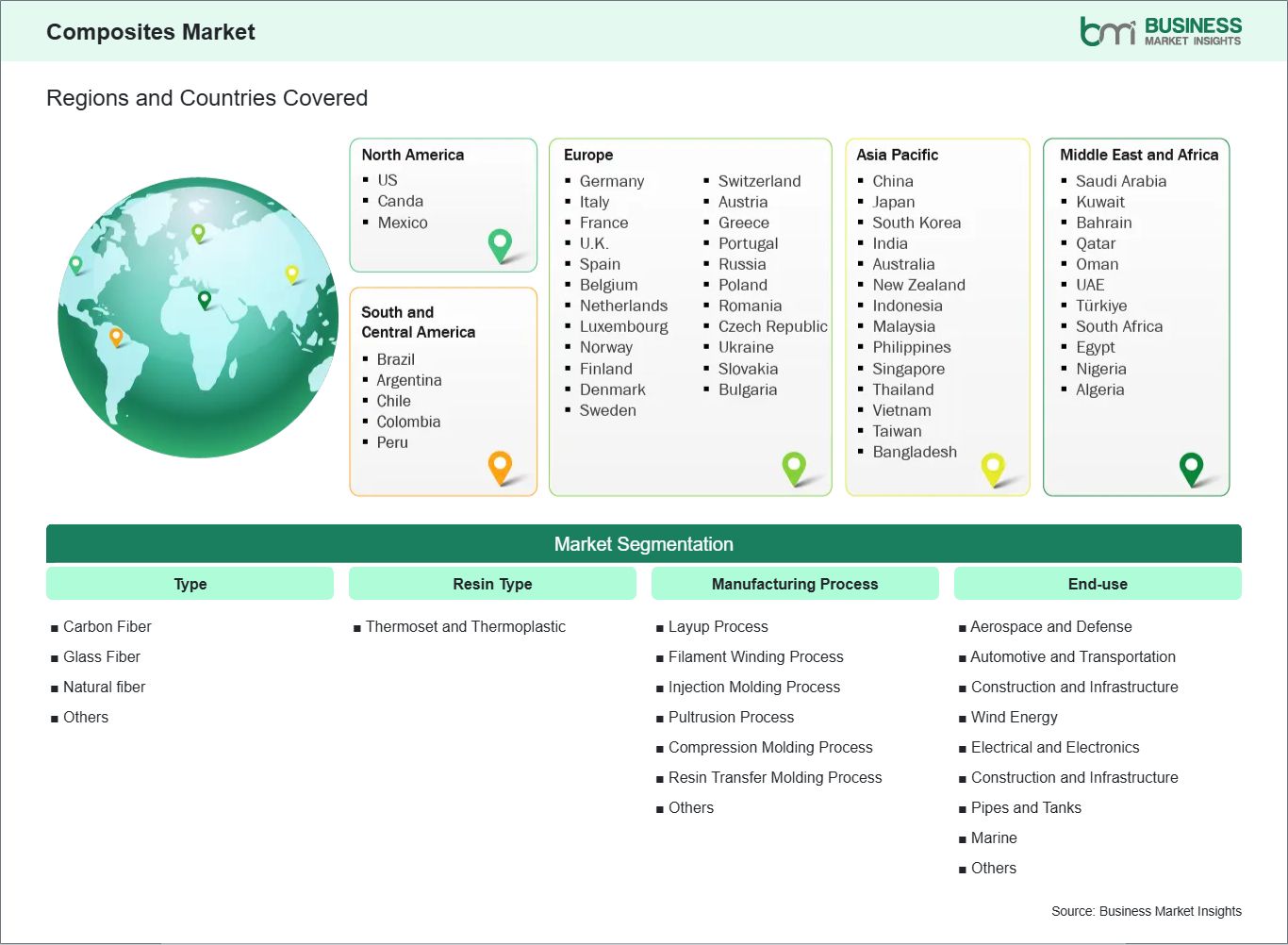
Key segments that contributed to the derivation of the Composites market analysis are type, resin type, manufacturing process, and end use.
- By Type, the market is segmented into Carbon Fiber, Glass Fiber, Natural Fiber, and Others.
- By Resin Type, the market is segmented into Thermoset and Thermoplastic.
- By Manufacturing Process, the market is segmented into Layup Process, Filament Winding Process, Injection Molding Process, Pultrusion Process, Compression Molding Process, Resin Transfer Molding Process, and Others.
- By End Use, the market is segmented into Aerospace and Defense, Automotive and Transportation, Construction and Infrastructure, Wind Energy, Electrical and Electronics, Construction and Infrastructure, Pipes and Tanks, Marine, and Others.
Market Forces
Composites Market Drivers and Opportunities
Lightweighting Mandates in Aerospace and Automotive
A key driver of growth in the composites industry is the increasing emphasis on lightweight design across the aviation and automotive sectors to improve energy efficiency and comply with stringent environmental standards. In aviation, next-generation aircraft such as the Boeing 787 and Airbus A350 now incorporate composites in more than half of their primary structures by weight — a shift that significantly reduces fuel consumption and environmental impact. As a result, the sector remains a major consumer of high-modulus carbon composites and epoxy systems.
In the automotive industry, and particularly with the rapid shift toward electric vehicles, manufacturers are prioritizing weight reduction to enhance driving range and overall efficiency. Composites are being integrated into vehicle bodies and battery enclosures to deliver superior strength and crash performance while minimizing weight.
Sustainability and Advanced Recycling Technologies
Research and development of sustainability and recycling technologies in the composites industry offer considerable long-term opportunities within the composites industry. Bio-composites made from natural fibers such as hemp, flax, and jute, and bio-resins or recycled resins, will help in sustainable manufacturing practices and meet sustainability needs in the automotive interior and consumer products sectors.
The key advantage offered by thermoplastic composites is their ability to be reheated, remolded, and recycled. Another aspect that is propelling the use of thermoplastics is the maturation of processing methods in the industry. This has paved the way for a closed-loop system to be implemented in the composites industry. The evolution of recycling methods, such as pyrolysis and solvolysis processes in recycling carbon fibers from the disposed of thermosets, has also aided in boosting the long-term outlook.
Size and Share Analysis
Composites Market Size and Share Analysis
The Composites Market demonstrates steady growth, with size and share analysis revealing evolving trends and competitive positioning among key players. Further examination of subsegments categorized within type, resin type, manufacturing process, and end use, offering insights into their contribution to overall market performance.
For instance, carbon fiber stands out in aerospace applications for its unmatched strength-to-weight ratio, enabling fuel efficiency and structural integrity. Thermoset resins dominate structural uses due to their rigidity and chemical resistance, while thermoplastics are gaining traction for recyclability and impact resistance. Among manufacturing processes, injection molding is widely adopted for automotive components, offering precision and scalability. In end-use applications, wind energy continues to rely on glass fiber composites for turbine blades, balancing performance with cost-effectiveness.
Report Coverage
Composites Market Report Coverage and Deliverables
The Composites Market Size and Forecast (2022–2033) report provides a detailed analysis of the market covering below areas:
- Composites market size and forecast at global, regional, and country levels for all the key market segments covered under the scope
- Composites market trends, as well as market dynamics such as drivers, restraints, and key opportunities
- Composites market analysis covering key market trends, global and regional framework, major players, regulations, and recent market developments
- Industry landscape and competition analysis covering market concentration, heat map analysis, prominent players, and recent developments for the Composites market
- Detailed company profiles, including SWOT analysis
Geographic Insights
Composites Market Geographic Insights
The geographical scope of the Composites Market report is divided into five regions: North America, Europe, Asia Pacific, the Middle East & Africa, and South & Central America.
North America remains focused on advanced aerospace and defense applications, supported by strong R&D initiatives and technological innovation. Europe emphasizes sustainable composite solutions, driven by stringent environmental regulations and renewable energy projects. Asia Pacific is witnessing rapid industrialization and infrastructure development, with significant demand from the automotive and electronics sectors. The Middle East & Africa are increasingly adopting composites in oil and gas infrastructure for corrosion resistance, while South & Central America are gradually integrating composites into construction and transportation projects to support industrial growth.
Industry Activity
Recent Developments
The Composites Market is evaluated through qualitative and quantitative data gathered via primary and secondary research, including corporate publications, association data, and databases. Key developments include:
- In November 2024, Toray Advanced Composites, a leading innovator in advanced material technology, announced the expansion of its continuous fiber reinforced thermoplastic composite materials portfolio through the acquisition of Gordon Plastics' assets, technology, and intellectual property, located in Englewood, Colorado.
- In September 2024, Owens Corning highlighted the versatility and performance of composite materials at CAMX 2024. The company’s presence at the event reinforces its commitment to advancing material substitution and supporting customer-driven innovation, productivity, and sustainability. Throughout the show, Owens Corning’s global composites experts and business leaders engaged with attendees to discuss its portfolio of industry-leading solutions.
Trust & Transparency
Research Methodology
The market analysis combines proprietary research with secondary data from government agencies, company disclosures, regulatory filings, industry databases and expert interviews. Market estimates are validated through data triangulation, cross-market benchmarking and analyst
review.
View Full Research Methodology
Key Sources Referred:
World Bank – Global Trade IndicatorsWorld Trade Organization (WTO)International Monetary Fund (IMF)International Trade Administration (ITA)Company WebsitesCompany Annual ReportsCompany Investor Presentations