
Synthetic Fibers Market Outlook: Size, Share, Trends, Growth Analysis, Competitive Landscape & Forecast, 2026-2033

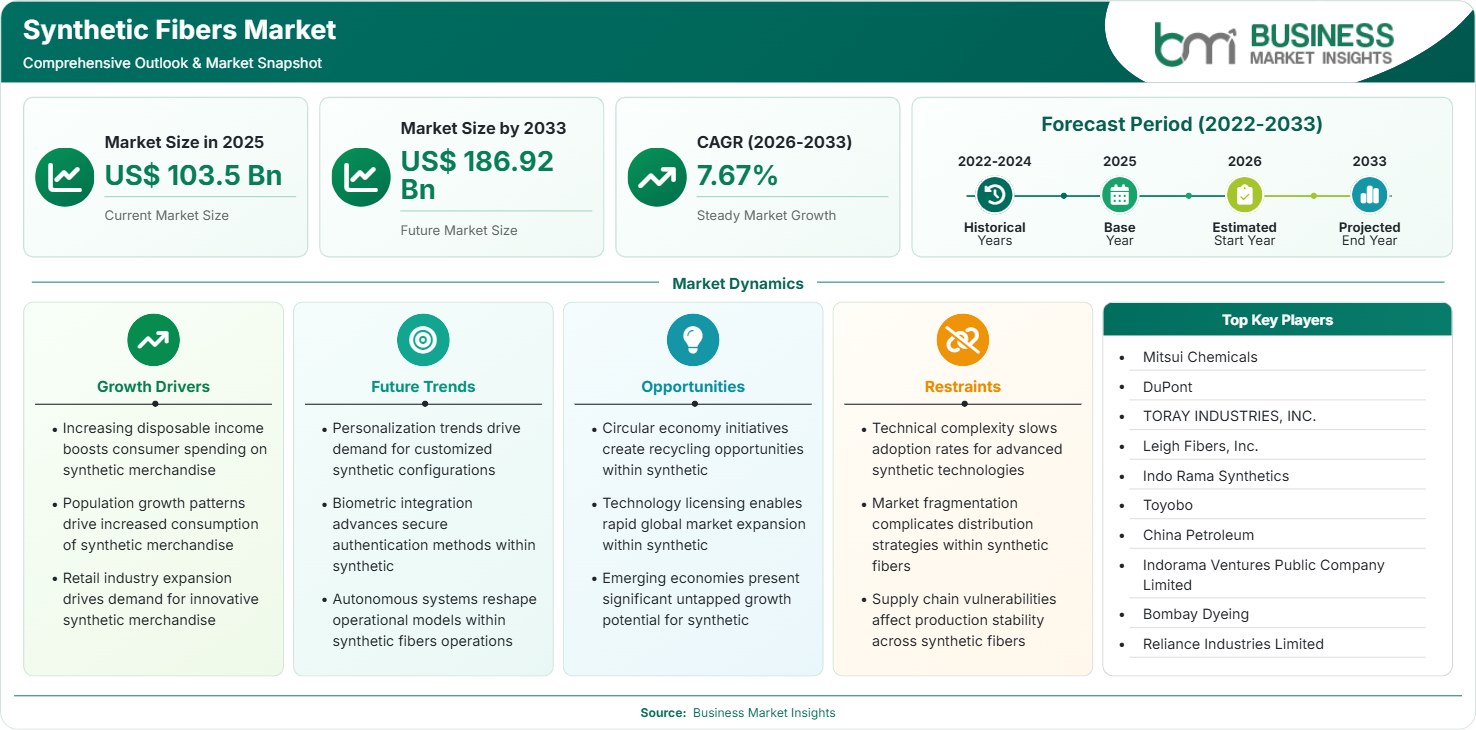
The Synthetic Fibers Market size was valued at US$ 103.5 Billion in 2025 and is projected to reach US$ 186.92 Billion by 2033, growing at a CAGR of 7.67% during 2026–2033. Growth is anchored by rising apparel consumption, automotive lightweighting, and expanding home furnishing demand, while recycled-fiber capacity additions and technical textile innovation continue to open new revenue pathways for manufacturers across polymer chains.

Report Coverage
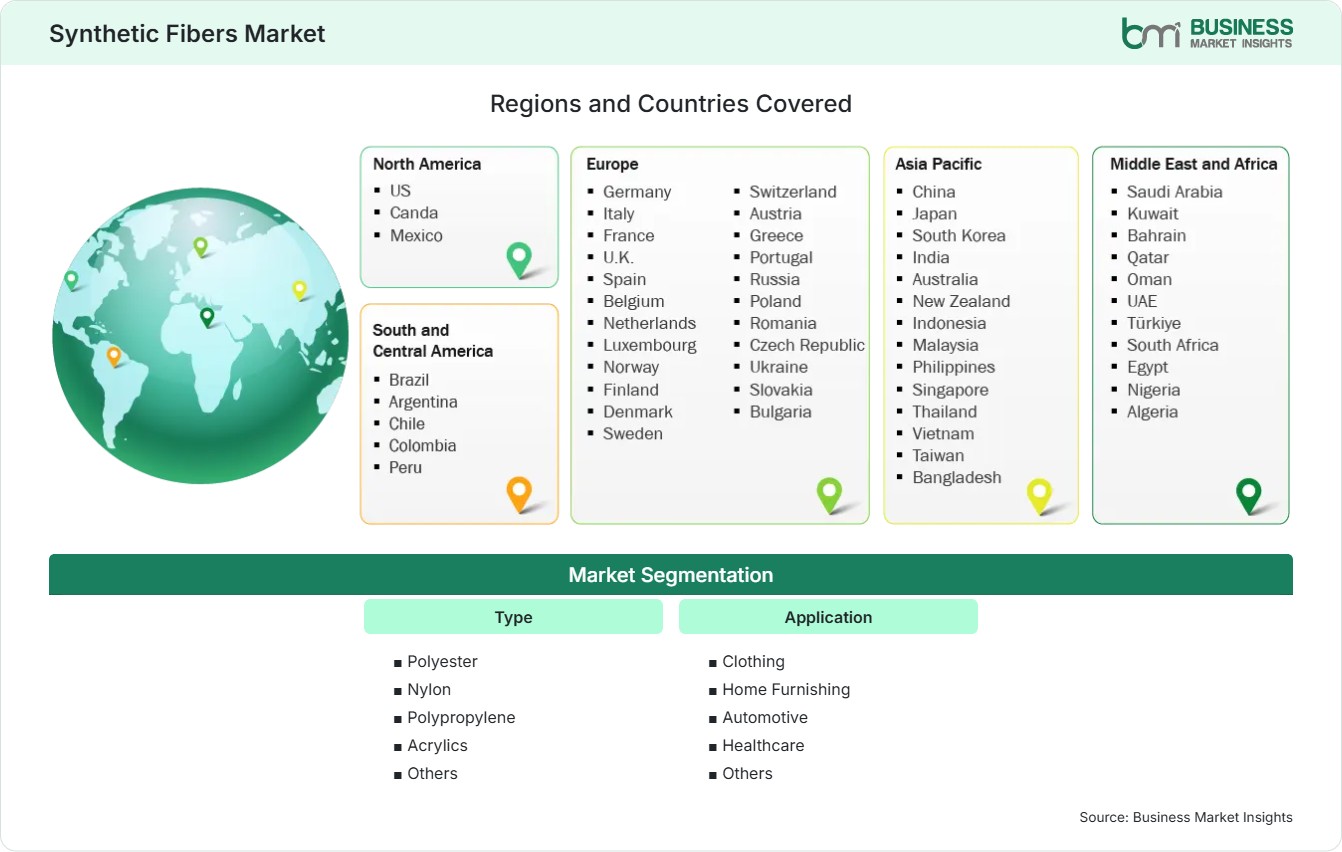
  • Type: Polyester, Nylon, Polypropylene, Acrylics, Others
  • Application: Clothing, Home Furnishing, Automotive, Healthcare, Others
US$ 103.5 Bn Market size in 2025
US$ 186.92 Bn Market Size by 2033
7.67% CAGR, 2026 - 2033
2026-2033 Forecast Period

AI Overview

Synthetic Fibers Market Summary

  • North America Region: holds a market share of 11%-13% in 2025, growing with a CAGR of 7.0%-7.6% between 2026-2033, supported by reshoring of textile manufacturing, defense-grade fiber demand, and recycling infrastructure investment. The U.S. leads regional consumption, expanding at a CAGR near 7.1%-7.5% through 2033, driven by technical textiles and polymer innovation.
  • Fastest Growing Region: Asia Pacific records a market share of 61%-64% in 2025, growing with a CAGR of 8.2%-8.8% between 2026-2033, propelled by expanding textile manufacturing bases in China and India, rising disposable income, and vertically integrated polyester production capacity.
  • Leading Segment: Polyester commands a market share of 45%-48% in 2025, growing with a CAGR of 7.2%-7.6% between 2026-2033, owing to its cost efficiency, recyclability, and dominant use across apparel and home furnishing applications globally.
  • High Growth Segment: Nylon records a market share of 22%-25% in 2025, growing with a CAGR of 8.5%-9.0% between 2026-2033, fueled by rising automotive component substitution, industrial rope and net applications, and demand for high-tenacity technical fabrics.
  • Key Market Opportunity: Bio-based and chemically recycled fiber platforms present a compelling opportunity, as brand-owner sustainability mandates and extended producer responsibility rules push manufacturers toward closed-loop polymer sourcing strategies.
  • Major Market Players: Mitsui Chemicals, Inc., DuPont de Nemours, Inc., Toray Industries, Inc., Leigh Fibers, Inc., Indo Rama Synthetics (India) Limited, Toyobo Co., Ltd., CPC Corporation, Taiwan, Indorama Ventures Public Company Limited, Bombay Dyeing & Manufacturing Company Limited, and Reliance Industries Limited.
Strategic Insights

Synthetic Fibers Market: Strategic Insights

Synthetic Fibers Market Strategic Framework
FREE PDF
Request your free sample
Request free sample
Stakeholder View

Key Takeaways

  • Vertical integration from petrochemical feedstock through spinning and texturizing is consolidating pricing power among a smaller group of large-scale producers, reshaping supplier negotiation dynamics for downstream textile converters.
  • Automotive interiors and filtration media represent the highest-upside application pathways, as lightweighting mandates and industrial air/liquid filtration standards expand addressable volume beyond traditional apparel channels.
  • Chemical recycling and bio-based polymer routes are emerging as the defining innovation trend, with producers scaling depolymerization technology to meet brand-owner recycled-content commitments ahead of regulatory deadlines.
  • India presents a compelling regional investment case, supported by domestic polyester capacity expansion, favorable production-linked incentive schemes, and rising per-capita textile consumption.
  • Recent consolidation activity, including capacity-sharing agreements and joint ventures between regional spinners and global polymer majors, signals accelerating M&A interest in recycled-fiber platforms.
  • Healthcare-grade nonwoven synthetic fibers are gaining strategic importance as hospital systems and medical device makers prioritize domestic supply security following recent global supply chain disruptions.
Geographic Outlook

Synthetic Fibers Market Regional Highlights

North America Synthetic Fibers Market

North America held a Synthetic Fibers Market share of 11%-13% in 2025 and is projected to expand at a CAGR of 7.0%-7.6% through 2033. Demand is anchored by automotive lightweighting programs, defense and protective textile procurement, and a maturing recycled-polyester supply chain. Producers are prioritizing near-shored capacity to reduce exposure to trans-Pacific freight volatility and tariff uncertainty affecting imported fiber and yarn.

  • Automotive interior suppliers are substituting natural fiber composites with high-tenacity nylon and polyester blends to meet stringent vehicle weight-reduction targets across passenger and commercial platforms.
  • Defense procurement programs are driving sustained demand for flame-resistant and ballistic-grade synthetic fibers used in protective apparel, tenting, and parachute systems across allied military supply chains.
  • Recycled-content legislation across several U.S. states is compelling apparel and packaging brands to secure long-term offtake agreements with domestic mechanical recycling facilities.
  • Healthcare system reshoring initiatives are expanding domestic nonwoven synthetic fiber capacity for surgical gowns, masks, and wound-care textiles previously sourced overseas.

US Synthetic Fibers Market

The United States accounted for the majority of North American Synthetic Fibers Market consumption in 2025, expanding at a CAGR of 7.1%-7.5% through 2033. Domestic demand is concentrated in technical textiles, automotive components, and performance apparel, supported by continued polymer innovation investment from integrated chemical producers.

  • Performance apparel brands are increasing use of moisture-wicking polyester and nylon blends as athleisure and outdoor categories sustain double-digit retail growth momentum.
  • Domestic polymer producers are expanding continuous polymerization lines to reduce reliance on imported staple fiber and filament yarn from Asian suppliers.
  • Filtration and industrial fabric manufacturers are scaling meltblown and spunbond capacity to serve air and liquid filtration markets tied to semiconductor and pharmaceutical facility expansion.

Europe Synthetic Fibers Market

Europe held a Synthetic Fibers Market share of 15%-17% in 2025, expanding at a CAGR of 6.5%-7.0% through 2033. Regulatory pressure under the EU Strategy for Sustainable and Circular Textiles is the dominant demand driver, compelling producers to scale recycled and bio-attributed fiber volumes ahead of mandatory recycled-content thresholds.

  • Germany leads regional consumption on the strength of its automotive and industrial technical textile base, expanding at a CAGR of 6.8%-7.2% through 2033 amid vehicle lightweighting demand.
  • Italy remains the fastest-growing European market, projected to expand at a CAGR of 7.3%-7.8% through 2033, driven by luxury apparel manufacturing and premium synthetic-natural fiber blends.
  • Extended producer responsibility rules are forcing apparel brands to redesign products for fiber-to-fiber recyclability, reshaping polymer selection criteria across the supply chain.
  • Energy price volatility is prompting European spinners to relocate energy-intensive polymerization stages to lower-cost neighboring regions while retaining finishing operations domestically.

Asia Pacific Synthetic Fibers Market

Asia Pacific held a market share of 61%-64% in 2025, expanding at a CAGR of 8.2%-8.8% through 2033, making it both the largest and fastest-growing regional market and anchoring overall Synthetic Fibers Market share concentration globally. Vertically integrated polyester and nylon production across China, India, and Indonesia continues to anchor global supply, supported by low-cost energy access and expanding domestic apparel consumption.

  • China remains the leading national market, supported by integrated PTA-to-polyester production chains, though growth is moderating to a CAGR of 7.0%-7.5% through 2033 as capacity matures.
  • India is the fastest-growing major national market, projected to expand at a CAGR of 9.0%-9.6% through 2033, supported by production-linked incentive schemes and rising domestic textile consumption.
  • Rising intra-regional trade agreements are reducing tariff friction for fiber and yarn exports between Southeast Asian manufacturing hubs and downstream garment producers.
  • Automotive component manufacturers across Japan and South Korea are increasing high-performance nylon adoption for airbag fabric and engine-bay components.

Rest of World Synthetic Fibers Market

South and Central America accounted for a Synthetic Fibers Market share of 4%-5% in 2025, expanding at a CAGR of 7.4%-7.9% through 2033, led by Brazil's textile manufacturing base and rising automotive component localization. The Middle East and Africa region held a share of 3%-4% in 2025, projected to grow at a CAGR of 7.8%-8.3% through 2033, supported by petrochemical integration in Gulf Cooperation Council states.

  • Brazil leads Latin American consumption, supported by domestic apparel manufacturing and government incentives for textile sector modernization, expanding at a CAGR of 7.3%-7.7% through 2033.
  • Saudi Arabia and the United Arab Emirates are emerging as the fastest-growing markets within MEA, projected to expand at a CAGR of 8.5%-9.1% through 2033 on petrochemical-integrated fiber capacity.
  • South Africa's technical textile sector is expanding on the back of mining and industrial protective apparel demand tied to infrastructure investment programs.
  • Regional free trade zones in the Gulf are attracting fiber producers seeking export-oriented manufacturing bases with favorable feedstock access and tax incentives.
Global Market Geography
FREE PDF
Request your free sample
Request free sample
Segment Analysis

Synthetic Fibers Market Segmentation

Type

This segment defines the polymer scope of the Synthetic Fibers Market and holds a market share of 45%-48% in 2025 for its leading category, growing at a CAGR of 7.2%-7.7% between 2026-2033. Adoption is driven by cost efficiency, mechanical versatility, and expanding recycled-polymer availability across apparel and industrial applications.

  • Polyester: dominates fiber consumption globally due to low production cost, strong tensile strength, and broad compatibility with mechanical and chemical recycling processes across apparel and home textile applications.
  • Nylon: gains traction in automotive, industrial rope, and technical apparel applications owing to superior abrasion resistance, elasticity, and performance under high-stress mechanical loading conditions.
  • Polypropylene: expands steadily in nonwoven hygiene, geotextile, and packaging applications due to low density, moisture resistance, and cost-effective extrusion processing economics.
  • Acrylics: sustains demand in home furnishing and outerwear applications as a wool substitute, valued for softness, colorfastness, and resistance to sunlight degradation.

Application

This segment reflects end-use consumption patterns and holds a market share of 44%-47% in 2025 for its leading category, growing at a CAGR of 7.1%-7.6% between 2026-2033. The Synthetic Fibers Market scope continues broadening beyond apparel as automotive and healthcare applications scale rapidly across developed and emerging economies.

  • Clothing: remains the dominant application as fast-fashion cycles and athleisure demand sustain high-volume consumption of polyester and nylon blended fabrics worldwide.
  • Home Furnishing: benefits from rising e-commerce penetration and consumer preference for durable, stain-resistant upholstery and carpet fibers across residential and hospitality sectors.
  • Automotive: expands rapidly as manufacturers substitute heavier materials with lightweight synthetic fiber composites to meet fuel efficiency and emissions reduction targets.
  • Healthcare: grows on rising demand for nonwoven surgical textiles, wound-care materials, and protective apparel amid expanding global healthcare infrastructure investment.
Market Forces

Synthetic Fibers Market Dynamics

Key Market Drivers

Automotive Lightweighting Acceleration

Automakers are substituting metal and natural fiber components with high-tenacity synthetic fibers to meet tightening fuel efficiency and emissions standards across major markets. Nylon and polyester composites now feature extensively in airbag fabric, seat covers, headliners, and under-the-hood components, reducing vehicle weight by measurable margins per platform. This substitution trend directly supports Synthetic Fibers Market growth, as global vehicle production volumes recover and electric vehicle platforms adopt lightweight interior materials to offset battery weight. Regulatory bodies, including the International Energy Agency, have highlighted transport-sector decarbonization as a structural driver of material substitution, reinforcing sustained demand for engineered synthetic fiber composites across passenger and commercial vehicle segments through the forecast period, supporting broader market trends toward performance-material integration.

Recycled Polyester Capacity Expansion

The commitment to sustainability made by brand owners is forcing apparel and packaging businesses to enter into long-term agreements offtake for recycled polyester, resulting in major investments in recycling facilities around the world. Big fibers are making announcements about plans for expansion of capacity over multiple years using post-consumer PET bottles and textiles as their feedstock source, thus reducing reliance on petrochemical inputs. The economics of production is being transformed since the recycled fiber is sold at higher prices and helps meet extended producer responsibility. The scale of this transition underscores its role as a primary structural driver rather than a peripheral sustainability initiative within the broader Synthetic Fibers Market.

Technical Textile Demand in Filtration and Medical Applications

Expanding industrial filtration requirements across semiconductor, pharmaceutical, and water treatment facilities are driving sustained demand for spunbond and meltblown synthetic fiber media. Healthcare systems are simultaneously scaling domestic nonwoven textile procurement for surgical gowns, masks, and wound-care products following recent supply chain disruptions that exposed import dependency risks. Various regulatory authorities, such as the World Health Organization, have advocated supply chain resilience for vital medical textiles, leading to various incentives for reshoring offered by the governments of many developed nations. Both of these sources of demand for fiber makers offer revenue streams that are not cyclically dependent on fashion.

Key Market Opportunities

Bio-Based and Chemically Recycled Fiber Platforms

Producers investing early in bio-based polymer feedstock and advanced depolymerization technology are positioned to capture premium pricing as brand owners commit to verified recycled-content sourcing targets ahead of regulatory deadlines. Chemical recycling, as opposed to mechanical recycling, allows for fiber-grade production using blends of textile wastes, thus opening up a much broader range of source material than bottle-grade PET. This has made venture and strategic capital flow into depolymerization operations, as well as into partnerships between waste management companies and traditional polymer producers. Early entrants into this process can leverage their positions by forming long-term contracts with apparel makers looking for traceable, recycled-content fibers before their competitors can do the same.

Emerging Market Capacity Localization

Fiber manufacturers have been developing their manufacturing facilities in Southeast Asia, South Asia, and certain parts of Africa to benefit from the tariffs available, reduced labor costs, and closeness to the burgeoning local demand for garments. This strategy is also consistent with the diversification initiative by brands in response to the volatility witnessed in trade policies recently. Incentive schemes from governments, like the production-linked incentives provided by India to synthetic fibers, have also been targeting foreign direct investment into local manufacturing facilities. Synthetic Fibers Market forecasts point toward these emerging manufacturing hubs capturing a growing share of global capacity additions through 2033, as producers balance cost efficiency against supply chain resilience considerations in an increasingly fragmented global trade environment.

High-Performance Fiber Adoption in Renewable Energy Infrastructure

Emerging Synthetic Fibers Market trends indicate that wind turbine blade manufacturing, solar panel backsheets, and battery separator applications are creating new demand channels for high-strength synthetic fibers beyond traditional textile end-uses. As renewable energy infrastructure investment accelerates globally under national decarbonization commitments, composite material suppliers are scaling production of glass and carbon-fiber-reinforced synthetic polymer systems tailored to these applications. This diversification opens a structurally distinct, less cyclical revenue stream for fiber producers compared to apparel-linked demand, with the International Renewable Energy Agency projecting continued capacity growth across wind and solar installations that will require sustained composite material input through the next decade.

Market Restraints and Challenges

Petrochemical Feedstock Price Volatility

Factor: Synthetic fiber production remains heavily dependent on petrochemical-derived feedstocks including purified terephthalic acid and monoethylene glycol, whose prices fluctuate with crude oil markets and refinery capacity constraints.

 Impact: This volatility compresses producer margins during price spikes and complicates long-term contract pricing with downstream textile converters, forcing manufacturers to either absorb cost increases or pass them through to brand-owner customers who face their own competitive pricing pressure. Regional spinners without hedges against fluctuations in feedstock prices suffer more from volatility in pricing cycles, and this may lead to increased consolidation in the industry because scale is now an important factor that determines margins. Uncertainty about feedstock prices leads to deferred capital spending on new polymerization capacity.

Environmental Regulation and Microplastic Concerns

Factor: Growing regulatory scrutiny over synthetic fiber microplastic shedding during laundering, combined with tightening extended producer responsibility mandates across the European Union and select U.S. states, is increasing compliance costs for fiber and textile manufacturers.

Impact: Pressure has been created on manufacturers to adopt filter technology, change fibers to reduce shedding, and document their use of recycled content; all of which raise production costs and cannot be passed on to price-sensitive clothing markets. Failure to meet the requirements will lock out the manufacturers from accessing the market, while the cost of meeting the requirements will affect small manufacturers without the financial capacity to adopt the technology.

Company Analysis

Competitive Landscape

The following Synthetic Fibers Market analysis highlights the strategic positioning of leading producers across polymer integration, capacity scale, and application specialization.

Company Name

Overview

Products and Services Relevant to This Market

Mitsui Chemicals, Inc.

Japanese diversified chemical major with integrated petrochemical operations supplying polymer feedstock across global textile and industrial fiber value chains.

Supplies PTA and polyester intermediates, functional polymer resins, and specialty fiber additives for apparel and industrial applications.

DuPont de Nemours, Inc.

U.S. specialty materials leader with a legacy nylon and performance fiber portfolio serving apparel, industrial, and protective textile markets.

Produces high-performance nylon, aramid fibers, and engineered polymer solutions for protective apparel and industrial composites.

Toray Industries, Inc.

Japanese integrated fiber and materials conglomerate operating across polyester, nylon, and carbon fiber production worldwide.

Manufactures polyester and nylon filament yarn, staple fiber, and advanced composite fiber materials for apparel and automotive uses.

Leigh Fibers, Inc.

U.S.-based recycler and processor specializing in textile waste conversion into reusable fiber feedstock for downstream manufacturers.

Provides recycled and reclaimed synthetic fiber materials for nonwoven, automotive, and industrial insulation applications.

Indo Rama Synthetics (India) Limited

Indian polyester fiber and yarn producer with integrated spinning and polymerization capacity serving domestic and export markets.

Manufactures polyester staple fiber, filament yarn, and polymer chips for apparel and home textile applications.

Toyobo Co., Ltd.

Japanese materials and fiber manufacturer with diversified operations spanning films, textiles, and specialty industrial fibers.

Produces high-performance polyester and nylon fibers, films, and technical textile materials for industrial and apparel end-uses.

CPC Corporation, Taiwan

Taiwanese state-owned petrochemical enterprise supplying upstream feedstock to regional synthetic fiber and polymer manufacturers.

Supplies petrochemical intermediates including PTA and polymer feedstock for regional fiber production operations.

Indorama Ventures Public Company Limited

Thailand-headquartered global polymer major and the world's largest integrated producer of PET resin and polyester fiber.

Manufactures polyester fiber, PET resin, and specialty yarn products serving apparel, packaging, and industrial markets.

Bombay Dyeing & Manufacturing Company Limited

Indian textile heritage company with integrated polyester and home furnishing fiber manufacturing operations.

Produces polyester staple fiber, home furnishing textiles, and blended fabric products for domestic and export markets.

Reliance Industries Limited

India's largest integrated petrochemical and polyester producer with vertically integrated feedstock-to-fiber capacity.

Manufactures polyester staple fiber, filament yarn, and recycled PET-based fiber products across global export markets.

Trust & Transparency

Research Methodology

The market analysis combines proprietary research with secondary data from government agencies, company disclosures, regulatory filings, industry databases and expert interviews. Market estimates are validated through data triangulation, cross-market benchmarking and analyst review.

View Full Research Methodology

Questions Answered

Frequently Asked Questions

What restrains the growth of the Synthetic Fibers Market?

Petrochemical feedstock price volatility and tightening microplastic and recycled-content regulations increase compliance costs and compress producer margins industry-wide.

What is driving demand for synthetic fibers in automotive applications?

Vehicle lightweighting mandates and emissions regulations are pushing automakers toward high-tenacity nylon and polyester composites to reduce component weight.

Which fiber type dominates the market?

Polyester dominates due to its cost efficiency, recyclability, and broad compatibility across apparel, home furnishing, and industrial applications globally.

Which region leads the global synthetic fibers industry?

Asia Pacific leads both in market share and growth rate, supported by integrated polyester and nylon production hubs across China, India, and Southeast Asia.

What was the market valuation in 2025 per the Synthetic Fibers Market Report?

The market was valued at USD 103.5 Billion in 2025 and is projected to reach USD 186.92 Billion by 2033, expanding at a 7.67% CAGR through the forecast period.

Access the Full Synthetic Fibers Market Report

Get segment-level forecasts, regional estimates, competitive benchmarking, company profiles and downloadable Excel datasets.

Access the full Synthetic Fibers Market Report
350 pages PDF & Excel | 2026-08-17
Similar Research

Related Market Reports