
Synthetic Adsorbents Market Outlook: Size, Share, Trends, Growth Analysis, Competitive Landscape & Forecast, 2026-2033

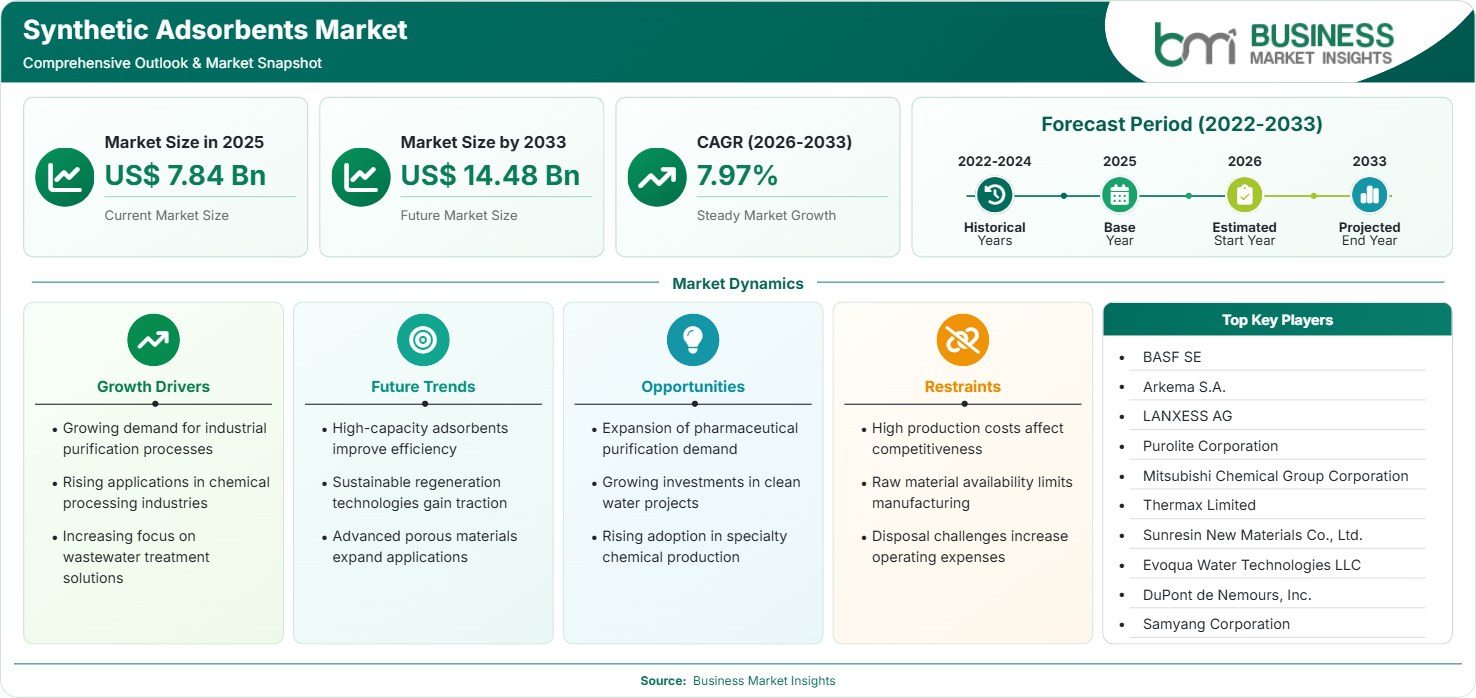
The Synthetic Adsorbents Market size was valued at US$ 7.84 billion in 2025 and is projected to reach US$ 14.48 billion by 2033, growing at a CAGR of 7.97% during 2026–2033. Growing demand for industrial purification processes, expanding chemical manufacturing, increasing wastewater treatment activities, and rising investments in sustainable separation technologies continue supporting market expansion.

Report Coverage
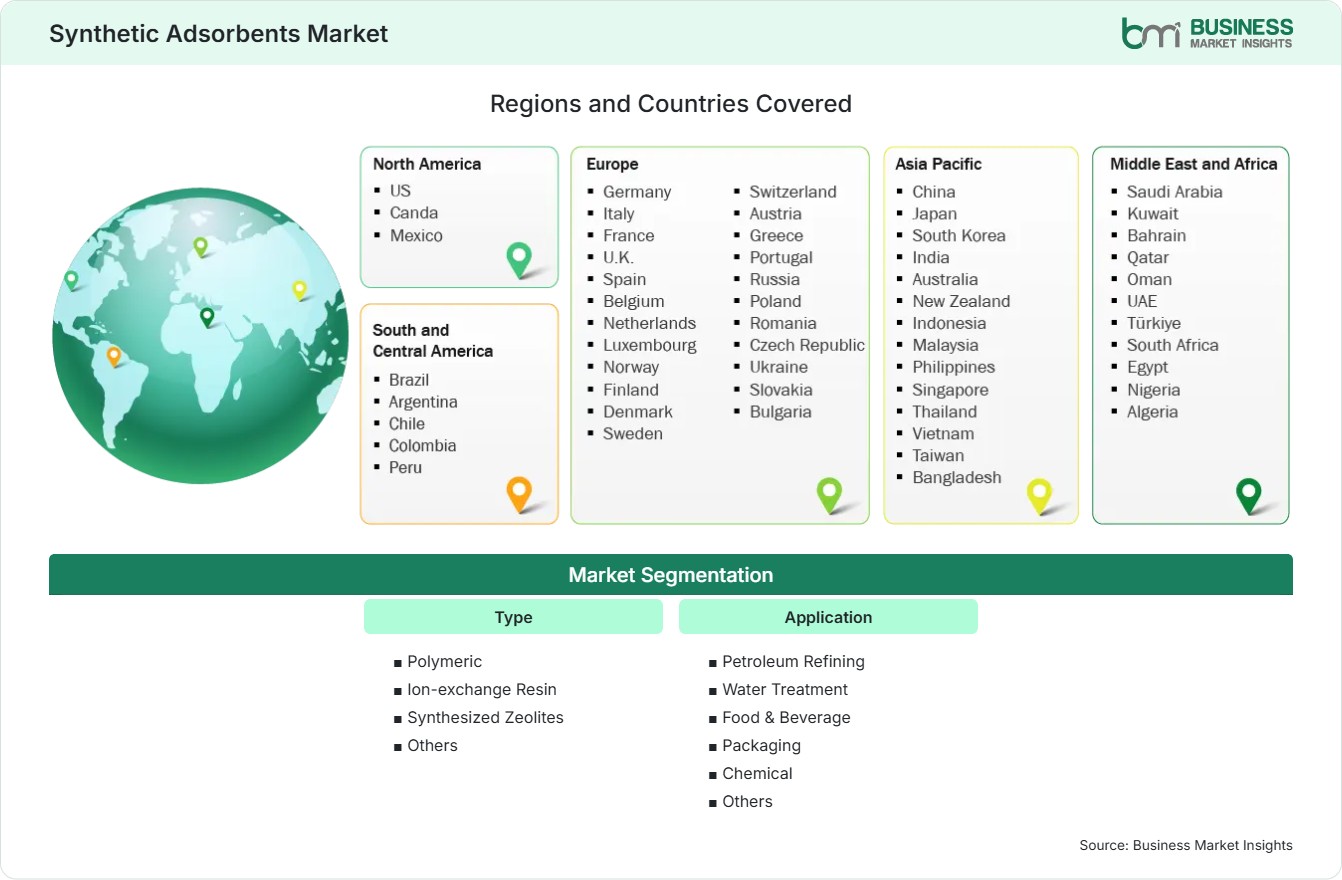
  • Type: Polymeric, Ion-exchange Resin, Synthesized Zeolites, Others
  • Application: Petroleum Refining, Water Treatment, Food & Beverage, Packaging, Chemical, Others
US$ 7.84 Bn Market size in 2025
US$ 14.48 Bn Market Size by 2033
7.97% CAGR, 2026 - 2033
2026-2033 Forecast Period

AI Overview

Synthetic Adsorbents Market Summary

  • North America Region: North America accounts for 34%–37% market share in 2025 and is expected to grow at a CAGR of 7.4%–8.0% during 2026–2033. Strong investments in water treatment, petrochemical processing, pharmaceutical production, and environmental compliance continue supporting regional demand. The U.S. remains the largest contributor, expanding at an estimated 7.5%–8.1% CAGR through continued industrial modernization and advanced purification technologies.
  • Fastest Growing Region: Asia Pacific holds 29%–32% market share in 2025 and is projected to register a CAGR of 8.7%–9.3% during the forecast period. Expanding chemical production, industrial wastewater treatment, pharmaceutical manufacturing, and government environmental initiatives continue driving regional demand.
  • Leading Segment: Polymeric adsorbents represent 36%–39% market share in 2025 and are anticipated to expand at a CAGR of 8.2%–8.8%, supported by broad adoption across chemical purification, pharmaceutical processing, and water treatment applications.
  • High Growth Segment: Water Treatment accounts for 30%–33% market share in 2025 and is forecast to grow at a CAGR of 8.5%–9.1%, driven by stricter wastewater regulations, industrial recycling initiatives, and increasing investments in municipal water infrastructure.
  • Key Market Opportunity: Growing adoption of high-performance purification materials in pharmaceuticals, specialty chemicals, water recycling, and environmental remediation is creating long-term opportunities for synthetic adsorbent manufacturers.
  • Major Market Players: BASF SE, Arkema S.A., LANXESS AG, Purolite Corporation, Mitsubishi Chemical Group Corporation, Thermax Limited, Sunresin New Materials Co., Ltd., Evoqua Water Technologies LLC, DuPont de Nemours, Inc., and Samyang Corporation.
Strategic Insights

Synthetic Adsorbents Market: Strategic Insights

Synthetic Adsorbents Market Strategic Framework
FREE PDF
Request your free sample
Request free sample
Stakeholder View

Key Takeaways

  • The value chain is becoming increasingly integrated as raw material suppliers, resin manufacturers, engineering companies, and end users collaborate to improve purification efficiency and process sustainability.
  • Water treatment and specialty chemical production continue generating attractive commercial opportunities as industries seek advanced separation materials capable of meeting increasingly strict quality and environmental standards.
  • Product innovation is centered on improving adsorption efficiency, regeneration capability, chemical resistance, and operational lifespan to reduce lifecycle costs for industrial users.
  • Asia Pacific presents the strongest long-term investment potential due to expanding industrial production, rising environmental compliance requirements, and increasing investment in water infrastructure.
  • Strategic acquisitions, production capacity expansion, and technology licensing agreements continue strengthening competitive positioning among leading manufacturers operating in global purification markets.
  • Sustainability initiatives are encouraging development of advanced adsorbent materials that improve resource recovery, reduce industrial waste generation, and support circular manufacturing processes.
Geographic Outlook

Synthetic Adsorbents Market Regional Highlights

North America Synthetic Adsorbents Market

North America represents 34%–37% Synthetic Adsorbents Market share in 2025 and is projected to grow at a CAGR of 7.4%–8.0% during 2026–2033. Strong industrial infrastructure, advanced chemical manufacturing, strict environmental regulations, and continuous investment in water treatment facilities support regional demand. Industrial users continue replacing conventional purification technologies with high-performance synthetic adsorbents to improve production efficiency, reduce emissions, and comply with evolving environmental standards.

  • Chemical manufacturers increasingly adopt advanced adsorbent materials to improve separation efficiency, product purity, and resource recovery across large-scale industrial operations.
  • Municipal and industrial water treatment facilities continue expanding use of synthetic adsorption technologies to address stricter wastewater discharge and water reuse requirements.
  • Refining and petrochemical companies invest in improved purification systems that enhance operational performance while reducing environmental impact and operating costs.
  • Ongoing investments in sustainable industrial processing and environmental compliance continue supporting demand for advanced adsorption technologies.

US Synthetic Adsorbents Market

The United States contributes approximately 80%–83% of North American revenue and is expected to register a CAGR of 7.5%–8.1% during 2026–2033. Strong demand from chemical processing, pharmaceutical production, petroleum refining, and industrial water treatment continues supporting steady market expansion across the country.

  • Industrial manufacturers continue modernizing purification systems to improve process efficiency and regulatory compliance.
  • Water treatment operators increasingly invest in advanced adsorption technologies supporting water reuse and contaminant removal.
  • Chemical producers adopt high-capacity adsorbents to improve production quality and operational reliability.
  • Environmental sustainability initiatives continue encouraging broader deployment of advanced purification materials.

Europe Synthetic Adsorbents Market

Europe accounts for 24%–27% market share in 2025 and is forecast to expand at a CAGR of 7.6%–8.2% through 2026–2033. Strong environmental legislation, advanced chemical manufacturing, and growing investment in sustainable industrial processes continue supporting regional growth. Germany leads regional demand, while Poland records one of the fastest growth rates through expanding industrial production and environmental infrastructure.

  • Chemical companies continue investing in advanced purification technologies supporting sustainable manufacturing.
  • Water recycling initiatives encourage greater adoption of synthetic adsorbents across municipal and industrial facilities.
  • Pharmaceutical manufacturers strengthen demand for high-purity separation materials in production processes.
  • Environmental compliance requirements continue supporting replacement of conventional purification systems.

Asia Pacific Synthetic Adsorbents Market

Asia Pacific represents 29%–32% market share in 2025 and is expected to record the fastest 8.7%–9.3% CAGR during the forecast period. Expanding chemical manufacturing, industrial wastewater treatment, pharmaceutical production, and government environmental initiatives continue driving regional demand. China leads regional consumption, while India records the strongest long-term growth potential.

  • Rapid industrialization continues increasing demand for advanced purification technologies across manufacturing industries.
  • Governments expand wastewater treatment infrastructure to improve environmental performance and water resource management.
  • Pharmaceutical production growth supports increasing demand for high-performance adsorption materials.
  • Manufacturers continue expanding regional production capacity to serve growing domestic and export markets.

Rest of World Synthetic Adsorbents Market

The Rest of World region accounts for 8%–11% market share in 2025 and is anticipated to grow at a CAGR of 7.8%–8.4% during 2026–2033. Industrial diversification, water infrastructure investment, and expanding petrochemical production continue supporting demand across Latin America, the Middle East, and Africa.

  • Gulf countries continue investing in industrial water treatment and petrochemical purification technologies.
  • Brazil leads regional demand through expanding chemical manufacturing and environmental infrastructure projects.
  • Industrial wastewater management programs encourage broader adoption of advanced adsorption materials.
  • Growing investment in sustainable manufacturing supports long-term market opportunities across emerging economies.
Global Market Geography
FREE PDF
Request your free sample
Request free sample
Segment Analysis

Synthetic Adsorbents Market Segmentation

Type

The type segment remains the core of the industry as manufacturers continue developing high-performance materials for purification, separation, and catalyst support applications. It accounted for 36%–39% market share in 2025 and is projected to grow at a CAGR of 8.2%–8.8% during 2026–2033. Product innovation, longer service life, and improved adsorption efficiency continue expanding the Synthetic Adsorbents Market scope across chemical processing, environmental protection, and industrial manufacturing.

  • Polymeric: Widely used for purification, solvent recovery, pharmaceutical processing, and food applications due to high adsorption capacity, excellent chemical stability, and effective regeneration across repeated industrial operating cycles.
  • Ion-exchange Resin: Extensively utilized in water softening, demineralization, metal recovery, and chemical separation processes where selective ion removal and high operational efficiency remain essential for industrial performance.
  • Synthesized Zeolites: Commonly adopted in petroleum refining, gas separation, catalyst support, and air purification because of their uniform pore structure, thermal stability, and strong molecular adsorption characteristics.
  • Others: Includes specialty synthetic adsorbents designed for niche industrial applications requiring customized adsorption performance, selective contaminant removal, and compatibility with specialized manufacturing processes.

Application

Application diversity continues expanding as industries increasingly rely on advanced adsorption materials to improve product quality, operational efficiency, and environmental compliance. This segment accounted for 30%–33% market share in 2025 and is expected to register a CAGR of 8.5%–9.1% during 2026–2033. Current Synthetic Adsorbents Market trends reflect growing adoption across both established and emerging industrial sectors.

  • Petroleum Refining: Synthetic adsorbents improve hydrocarbon purification, sulfur removal, catalyst protection, and separation efficiency while supporting higher-quality fuel production and refinery process optimization.
  • Water Treatment: Municipal and industrial treatment facilities increasingly deploy synthetic adsorbents to remove organic contaminants, heavy metals, and dissolved impurities while supporting water recycling and reuse initiatives.
  • Food & Beverage: Manufacturers utilize adsorption materials for sugar refining, edible oil purification, beverage processing, and ingredient purification to maintain product quality and regulatory compliance.
  • Packaging: High-performance adsorbents help control moisture, odors, oxygen, and contaminants within packaging systems, extending product shelf life and improving storage stability.
  • Chemical: Chemical manufacturers apply synthetic adsorbents for purification, catalyst recovery, solvent recycling, and separation processes that improve production efficiency and product consistency.
  • Others: Includes pharmaceutical purification, environmental remediation, biotechnology processing, electronics manufacturing, and laboratory applications requiring high-performance adsorption technologies.
Market Forces

Synthetic Adsorbents Market Dynamics

Key Market Drivers

Growing demand for industrial purification processes

The use of artificial adsorbents has become more common in the various industries due to increased efficiency, improved quality of the products being produced, and reduction of contamination that occurs in the process of production. The petroleum industry, the chemical industry, and the pharmaceutical industry depend on artificial adsorption substances for the purification of various products, recovery of chemicals, and consistency in processes. Industrial activities contribute greatly to energy consumption, according to the International Energy Agency. These factors are supporting Synthetic Adsorbents Market growth as companies invest in high-performance materials that provide better selectivity, regeneration capability, and longer operating cycles across industrial purification applications.

Rising applications in chemical processing industries

Synthetic adsorbents are gaining popularity in the separation, purification, catalyst protection, and process optimization operations performed by chemical companies. The use of such materials ensures that there is an improvement in chemical reactions, and also helps in ensuring that the quality of products is maintained by getting rid of unnecessary chemicals. The rising production of specialty chemicals and pharmaceuticals and the need for high-quality industrial products have created more scope for advanced adsorption techniques. There is an increased emphasis by manufacturers on developing custom-made synthetic adsorbents that are chemically resistant and have high adsorption capacity.

Increasing focus on wastewater treatment solutions

Environmental issues and stringent wastewater discharge standards are driving companies and municipalities to implement efficient purification technologies. Adsorbent materials offer excellent options for eliminating organic compounds, heavy metals, and other dissolved pollutants from the industrial wastewater flows. The growing water shortages and focus on water reusing are also promoting the development of new purification systems. There is a growing demand for adsorbent materials among industrial facilities, power stations, and municipalities. All these factors influence the trends in Synthetic Adsorbents Market.

Key Market Opportunities

Expansion of pharmaceutical purification demand

Pharmaceuticals have emerged as a promising prospect for synthetic adsorbent makers on account of rising demand for purified substances and superior purification techniques. Pharmaceutical companies need efficient purification systems in order to purify ingredients and achieve purity standards. Synthetic adsorbents have been receiving greater consideration owing to their stable structure, ability to undergo multiple processing cycles, and chemical stability. Construction of more pharmaceutical plants, especially in Asia Pacific regions and other developing countries, will lead to increased demand for adsorption products. Synthetic Adsorbents Market Forecasts indicate continued opportunities as healthcare companies increase investments in advanced manufacturing technologies.

Growing investments in clean water projects

Investments in clean water campaigns are growing as an attempt to overcome the increase in water stresses and environmental issues. Synthetic adsorbents are now gaining importance in modern filtering and wastewater treatment facilities owing to their capability of eliminating contaminants. Government infrastructure campaigns and industrial water recycling campaigns are presenting a new set of opportunities to adsorbent providers in the form of custom-made products. Industries' efforts to conserve water and minimize discharge contamination will further drive the use of advanced adsorbents in filtration processes.

Rising adoption in specialty chemical production

Specialty chemical manufacturers have been favoring synthetic adsorbents in order to enhance their purity and better process control in addition to the formulation of complicated chemical processes. This allows them to use selective adsorption for separation and purification in cases that need such features. The development of electronic chemicals, pharmaceutical intermediates, and advanced materials leads to an increased demand for specialized adsorption processes. The manufacturers of specialized adsorbents with enhanced durability and regeneration will be able to capitalize on this trend. The construction of more facilities for specialty chemicals has provided commercial growth for synthetic adsorbents.

Market Restraints and Challenges

High production costs affect competitiveness

Synthetic adsorbents require advanced manufacturing processes, specialized raw materials, and controlled production environments, which increase overall production expenses. Factor: Higher manufacturing costs associated with polymer synthesis, chemical processing, quality control, and technological development can limit price competitiveness compared with conventional adsorption materials. Impact: Higher production costs might limit its application among consumers who consider costs when making decisions, especially in developing countries where industries prefer low-cost options. Manufacturing companies are currently emphasizing process improvement, automation, and innovation in materials to achieve cost reduction without affecting adsorption properties.

Raw material availability limits manufacturing

The availability and pricing stability of key raw materials influence production capacity and supply chain reliability for synthetic adsorbent manufacturers. Factor: Dependence on specialized polymers, chemical intermediates, and mineral-based inputs can create supply challenges due to price fluctuations, geopolitical disruptions, and limited sourcing options. Impact: Material limitations can lead to higher production costs, late deliveries, and restrict producers from being able to scale up production quickly to match market demands. More companies are starting to consider diversifying their sources for materials and using alternative materials in an attempt to remain more resilient.

Company Analysis

Competitive Landscape

The competitive environment is shaped by material innovation, production capacity expansion, and increasing demand for customized purification solutions across industrial sectors. Synthetic Adsorbents Market analysis highlights that leading companies are focusing on advanced resin technologies, specialty adsorption materials, strategic partnerships, and application-specific solutions to strengthen their positions. Companies are also investing in sustainable manufacturing approaches to improve product efficiency, reduce operational costs, and support growing demand from water treatment, chemical processing, and pharmaceutical industries.

Company Name

Overview

Products and Services relevant to this market

BASF SE

Global chemical company providing advanced materials, catalysts, and specialty solutions for industrial purification and separation applications.

Synthetic resins, adsorption materials, specialty chemicals, purification solutions, and technologies supporting industrial separation processes.

Arkema S.A.

Specialty materials manufacturer focused on high-performance polymers, chemical solutions, and advanced materials for industrial applications.

Polymer-based adsorbents, specialty materials, chemical processing solutions, and customized purification technologies.

LANXESS AG

German specialty chemicals company supplying ion exchange resins and water treatment solutions for industrial applications.

Lewatit ion exchange resins, water purification systems, chemical separation solutions, and industrial treatment technologies.

Purolite Corporation

Leading resin technology company specializing in ion exchange, adsorbents, and separation solutions for diverse industries.

Synthetic polymeric adsorbents, ion exchange resins, pharmaceutical purification materials, and water treatment solutions.

Mitsubishi Chemical Group Corporation

Global chemical manufacturer developing advanced materials and functional products for industrial and healthcare applications.

Adsorbent materials, specialty polymers, separation technologies, and chemical purification solutions.

Thermax Limited

Energy and environmental solutions provider offering water treatment and industrial process technologies.

Water purification systems, treatment solutions, adsorption technologies, and environmental management services.

Sunresin New Materials Co., Ltd.

Chinese manufacturer specializing in adsorption resin technologies and advanced separation materials.

Adsorption resins, ion exchange materials, wastewater treatment solutions, and specialty purification systems.

Evoqua Water Technologies LLC

Water treatment technology provider delivering advanced purification and resource recovery solutions.

Ion exchange systems, water treatment equipment, adsorption technologies, and industrial purification services.

DuPont de Nemours, Inc.

Science-based materials company offering advanced water and industrial separation technologies.

Ion exchange resins, filtration technologies, purification materials, and industrial separation solutions.

Samyang Corporation

Korean industrial company producing specialty chemicals and functional materials for industrial applications.

Ion exchange resins, purification materials, specialty polymers, and advanced chemical processing solutions.

Trust & Transparency

Research Methodology

The market analysis combines proprietary research with secondary data from government agencies, company disclosures, regulatory filings, industry databases and expert interviews. Market estimates are validated through data triangulation, cross-market benchmarking and analyst review.

View Full Research Methodology

Questions Answered

Frequently Asked Questions

What does the Synthetic Adsorbents Market Report include?

The Market Report covers market dynamics, segmentation analysis, regional developments, competitive strategies, technological advancements, growth opportunities, and future outlook for industry participants.

How are manufacturers improving synthetic adsorbent performance?

Companies are developing materials with higher adsorption capacity, improved regeneration properties, better chemical resistance, and customized characteristics designed for specific industrial separation requirements.

Why is water treatment an important application area?

Growing water scarcity, stricter environmental regulations, and increased focus on wastewater recycling are encouraging industries and municipalities to adopt advanced adsorption-based purification technologies.

Which type of synthetic adsorbent is widely used in industrial applications?

Polymeric adsorbents and ion exchange resins are widely used because they provide strong adsorption performance, chemical stability, regeneration capability, and suitability across multiple industrial processes.

What industries are driving demand for synthetic adsorbents market?

Petroleum refining, water treatment, pharmaceuticals, food processing, and chemical manufacturing are major industries adopting synthetic adsorbents due to their ability to improve purification efficiency and product quality.

Access the Full Synthetic Adsorbents Market Report

Get segment-level forecasts, regional estimates, competitive benchmarking, company profiles and downloadable Excel datasets.

Access the full Synthetic Adsorbents Market Report
350 pages PDF & Excel | 2026-08-06
Similar Research

Related Market Reports