
Synthetic Paper Market Outlook: Size, Share, Trends, Growth Analysis, Competitive Landscape & Forecast, 2026-2033

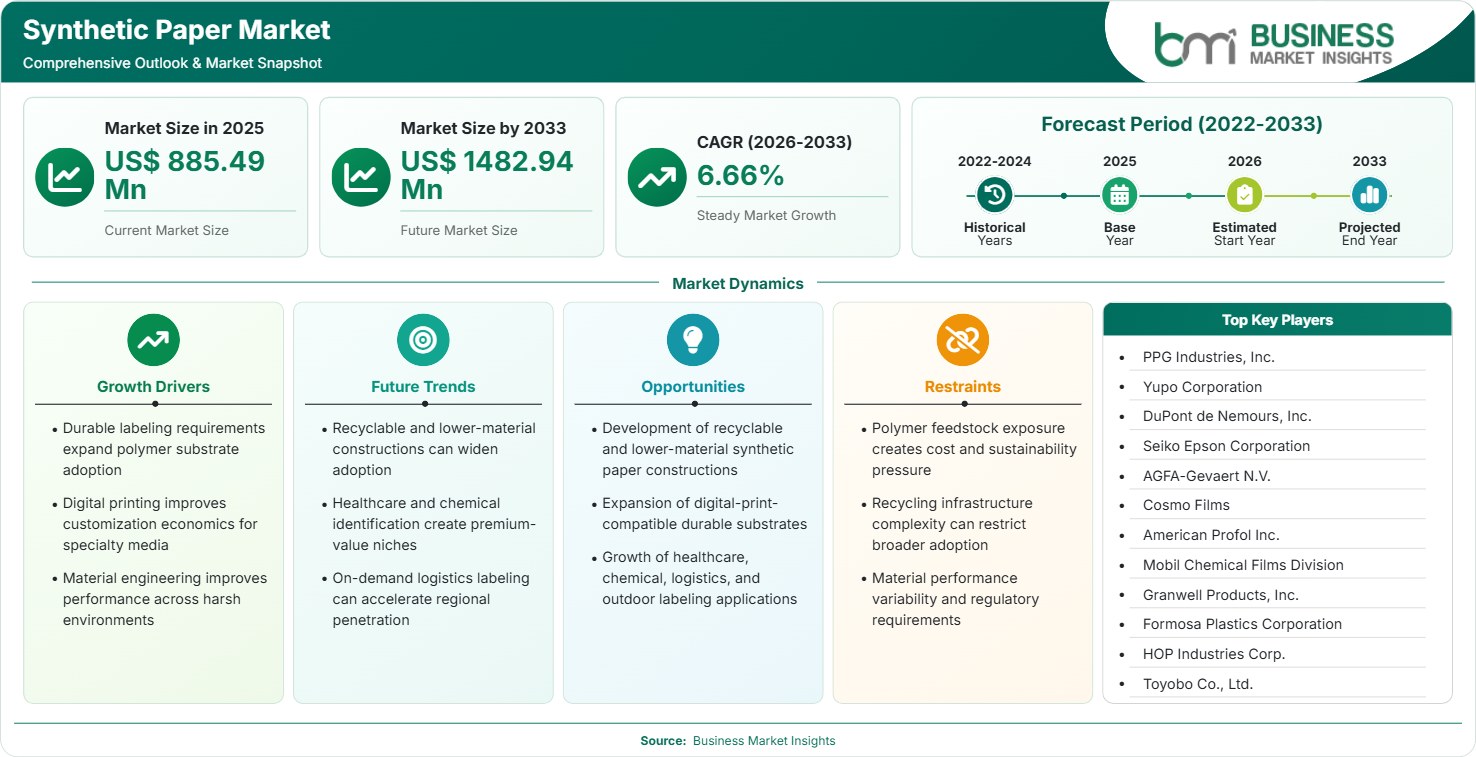
The Synthetic Paper Market size was valued at US$ 885.49 Million in 2025 and is projected to reach US$ 1482.94 Million by 2033, growing at a CAGR of 6.66% during 2026–2033, supported by durable labeling, digital printing, water resistance, circularity initiatives, and demand for longer-life printed materials.

Report Coverage
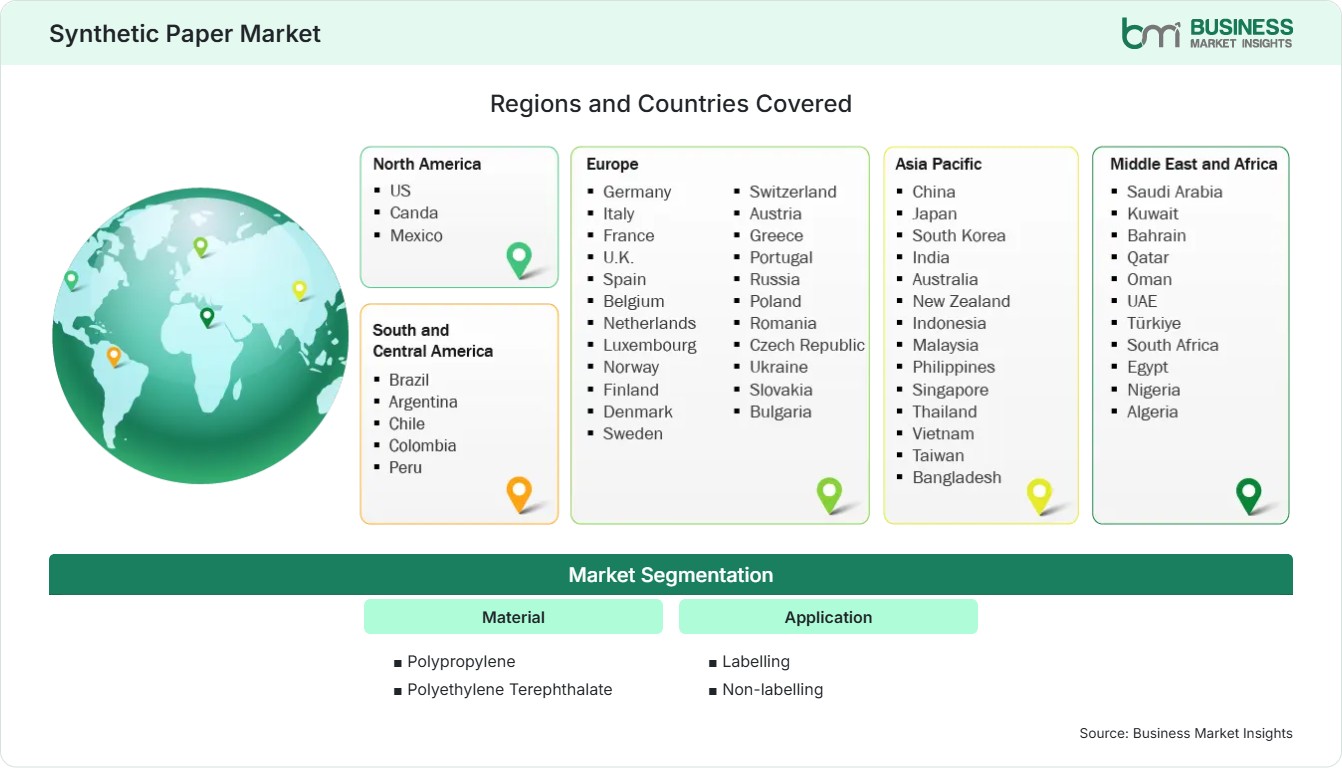
  • Material: Polypropylene, Polyethylene Terephthalate
  • Application: Labelling, Non-labelling
US$ 885.49 Mn Market size in 2025
US$ 1482.94 Mn Market Size by 2033
6.66% CAGR, 2026 - 2033
2026-2033 Forecast Period

AI Overview

Synthetic Paper Market Summary

  • North America Region: North America holds a 24%–27% regional share in 2025, growing at a 5.8%–6.3% CAGR during 2026–2033, supported by durable labels, chemical identification, secure documents, digital printing, and specialty packaging demand. U.S. demand remains strongest within North America, with a 5.7%–6.2% CAGR through 2033.
  • Fastest Growing Region: Asia Pacific holds a 36%–39% Synthetic Paper Market share in 2025 and is projected to expand at a 7.1%–7.7% CAGR during 2026–2033, driven by converting capacity, e-commerce labels, export packaging, and expanding digital print infrastructure.
  • Leading Segment: Polypropylene holds a 68%–72% share in 2025 and is projected to grow at a 6.3%–6.8% CAGR during 2026–2033, supported by waterproof performance, lightweight construction, printability, and broad label conversion compatibility.
  • High Growth Segment: Polyethylene Terephthalate holds a 15%–18% share in 2025 and is projected to expand at a 7.0%–7.6% CAGR during 2026–2033, supported by dimensional stability, heat resistance, premium graphics, and demanding industrial labels.
  • Key Market Opportunity: Demand for durable variable-data labels creates room for recyclable constructions, digital-print compatibility, liner reduction, high-resolution graphics, and specialty substrates serving chemicals, healthcare, logistics, and outdoor applications.
  • Major Market Players: PPG Industries, Inc.; Yupo Corporation; DuPont de Nemours, Inc.; Seiko Epson Corporation; AGFA-Gevaert N.V.; Cosmo Films; American Profol Inc.; Mobil Chemical Films Division; Granwell Products, Inc.; Formosa Plastics Corporation; HOP Industries Corp.; Toyobo Co., Ltd.; and Neenah, Inc.
Strategic Insights

Synthetic Paper Market: Strategic Insights

Synthetic Paper Market Strategic Framework
FREE PDF
Request your free sample
Request free sample
Stakeholder View

Key Takeaways

  • The value chain integrates producers, printers, converters, and brands, making qualification critical.
  • Labelling offers the clearest upside because identification combines variable data, traceability, barcodes, and environmental resistance.
  • Product development favors thinner films, improved print receptivity, coatings, and printing compatibility.
  • Asia Pacific offers the strongest investment case because manufacturing scale and logistics support consumption.
  • PPG’s 2025 GPA agreement demonstrates channel expansion potential.
Geographic Outlook

Synthetic Paper Market Regional Highlights

North America Synthetic Paper Market

North America holds a 24%–27% share in 2025 and is projected to grow at a 5.8%–6.3% CAGR through 2033. Regional demand benefits from specialty printing, pharmaceutical and chemical labeling, secure credentials, and durable outdoor graphics. The U.S. accounts for the dominant portion of regional consumption. PPG’s Teslin platform illustrates the region’s emphasis on high-performance substrates for labels, laminated materials, and secure documents.

  • Regional share is supported by industrial labeling demand where moisture, abrasion, chemicals, and traceability requirements make conventional paper less suitable.
  • Digital printing improves short-run economics because variable-data production supports personalized labels, credentials, menus, maps, and industrial documents.
  • Healthcare and chemical applications remain attractive because durable substrates retain readable information under demanding handling and environmental conditions.
  • Sustainability requirements push suppliers toward lighter structures, recycled content, and designs improving material efficiency without sacrificing durability.

US Synthetic Paper Market

The U.S. holds an estimated 82%–86% share of North American consumption in 2025 and is projected to expand at a 5.7%–6.2% CAGR of the Synthetic Paper Market through 2033. Its advantage comes from established specialty-substrate suppliers, digital-print adoption, and large industrial end-use markets. PPG’s Teslin portfolio covers durable labels, digital printing, laminated materials, and secure credentials, while Epson supports synthetic label workflows for chemical, pharmaceutical, medical, and laboratory applications.

  • Growth is linked to compliance-sensitive labeling, where print permanence and resistance to water, chemicals, abrasion, and handling support reliability.
  • Converters increasingly combine synthetic face stocks with digital printing and permanent adhesives to produce customized identification labels efficiently.
  • Specialty credentials and durable documents add demand because substrates must support printing, lamination, writing, stamping, and repeated handling.

Europe Synthetic Paper Market

Europe holds a 22%–25% share in 2025 and is projected to grow at a 6.1%–6.7% CAGR through 2033. Germany, France, Italy, and the United Kingdom represent major converting and packaging markets, while Germany is positioned near the upper end of regional growth at a 6.4%–6.9% CAGR. Recyclability and packaging-waste rules increase the importance of material efficiency, mono-material design, and documented end-of-life pathways.

  • Germany’s conversion base supports technically consistent labels and specialty print media, with growth benefiting from automation and digitally controlled production.
  • The United Kingdom is positioned for a 6.2%–6.7% CAGR as durable labels support logistics, healthcare, chemicals, and outdoor uses.
  • France and Italy benefit from packaging, retail, and commercial-print ecosystems where water resistance and premium graphics extend usability.
  • European share will increasingly depend on recyclability evidence, material reduction, and compatibility with producer-responsibility requirements.

Asia Pacific Synthetic Paper Market

The Asia Pacific region is estimated to account for 36%-39% in 2025 and to grow at the fastest pace among all regions, at a 7.1%-7.7% CAGR through 2033. The key markets for the production and processing of synthetic paper are Japan, China, South Korea, and India, with India among the fastest-growing countries in the region, at a CAGR of 7.5%-8.0%. Production of packaging, e-commerce logistics, exports, and specialty film enables use in labels and non-labeling applications. Cosmo Films demonstrates the region’s emphasis on polypropylene synthetic paper for tags, packaging, identification, and outdoor uses.

  • Japan combines advanced material engineering with synthetic-paper expertise, supporting premium applications requiring consistent printability, dimensional control, and durability.
  • China benefits from large-scale film conversion, packaging manufacturing, and logistics demand, creating broad demand for durable labeling substrates.
  • India’s growth is supported by specialty-film capacity, retail packaging, identification products, and export-oriented converting operations.
  • South Korea contributes through electronics, industrial manufacturing, and premium printing where heat resistance and dimensional stability improve performance.

Rest of World Synthetic Paper Market

Rest of World has an 11%–14% market share in 2025 and is expected to exhibit a 5.8%–6.5% CAGR in terms of the Synthetic Paper Market until 2033. South and Central America have an advantage owing to applications in food, beverages, agriculture, logistics, and retail labeling, with Brazil and Mexico as leading countries. The Middle East and Africa are driven by adoption in signage, industrial identification, healthcare, and logistics. Saudi Arabia and the UAE are expected to be among the fastest-growing regions due to increasing infrastructure investments and trade.

  • Brazil’s converting ecosystem supports durable labels for food, beverage, agriculture, and industrial goods, where moisture resistance protects variable information through distribution.
  • Mexico benefits from manufacturing integration with North American supply chains, increasing demand for traceability labels, industrial identification, and export-oriented packaging.
  • Saudi Arabia’s high-growth applications include logistics, construction, healthcare, and outdoor graphics, where resistance to heat, dust, and handling improves printed-material longevity.
  • The United Arab Emirates offers specialized demand across logistics, retail, hospitality, and infrastructure projects, supporting premium durable media and customized graphics.
Global Market Geography
FREE PDF
Request your free sample
Request free sample
Segment Analysis

Synthetic Paper Market Segmentation

Material

The Synthetic Paper Market is dominated by Polypropylene, which leads the material composition segment with a 68%-72% market share in 2025 and a 6.3%-6.8% CAGR from 2026 to 2034. Its lightweight, moisture-resistant nature, durability, and film-processing technology make it suitable for use in labels and printing. PET is gaining ground in heat-resistant applications demanding dimensional stability, heat resistance, and premium surface performance.

  • Polypropylene: Widely used for waterproof, tear-resistant labels, tags, menus, maps, and packaging graphics; mature extrusion capacity and printing compatibility support adoption.
  • Polyethylene Terephthalate: Selected for dimensional stability, heat resistance, clarity, and premium graphics where labels face elevated temperatures, mechanical stress, or demanding appearance requirements.

Application

Labeling is by far the dominant use case, accounting for 58% to 62% of the market in 2025 and a 6.7% to 7.2% CAGR from 2026 to 2034. Traceability, chemical resistance, outdoor durability, and variable-data printing enable use cases for the technology. Non-labeling use cases include signs, menus, maps, credentials, commercial printing, and specialty documents requiring longer service life.

  • Labelling: Supports food, beverage, pharmaceutical, chemical, horticulture, logistics, and industrial identification where water resistance, abrasion protection, secure printing, and barcode readability improve information reliability.
  • Non-labelling: Covers maps, menus, certificates, signage, manuals, promotional graphics, and credentials; adoption depends on tear resistance, print quality, repeated handling, and exposure to demanding environments.
Market Forces

Synthetic Paper Market Dynamics

Key Market Drivers

Durable labeling requirements expand polymer substrate adoption

Factors supporting the Synthetic Paper Market growth include labeling applications that require readable paper in the presence of water, wear and tear, chemical exposure, or constant handling. According to PPG, Teslin papers offer a durable option for product labeling, warning labels for dangerous goods, and food and drug traceability labeling. Their specialty print range resists water, steam, temperature changes, chemicals, solvents, tearing, and wear and tear. Similarly, Epson provides labels made of synthetic paper for various purposes, including chemical and pharmaceutical applications, medical devices, and laboratories, and they are certified to BS 5609 standards. Such technical requirements convert durability from being a luxury to a necessity. As converters emphasize failure reduction, information longevity, and better scanning, synthetic labels gain market share.

Digital printing improves customization economics for specialty media

Compatibility with digital workflow processes is influencing trends in the Synthetic Paper Market as it supports short runs, variable data, personalization, and quick replenishment. According to PPG, inkjet, laser, and thermal transfer printers are compatible, while Epson's ColorWorks label systems focus on on-demand printing with features such as customizability, efficiency, and reduced waste. All these factors matter for logistics, controlled goods, seasonal promotions, and branding and packaging. Since the inventory used in such systems is always dynamic, reduced print runs lower the cost of printing smaller lots, enabling converters to serve fragmented market demands without maintaining inventories of printed labels. In view of higher speeds, better color control, and greater automation in print engines, media that feeds well and keeps bar codes legible is important in the digital label environment.

Material engineering improves performance across harsh environments

In the Synthetic Paper market trends, there is increasing emphasis on films engineered to be printable yet mechanically and environmentally sound. The polypropylene film structure is lightweight, waterproof, and flexible, while the PET film structure offers dimensional and thermal stability. According to Cosmo Films, polypropylene synthetic paper is ideal for labels, packaging, ID cards, books, certifications, and outdoor applications. It works well with different printing techniques. Yupo also claims its polypropylene synthetic paper has paper-like printability and plastic-like properties, while exploring recycling and efficient production programs. In this case, there is competition among the synthetic papers in surface energy, adhesion, opacity, stiffness, folding endurance, and gauge reduction.

Key Market Opportunities

Recyclable and lower-material constructions can widen adoption

The most interesting field would be improving the eco-friendliness of the polymer substrate without compromising on its strength, since this determines its commercial viability. The Synthetic Paper Market forecasts have become increasingly driven by customer demand for decreased material use, recyclability, and documented lifecycle performance. As already highlighted in the PPG distribution strategy for 2025, the Teslin product contains 60% less plastic than other synthetic paper products, illustrating how efficient use of materials can be an advantage for the product. Yupo focuses on recycling, the use of recycled materials, process efficiency, and resource conservation across the entire value chain. Suppliers that combine downgauging, recycled inputs, compatible adhesives, and recoverable structures can address sustainability concerns while preserving performance in high-failure-risk applications.

Healthcare and chemical identification create premium-value niches

The healthcare, lab, and chemical labeling sectors represent a promising area for growth, as there is a clear link between information quality and its impact on operations and compliance. Epson offers synthetic labels for chemical labeling in accordance with GHS requirements and for use in healthcare, labs, and other product applications. These properties allow providing higher specifications than regular retail labeling products. The areas for expansion include cold chain identification, environments requiring sterilization, sample labeling, and industrial packaging, where standard paper would wear out. Manufacturers will be able to add value by qualifying materials, printers, adhesives, and ink for each particular application ecosystem, making them harder to commoditize and more resistant to simple price-based substitution.

On-demand logistics labeling can accelerate regional penetration

The opportunities in e-commerce, track-and-trace, warehouse automation, and international logistics are ideal applications for durable variable data media. The market opportunities for Synthetic Paper products are growing with the use of conveyor-based label transport, outdoor loading dock operations, cold storage, and repeated handling. The 2025 PACK EXPO initiative from Epson focused on on-demand custom labeling using PrecisionCore printing. The link between digital printing and flexible packaging processes was strengthened further by the initiative. The converters can opt for integrated solutions for synthetic face stock, adhesives, printer calibration, barcode verification, and automatic dispensing.

Market Restraints and Challenges

Polymer feedstock exposure creates cost and sustainability pressure

Factor: Synthetic paper depends heavily on polymer resins, so fluctuations in petrochemical feedstocks, energy costs, and film-processing economics can affect substrate pricing and margins. PPG identifies petroleum-based resins as common across the category, although constructions differ materially by polymer and process.

Impact: Buyers may compare synthetic media directly with conventional paper when durability requirements are low, limiting premium pricing and slowing substitution in cost-sensitive applications. Producers must therefore demonstrate measurable performance advantages such as lower replacement frequency, reduced failure risk, or lighter construction. The challenge is amplified when customers apply strict sustainability criteria to plastic-containing products. Suppliers that cannot document material efficiency, recycling pathways, or lifecycle benefits may face procurement resistance even when their products outperform paper technically.

Recycling infrastructure complexity can restrict broader adoption

Factor: Synthetic papers may combine polymers, coatings, inks, adhesives, fillers, and laminates, making recovery dependent on local collection and sorting systems. Yupo emphasizes recycling throughout its supply chain, while broader packaging policy is moving toward stronger recyclability requirements and eco-modulated producer responsibility.

Impact: Converters and brands may hesitate to specify polymer-based paper substitutes when end-of-life pathways are uncertain or when multilayer structures complicate recycling claims. European packaging rules are increasing scrutiny of recyclability and material efficiency, raising the need for evidence-based design decisions. Producers must engineer compatible constructions and provide clearer disposal guidance; otherwise, sustainability concerns can offset the functional advantages that otherwise support adoption in labels, graphics, and specialty printing.

Company Analysis

Competitive Landscape

Synthetic Paper Market analysis shows competition centered on polymer formulation, print compatibility, durability, coatings, converting support, and distribution reach. PPG and Yupo emphasize differentiated substrate technologies, while Cosmo Films, Epson, and other participants address specialized media and printing ecosystems. The competitive field also includes diversified chemical, film, and paper businesses with capabilities spanning raw materials, coatings, specialty films, and downstream converting.

Company Name

Overview

Products and Services relevant to this market

PPG Industries, Inc.

U.S. specialty-materials producer with established synthetic substrate technology.

TESLIN synthetic paper, durable labels, digital-print media, laminated materials, and secure credentials.

Yupo Corporation

Japanese specialist focused on polymer-based synthetic paper.

YUPO polypropylene synthetic paper for labels, commercial printing, packaging, graphics, and specialty applications.

DuPont de Nemours, Inc.

Diversified materials company with Tyvek technology.

Tyvek synthetic material for medical packaging, graphics, protective uses, and durable printed applications.

Seiko Epson Corporation

Japanese technology company linking digital printing and label media.

Durable synthetic label media, ColorWorks-compatible materials, and on-demand digital label solutions.

AGFA-Gevaert N.V.

Belgian imaging and specialty-print group.

Imaging and printing solutions, media technologies, and workflow support for specialty applications.

Cosmo Films

Indian specialty-film producer with synthetic-paper products.

Polypropylene synthetic paper for labels, tags, packaging, identification, and outdoor graphics.

American Profol Inc.

U.S. film specialist serving polypropylene applications.

Polypropylene films and customized structures supporting durable print and packaging requirements.

Mobil Chemical Films Division

Film business associated with polymer-based film technologies.

Polyolefin film solutions and specialty film capabilities relevant to printable substrates.

Granwell Products, Inc.

U.S. specialty-material supplier serving printing applications.

Specialty films, synthetic substrates, laminating materials, and converting-oriented media.

Formosa Plastics Corporation

Taiwan-based petrochemical and polymer producer.

Polypropylene, polyethylene, PET-related materials, and polymer inputs supporting substrate manufacturing.

HOP Industries Corp.

U.S. specialty film and converting supplier.

Synthetic films, pressure-sensitive materials, laminating products, and printable substrates.

Toyobo Co., Ltd.

Japanese materials producer with polymer and film technologies.

Polyester films, specialty films, coatings, and functional materials for printing and labeling.

Neenah, Inc.

Specialty paper and materials business with technical media experience.

Specialty substrates, durable media, and engineered papers for demanding print applications.

Trust & Transparency

Research Methodology

The market analysis combines proprietary research with secondary data from government agencies, company disclosures, regulatory filings, industry databases and expert interviews. Market estimates are validated through data triangulation, cross-market benchmarking and analyst review.

View Full Research Methodology

Questions Answered

Frequently Asked Questions

What should buyers evaluate before selecting a synthetic paper grade?

Buyers should assess polymer type, surface treatment, ink compatibility, adhesive performance, printing method, exposure conditions, certifications, and end-of-life.

What does sustainability mean for polymer-based paper alternatives?

Sustainability depends on material efficiency, recycled inputs, recyclability, longevity, and credible end-of-life pathways.

How does digital printing affect substrate demand?

Digital printing supports short runs, variable data, customization, and on-demand production. Synthetic substrates benefit when labels remain durable while designs or quantities change.

Which applications offer the highest value for synthetic substrates?

This Synthetic Paper Market Report finds regulated and harsh-environment labels offer strong value because failure can create compliance, traceability, safety, or replacement costs.

Why is polypropylene the dominant material in synthetic paper?

Polypropylene combines low density, moisture resistance, flexibility, toughness, and established converting infrastructure. These properties suit durable labels, tags, menus, and graphics.

Access the Full Synthetic Paper Market Report

Get segment-level forecasts, regional estimates, competitive benchmarking, company profiles and downloadable Excel datasets.

Access the full Synthetic Paper Market Report
350 pages PDF & Excel | 2026-08-31