Thermal Paper Market Regional Highlights
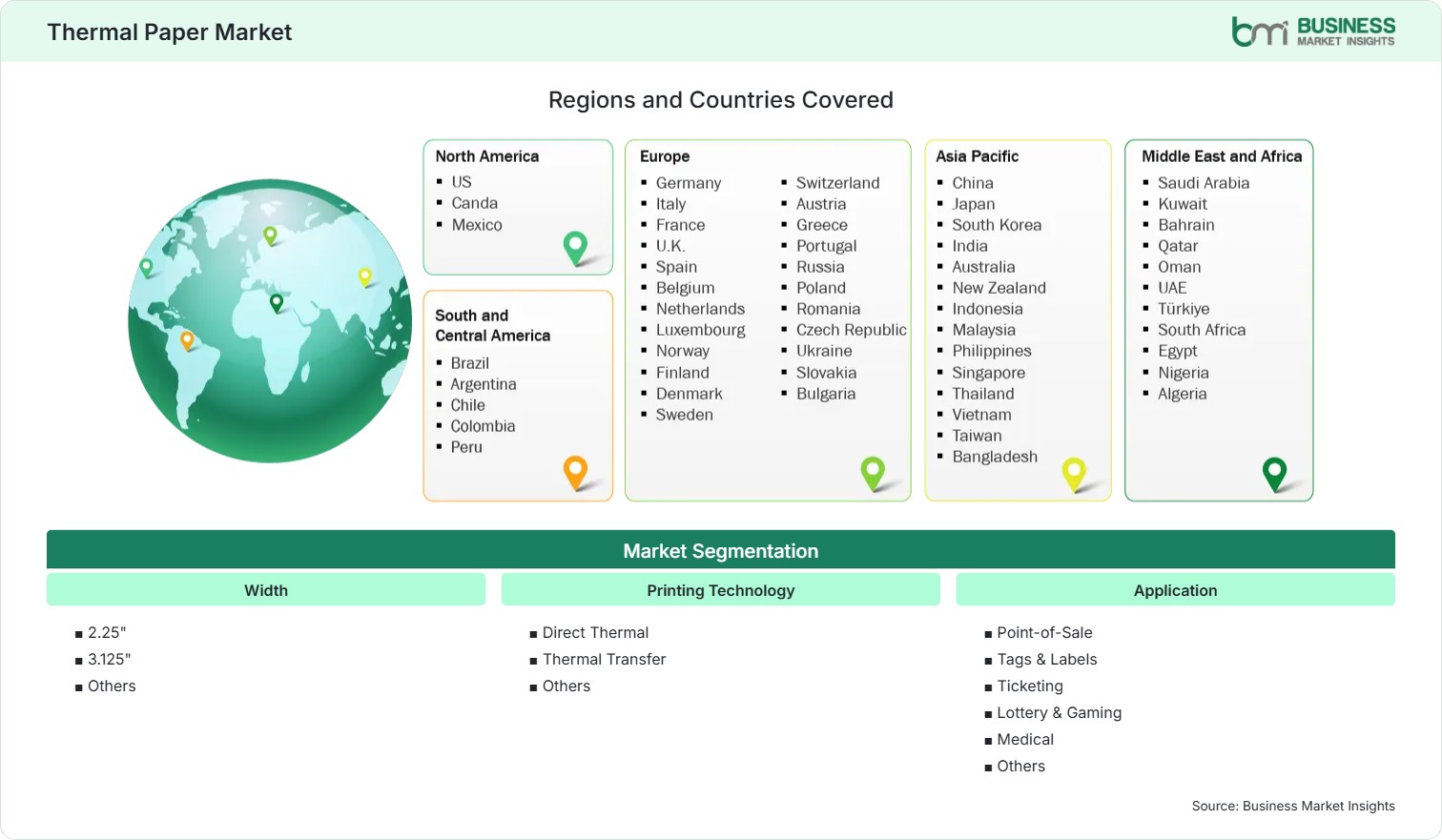
North America Thermal Paper
North America accounted for 32%–35% of the thermal paper market share in 2025 and is projected to expand at 5.4%–5.9% CAGR through 2033. Growth is supported by retail network density, logistics infrastructure, healthcare identification systems, and adoption of sustainable thermal products. Large enterprise fleets continue replacing conventional media with compliant alternatives. Thermal Paper Market growth remains supported by e-commerce fulfillment and inventory tracking investments.
- Retail modernization sustains receipt and labeling demand across supermarkets, convenience stores, pharmacies, and hospitality locations.
- BPA-free and phenol-free product adoption accelerates due to evolving environmental and occupational safety standards.
- Logistics hubs increasingly require barcode labels supporting parcel tracking and distribution efficiency.
- Healthcare facilities expand patient identification and specimen labeling requirements.
- Automation investments improve printer deployment and consumable utilization.
US Thermal Paper
The United States represents 78%–82% of North American Thermal Paper Market demand and is expected to expand at 5.5%–6.0% CAGR. Adoption is driven by large retail chains, transportation systems, healthcare networks, restaurant franchises, and expanding warehouse operations. Investments in fulfillment infrastructure continue supporting long-term consumption of labeling and receipt solutions.
- E-commerce operators increase usage of shipping labels and warehouse identification systems.
- Large retailers continue deploying advanced POS ecosystems requiring reliable media supplies.
- Healthcare regulation supports patient safety labeling applications.
- Sustainable procurement programs encourage adoption of recyclable and chemical-compliant products.
Europe Thermal Paper
The Europe region accounted for 26% to 29% in 2025 and is expected to grow at a CAGR of 5.1% to 5.7%. Germany is the largest Thermal Paper Market, and the Eastern European region is offering more growth opportunities. Regulations play an important role in purchase decisions and have thus made phenol-free paper popular. Investment in transportation ticketing and logistics infrastructure remains a key driver of demand.
- Germany leads regional revenue generation, supported by industrial labeling demand.
- Poland and Romania demonstrate above-regional growth linked to logistics expansion.
- Sustainability regulations encourage replacement of legacy thermal grades.
- Public transport modernization supports ticketing applications.
- Food traceability requirements strengthen label consumption.
Asia Pacific Thermal Paper
Asia-Pacific is the fastest-growing region with a market share of 28%-31% and a CAGR of 7.3%-7.9%. China is the largest consumer and producer in the region, whereas India and Southeast Asia are driving the growth through additional demand. Growth is supported by industrialization, retail development, and manufacturing investments.
- China remains the dominant regional producer and consumer.
- India records one of the strongest growth trajectories due to retail formalization.
- E-commerce expansion increases tags and labels demand.
- Transportation infrastructure investment boosts ticketing applications.
- Manufacturing clusters strengthen regional supply availability.
Rest of World Thermal Paper
The Rest of World is projected to have a 10%-13% share in 2025 and register 6.0%-6.6% CAGR. South and Central America take advantage of advancements in retail infrastructure and logistics. Transport, healthcare, and commercial infrastructure developments contribute to the growth of the Middle East and Africa. Brazil dominates Latin America's market demand, while Saudi Arabia and the UAE dominate the Middle East's.
- Brazil remains the leading Latin American market.
- Mexico-linked logistics activity supports regional trade flows.
- Saudi Arabia benefits from large-scale economic diversification initiatives.
- UAE investment in retail and tourism boosts printing requirements.
- Healthcare infrastructure projects support labeling consumption.