Pulp And Paper Market Regional Highlights
North America Pulp and Paper Market
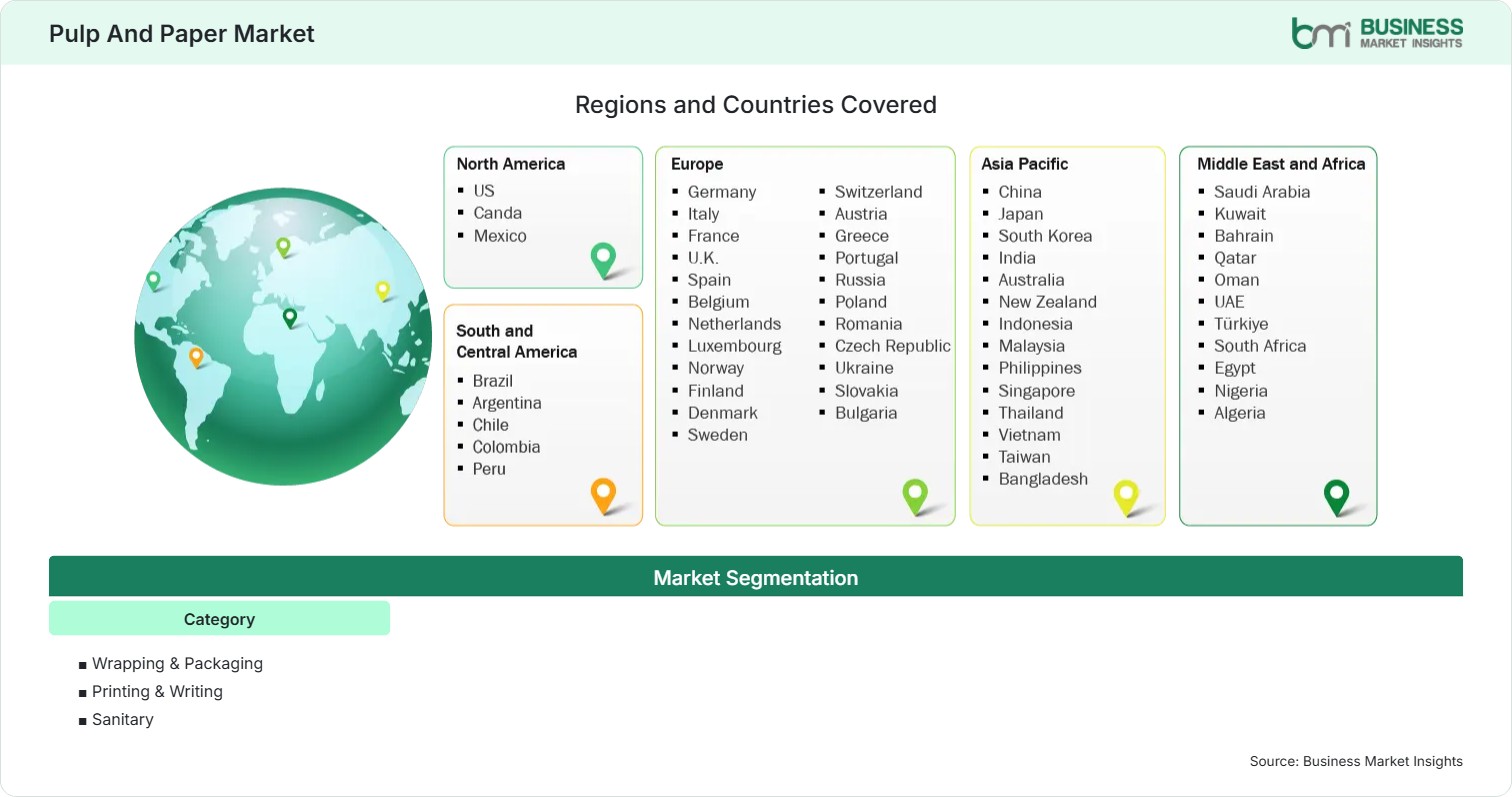
North America represents 24%–28% Pulp and Paper Market share in 2025 and records a CAGR of 1.8%–2.4% through 2033. The region benefits from mature packaging infrastructure, high tissue consumption, extensive recycling networks, and established forestry resources. The United States remains the principal demand center, while Canada contributes substantial pulp, paper, and forest-product exports. Capacity rationalization and machine conversions are redirecting assets toward packaging and tissue. The region's growth is therefore moderate but increasingly supported by product-mix optimization and operational efficiency rather than broad-based volume expansion.
- Packaging conversion remains central as producers redirect declining graphic-paper assets toward containerboard, corrugated materials, and higher-value applications. E-commerce fulfillment and foodservice shipments reinforce demand for fiber-based transport formats.
- Recycled fiber availability, collection quality, and transportation costs influence mill economics. Integrated producers with regional fiber networks can reduce procurement volatility and improve manufacturing resilience.
- Tissue and hygiene products provide defensive demand because consumption is linked to household, healthcare, hospitality, and institutional requirements rather than discretionary printing activity.
- Sustainability investments increasingly target energy efficiency, renewable power, water reduction, and lightweighting. These initiatives support lower operating costs while helping customers meet packaging carbon objectives.
US Pulp and Paper Market
The U.S. represents 20%–24% of the Pulp and Paper Market in 2025 and grows at a CAGR of 1.9%–2.5% through 2033. Demand is increasingly packaging-oriented, with containerboard, corrugated products, tissue, and specialty grades outperforming traditional printing papers. AF&PA reported 2024 paper and paperboard production rose 3.2%, while capacity declined 2.0% to 78.1 million tons, reflecting structural rationalization and improved asset utilization.
- E-commerce, food delivery, warehouse distribution, and consumer packaged goods support containerboard demand, creating incentives for mill conversions and higher-performance corrugated grades.
- Tissue consumption remains supported by household and institutional hygiene needs, while premiumization creates opportunities for softer, stronger, and more absorbent products.
- Domestic fiber availability provides strategic resilience, but labor, freight, energy, and recovered-paper costs continue influencing investment decisions and operating margins.
Europe Pulp and Paper Market
Europe accounts for 18%–22% Pulp and Paper Market share in 2025, with a CAGR of 0.7%–1.4% through 2033. Germany, Sweden, Finland, and Italy remain important production and conversion centers, while Poland is a higher-growth packaging location at approximately 2.0%–3.0% CAGR. The region's transition emphasizes circularity, renewable feedstocks, and packaging innovation. Cepi reported 2025 European paper and board production declined 1.5%, while packaging paper and board remained broadly stable, highlighting the resilience of packaging relative to graphic grades.
- Germany remains a major converting and industrial packaging hub, supported by manufacturing activity, food processing, automotive logistics, and sophisticated recycling infrastructure.
- Sweden and Finland retain strong positions in forestry, pulp, renewable packaging, and bio-based material development, benefiting from integrated wood resources and advanced mill technology.
- Poland is positioned for faster growth as nearshoring, manufacturing investment, retail modernization, and e-commerce logistics increase demand for corrugated and transport packaging.
- Regulatory pressure is accelerating recyclable design, recycled content, and fiber-based substitution. Producers with advanced barrier technologies can address applications previously dominated by multilayer plastics.
Asia Pacific Pulp and Paper Market
Asia Pacific commands 42%–46% share of the Pulp and Paper Market in 2025 and records the fastest regional CAGR of 3.1%–3.8% through 2033. China remains the leading production center, while India, Indonesia, and Vietnam offer higher-growth opportunities. China increased paper and board production 2.9% in 2025, contrasting with declines across several mature producing economies. Expanding consumer markets, e-commerce, packaged foods, industrial exports, and hygiene consumption continue shifting regional demand toward packaging and sanitary grades.
- China combines substantial production capacity with enormous domestic consumption, although competitive pricing, overcapacity concerns, and fiber sourcing remain important considerations for producers.
- India offers high-growth potential at approximately 4.0%–5.0% CAGR as organized retail, food delivery, e-commerce, pharmaceuticals, and household consumption increase demand for packaging and tissue.
- Indonesia and Vietnam are attractive emerging production locations, supported by manufacturing relocation, export-oriented industries, urbanization, and growing domestic consumption.
- Japan remains technologically advanced but structurally mature, encouraging producers to focus on specialty papers, functional materials, packaging innovation, and overseas expansion.
Rest of World Pulp and Paper Market
South and Central America account for approximately 8%–11% share in 2025 and expand at a CAGR of 2.4%–3.2% through 2033. Brazil leads regional production and remains strategically important for market pulp, supported by competitive plantation forestry and efficient mill operations. Mexico benefits from manufacturing and packaging demand, while Colombia and Chile provide additional Pulp and Paper Market growth opportunities linked to consumer products and industrial activity.
The Middle East and Africa contribute approximately 5%–8% share and expand at 2.7%–3.6% CAGR. Saudi Arabia, the United Arab Emirates, South Africa, and Egypt are important demand centers, with packaging, tissue, and imported pulp shaping regional supply structures.
- Brazil's plantation-based forestry model supports cost-efficient pulp production and creates opportunities for export-oriented capacity, specialty cellulose, and integrated bio-refinery development.
- Mexico benefits from proximity to North American supply chains, supporting packaging conversion, industrial shipments, food processing, and consumer goods manufacturing.
- Gulf economies provide opportunities for tissue and packaging through population growth, tourism, foodservice, and retail modernization, despite reliance on imported fiber and pulp.
- South Africa remains an established forestry and pulp producer, while Egypt offers demand potential from population growth, food packaging, and consumer product distribution.