
Metal Fiber Market Outlook: Size, Share, Trends, Growth Analysis, Competitive Landscape & Forecast, 2026-2033

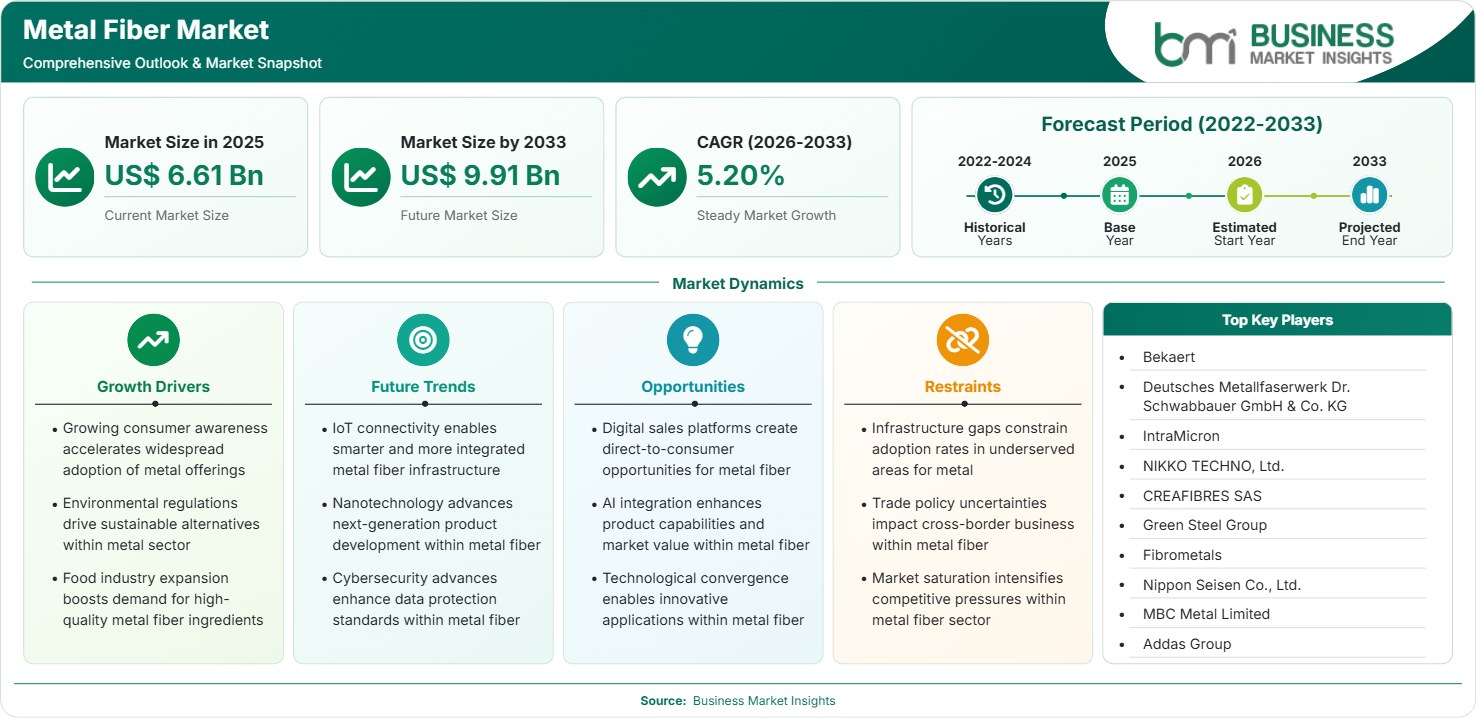
The Metal Fiber Market size was valued at US$ 6.61 Billion in 2025 and is projected to reach US$ 9.91 Billion by 2033, growing at a CAGR of 5.20% during 2026–2033. Demand is supported by filtration modernization, EMI shielding adoption, lightweight industrial materials, aerospace applications, advanced textiles, hydrogen technologies, and increasing investments in high-performance conductive and heat-resistant engineered products.

Report Coverage
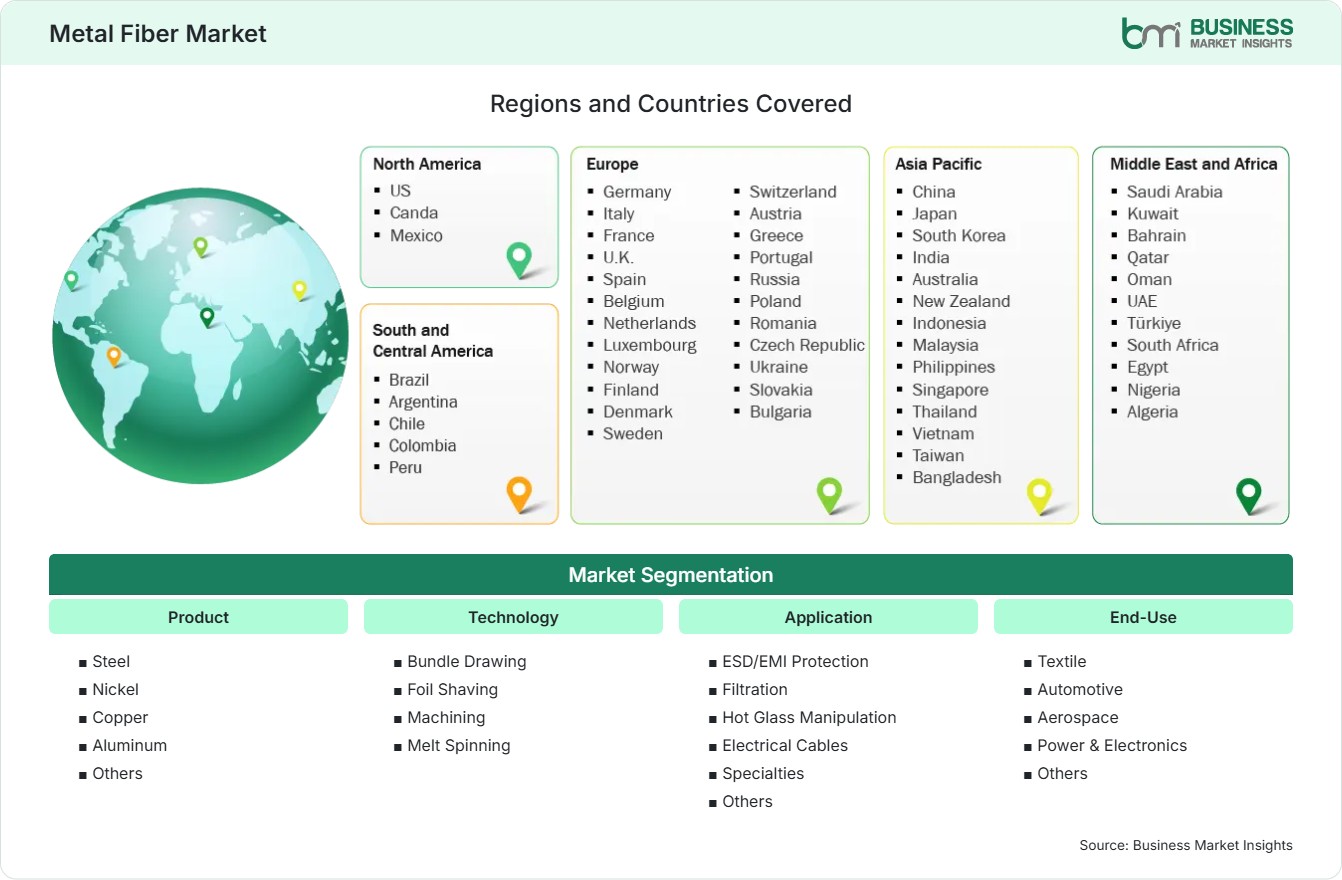
  • Product: Steel, Nickel, Copper, Aluminum, Others
  • Technology: Bundle Drawing, Foil Shaving, Machining, Melt Spinning
  • Application: ESD/EMI Protection, Filtration, Hot Glass Manipulation, Electrical Cables, Specialties, Others
  • End-Use: Textile, Automotive, Aerospace, Power & Electronics, Others
US$ 6.61 Bn Market size in 2025
US$ 9.91 Bn Market Size by 2033
5.20% CAGR, 2026 - 2033
2026-2033 Forecast Period

AI Overview

Metal Fiber Market Summary

  • North America Region: North America holds a market share of 32%–35% in 2025, growing at a CAGR of 4.6%–4.9% during 2026–2033. Growth is supported by aerospace manufacturing, industrial filtration upgrades, semiconductor investments, defense spending, hydrogen infrastructure projects, and increasing demand for conductive, corrosion-resistant materials across advanced industrial applications. The U.S. market benefits from aerospace, electronics, and filtration demand, advancing at approximately 4.7%–5.0% CAGR.
  • Fastest Growing Region: Asia Pacific holds a market share of 29%–32% in 2025, growing at a CAGR of 6.3%–6.7% during 2026–2033. Expansion is driven by electronics production, automotive electrification, industrialization, filtration investments, manufacturing capacity additions, and increasing adoption of conductive fibers in advanced engineering applications.
  • Leading Segment: Steel accounts for a 38%–42% share in 2025 and is expected to expand at a CAGR of 4.8%–5.2%. Advantages include durability, cost efficiency, corrosion resistance, scalability, industrial filtration suitability, and broad adoption across automotive, construction, aerospace, and textile value chains.
  • High Growth Segment: ESD/EMI Protection represents a 20%–24% share in 2025 and is growing at a CAGR of 6.8%–7.3%. Rising electronics density, semiconductor production growth, data center expansion, electric vehicles, communication infrastructure deployment, and stringent electromagnetic compatibility requirements continue supporting adoption.
  • Key Market Opportunity: Commercialization of hydrogen electrolyzers, sustainable filtration systems, smart textiles, and conductive composites is opening premium-value opportunities for manufacturers developing customized metallic fiber solutions with enhanced performance and lifecycle characteristics.
  • Major Market Players: Bekaert NV, ArcelorMittal S.A., Nippon Steel Corporation, Sandvik AB, Kobe Steel, Ltd., Alleima AB, Toray Industries, Inc., Kuraray Co., Ltd., Green Steel Group, and NV Bekaert SA.
Strategic Insights

Metal Fiber Market: Strategic Insights

Metal Fiber Market Strategic Framework
FREE PDF
Request your free sample
Request free sample
Stakeholder View

Key Takeaways

  • The industry value chain is increasingly integrated, with raw material suppliers, fiber processors, filtration manufacturers, and end-use OEMs collaborating to reduce lead times and improve application-specific performance.
  • ESD/EMI protection applications offer some of the strongest revenue opportunities due to expanding semiconductor fabrication, electric vehicle production, telecommunications infrastructure deployment, and electronic miniaturization.
  • Innovation is shifting toward ultra-fine metallic fibers, hybrid metal-polymer composites, and porous metallic structures designed for advanced filtration, hydrogen production systems, and smart textile applications.
  • Asia Pacific presents the strongest investment case as manufacturing relocation, electronics output growth, and government-backed industrial expansion programs accelerate demand across multiple sectors.
  • Strategic partnerships and capacity expansions are becoming more common as producers seek greater vertical integration, broader product portfolios, and access to high-growth specialty applications.
  • Sustainability considerations increasingly influence procurement decisions, encouraging development of recyclable, longer-life metallic fiber products that improve operational efficiency and lower lifecycle costs.
Geographic Outlook

Metal Fiber Market Regional Highlights

North America Metal Fiber Market

North America accounted for approximately 32%–35% of the Metal Fiber Market share in 2025 and is anticipated to register a CAGR of 4.6%–4.9% through 2033. Aerospace production, industrial automation, filtration upgrades, and semiconductor investments continue supporting demand. The region benefits from advanced manufacturing capabilities and strong requirements for high-performance conductive materials. Regulatory focus on process efficiency and emissions control also accelerates adoption across filtration and specialty applications. Ongoing investments in clean-energy infrastructure further strengthen regional demand fundamentals.

  • Aerospace OEMs increasingly utilize metallic fibers in thermal insulation, filtration assemblies, and specialty composites requiring durability under demanding operating environments.
  • Semiconductor manufacturing expansion supports conductive materials demand for ESD protection and precision-engineered industrial systems.
  • Hydrogen infrastructure investments stimulate consumption of porous metallic media for electrolysis and gas-management applications.
  • Industrial filtration modernization remains a leading contributor to replacement demand across manufacturing sectors.
  • Defense and electronics industries continue prioritizing advanced shielding materials to improve operational reliability.

US Metal Fiber Market

The U.S. accounts for roughly 72% - 76% of regional consumption and is expected to register a 4.7% - 5.0% CAGR through 2033. U.S. domestic consumption is driven by aerospace manufacturing, high-end electronics, industrial automation, and filtration needs. Focus areas of the government include critical manufacturing capabilities, supply chain resilience, semiconductor manufacturing, and energy-related technologies, which bode well for the market's prospects.

  • Semiconductor fabrication investments increase requirements for contamination control and electromagnetic shielding materials.
  • Aerospace manufacturing programs continue creating demand for lightweight, durable engineered products in specialized applications.
  • Industrial decarbonization initiatives support broader use of advanced filtration and energy-efficient process technologies.
  • Growing electric vehicle production enhances opportunities for conductive and shielding material suppliers.

Europe Metal Fiber Market

Europe had a market share of 27%–30% in 2025 and is forecast to grow at a CAGR of 4.9%–5.3% through 2033. Germany is currently the leader in this region, although Eastern Europe has shown more rapid manufacturing growth, at about 5.5%–5.8% CAGR. Demand for this region comes from industrial filtration needs, electric car production, aircraft manufacturing, and engineering driven by sustainability reasons. Environmental regulations favor the use of high-quality filtration systems, while advancements in materials science enable innovation.

  • Germany leads regional consumption through automotive engineering, industrial machinery, and advanced manufacturing investment.
  • France maintains strong demand from aerospace programs and specialty industrial applications.
  • Nordic countries support innovation through advanced metallurgy and material-science capabilities.
  • Environmental compliance requirements increase deployment of metallic filtration technologies.
  • Electrification initiatives drive demand for conductive shielding and specialty materials.

Asia Pacific Metal Fiber Market

The Asia-Pacific region accounts for 29% to 32% of the global market share in 2025 and is expected to be the fastest-growing region with a CAGR of 6.3% to 6.7%. China will continue to dominate the market, but India is experiencing rapid growth, with a CAGR of 7.0%-7.4%. Manufacturing of electronics, increased automobile production, industrialization, and infrastructure investment continue driving adoption. Strong manufacturing ecosystems, export-oriented production networks, and increasing technology investments contribute to sustained regional expansion and rising global competitiveness.

  • China dominates regional consumption through electronics, industrial manufacturing, and filtration applications.
  • India benefits from industrial expansion, government manufacturing programs, and infrastructure development.
  • Japan maintains leadership in advanced materials innovation and precision engineering applications.
  • South Korea supports demand through semiconductor and electronics manufacturing growth.
  • Southeast Asia increasingly attracts production investments seeking diversified supply chains.

Rest of World Metal Fiber Market

Rest of World accounted for 8% to 10% of the world’s requirement in 2025 and is anticipated to grow at a CAGR of 5.1% to 5.5% between 2026 and 2033. South & Central America have benefited from industrial growth and associated filtration requirements. The Middle East & Africa have been experiencing an increasing adoption of filtration systems to support energy and water projects in the region. Brazil dominates the regional demand, while Saudi Arabia and the UAE have seen strong growth.

  • Brazil remains the principal market due to industrial activity and manufacturing modernization efforts.
  • Mexico benefits from integration with North American manufacturing supply chains.
  • Saudi Arabia supports growth through industrial diversification and energy-transition investments.
  • UAE encourages demand through advanced manufacturing and infrastructure projects.
  • Water treatment investments strengthen adoption of metallic filtration solutions across multiple economies.
Global Market Geography
FREE PDF
Request your free sample
Request free sample
Segment Analysis

Metal Fiber Market Segmentation

Product

This section was the largest contributor to revenues, with steel's market share ranging from 38%–42%, and steel's growth rate at a 4.8%–5.2% CAGR during the year. The scope of the Metal Fiber Market is expanding due to the use of anti-corrosion and conductive materials. Demand trends indicate needs in industrial filtration, light engineering, and conductivity.

  • Steel: Widely used in filtration, reinforcement, conductive textiles, and industrial processing because of durability, mechanical strength, affordability, and established manufacturing scalability.
  • Nickel: Preferred for high-temperature applications requiring corrosion resistance, conductivity, and long operational life within demanding industrial environments.
  • Copper: Supports electrical conductivity applications including EMI shielding, electronic systems, and advanced composite structures requiring reliable signal management.
  • Aluminum: Gains traction in lightweight engineering applications where weight reduction and corrosion resistance offer measurable performance advantages.

Technology

Bundle drawing continues to be the leading production technique, with a 40%-44% market share in 2025, while melt spinning shows greater growth potential at a 6.0%-6.5% CAGR. Technology choice is influenced by factors like fiber diameter specifications, cost-efficiency, alloy capability, and performance criteria.

  • Bundle Drawing: Produces fine fibers efficiently and consistently for filtration, shielding, and specialty industrial applications.
  • Foil Shaving: Supports production of metallic fibers with controlled dimensions suitable for textiles and conductive materials.
  • Machining: Utilized for specialized products requiring application-specific dimensions and mechanical properties.
  • Melt Spinning: Expands rapidly because of scalability and suitability for advanced alloy-based fiber production.

Application

The applications remain diverse, with ESD/EMI Protection accounting for 20%–24% of the market and showing the fastest growth rate of 6.8%–7.3%. The trends in the metal fiber market are increasingly linked to the miniaturization of electronics, improved filtration, and the use of engineered materials across industrial sectors.

  • ESD/EMI Protection: Driven by electronics density, semiconductor manufacturing, telecommunications infrastructure, and electric mobility systems.
  • Filtration: Benefits from requirements for high-temperature resistance, durability, and process efficiency improvements.
  • Hot Glass Manipulation: Utilized where heat resistance and non-scratching surface properties are essential for manufacturing operations.
  • Electrical Cables: Supports conductivity enhancement and specialized technical performance requirements.
  • Specialties: Includes advanced industrial, aerospace, and research-oriented applications requiring customized metallic fiber solutions.

End-Use

Textile holds the highest end-use segment market share, at 26% to 30%, while Power & Electronics exhibits the highest CAGR, at 6.4% to 6.9%. The adoption is driven by performance requirements, standards, and demand for high-tech materials.

  • Textile: Metallic yarns and conductive fabrics support protective clothing, smart textiles, and industrial applications.
  • Automotive: Expanding electrification and lightweighting initiatives create opportunities for specialized material integration.
  • Aerospace: Requires durable, lightweight, and high-performance materials for technically demanding environments.
  • Power & Electronics: Increasingly utilizes conductive fibers for shielding, connectivity, and advanced electronic systems.
Market Forces

Metal Fiber Market Dynamics

Key Market Drivers

Expansion of Industrial Filtration Infrastructure

Industrial filtration will continue to be a driver of increased demand. Stricter emission regulations, efficiency requirements, and contamination management have prompted companies to use metallic filtration media. In accordance with various global initiatives and programs that promote industrial efficiency and environmental regulations, companies tend to install durable filtration systems that perform well at higher temperatures and in corrosive environments. Metal Fiber Market growth is driven by metals' ability to offer higher permeability and durability than other options. Industrial facilities, including energy, chemical processing, pharmaceuticals, and manufacturing, place great emphasis on efficiency throughout the filtration system's lifecycle.

Rising Electronics and Electromagnetic Shielding Requirements

The rapid expansion of semiconductor manufacturing, telecommunications infrastructure, data centers, and electric vehicles is increasing the requirements for electromagnetic interference control. Electronic miniaturization creates an even greater demand for the development of advanced materials capable of performing at a high level under such conditions. The Metal Fiber Market is also expected to grow due to increasing investments in electronics manufacturing facilities across the Asia Pacific region, North America, and Europe. The metallic fibers are electrically conductive, mechanically flexible, and can be incorporated into composite materials to enhance their suitability for shielding applications. As more and more devices get connected, signal integrity becomes increasingly critical.

Growth of Aerospace and Advanced Engineering Applications

Special metal fibers are gaining traction among aerospace companies for use in filter systems, insulators, and engineered components that require robustness and heat resistance. The expansion of air traffic, driven by IATA, and the upgrading of aerospace fleets drive investment in this field. Metal Fiber Market trends are also supported by the need for materials that are both lightweight and mechanically strong. The advanced engineering industry focuses on identifying materials that meet multiple performance targets simultaneously. Increased investments in R&D of new alloys and special manufacturing processes create an even wider scope of applications.

Key Market Opportunities

Hydrogen Economy and Electrolyzer Deployment

Global hydrogen strategies have opened significant opportunities for the use of porous metallic materials in electrolysis applications. Governments in various countries, including those in Europe, Asia, and North America, are investing in the construction of hydrogen production facilities. Some benefits offered by metallic fibers include permeability, durability, and corrosion resistance. The Metal Fiber Market forecasts have been significantly impacted by demand driven by the installation of electrolyzers in energy transition-related investments. Manufacturers that can supply customized materials that perform well under hydrogen conditions can secure lucrative contracts. As the commercialization process improves and system efficiency improves, the use of metallic fiber components will increase across the hydrogen value chain.

Development of Smart and Conductive Textiles

The incorporation of wearables, industry-monitoring fabrics, military uniforms, and healthcare products presents promising prospects for conductive metal fibers in textiles. The materials serve in sensing, communication, and electromagnetic shielding roles while retaining flexibility. Collaboration among fabric makers, electronics producers, and material companies will fast-track the commercialization process. There is an increasing demand for multifunctional textiles in various industrial and consumer segments. Manufacturers specializing in lightweight, strong, and washable conductive textiles will most likely benefit from increased uptake of these technologies within the ecosystem.

Localization of Advanced Manufacturing Capacity

Resilience efforts in the supply chain are making manufacturers focus on regionalized production facilities. Governments have begun encouraging domestic manufacturing investments through a range of policies, including industrial policies, incentives, and infrastructure development programs. Besides reducing logistics risk, regionalization can also lead to greater customer responsiveness and customization. The establishment of state-of-the-art manufacturing facilities in India, Southeast Asia, the United States, and certain Middle Eastern countries can increase capacity. By reinforcing regional production capability and technical support, companies can gain a competitive advantage.

Market Restraints and Challenges

Raw Material Price Volatility and Margin Pressure

Factor: Fluctuations in steel, nickel, copper, and specialty alloy prices directly affect production economics. Impact: Manufacturers face challenges maintaining stable margins and predictable pricing structures for customers. Commodity market uncertainty can reduce procurement visibility and complicate contract negotiations. Because many metallic fiber applications are specification-driven, rapid cost escalation cannot always be transferred immediately to end users. Producers must therefore implement inventory strategies, supplier diversification, and operational efficiency initiatives to manage exposure. Smaller suppliers often experience greater vulnerability due to limited purchasing leverage, making sustained profitability more difficult during periods of heightened raw-material volatility.

Technical Complexity and Qualification Requirements

Factor: Many applications require rigorous performance validation, certification, and engineering qualification. Impact: New product commercialization timelines can extend considerably, increasing development costs and delaying revenue realization. Aerospace, electronics, and specialized industrial sectors frequently require extensive testing before adoption. Qualification requirements may limit rapid market penetration for emerging suppliers and innovative products. Customers typically prioritize long-term reliability and process consistency, creating barriers for new entrants. The need for technical expertise, high-precision manufacturing equipment, and application-specific engineering capabilities increases capital intensity, potentially constraining industry participation and slowing adoption in certain use cases.

Company Analysis

Competitive Landscape

The competitive environment reflects ongoing innovation, capacity expansions, and specialized product development. Metal Fiber Market analysis indicates strong competition across filtration, conductive materials, advanced textiles, and industrial engineering applications.

Company Name

Overview

Products and Services relevant to this market

Bekaert NV

Global leader in advanced steel wire and engineered metallic fiber technologies serving industrial and specialty applications.

Metal fibers, filtration media, conductive materials, aerospace solutions, hydrogen-related metallic structures.

ArcelorMittal S.A.

Integrated steel producer with advanced material capabilities and global manufacturing footprint.

Specialty steel materials, industrial fibers, engineered metallic products, advanced alloy solutions.

Nippon Steel Corporation

Major steel manufacturer with strong capabilities in specialty material development.

High-performance steel materials, metallic fibers, industrial and engineering solutions.

Sandvik AB

Engineering company focused on advanced materials and industrial technologies.

Specialty alloys, precision materials, filtration-related products, industrial engineering solutions.

Kobe Steel, Ltd.

Diversified materials producer with strong metallurgical expertise.

Specialty metals, engineered materials, industrial fiber applications, alloy technologies.

Alleima AB

Advanced materials specialist serving precision industrial markets.

Stainless materials, specialty alloys, engineered metallic solutions, industrial applications.

Toray Industries, Inc.

Global materials innovator with expertise across advanced fibers and composites.

Functional fibers, composite materials, specialty engineered solutions.

Kuraray Co., Ltd.

Specialty chemical and material producer supporting high-performance applications.

Functional materials, industrial fibers, engineered performance solutions.

Green Steel Group

Industrial materials company focused on sustainable metal-processing solutions.

Steel-related engineered products and specialty material offerings.

NV Bekaert SA

Established metallic fiber supplier serving global industrial and filtration markets.

Metal fiber media, conductive fibers, industrial and technical textile solutions.

Trust & Transparency

Research Methodology

The market analysis combines proprietary research with secondary data from government agencies, company disclosures, regulatory filings, industry databases and expert interviews. Market estimates are validated through data triangulation, cross-market benchmarking and analyst review.

View Full Research Methodology

Questions Answered

Frequently Asked Questions

Which emerging technologies could reshape future demand?

Hydrogen electrolysis systems, smart textiles, advanced conductive composites, sustainable filtration technologies, and next-generation energy storage infrastructure are expected to create new high-value demand opportunities.

How does the Metal Fiber Market Report evaluate competition?

The Market Report assesses suppliers based on product portfolios, material innovation, manufacturing capabilities, technology development, industry partnerships, and strategic expansion initiatives.

What makes Asia Pacific the fastest-growing regional market?

Rapid industrialization, electronics manufacturing expansion, infrastructure investments, automotive production growth, and supportive government manufacturing initiatives collectively drive higher regional demand.

Why are metallic fibers preferred in industrial filtration?

Metallic fibers offer high permeability, corrosion resistance, thermal stability, and extended operational life. These characteristics improve filtration efficiency while reducing maintenance frequency in demanding industrial environments.

Which application area is generating the strongest growth momentum?

ESD/EMI protection applications are expanding fastest due to semiconductor manufacturing growth, electronics miniaturization, electric vehicle adoption, and stricter electromagnetic compatibility requirements across industrial and consumer systems.

Access the Full Metal Fiber Market Report

Get segment-level forecasts, regional estimates, competitive benchmarking, company profiles and downloadable Excel datasets.

Access the full Metal Fiber Market Report
350 pages PDF & Excel | 2026-08-17
Similar Research

Related Market Reports