Bamboo Fiber Market Outlook: Size, Share, Trends, Growth Analysis, Competitive Landscape & Forecast, 2022-2033

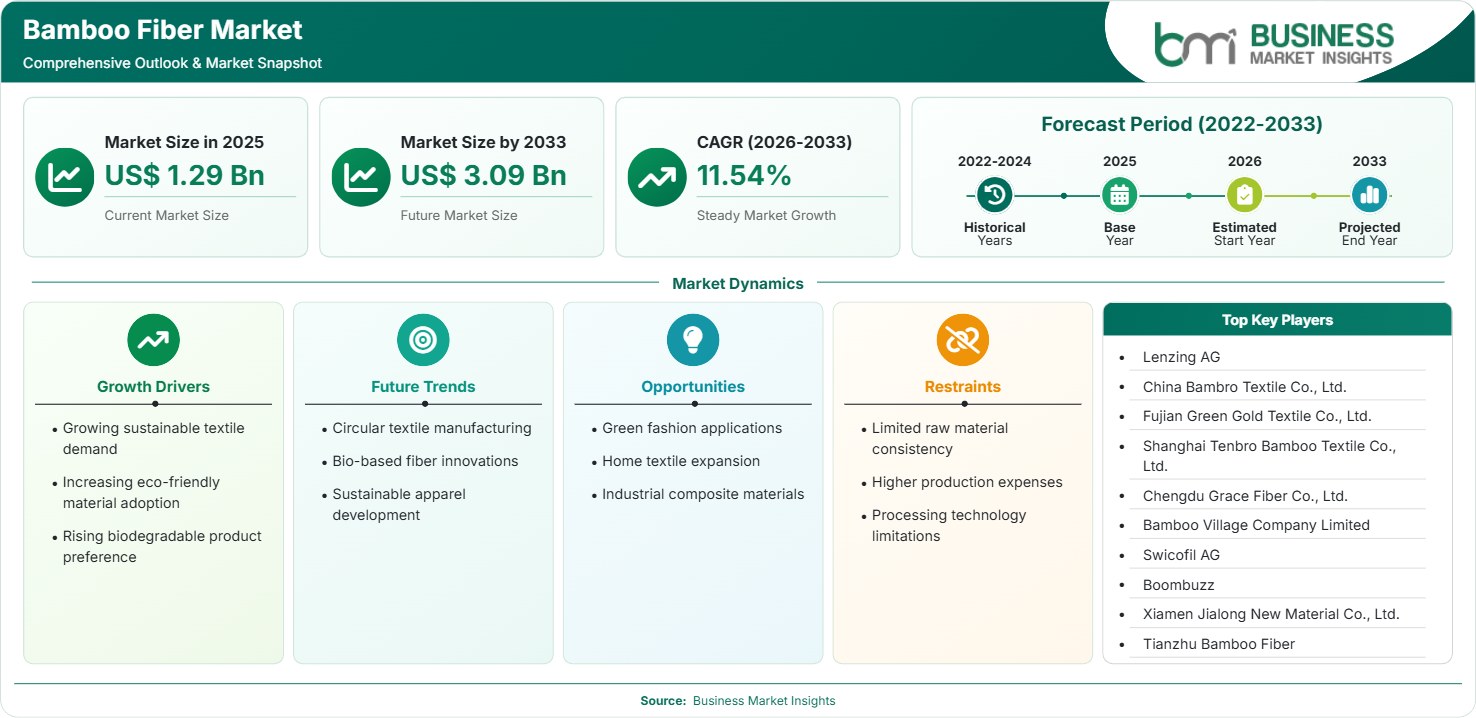
The Bamboo Fiber Market size was valued at US$ 1.29 billion in 2025 and is projected to reach US$ 3.09 billion by 2033, growing at a CAGR of 11.54% during 2026–2033. Growing demand for sustainable textiles, increasing adoption of eco-friendly materials, and rising preference for biodegradable products continue to drive market expansion, while green fashion applications, home textile expansion, and industrial composite materials create promising long-term opportunities.

Report Coverage
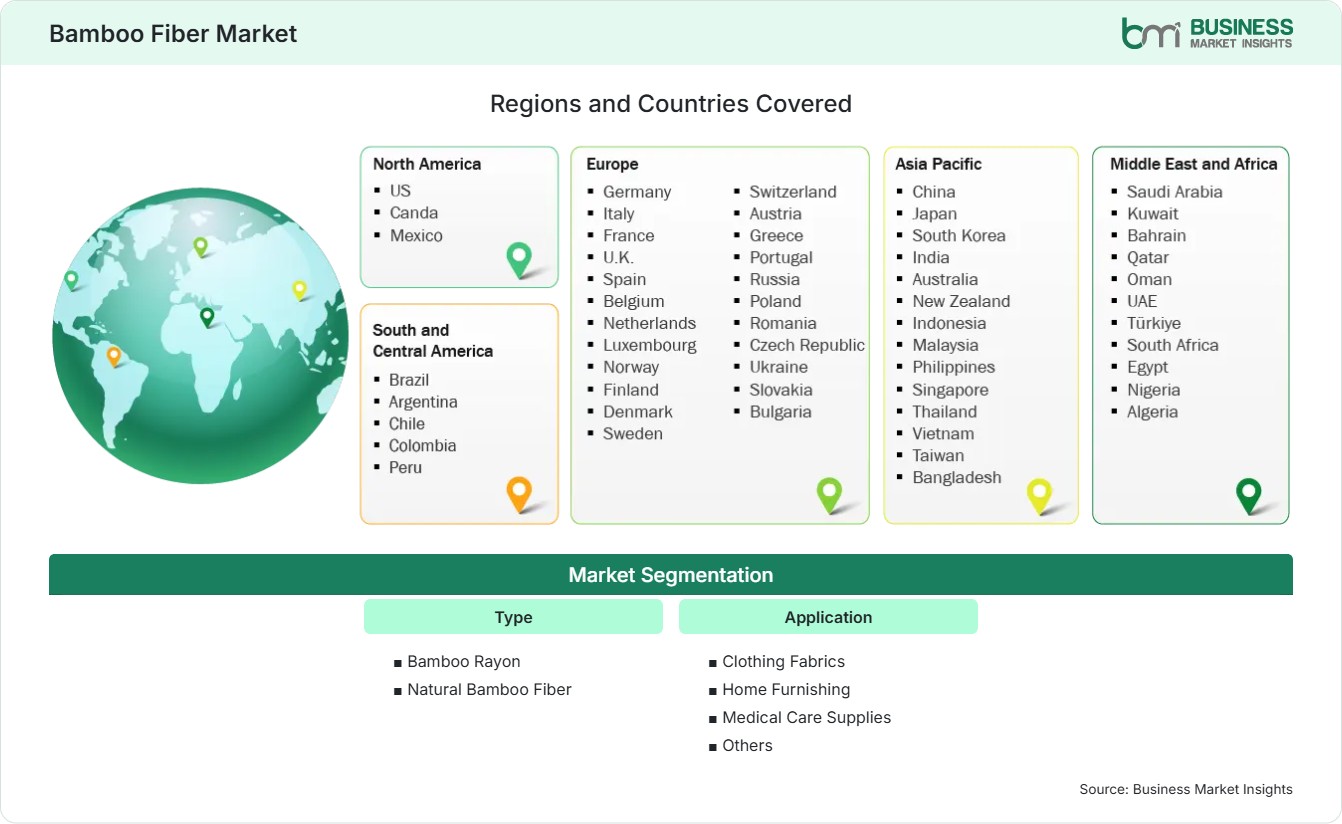
  • Type: Bamboo Rayon, Natural Bamboo Fiber
  • Application: Clothing Fabrics, Home Furnishing, Medical Care Supplies, Others
US$ 1.29 Bn Market size in 2025
US$ 3.09 Bn Market Size by 2033
11.54% CAGR, 2026 - 2033
2026-2033 Forecast Period

01 AI Overview

Bamboo Fiber Market Summary

  • North America: North America holds 28%–31% market share in 2025 and is projected to grow at a CAGR of 10.9%–11.7% during 2026–2033. Rising consumer preference for sustainable textiles, increasing eco-conscious apparel purchases, and expanding green manufacturing initiatives continue supporting regional demand. The U.S. market is expected to expand at a CAGR of 11.1%–11.9% through 2033.
  • Fastest Growing Region: Asia Pacific accounts for 38%–41% of the market in 2025 and is forecast to register the highest CAGR of 12.2%–13.0% during 2026–2033. Strong bamboo cultivation, expanding textile manufacturing capacity, and increasing exports of sustainable fabrics continue driving regional growth.
  • Leading Segment: Bamboo Rayon represents 69%–72% market share in 2025 and is anticipated to grow at a CAGR of 11.6%–12.4% during the forecast period. High demand from apparel manufacturers and home textile producers continues supporting widespread commercial adoption.
  • High Growth Segment: Clothing Fabrics account for 46%–49% market share in 2025 and are projected to register a CAGR of 12.0%–12.8% through 2033. Growing demand for breathable, biodegradable, and moisture-wicking fabrics continues strengthening segment expansion.
  • Key Market Opportunity: Increasing adoption of sustainable fibers in apparel, home furnishings, technical textiles, and eco-friendly consumer products is creating significant opportunities for bamboo fiber manufacturers worldwide.
  • Major Market Players: Lenzing AG, China Bambro Textile Co., Ltd., Fujian Green Gold Textile Co., Ltd., Shanghai Tenbro Bamboo Textile Co., Ltd., Chengdu Grace Fiber Co., Ltd., Bamboo Village Company Limited, Swicofil AG, Boombuzz, Xiamen Jialong New Material Co., Ltd., Tianzhu Bamboo Fiber.
02 Strategic Insights

Bamboo Fiber Market: Strategic Insights

Bamboo Fiber Market Strategic Framework
FREE PDF
Request your free sample
Request free sample
03 Stakeholder View

Key Takeaways

  • The industry value chain continues strengthening through sustainable bamboo cultivation, fiber processing, textile manufacturing, product branding, and environmentally responsible retail distribution.
  • Apparel and home textile manufacturers present the strongest commercial opportunities owing to growing consumer demand for biodegradable, soft, and moisture-absorbing fabrics.
  • Innovation in closed-loop processing technologies, environmentally friendly fiber treatment, and advanced textile finishing is improving product quality and sustainability performance.
  • Asia Pacific offers the most attractive investment opportunity due to abundant bamboo resources, expanding textile manufacturing infrastructure, and increasing exports of sustainable fabrics.
  • Strategic collaborations between textile manufacturers, sustainable fashion brands, and raw material suppliers continue accelerating commercialization of bamboo-based textile products.
04 Geographic Outlook

Bamboo Fiber Market Regional Highlights

North America Bamboo Fiber Market

North America accounts for 28%–31% of the global market in 2025 and is projected to expand at a CAGR of 10.9%–11.7% through 2033. Increasing adoption of sustainable textiles, growing demand for biodegradable consumer products, and rising environmental awareness continue supporting regional growth. The Bamboo Fiber Market share remains strong due to increasing investments in eco-friendly apparel and premium home furnishing products.

  • Sustainable fashion brands continue expanding bamboo fiber product portfolios.
  • Consumer preference for biodegradable textiles supports market demand.
  • Green manufacturing initiatives encourage renewable fiber adoption.
  • Retailers increasingly introduce environmentally certified textile products.

US Bamboo Fiber Market

The United States dominates regional revenue and is expected to register a CAGR of 11.1%–11.9% during the forecast period. Rising demand for sustainable apparel, eco-friendly home furnishings, and environmentally responsible consumer products continues driving bamboo fiber consumption across multiple end-use industries.

  • Sustainable apparel demand continues increasing among consumers.
  • Premium home textiles strengthen renewable fiber adoption.
  • Eco-certification standards encourage environmentally responsible sourcing.

Europe Bamboo Fiber Market

Europe represents 25%–28% of the global market in 2025 and is projected to grow at a CAGR of 10.7%–11.5% during 2026–2033. Germany leads regional consumption, while Italy demonstrates strong growth supported by sustainable fashion manufacturing, premium home textiles, and circular economy initiatives.

  • Circular economy policies encourage sustainable textile production.
  • Germany remains a leading eco-textile consumer market.
  • Italy records growing adoption in premium fashion manufacturing.
  • Green certification standards strengthen market competitiveness.

Asia Pacific Bamboo Fiber Market

Asia Pacific accounts for 38%–41% of global revenue in 2025 and is expected to record the fastest CAGR of 12.2%–13.0% through 2033. China leads regional production and consumption, while India records the highest growth owing to expanding textile manufacturing, bamboo cultivation, and sustainable export-oriented production.

  • Strong bamboo cultivation supports stable raw material availability.
  • Textile manufacturing expansion increases fiber consumption.
  • Sustainable exports strengthen regional production capacity.
  • Eco-friendly apparel demand supports long-term market growth.

Rest of World Bamboo Fiber Market

The Rest of World region accounts for 6%–8% of the global market in 2025 and is projected to grow at a CAGR of 10.3%–11.1% during the forecast period. Brazil, South Africa, and the UAE continue to witness rising adoption of sustainable textile products, expanding retail availability, and increasing environmental awareness among consumers.

  • Sustainable retail channels continue expanding across emerging markets.
  • Eco-friendly home furnishings support regional demand growth.
  • Textile imports strengthen bamboo fiber product availability.
  • Environmental awareness encourages renewable material adoption.
Global Market Geography
FREE PDF
Request your free sample
Request free sample
05 Segment Analysis

Bamboo Fiber Market Segmentation

Type

The Type segment accounted for 68%–71% of the overall market in 2025 and is projected to grow at a CAGR of 11.6%–12.4% during 2026–2033. Rising consumer preference for sustainable textiles, increasing adoption of biodegradable fibers, and continuous innovation in environmentally responsible manufacturing processes are supporting market expansion. Manufacturers are improving fiber quality, durability, softness, and moisture management properties to meet growing demand from apparel, home furnishing, and healthcare industries while strengthening production efficiency and sustainability.

  • Bamboo Rayon: Bamboo rayon dominates the market owing to its soft texture, excellent moisture absorption, breathability, and widespread adoption across apparel, home textiles, and personal care products requiring comfort and durability.
  • Natural Bamboo Fiber: Natural bamboo fiber is witnessing growing demand for premium eco-friendly products due to its biodegradability, antibacterial properties, natural appearance, and increasing acceptance in sustainable textile manufacturing.

Application

The Application segment accounted for 45%–48% of the market in 2025 and is expected to expand at a CAGR of 11.8%–12.6% through 2033. Increasing environmental awareness, growing demand for renewable textile materials, and rising adoption of biodegradable fibers continue driving product utilization across multiple industries. The Bamboo Fiber Market trends indicate expanding applications in apparel manufacturing, home furnishings, healthcare products, and specialty textiles as manufacturers increasingly prioritize sustainable raw materials and environmentally responsible production.

  • Clothing Fabrics: Clothing fabrics remain the leading application due to increasing consumer demand for breathable, lightweight, moisture-wicking, and environmentally sustainable apparel suitable for everyday and performance wear.
  • Home Furnishing: Home furnishing manufacturers increasingly incorporate bamboo fiber into bedding, towels, curtains, upholstery, and decorative textiles to improve comfort, sustainability, and product durability.
  • Medical Care Supplies: Healthcare manufacturers utilize bamboo fiber in medical textiles, bandages, protective clothing, and hygiene products because of its softness, moisture management, and natural antibacterial characteristics.
  • Others (Bathroom Textiles and Others): Bathroom textiles and other specialty applications continue expanding through increasing adoption in reusable towels, cleaning products, spa accessories, and eco-friendly household textile solutions.
06 Market Forces

Bamboo Fiber Market Dynamics

Key Market Drivers

Growing sustainable textile demand

The growing preference among consumers for environmentally friendly clothing and household items is fueling the demand for fiber made from bamboo throughout the world. Fashion designers, textile manufacturers, and marketers are developing more eco-friendly products in an attempt to limit the environmental impact of their operations in response to the changing consumer preferences towards renewable, biodegradable, sustainable, and lower carbon-footprint materials. Moreover, the growing awareness of eco-manufacturing methods, circular economy, and sustainable fashion industry practices is leading to the use of bamboo fiber owing to its natural softness, breathability, moisture-wicking, and eco-friendly nature.

Increasing eco-friendly material adoption

Many manufacturers within the clothing, furniture, personal care, and consumer goods sectors have begun using sustainable substitutes for their regular synthetic materials to boost their green credentials and contribute to achieving their sustainability objectives. Bamboo fiber has many desirable characteristics such as good biodegradability, moisture absorbency, breathability, softness, anti-bacterial action, and increased comfort, and hence makes a good choice for green product manufacturing. Its renewability and reduced environmental impact, along with compatibility with green manufacturing processes, also contribute towards its growing use in various industries.

Rising biodegradable product preference

Increasing awareness about plastic pollution, textile pollution, and the adverse effects of synthetic fibers on the environment has led to an increased use of biodegradable and sustainable fibers. The introduction of policies that promote the use of eco-friendly fibers and recycling concepts is contributing significantly to increasing demand for bamboo textiles across various end-user industries. Moreover, increased investment in sustainable manufacturing practices and green labeling has facilitated the increasing demand for bamboo fibers in various industries such as fashion, home textiles, personal care, and industrial applications.

Key Market Opportunities

Green fashion applications

The rising number of sustainable fashion brands adopting bamboo fiber products to create environmentally friendly clothing lines, according to changing consumer demands, is a testament to the opportunities present in this segment of the market. The rising demand for ethical fashion, organic clothes, eco-friendly clothing, and environmentally friendly manufacturing practices is offering substantial growth opportunities in the bamboo fiber industry. Furthermore, the growing use of green and renewable fabrics and other sustainable fashion trends like circular fashion is prompting clothing brands to adopt bamboo fibers in their activewear, casual wear, intimate wear, baby wear, and home textiles.

Home textile expansion

Increasing demand for sustainable bedding, towels, curtains, upholstery, decorative fabrics, and other home textile products is creating favorable growth opportunities reflected in the Bamboo Fiber Market forecast, as manufacturers increasingly incorporate bamboo fiber into premium home furnishing collections. Bamboo fiber offers improved softness, strength, breathability, moisture control, and inherent antimicrobial properties, making it a good choice for high-quality, environmentally friendly home furnishings. The growing demand for sustainable living and eco-friendly home furnishings is also helping to make these products distinctive and offering growth opportunities for manufacturers in the global home furnishings industry.

Industrial composite materials

Growing research and development activities focused on bio-based composite materials are expanding the application scope of bamboo fiber beyond traditional textile products. Companies are now studying the use of bamboo fiber as a green reinforcing fiber for manufacturing lightweight industrial parts, automotive interiors, building materials, furniture, packaging, and eco-friendly composites. Due to its high strength-to-weight ratio, biodegradability, renewability, and good mechanical properties, bamboo fiber becomes an ideal substitute for synthetic reinforcement fibers. In addition, increased interest in low-carbon materials and sustainable manufacturing is contributing to the growth in the use of bamboo fiber composites across different industrial segments.

Market Restraints and Challenges

Limited raw material consistency

Factor: Variations in bamboo species, cultivation conditions, climatic factors, harvesting methods, fiber extraction techniques, and processing technologies can significantly affect raw material quality, fiber uniformity, mechanical properties, and production consistency across different manufacturing facilities. Differences in moisture content, fiber length, strength, and chemical composition further contribute to quality variability throughout the supply chain. Impact: Inconsistent raw material quality may increase processing complexity, raise production costs, reduce manufacturing efficiency, and result in variations in fabric quality, durability, softness, and overall product performance. These challenges can limit broader adoption of bamboo fiber in premium apparel, home textiles, and other high-value applications where consistent quality, performance, and reliability are essential.

Higher production expenses

Factor: Sustainable fiber extraction technologies, environmentally responsible processing methods, stringent quality certification requirements, and specialized manufacturing equipment significantly increase production costs compared with conventional textile fibers. Additional expenses associated with eco-friendly chemical processing, wastewater treatment, quality assurance, and compliance with environmental standards further elevate overall manufacturing and operational costs. Impact: Elevated manufacturing expenses may reduce price competitiveness, limit adoption in cost-sensitive markets, and encourage manufacturers to focus on premium product positioning and value-added textile applications. These higher costs can also slow large-scale commercialization, constrain market penetration in developing economies, and challenge broader adoption despite the growing demand for sustainable and environmentally responsible textile materials.

07 Company Analysis

Competitive Landscape

The Bamboo Fiber Market analysis indicates that the competitive landscape is characterized by continuous investments in sustainable fiber processing, environmentally responsible textile manufacturing, and product innovation. Leading companies are expanding production capacity, improving fiber extraction technologies, and collaborating with apparel brands to strengthen their market presence. Rising consumer demand for biodegradable textiles and sustainable fashion is further encouraging manufacturers to develop high-quality bamboo fiber products with enhanced performance, durability, and comfort for a wide range of global textile and apparel applications.

Company Name

Overview

Products and Services Relevant to this Market

Lenzing AG

Global producer of sustainable wood and cellulose-based specialty fibers for textile applications.

Bamboo-based regenerated fibers, specialty cellulose fibers, sustainable textile solutions, fiber innovation services.

China Bambro Textile Co., Ltd.

Chinese manufacturer specializing in bamboo textile products and fiber processing.

Bamboo fiber, bamboo yarns, apparel fabrics, home textile materials, textile manufacturing solutions.

Fujian Green Gold Textile Co., Ltd.

Textile company focused on eco-friendly bamboo fiber manufacturing and exports.

Bamboo yarn, bamboo fabrics, knitted textiles, woven fabrics, sustainable textile products.

Shanghai Tenbro Bamboo Textile Co., Ltd.

Manufacturer specializing in bamboo fiber and blended textile materials.

Bamboo rayon, bamboo blended fabrics, apparel textiles, home furnishing fabrics.

Chengdu Grace Fiber Co., Ltd.

Producer of regenerated cellulose fibers and bamboo textile materials.

Bamboo fibers, regenerated fibers, textile raw materials, industrial fiber solutions.

Bamboo Village Company Limited

Manufacturer and supplier of bamboo-based consumer textile products.

Bamboo fabrics, bedding products, towels, clothing textiles, eco-friendly household textiles.

Swicofil AG

Swiss specialty fiber distributor serving global textile manufacturers.

Bamboo fibers, specialty textile fibers, engineered fiber solutions, technical textile materials.

Boombuzz

Sustainable textile company offering bamboo-based consumer products.

Bamboo apparel, bamboo fabrics, eco-friendly garments, sustainable textile accessories.

Xiamen Jialong New Material Co., Ltd.

Manufacturer of advanced bamboo-based textile and functional fiber materials.

Bamboo fibers, functional textile materials, blended yarns, specialty fiber products.

Tianzhu Bamboo Fiber

Leading developer of bamboo cellulose fiber technologies for textile manufacturing.

Bamboo cellulose fiber, regenerated bamboo fibers, textile raw materials, fiber technology solutions.

08 Industry Activity

Recent Developments

June 2026

Lenzing AG showcased its scalable bio-based nonwoven fiber solutions at major international industry fairs. The innovations highlighted sustainable cellulose-based fibers for textile and hygiene applications.

April 2026

Lenzing AG introduced a three-tier cellulosic fiber portfolio for next-generation protective wear. The launch expanded its sustainable regenerated fiber solutions for technical textile applications.

April 2026

Spinnova Plc initiated trial runs at the Woodspin demo factory to enhance production efficiency and fibre quality. The initiative supports the commercialization of industrial-scale sustainable cellulose-based fibre production.

March 2026

Spinnova Plc announced that Circulose joined its ecosystem to advance textile-to-textile recycling. The collaboration aims to accelerate the scale-up of sustainable cellulose fibre technology.

10 Trust & Transparency

Research Methodology

The market analysis combines proprietary research with secondary data from government agencies, company disclosures, regulatory filings, industry databases and expert interviews. Market estimates are validated through data triangulation, cross-market benchmarking and analyst review.

View Full Research Methodology

11 Questions Answered

Frequently Asked Questions

What future opportunities are expected to shape the market?

Future opportunities include green fashion applications, home textile expansion, industrial composite materials, sustainable consumer products, premium eco-textiles, and increasing adoption of renewable fibers across diverse industrial sectors.

Who are the major companies operating in the Bamboo Fiber Market Report?

Major companies include Lenzing AG, China Bambro Textile Co., Ltd., Fujian Green Gold Textile Co., Ltd., Shanghai Tenbro Bamboo Textile Co., Ltd., Chengdu Grace Fiber Co., Ltd., Bamboo Village Company Limited, Swicofil AG, Boombuzz, Xiamen Jialong New Material Co., Ltd., and Tianzhu Bamboo Fiber.

Which type segment holds the largest market share?

Bamboo Rayon dominates the market with a 69%–72% share in 2025 owing to its softness, moisture absorption, durability, comfort, and extensive application across apparel and home textile manufacturing.

Which region dominates the Bamboo Fiber Market?

Asia Pacific leads the market with a 38%–41% share in 2025, supported by abundant bamboo resources, strong textile manufacturing capabilities, expanding exports, and increasing adoption of sustainable production practices.

What is driving the growth of the Bamboo Fiber Market?

The market is driven by growing demand for sustainable textiles, increasing adoption of eco-friendly materials, rising consumer preference for biodegradable products, expanding green fashion initiatives, and growing investments in environmentally responsible textile manufacturing.

Access the Full Bamboo Fiber Market Report

Get segment-level forecasts, regional estimates, competitive benchmarking, company profiles and downloadable Excel datasets.

Access the full Bamboo Fiber Market Report
350 pages PDF & Excel | 2026-07-31