
Rayon Fibers Market Outlook: Size, Share, Trends, Growth Analysis, Competitive Landscape & Forecast, 2026-2033

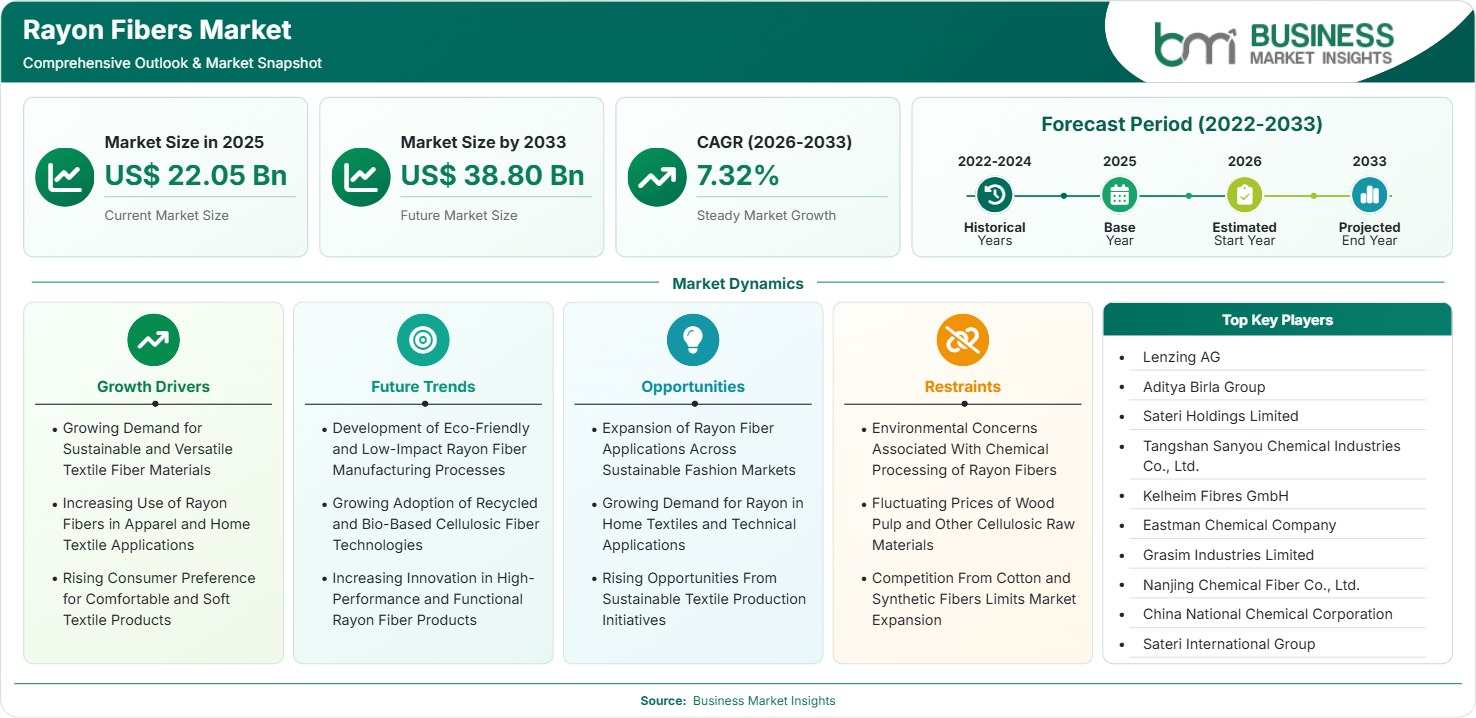
The Rayon Fibers Market size was valued at US$ 22.05 Billion in 2025 and is projected to reach US$ 38.80 Billion by 2033, growing at a CAGR of USD 7.32% during 2026–2033, driven by sustainable textile demand, premium cellulosic fibers, circularity investments, and expanding apparel, hygiene, and home textile applications.

Report Coverage
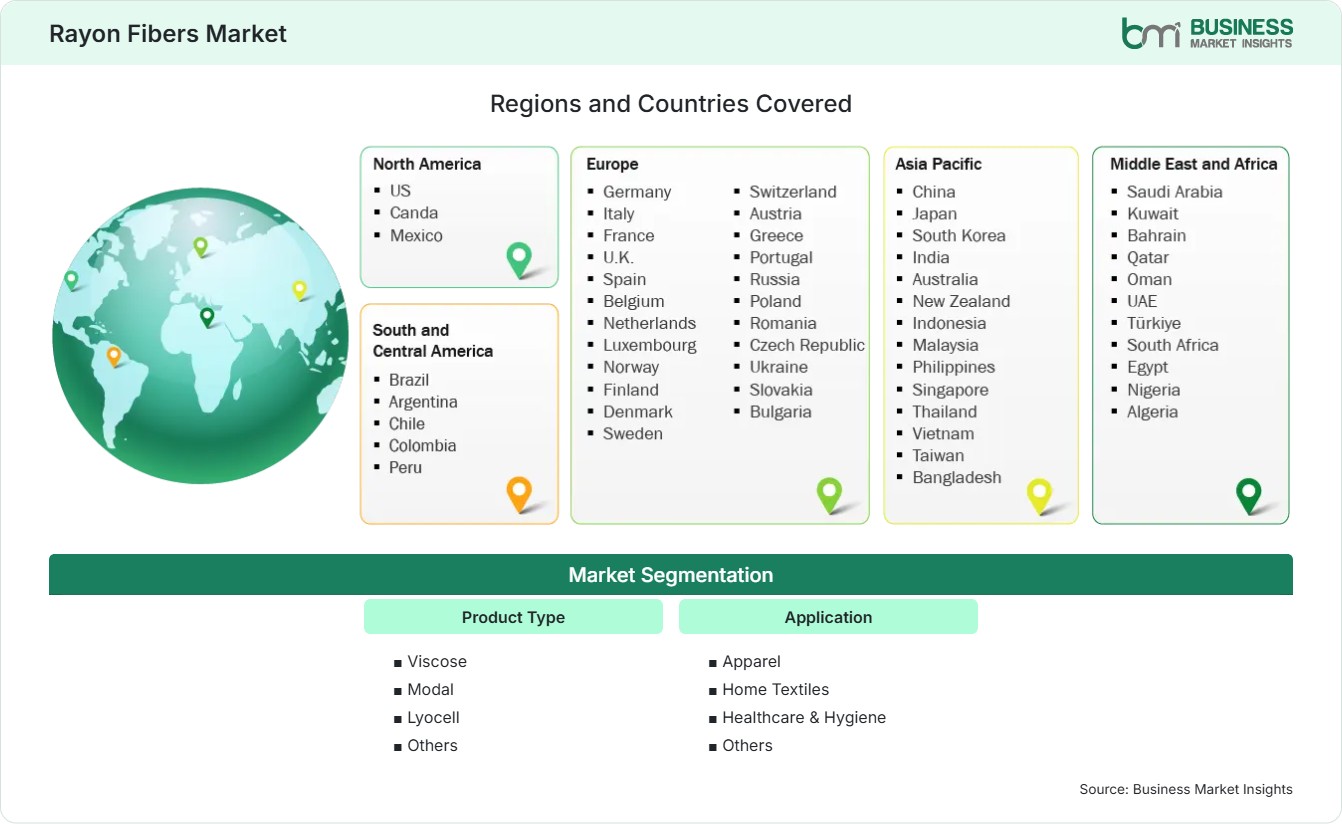
  • Product Type: Viscose, Modal, Lyocell, Others
  • Application: Apparel, Home Textiles, Healthcare & Hygiene, Others
US$ 22.05 Bn Market size in 2025
US$ 38.80 Bn Market Size by 2033
7.32% CAGR, 2026 - 2033
2026-2033 Forecast Period

01 AI Overview

Rayon Fibers Market Summary

  • North America Region: North America holds market share of 10%–13% in 2025, growing with a CAGR of 6.2%–6.8% due to factors such as sustainable fashion, high-quality fibers, hygiene uses, traceability, recycling of cellulose, and environmentally responsible brands. Demand from the United States is expected to increase at a CAGR of 6.3%-6.9% until 2033.
  • Fastest Growing Region: Asia Pacific holds market rayon fibers market share of 62%–66% in 2025, growing with a CAGR of 7.8%–8.5%, supported by textile manufacturing scale, expanding domestic consumption, integrated pulp-to-fiber supply chains, capacity investments, and rising specialty-fiber exports.
  • Leading Segment: Viscose holds market share of 62%–67% in 2025, growing with a CAGR of 6.8%–7.4%, driven by established manufacturing infrastructure, broad apparel adoption, competitive economics, moisture management, and strong demand from large textile-processing clusters.
  • High Growth Segment: Lyocell holds market share of 10%–14% in 2025, growing with a CAGR of 9.5%–10.5%, supported by closed-loop processing, premium fashion, sustainable sourcing, improved performance, denim applications, and increasing brand preference for lower-impact cellulosic materials.
  • Key Market Opportunity: Circular cellulose, recycled textile feedstocks, closed-loop production, and specialty fibers create attractive investment opportunities as brands prioritize traceability, resource efficiency, premium performance, and differentiated sustainable material portfolios.
  • Major Market Players: Lenzing AG, Aditya Birla Group, Sateri Holdings Limited, Tangshan Sanyou Chemical Industries Co., Ltd., Kelheim Fibres GmbH, Eastman Chemical Company, Grasim Industries Limited, Nanjing Chemical Fiber Co., Ltd., China National Chemical Corporation, Sateri International Group.
02 Strategic Insights

Rayon Fibers Market: Strategic Insights

Rayon Fibers Market Strategic Framework
FREE PDF
Request your free sample
Request free sample
03 Stakeholder View

Key Takeaways

  • The supply chain is becoming more vertically integrated, with leading producers combining dissolving pulp sourcing, fiber manufacturing, specialty formulation, certification, and downstream brand partnerships.
  • The strongest upside lies in lyocell, modal, specialty viscose, and circular fibers serving premium apparel, denim, hygiene, and home-textile applications.
  • Technology competition is shifting toward closed-loop solvent recovery, recycled textile feedstocks, waste-derived cellulose, improved fiber tenacity, and digitally enabled traceability.
  • India presents a compelling regional investment case because of its textile manufacturing ecosystem, domestic consumption base, export capabilities, and ongoing cellulosic-fiber capacity additions.
  • Investment is increasingly directed toward sustainability-led capacity, recycling infrastructure, and technology partnerships rather than undifferentiated volume expansion.
04 Geographic Outlook

Rayon Fibers Market Regional Highlights

North America Rayon Fibers Market

North America accounted for a 10%–13% share in 2025, with a 6.2%–6.8% CAGR projected through 2033. This region is fueled mainly by the import of fibers and textiles, luxury clothing needs, hygiene items, sustainability brand initiatives, and material traceability demands from retailers. North America leads in terms of consumer demand, whereas Canada and Mexico offer inputs through their specialty textiles manufacturing and nearshoring operations.

  • Sustainable sourcing requirements are encouraging brands to prioritize certified cellulosics, recycled inputs, and traceable forest-based feedstocks across apparel and home-textile procurement programs.
  • Premium fashion and denim applications are supporting higher-value lyocell and modal demand, particularly where softness, drape, moisture management, and environmental credentials influence material selection.
  • Hygiene and personal-care applications provide resilient demand for absorbent cellulosic fibers, supported by nonwoven product development and consumer preference for comfortable, skin-friendly materials.
  • Nearshoring of textile manufacturing in Mexico can strengthen regional fiber demand by shortening supply chains and increasing integration between North American brands and Latin American production bases.

US Rayon Fibers Market

The US represented approximately 8%–11% of global consumption in 2025 and is projected to grow at a 6.3%–6.9% CAGR through 2033. The market is characterized by strong downstream brand influence, premium apparel consumption, home textiles, hygiene applications, and sustainability-led procurement. Domestic fiber production remains limited compared with Asian manufacturing hubs, making import networks and supplier traceability strategically important.

  • Major fashion and retail brands increasingly evaluate fiber sourcing through sustainability, traceability, recycled content, and responsible forestry criteria, favoring differentiated regenerated-cellulose suppliers.
  • Demand for lyocell and premium modal benefits from athleisure, denim, intimate apparel, bedding, and soft-touch fabrics where comfort and performance justify higher material positioning.
  • Circular textile initiatives are creating opportunities for recycled cellulose technologies, although collection systems, sorting infrastructure, and commercial-scale recycling economics remain important execution considerations.

Europe Rayon Fibers Market

Europe held a 14%–17% share in 2025 and is projected to expand at a 6.7%–7.4% CAGR through 2033. Germany, Italy, France, and the United Kingdom remain leading demand centers, while Italy and Germany benefit from sophisticated textile value chains. Sweden and Austria are high-growth innovation markets, supported by sustainable-fiber technology, circularity initiatives, and premium textile development.

  • European brands are increasing scrutiny of fiber origin, chemical management, and environmental performance, strengthening demand for certified cellulosics with verifiable supply-chain credentials.
  • Germany leads industrial textile and sustainability-driven procurement activity, while Italy supports premium apparel and fashion applications requiring differentiated hand feel, drape, and fabric performance.
  • France benefits from luxury and premium-fashion demand, where lyocell and modal provide opportunities for lower-impact fabric development without sacrificing aesthetic or tactile characteristics.
  • Sweden is emerging as a high-growth innovation center, supported by investment in next-generation cellulose technologies, recycled feedstocks, and scalable alternatives to conventional fiber manufacturing.
  • Austria maintains a strong position in specialty regenerated-cellulose innovation, benefiting from technical expertise and proximity to European textile-processing and apparel markets.

Asia Pacific Rayon Fibers Market

Asia Pacific dominated with a 62%–66% share in 2025 and is projected to record a 7.8%–8.5% CAGR through 2033. China and India remain leading markets because of manufacturing scale and integrated textile ecosystems. India, Vietnam, Indonesia, and Bangladesh represent high-growth opportunities as apparel production, domestic consumption, export capacity, and sustainable-fiber adoption continue expanding.

  • China remains the largest production hub, with integrated fiber manufacturing, extensive textile conversion capacity, and established export networks supporting regional supply and competitive pricing.
  • India combines large textile manufacturing capacity with expanding specialty-fiber investments, including Grasim's planned Lyocell capacity, strengthening its position in higher-value regenerated cellulose.
  • Vietnam and Bangladesh benefit from expanding apparel exports and increasing brand requirements for lower-impact materials, creating opportunities for imported specialty fibers and sustainable fabric production.
  • Indonesia is positioned for faster growth as textile manufacturing expands and domestic brands increasingly explore sustainable fibers for apparel, home textiles, and lifestyle products.
  • Japan and South Korea offer premium technology-oriented opportunities, particularly in specialty fibers, high-performance textiles, advanced processing, and sustainable material innovation.

Rest of World Rayon Fibers Market

Rest of World represented a 9%–12% share in 2025 and is projected to grow at a 6.9%–7.7% CAGR through 2033. South and Central America are supported by apparel production and regional consumer demand, while Middle East and Africa offer emerging opportunities. Brazil and Mexico lead regional demand, while Türkiye, the UAE, and South Africa show comparatively stronger rayon fibers market growth potential.

  • Brazil offers the strongest regional demand base, supported by domestic apparel consumption, established textile manufacturing, and increasing interest in sustainable fiber alternatives.
  • Mexico's textile ecosystem is benefiting from nearshoring, creating opportunities for fiber suppliers that can support shorter lead times and North American brand sourcing requirements.
  • Turkiye combines a large textile-processing industry with proximity to European fashion markets, creating demand for differentiated fibers and sustainability-certified materials.
  • The UAE is emerging as a regional distribution and sourcing hub, supporting fiber trade and textile supply-chain connectivity across Middle Eastern markets.
  • South Africa offers a smaller but developing opportunity base, with growth linked to apparel demand, local textile initiatives, and increasing sustainability awareness among manufacturers.
Global Market Geography
FREE PDF
Request your free sample
Request free sample
05 Segment Analysis

Rayon Fibers Market Segmentation

Product Type

Product Type accounted for the largest portion of the Rayon Fibers Market in 2025, with a 100% market framework distributed across viscose, modal, lyocell, and other fibers. Viscose remains dominant because of scale and affordability, while lyocell and modal gain momentum through sustainability, comfort, premiumization, and differentiated textile performance. Product innovation increasingly emphasizes resource efficiency, circularity, and traceability.

  • Viscose: The largest product category, supported by established manufacturing infrastructure, broad apparel penetration, competitive pricing, absorbency, and extensive textile-processing compatibility.
  • Modal: Demand is supported by exceptional softness, dimensional stability, repeated-wash performance, and applications in intimate apparel, underwear, sleepwear, and premium home textiles.
  • Lyocell: Closed-loop production, high solvent recovery, softness, strength, and premium positioning support adoption in denim, activewear, apparel, bedding, and sustainable fashion collections.

Application

Application demand is concentrated in apparel, home textiles, healthcare and hygiene, and other uses, with apparel representing the leading application category. The Rayon Fibers Market scope is expanding as manufacturers develop fibers optimized for softness, absorbency, strength, and sustainability. Healthcare and hygiene applications provide attractive diversification, while home textiles benefit from premium bedding and soft furnishing demand.

  • Apparel: The largest application, driven by comfort, drape, moisture management, softness, fashion versatility, and growing adoption of sustainable cellulosic fibers across premium clothing categories.
  • Home Textiles: Bedding, towels, curtains, and furnishing fabrics benefit from rayon's softness and absorbency, with premium sustainable fibers gaining attention among environmentally conscious consumers.
  • Healthcare & Hygiene: Absorbent, soft, and biodegradable cellulosic fibers support wipes, medical textiles, personal hygiene products, and other nonwoven applications requiring skin compatibility and functional performance.
06 Market Forces

Rayon Fibers Market Dynamics

Key Market Drivers

Growing Demand for Sustainable Textile Fiber Materials

The concept of sustainability is driving changes in fiber sourcing as brands become more conscious about where their materials come from and how chemicals and water are managed along with cost and performance. Lenzing projected that total production of regenerated cellulose fibers would stand at around 8.7 million tons in 2025, marking an increase of about 4%. All these dynamics are driving Rayon Fibers Market by way of premiumization and differentiation in technology. The strongest Rayon Fibers Market trends are therefore moving beyond conventional viscose volume toward certified, traceable, and resource-efficient product portfolios.

Increasing Use of Rayon Fiber in Apparel and Home Textiles

Apparel will continue to be the main source of demand due to the combination of softness, drape, moisture absorbency, and machine compatibility of rayon. Both modal and lyocell are increasingly replacing polyester for applications such as denim, sportswear, intimate apparel, and high-end casualwear. Home textiles are also using increasing amounts of these two fibers for applications such as bedding and upholstery. The increase in global production of textiles in the Asia Pacific region provides another impetus to fiber conversion volumes. Companies that provide high-quality fiber products can attract more value-added demand from brands seeking a balance between performance and sustainability.

Rising Consumer Preference for Comfortable and Soft Textile Products

The consumer inclination toward light-weight and breathable fabrics justifies the use of rayon in apparel as well as home textiles. Modal offers softness and durability whereas lyocell is a combination of moisture management along with superior touch. These characteristics are particularly relevant in intimate apparel, sleepwear, sportswear, bedding, and towels. The market potential is enhanced even further when the fabric offers such benefits along with claims that it does not harm the environment. With increasing awareness among consumers regarding material content and provenance of products, manufacturers are increasingly positioning regenerated cellulose fibers as a distinctive feature.

Key Market Opportunities

Expansion of Rayon Fiber Applications Across Sustainable Fashion Markets

Fashion brands are diversifying their offerings of sustainable materials from simple viscose to lyocell, modal, recycled cellulose, and specialty regenerated fiber. This opens up avenues for manufacturers to create grades suited for specific applications, with guaranteed supply, increased longevity, and better processability. Some of the most profitable investment opportunities in the industry include high-end denim, sportswear, intimate wear, luxury fashion, and blended products. Manufacturers who can form partnerships with mills and brands for an extended period are guaranteed a consistent order flow, as well as assist their customers to achieve their sustainability goals.

Growing Demand for Rayon in Home Textiles and Technical Applications

The development of home textiles can further create possibilities for future expansion in the use of soft, sustainable materials in bed linens, towels, upholstery, and fabrics for furnishing. Opportunities for technical applications exist in the areas of wipes, absorbents, and special nonwovens where fibers made from cellulose.. Lenzing's product range represents the variety of possible applications in textiles, nonwovens, personal care, and hygiene from regenerated cellulose fibers. The investment in the research on fiber development can create opportunities outside traditional clothing applications.

Rising Opportunities from Sustainable Textile Production Initiatives

Sustainability efforts are generating opportunities for companies that are making investments in water reclamation, closed-loop processes, responsible forestry, and circular feedstocks. Birla Cellulose has reported initiatives aimed at significant water intensity reductions and the launch of Liva Reviva M made out of recycled garments that may result in unique products. These types of investment efforts may help in premium pricing, brand development, and regulatory readiness. The most promising Rayon Fibers Market Forecasts would rely on scaling such technologies efficiently and reliably.

Market Restraints and Challenges

Environmental Concerns Associated with Chemical Processing of Rayon Fibers

Factor: The conventional method of viscose production is characterized by chemically intensive operations, which may pose environmental and health risks due to inefficient chemical recovery and treatment of wastewater. Impact: The manufacturers will incur more costs of compliance with regulations, increased pressure from brands, and suffer from reputational risks. The solution in the industry is moving towards closed-loop systems, efficient chemical recovery, sustainable sourcing, and third-party certifications.

Fluctuating Prices of Wood Pulp and Other Cellulosic Raw Materials

Factor: The process of dissolving wood pulp, along with other forms of cellulose-based feedstock, forms an important component in the upstream side and can be affected by conditions such as forests, energy prices, logistics, and supply-demand dynamics in specific locations. Impact: High cost of raw materials could lead to lower profit margins for producers or increase prices, making the products less competitive compared to artificial substitutes. This is more applicable to commodity viscose producers that compete through price.

07 Company Analysis

Competitive Landscape

The Rayon Fibers Market analysis indicates a competitive structure combining large-scale commodity producers, vertically integrated fiber manufacturers, specialty-fiber innovators, and diversified chemical companies. Competition is increasingly determined by sustainable feedstock access, production scale, certification, closed-loop technologies, specialty product development, and relationships with textile brands.

Company Name

Overview

Products and Services relevant to this market

Lenzing AG

Global regenerated-cellulose producer with strong positions in premium and specialty fibers and advanced sustainability capabilities.

TENCEL lyocell and modal, LENZING ECOVERO viscose, VEOCEL fibers, dissolving pulp, and specialty cellulosics.

Aditya Birla Group

Diversified global group with major cellulosic-fiber capabilities through Birla Cellulose and sustainability-focused innovation programs.

Viscose staple fiber, specialty fibers, cellulosic fashion yarns, recycled fibers, and sustainable fiber solutions.

Sateri Holdings Limited

Major global viscose producer focused on large-scale fiber manufacturing and sustainability-oriented product development.

Viscose staple fibers, specialty viscose products, sustainable fibers, and recycled-cellulose offerings.

Tangshan Sanyou Chemical Industries Co., Ltd.

Integrated Chinese chemical and fiber producer serving large-scale regenerated-cellulose and industrial markets.

Viscose staple fiber, chemical intermediates, industrial materials, and supporting chemical production capabilities.

Kelheim Fibres GmbH

German specialty viscose producer focused on customized fibers for technical, textile, and nonwoven applications.

Specialty viscose fibers, functional fiber shapes, hygiene fibers, and customized regenerated-cellulose solutions.

Eastman Chemical Company

Diversified materials company with a differentiated cellulose acetate fiber portfolio serving premium textile applications.

Naia cellulose acetate yarns, Naia Renew, specialty filament yarns, and sustainable textile material solutions.

Grasim Industries Limited

Major Indian cellulosic-fiber producer with substantial manufacturing scale and investment in next-generation Lyocell capacity.

Cellulosic staple fiber, cellulosic fashion yarn, specialty fibers, and planned Lyocell production capacity.

Nanjing Chemical Fiber Co., Ltd.

Chinese fiber producer with established capabilities in regenerated cellulose and related chemical manufacturing.

Viscose fibers, regenerated cellulose products, specialty textile materials, and chemical fiber solutions.

China National Chemical Corporation

Large Chinese chemical group with broad industrial materials capabilities and exposure to advanced chemical technologies.

Chemical materials, fiber-related technologies, industrial intermediates, and specialty material solutions.

Sateri International Group

Global-facing regenerated-cellulose business focused on sustainable viscose and circular fiber development.

Viscose staple fiber, specialty viscose, recycled cellulose, and traceable sustainable fiber solutions.

10 Trust & Transparency

Research Methodology

The market analysis combines proprietary research with secondary data from government agencies, company disclosures, regulatory filings, industry databases and expert interviews. Market estimates are validated through data triangulation, cross-market benchmarking and analyst review.

View Full Research Methodology

11 Questions Answered

Frequently Asked Questions

5. Which capability will most influence long-term supplier competitiveness?

The strongest suppliers will combine reliable capacity with sustainable feedstocks, efficient processing, specialty-fiber innovation, certification, and downstream customer integration.

4. How does brand sustainability affect fiber manufacturers in rayon fibers market report?

Brand sustainability requirements influence material selection, supplier qualification, certification, and product development.

3. What role does recycling play in future fiber supply?

Recycling can diversify cellulose feedstocks and reduce dependence on virgin wood resources.

2. Why are specialty fibers gaining strategic importance?

Specialty fibers allow producers to compete through performance rather than commodity pricing.

1. How is fiber traceability changing procurement decisions?

Traceability is becoming a procurement requirement because brands increasingly need evidence of responsible forestry, recycled content, and controlled processing.

Access the Full Rayon Fibers Market Report

Get segment-level forecasts, regional estimates, competitive benchmarking, company profiles and downloadable Excel datasets.

Access the full Rayon Fibers Market Report
350 pages PDF & Excel | 2026-08-05