
Fiber Based Packaging Market Outlook: Size, Share, Trends, Growth Analysis, Competitive Landscape & Forecast, 2026-2033

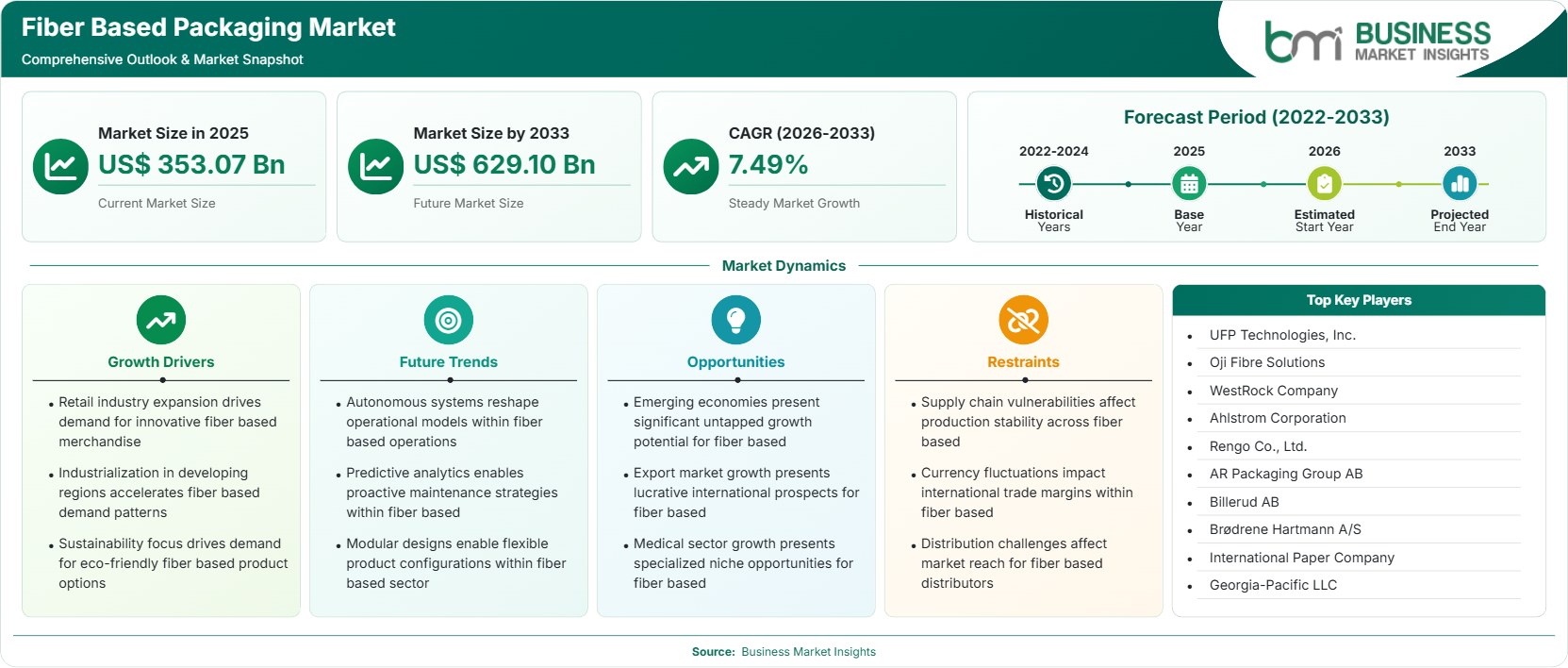
The Fiber Based Packaging Market size was valued at US$ 353.07 Billion in 2025 and is projected to reach US$ 629.1 Billion by 2033, growing at a CAGR of 7.49% during 2026–2033. Key growth drivers include sustainable packaging mandates, e-commerce expansion, plastic reduction initiatives, and rising food-service demand, while opportunities emerge from molded fiber innovation, recyclable packaging technologies, and emerging-market industrialization.

Report Coverage
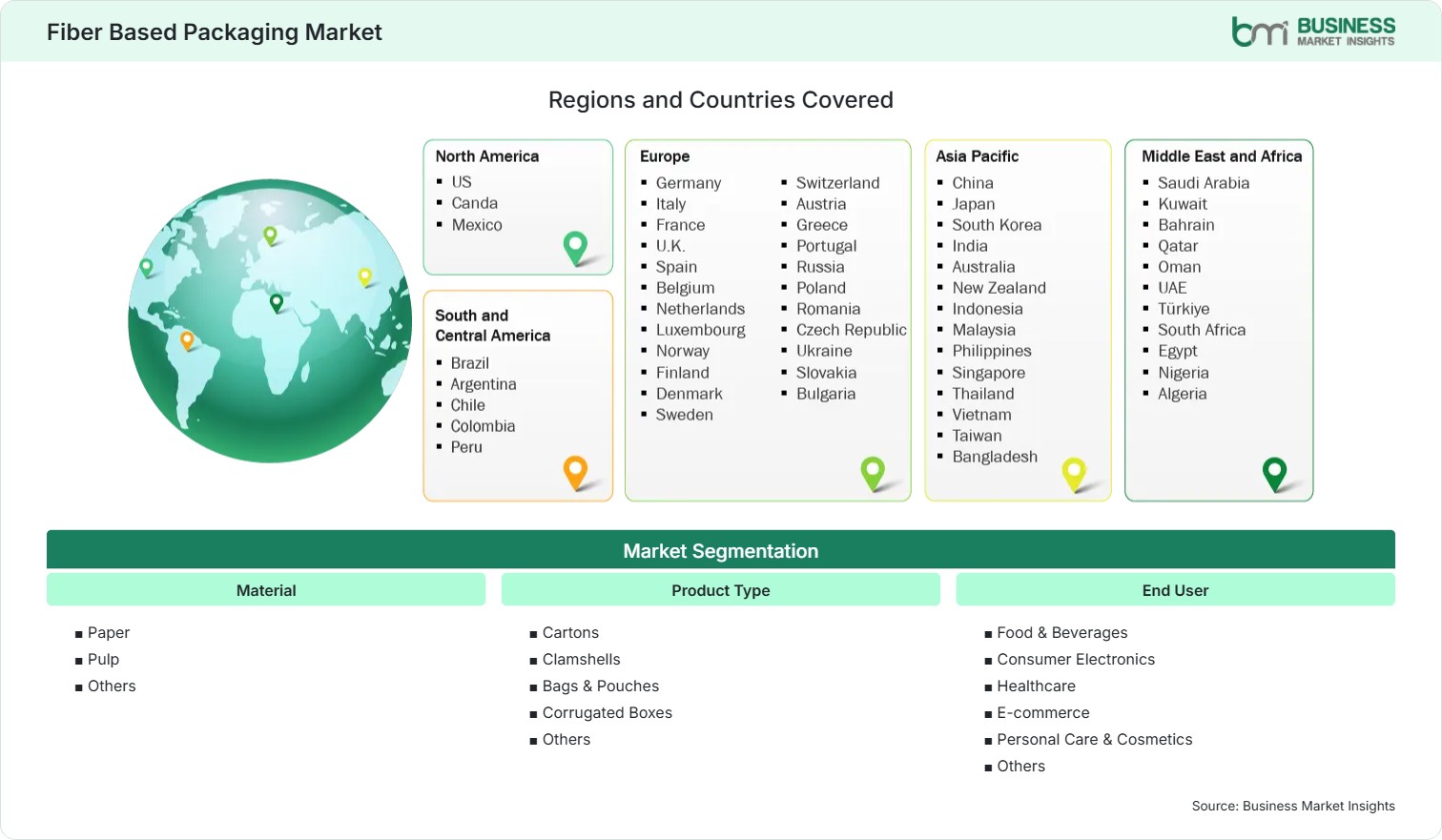
  • Material: Paper, Pulp, Others
  • Product Type: Cartons, Clamshells, Bags & Pouches, Corrugated Boxes, Others
  • End User: Food & Beverages, Consumer Electronics, Healthcare, E-commerce, Personal Care & Cosmetics, Others
US$ 353.07 Bn Market size in 2025
US$ 629.10 Bn Market Size by 2033
7.49% CAGR, 2026 - 2033
2026-2033 Forecast Period

AI Overview

Fiber Based Packaging Market Summary

  • North America Region: North America holds a fiber based packaging market share of 31%–34% in 2025, growing with a CAGR of 6.5%–7.1% during 2026–2033. Strong consumer preference for recyclable packaging, corporate sustainability targets, advanced converting technologies, and retail packaging innovation continue supporting demand across major end-use industries. The U.S. remains dominant, supported by e-commerce packaging investments and food packaging modernization, advancing at 6.7%–7.2% CAGR.
  • Fastest Growing Region: Asia Pacific accounts for 27%–30% share in 2025 and is projected to expand at a CAGR of 8.8%–9.5% during 2026–2033. Manufacturing growth, rising organized retail penetration, government restrictions on single-use plastics, and increasing packaged food consumption continue accelerating regional adoption.
  • Leading Segment: Paper holds 42%–46% market share in 2025 and advances at a CAGR of 7.2%–7.8% through 2033. Broad availability, strong recyclability infrastructure, printing compatibility, and cost efficiency support extensive use across consumer goods, food packaging, and industrial applications globally.
  • High Growth Segment: E-commerce represents 16%–19% share in 2025 and expands at a CAGR of 9.6%–10.2% during 2026–2033. Online retail expansion, demand for lightweight shipping solutions, product protection requirements, and sustainability commitments are driving increasing adoption of fiber-based packaging formats.
  • Key Market Opportunity: Development of advanced molded fiber packaging solutions capable of replacing rigid plastics in electronics, healthcare, and food applications creates substantial opportunities for manufacturers pursuing premium sustainable packaging portfolios globally.
  • Major Market Players: UFP Technologies, Inc.; Oji Fibre Solutions; WestRock Company; Ahlstrom Corporation; Rengo Co., Ltd.; AR Packaging Group AB; Billerud AB; Brødrene Hartmann A/S; International Paper Company; Georgia-Pacific LLC.
Strategic Insights

Fiber Based Packaging Market: Strategic Insights

Fiber Based Packaging Market Strategic Framework
FREE PDF
Request your free sample
Request free sample
Stakeholder View

Key Takeaways

  • The fiber based packaging market value chain is becoming increasingly integrated, with pulp suppliers, packaging converters, recyclers, and consumer brands collaborating to improve circularity, reduce raw material volatility, and enhance packaging performance.
  • E-commerce and Healthcare uses represent some of the best prospects for revenues given the increased need for protective, lightweight and eco-friendly packaging solutions.
  • The innovation of new products is increasingly focusing on molded fiber, water resistant coatings, and mono-material systems, which will increase recyclability and satisfy performance demands that have traditionally been met using plastics.
  • The Asia Pacific represents one of the best investment climates given the growth in production capacity, regulations, increased consumer awareness, and increased packaging usage.
  • Acquisitions are changing the nature of the competition as packaging companies increase their geographical presence, increase sustainability and gain access to recycled fibers.
Geographic Outlook

Fiber Based Packaging Market Regional Highlights

North America Fiber Based Packaging Market

North America accounts for 31%–34% of global revenue in 2025 and is projected to register a 6.5%–7.1% CAGR during 2026–2033. Strong recycling infrastructure, mature packaging supply chains, and sustainability-focused procurement policies support regional leadership. The region also benefits from technological innovation in corrugated packaging, molded fiber products, and advanced paper processing systems. Fiber Based Packaging Market share remains highest across food, beverage, and logistics applications.

  • The growing dedication of retailers to stop using plastics that create problems is leading to the increase in recyclable packaging such as cartons, corrugated boxes, and paper protective packaging in North America.
  • Building of automated packaging plants is increasing efficiency of manufacturing process meeting requirements for mass manufacturing while increasing sustainability.
  • Food service operators increasingly utilize fiber packaging products to meet environmental targets and comply with municipal restrictions on single-use plastic packaging.
  • Consumer preference for environmentally responsible packaging continues influencing purchasing behavior, encouraging brand owners to transition toward renewable and recyclable packaging materials.

US Fiber Based Packaging Market

The United States represents approximately 74%–78% of North American revenue in 2025 and advances at a 6.7%–7.2% CAGR through 2033. Large-scale consumer markets, robust e-commerce activity, and sustainability initiatives among major brands continue supporting demand. Significant investments in packaging automation, recycling facilities, and fiber innovation strengthen industry competitiveness. Federal and state-level environmental programs further encourage adoption of renewable packaging alternatives across diverse sectors.

  • Large-scale consumer packaged goods firms have been continually incorporating more paper-based packaging materials that can be recycled to meet their sustainability objectives and consumer expectations.
  • Expansion in e-commerce logistics is leading to constant demand for packaging such as corrugated boxes, protective inserts, and lightweight packaging.
  • Packaging manufacturers have been increasingly making investments in state-of-the-art converting equipment.

Europe Fiber Based Packaging Market

Europe holds approximately 25%–28% fiber based packaging market share in 2025 and is forecast to grow at a 6.9%–7.6% CAGR during 2026–2033. Stringent sustainability regulations, circular economy policies, and producer responsibility frameworks support widespread adoption. Germany leads regional revenue generation, while Eastern European markets demonstrate faster expansion. Strong consumer awareness and packaging waste reduction targets continue driving investment in recyclable and renewable packaging formats across industrial sectors.

  • The dominant player is Germany owing to its sophisticated manufacturing capacity and excellent innovations in packaging.
  • While Poland and the other East European nations have higher growth prospects due to growth in the industry and increased consumption of packaging.
  • Developments in the recycled fibers sector ensure reliable supply and promote sustainable development.
  • Food and beverages companies use high performing fiber packages for better environment and brand image.

Asia Pacific Fiber Based Packaging Market

Asia Pacific captures 27%–30% of global revenue in 2025 and records the fastest regional CAGR of 8.8%–9.5% through 2033. Rapid industrialization, rising disposable incomes, expanding retail infrastructure, and government action against plastic waste drive strong demand. China remains the largest regional market, while India demonstrates the highest growth trajectory. Manufacturing investments and increasing packaged goods consumption continue supporting fiber based packaging market expansion throughout the region.

  • China leads regional demand through its extensive manufacturing base, export activity, and growing sustainable packaging initiatives.
  • India demonstrates strong expansion potential supported by e-commerce growth, urbanization, and increasing regulatory focus on plastic waste reduction.
  • Food delivery platforms are generating substantial demand for disposable fiber packaging products across metropolitan markets.
  • Regional producers continue investing in pulp processing and packaging conversion capacity to support growing domestic consumption.
  • International packaging companies are expanding operations across Asia Pacific to capture emerging demand opportunities and strengthen supply chains.

Rest of World Fiber Based Packaging Market

The Rest of World region accounts for 11%–14% share in 2025 and is projected to expand at a 7.3%–8.0% CAGR during 2026–2033. South & Central America benefit from agricultural exports and growing consumer packaging demand. Meanwhile, Middle East and Africa markets are supported by retail modernization, food processing expansion, and sustainability initiatives. Economic diversification programs and industrial investments continue encouraging adoption of recyclable packaging materials.

  • Brazil remains the leading South & Central American market, supported by strong food processing and export packaging requirements.
  • Mexico benefits from manufacturing growth and integration into global supply chains requiring sustainable packaging solutions.
  • The United Arab Emirates demonstrates strong growth potential through retail expansion and sustainability-focused development programs.
  • Saudi Arabia continues investing in industrial diversification projects that increase packaging demand across consumer and industrial sectors.
  • Rising environmental awareness and regulatory developments encourage broader adoption of recyclable fiber packaging products throughout emerging economies.
Global Market Geography
FREE PDF
Request your free sample
Request free sample
Segment Analysis

Fiber Based Packaging Market Segmentation

Material

The material segment forms the foundation of industry demand and product differentiation. It accounted for approximately 48%–52% market share in 2025 and is expected to grow at a 7.3%–7.9% CAGR through 2033. Material selection is influenced by recyclability requirements, strength characteristics, cost efficiency, and regulatory compliance. The Fiber Based Packaging Market scope continues expanding as manufacturers develop advanced fiber blends that improve durability, barrier performance, and sustainability credentials across end-use industries.

  • Paper: Paper remains widely utilized due to excellent printability, broad recyclability infrastructure, lightweight characteristics, and compatibility with food, consumer goods, and industrial packaging applications.
  • Pulp: Pulp-based packaging supports molded fiber products, protective cushioning solutions, and sustainable alternatives to plastic packaging across electronics, healthcare, and food service sectors.

Product Type

The product type segment represents the most visible component of packaging innovation and adoption. It held approximately 38%–42% market share in 2025 and is anticipated to register a 7.6%–8.2% CAGR through 2033. Product development is increasingly focused on performance enhancement, material optimization, and sustainability objectives. Fiber Based Packaging Market trends indicate rising demand for lightweight, recyclable, and customized packaging formats supporting logistics efficiency and consumer engagement.

  • Cartons: Cartons provide excellent branding opportunities, shelf appeal, and product protection, making them highly preferred across food, beverage, pharmaceutical, and personal care applications.
  • Clamshells: Clamshell packaging gains traction through increasing demand for sustainable food packaging solutions, offering convenience, visibility, and improved product security during transportation.
  • Bags & Pouches: Fiber-based bags and pouches are increasingly replacing flexible plastic packaging, supported by growing consumer demand for renewable and environmentally responsible packaging alternatives.
  • Corrugated Boxes: Corrugated packaging remains essential for shipping and logistics operations, delivering superior protection, stackability, and recyclability across e-commerce and industrial supply chains.

End User

The end-user segment accounted for approximately 44%–48% market share in 2025 and is projected to expand at a 7.8%–8.4% CAGR through 2033. Demand patterns vary according to packaging performance requirements, regulatory obligations, and sustainability commitments. Consumer behavior, online retail growth, and environmental regulations continue reshaping purchasing decisions and encouraging broader adoption of renewable packaging solutions across major industries.

  • Food & Beverages: Food and beverage companies increasingly adopt fiber packaging to improve sustainability performance, comply with regulations, and satisfy evolving consumer preferences regarding environmentally friendly products.
  • Consumer Electronics: Electronics manufacturers utilize protective fiber packaging solutions to minimize environmental impact while ensuring product safety during transportation and distribution.
  • Healthcare: Healthcare applications require reliable, hygienic, and sustainable packaging formats that meet strict regulatory standards while supporting environmental responsibility objectives.
  • E-commerce: Rapid expansion of online retail activities continues driving demand for corrugated shipping boxes, protective inserts, and customized packaging solutions optimized for logistics efficiency.
  • Personal Care & Cosmetics: Beauty and personal care brands increasingly transition toward premium fiber packaging formats that enhance sustainability credentials and strengthen environmentally conscious brand positioning.
Market Forces

Fiber Based Packaging Market Dynamics

Key Market Drivers

Expansion of Sustainable Packaging Regulations Worldwide

Government policies in key economic regions are being adopted to encourage the use of packaging that can be recycled and renewed. The EU Packaging and Packaging Waste Directive, North America plastic reduction policies, and sustainability policies in Asia have resulted in favorable market conditions. Fiber-based packaging fits the requirements of the circular economy owing to recycling capabilities and renewable raw materials. Corporate environmental commitments add to the demand from multinational consumer goods corporations. The fiber-based packaging market growth is influenced by regulatory requirements and sustainability targets. Packaging suppliers who can provide recyclable, compostable, and high-performing materials are getting ahead because customers consider environmental considerations in their procurement process.

Rapid Growth of E-commerce Distribution Networks

Global growth in e-commerce is resulting in considerable growth in demand for corrugated boxes, paper mailers, molded fiber inserts, and other packaging needs. Based on the retail market projections around the world, online retail sales are growing at a faster rate than the rest of the retail sales, which means there is a need for effective packaging for such products. The use of fiber-based materials in packaging offers the benefit of being light, efficient in transport, and easy to recycle. There is an increasing need among retailers for packaging options that save money on shipping and improve customers’ experiences.

Advancements in Fiber Processing and Material Innovation

The continuous innovations in the area of fiber processing technology have been contributing to better packaging performance in different packaging applications. The industry players are working towards developing better molded fiber packaging, better barrier coatings, light weight corrugated packaging, and even paper composites that could potentially replace plastics. Innovations are being made in areas such as moisture protection, durability, print quality and recyclability. The Fiber Based Packaging Market trend would be more aligned to developing high performance packages which can meet both the sustainability and performance requirements.

Key Market Opportunities

Replacement of Single-Use Plastics Across Industries

Growing restrictions on single-use plastics create substantial opportunities for fiber-based packaging suppliers. Food service operators, retailers, healthcare providers, and consumer goods manufacturers are actively seeking alternatives capable of meeting performance requirements while improving environmental outcomes. Molded fiber trays, paper-based containers, and advanced packaging formats increasingly replace plastic products across diverse applications. Fiber Based Packaging Market Forecasts indicate sustained investment in product development and manufacturing capacity aimed at addressing this transition. Companies capable of offering scalable, cost-effective, and regulation-compliant alternatives are positioned to capture expanding demand. Strategic collaborations with brand owners further accelerate commercialization and adoption across multiple end-use industries.

Emergence of Premium Molded Fiber Packaging Solutions

Premium molded fiber packaging is gaining increasing popularity among electronics, luxury products, medical supplies, and specialty food items. The improvements in design versatility, physical performance, and aesthetics make fiber-based packaging a viable alternative to plastic and foam-based packaging options. The brand owners appreciate the fact that the fiber-based packaging offers both a sustainable advantage and premium consumer appeal. Investments in the improved forming technology and precise manufacturing equipment continue to generate new business opportunities in this area. The capability to offer customized, protected, and aesthetic packaging allows for creating a strong competitive advantage. As the sustainable awareness of consumers increases, the demand for premium fiber packaging will increase as well.

Expansion of Circular Economy Infrastructure

The increasing focus on recycling plants, fiber recycling systems, and sustainable packaging ecosystems will provide good long-term opportunities for growth. The circular economy will continue to be promoted by governments, industry bodies, and private sector members as a means of enhancing material recycling and minimizing waste. Better recycling systems ensure better supply of recycled fibers and also enable sustainability goals to be achieved. Packaging companies will gain from the availability of recycled feedstocks and improved green credentials. This will drive innovations, lower environmental impacts, and generate business opportunities in recycling operations and packaging production.

Market Restraints and Challenges

Volatility in Raw Material and Energy Costs

Factor: Fluctuating prices for pulp, recovered paper, chemicals, and energy significantly influence production economics. Impact: Manufacturers face pressure on profit margins and pricing strategies, particularly during periods of supply disruption or energy market instability. Global supply chain imbalances, transportation costs, and changing demand patterns contribute to cost volatility. Smaller producers are especially vulnerable because of limited purchasing power and lower operational flexibility. Although long-term demand fundamentals remain favorable, cost uncertainty can delay investment decisions and reduce profitability. Companies increasingly pursue operational efficiency, supply diversification, and long-term procurement agreements to mitigate exposure to raw material and energy market fluctuations.

Performance Limitations in Certain High-Barrier Applications

Factor: Some fiber materials face technical limitations regarding moisture resistance, grease protection, oxygen barriers, and durability under demanding conditions. Impact: Adoption may be constrained in applications requiring advanced protective properties traditionally provided by plastics or multilayer packaging materials. Manufacturers continue investing in coatings and material innovations to address these challenges; however, achieving performance requirements while maintaining recyclability remains complex. Certain end-use industries require extensive testing and regulatory approvals before transitioning to alternative packaging formats. These technical constraints may slow penetration into selected applications despite growing sustainability demand and regulatory support.

Company Analysis

Competitive Landscape

The competitive environment remains characterized by capacity expansion, sustainability-focused innovation, and strategic partnerships across the packaging value chain. Fiber Based Packaging Market analysis indicates that leading participants are investing in recyclable product portfolios, advanced fiber technologies, molded fiber solutions, and geographically diversified manufacturing networks.

Company Name

Overview

Products and Services Relevant to this Market

UFP Technologies, Inc.

Develops engineered packaging solutions serving healthcare, industrial, and consumer sectors with strong sustainability focus and protective packaging expertise.

Molded fiber packaging, protective packaging components, custom packaging solutions, sustainable material engineering, and specialty packaging products.

Oji Fibre Solutions

Major fiber packaging producer with integrated operations across pulp, paper, and packaging segments serving diverse industries.

Corrugated packaging, paper packaging products, industrial packaging solutions, recycled fiber products, and packaging conversion services.

WestRock Company

Global packaging manufacturer focused on sustainable packaging innovation, supply chain optimization, and integrated packaging systems.

Corrugated containers, cartons, consumer packaging, paperboard products, and customized fiber-based packaging solutions.

Ahlstrom Corporation

Specialty materials company delivering sustainable fiber-based solutions for industrial, healthcare, and consumer applications worldwide.

Fiber materials, specialty papers, packaging substrates, filtration materials, and sustainable packaging innovations.

Rengo Co., Ltd.

Leading packaging company with extensive expertise in corrugated products, paperboard manufacturing, and sustainable packaging development.

Corrugated boxes, packaging materials, paperboard products, logistics packaging, and industrial packaging systems.

AR Packaging Group AB

European packaging specialist providing innovative packaging solutions focused on branding, functionality, and sustainability.

Folding cartons, consumer packaging solutions, fiber packaging formats, printed packaging products, and packaging design services.

Billerud AB

Sustainability-focused packaging producer recognized for high-performance paper and fiber-based packaging materials.

Packaging paper, paperboard products, industrial packaging materials, and renewable packaging solutions.

Brødrene Hartmann A/S

Global leader in molded fiber packaging products serving food, beverage, and industrial markets.

Molded fiber packaging, egg packaging, food trays, protective packaging products, and sustainable packaging technologies.

International Paper Company

One of the world's largest packaging and paper companies with integrated manufacturing and distribution capabilities.

Corrugated packaging, containerboard, packaging solutions, recycled fiber products, and industrial packaging services.

Georgia-Pacific LLC

Major manufacturer of packaging and paper products supporting industrial, retail, and consumer applications.

Corrugated packaging, paper packaging products, packaging materials, logistics packaging, and fiber-based packaging systems.

Trust & Transparency

Research Methodology

The market analysis combines proprietary research with secondary data from government agencies, company disclosures, regulatory filings, industry databases and expert interviews. Market estimates are validated through data triangulation, cross-market benchmarking and analyst review.

View Full Research Methodology

Questions Answered

Frequently Asked Questions

Why is a Fiber Based Packaging Market Report important for strategic planning?

The report helps stakeholders evaluate demand patterns, regulatory developments, competitive positioning, investment opportunities, technology trends, supply chain dynamics, and regional growth prospects before making strategic business decisions.

What role does innovation play in market development?

Innovation enables development of stronger molded fiber products, improved barrier coatings, lightweight packaging structures, and premium packaging formats capable of replacing conventional plastic packaging solutions in multiple industries.

How does recycled fiber influence industry competitiveness?

Access to recycled fiber improves cost efficiency, supports sustainability objectives, strengthens circular economy performance, and helps manufacturers meet regulatory requirements while reducing dependence on virgin raw materials.

Which end-user industry offers the strongest long-term opportunity?

E-commerce presents one of the strongest long-term opportunities due to increasing parcel volumes, demand for protective packaging, supply chain expansion, and retailer sustainability commitments encouraging use of renewable packaging materials.

What factors are accelerating adoption of fiber-based packaging solutions?

Environmental regulations, consumer preference for sustainable products, corporate ESG commitments, growth in e-commerce shipments, and advancements in recyclable packaging technologies are accelerating adoption across industries including food, healthcare, and retail.

Access the Full Fiber Based Packaging Market Report

Get segment-level forecasts, regional estimates, competitive benchmarking, company profiles and downloadable Excel datasets.

Access the full Fiber Based Packaging Market Report
350 pages PDF & Excel | 2026-09-02