
Packaging Market Outlook: Size, Share, Trends, Growth Analysis, Competitive Landscape & Forecast, 2026-2033

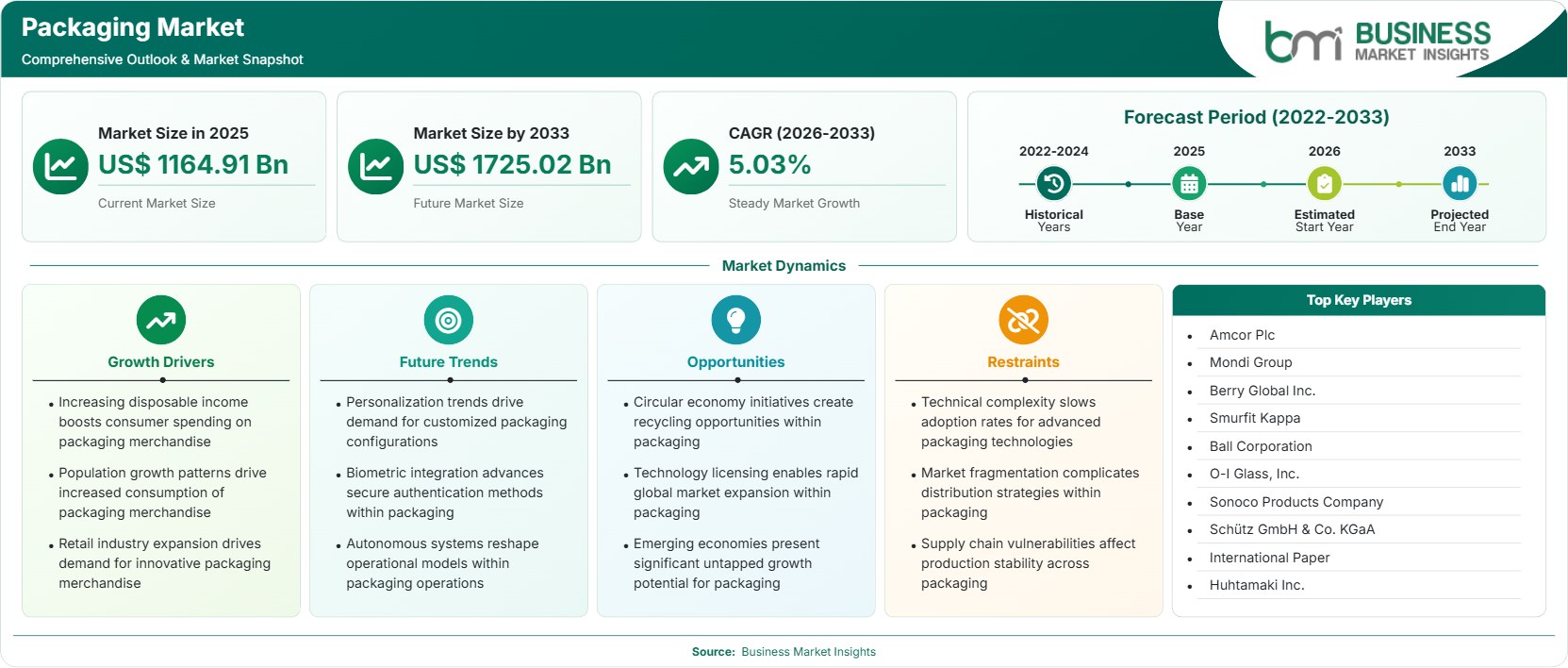
The Packaging Market size was valued at US$ 1164.91 Billion in 2025 and is projected to reach US$ 1725.02 Billion by 2033, growing at a CAGR of 5.03% during 2026–2033. Rising demand for sustainable packaging, expanding e-commerce logistics, food safety regulations, healthcare packaging innovations, and increasing investments in recyclable materials continue creating long-term opportunities across global value chains.

Report Coverage
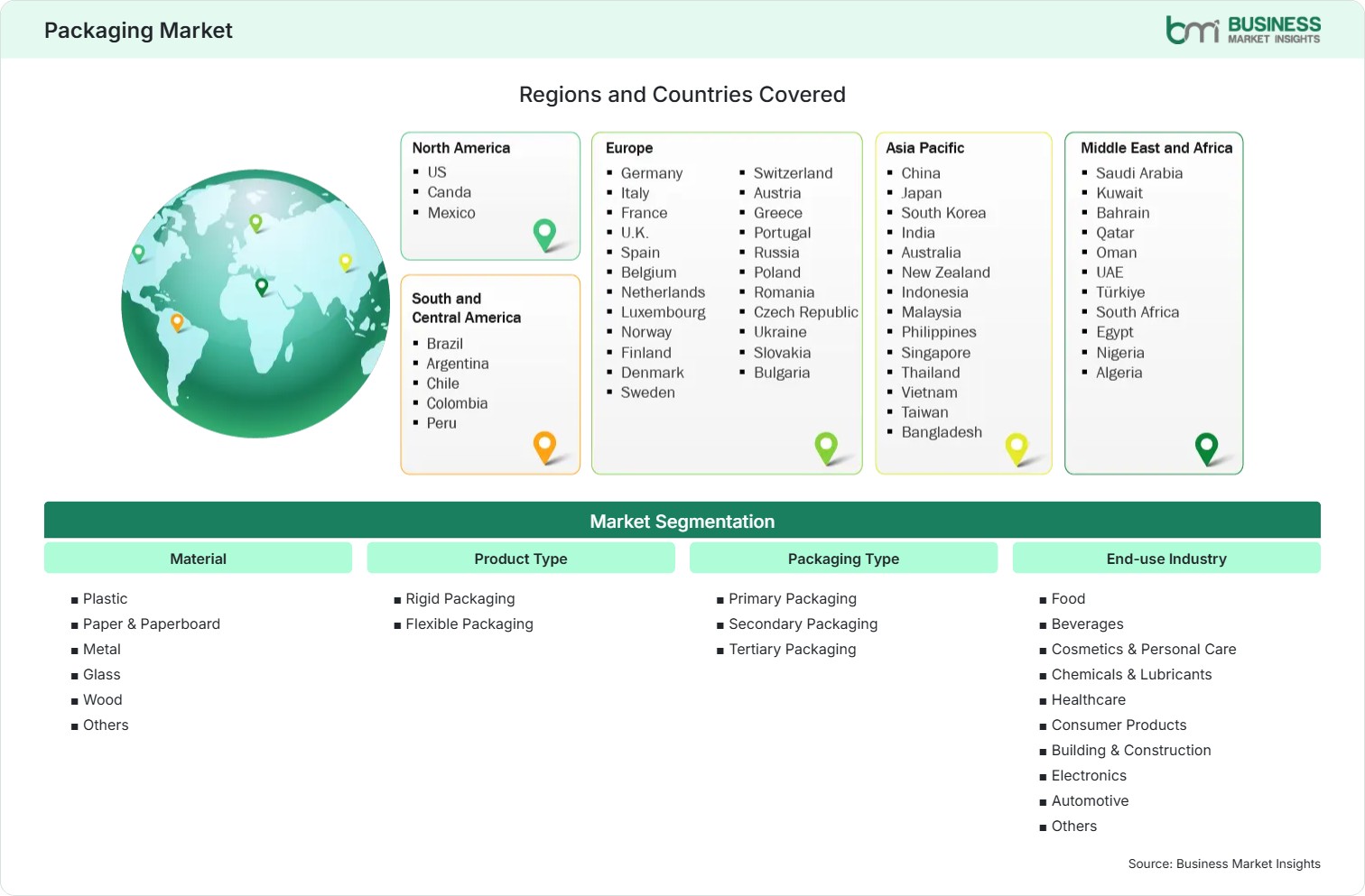
  • Material: Plastic, Paper & Paperboard, Metal, Glass, Wood, Others
  • Product Type: Rigid Packaging, Flexible Packaging
  • Packaging Type: Primary Packaging, Secondary Packaging, Tertiary Packaging
  • End-use Industry: Food, Beverages, Cosmetics & Personal Care, Chemicals & Lubricants, Healthcare, Consumer Products, Building & Construction, Electronics, Automotive, Others
US$ 1164.91 Bn Market size in 2025
US$ 1725.02 Bn Market Size by 2033
5.03% CAGR, 2026 - 2033
2026-2033 Forecast Period

AI Overview

Packaging Market Summary

  • North America Region: North America holds 34%–37% market share in 2025, growing with a 4.6%–4.9% CAGR during 2026–2033, supported by sustainable material adoption, advanced manufacturing, premium consumer goods demand, circular economy initiatives, automation investments, healthcare packaging expansion, regulatory compliance, smart labeling technologies, retail modernization, and digital supply chain integration. The U.S. leads regional demand through strong food, pharmaceutical, and e-commerce packaging investments, expanding at an estimated CAGR of 4.7%–5.0% during 2026–2033.
  • Fastest Growing Region: Asia Pacific accounts for 27%–30% market share in 2025 while advancing at a 6.3%–6.7% CAGR during 2026–2033, driven by manufacturing expansion, urbanization, organized retail growth, export-oriented production, sustainable packaging investments, rising healthcare consumption, digital commerce, government industrial initiatives, and increasing consumer spending.
  • Leading Segment: Plastic represents 37%–40% market share in 2025 with a projected 4.8%–5.2% CAGR through 2026–2033, supported by lightweight performance, cost efficiency, food preservation capabilities, advanced barrier technologies, recyclable polymer innovation, industrial versatility, logistics optimization, manufacturing scalability, and growing flexible packaging demand worldwide.
  • High Growth Segment: Healthcare accounts for 13%–16% market share in 2025 while expanding at 6.6%–7.0% CAGR through 2026–2033 owing to pharmaceutical production growth, biologics distribution, sterile packaging requirements, regulatory compliance, aging populations, vaccine transportation, medical device demand, serialization technologies, and cold-chain infrastructure development.
  • Key Market Opportunity: Expanding circular economy policies, mono-material innovations, reusable transport packaging, digital traceability, and intelligent packaging technologies enable manufacturers to improve sustainability, operational efficiency, regulatory compliance, consumer engagement, and long-term profitability across industrial applications globally.
  • Major Market Players: Amcor plc, Mondi plc, Berry Global Group, Inc., Smurfit Westrock plc, Ball Corporation, O-I Glass, Inc., Sonoco Products Company, Schütz GmbH & Co. KGaA, International Paper Company, Huhtamaki Oyj, Tetra Pak International S.A., Schoeller Allibert B.V., Silgan Holdings Inc., and ALLTUB Group.
Strategic Insights

Packaging Market: Strategic Insights

Packaging Market Strategic Framework
FREE PDF
Request your free sample
Request free sample
Stakeholder View

Key Takeaways

  • The industry value chain is evolving toward integrated material sourcing, converting, printing, filling, logistics, recycling, and post-consumer recovery, encouraging closer collaboration between raw material suppliers, converters, packaging manufacturers, brand owners, and waste management companies to improve efficiency and circularity.
  • Healthcare, food, and e-commerce logistics continue offering the strongest commercial opportunities because rising regulatory standards, online retail fulfillment, and demand for product safety are accelerating adoption of high-performance protective and sustainable packaging solutions worldwide.
  • Material innovation is shifting toward recyclable mono-material structures, bio-based polymers, lightweight containers, fiber-based alternatives, digital watermarking, smart sensors, antimicrobial coatings, and intelligent labeling technologies that improve product integrity while reducing environmental impact.
  • Asia Pacific presents the strongest long-term investment potential as manufacturing relocation, rising disposable incomes, industrial expansion, urbanization, and government support for sustainable production continue strengthening domestic consumption and export-oriented packaging ecosystems.
  • Strategic acquisitions, capacity expansion projects, joint ventures, and investments in recycling infrastructure remain defining competitive strategies as companies seek geographic diversification, operational efficiencies, stronger sustainability credentials, and enhanced customer service capabilities.
  • Future competitive differentiation will increasingly depend on lifecycle sustainability performance, digital supply chain integration, regulatory compliance, advanced barrier technologies, and scalable circular economy solutions capable of meeting evolving consumer and industrial expectations.
Geographic Outlook

Packaging Market Regional Highlights

North America Packaging Market

North America accounted for 34%–37% of global revenue in 2025 and is projected to expand at a 4.6%–4.9% CAGR during 2026–2033. The Packaging Market share in the region remains supported by mature consumer goods industries, high packaged food consumption, advanced pharmaceutical manufacturing, and widespread adoption of sustainable packaging solutions. Strong investments in recycling infrastructure, intelligent packaging technologies, and automation across converting facilities continue enhancing production efficiency. Regulatory emphasis on recycled content and circular economy initiatives further strengthens long-term market competitiveness.

  • The United States and Canada continue investing in advanced recycling technologies, digital printing, and lightweight packaging materials to improve sustainability while reducing manufacturing costs and transportation emissions across consumer and industrial sectors.
  • Growing pharmaceutical production, expanding e-commerce fulfillment centers, and rising demand for temperature-sensitive healthcare products are increasing adoption of high-barrier, tamper-evident, and traceable packaging solutions throughout regional supply chains.
  • Major packaging manufacturers are expanding automation, robotics, AI-enabled quality inspection, and predictive maintenance systems to improve operational efficiency, reduce waste generation, and strengthen manufacturing resilience against supply disruptions.
  • Food producers increasingly adopt recyclable fiber-based packaging, mono-material flexible packaging, and reusable transport containers to comply with environmental regulations while meeting evolving consumer sustainability expectations across retail channels.
  • Strategic collaborations among resin suppliers, converters, retailers, and recycling companies are accelerating commercialization of circular packaging systems, strengthening material recovery rates, and supporting long-term environmental objectives.

US Packaging Market

The United States represents 82%–85% of North American Packaging Market revenue and is expected to grow at a 4.7%–5.0% CAGR through 2026–2033. Strong manufacturing capabilities, expanding food processing, pharmaceutical innovation, and digital commerce continue supporting consistent demand. Federal and state sustainability initiatives, increasing investment in packaging automation, and widespread implementation of smart manufacturing technologies are strengthening competitiveness while encouraging development of recyclable, lightweight, and intelligent packaging formats across major end-use industries.

  • Strong consumer preference for packaged convenience foods continues supporting investments in flexible packaging, modified atmosphere packaging, and recyclable container solutions throughout nationwide retail distribution networks.
  • Pharmaceutical manufacturers increasingly utilize serialized, tamper-resistant, and sterile packaging systems to comply with stringent regulatory standards while ensuring product integrity throughout complex healthcare supply chains.
  • Investments in artificial intelligence, robotics, and automated warehousing continue improving manufacturing productivity, reducing operating costs, and increasing packaging line flexibility for multiple product categories.
  • Rising sustainability commitments among multinational consumer brands continue accelerating demand for recycled-content packaging, renewable materials, and closed-loop recycling partnerships across domestic manufacturing operations.

Europe Packaging Market

Europe held 24%–27% of global Packaging Market revenue in 2025 and is forecast to register a 4.8%–5.2% CAGR during 2026–2033. Circular economy legislation, extended producer responsibility policies, and ambitious recycling targets continue encouraging innovation across packaging materials. Germany remains the leading national market, while Poland demonstrates the fastest growth with a 5.8%–6.2% CAGR due to expanding manufacturing capacity, export-oriented production, and increasing investments in sustainable converting technologies and industrial automation.

  • Germany maintains regional leadership through advanced manufacturing, strong automotive and food industries, and continuous investment in recyclable material technologies supporting premium packaging production.
  • Poland benefits from expanding industrial output, competitive manufacturing costs, and increasing foreign direct investment supporting modernization of converting facilities and export-focused packaging production.
  • The European Union's packaging waste regulations encourage manufacturers to develop recyclable mono-material solutions, reduce virgin plastic consumption, and strengthen regional recycling infrastructure.
  • Demand for fiber-based packaging, reusable transport packaging, and premium cosmetic packaging continues expanding due to sustainability commitments from multinational consumer brands operating throughout Europe.
  • Smart labeling, digital printing, and product authentication technologies are increasingly integrated into pharmaceutical, luxury goods, and food packaging applications to improve traceability and regulatory compliance.

Asia Pacific Packaging Market

Asia Pacific represented 27%–30% of global revenue in 2025 and is anticipated to record the fastest regional Packaging Market expansion at a 6.3%–6.7% CAGR during 2026–2033. China leads regional demand, while India records the strongest growth with a 7.1%–7.5% CAGR supported by industrialization, organized retail expansion, pharmaceutical manufacturing, and rapid growth of online commerce. Rising investments in sustainable materials, manufacturing automation, and export-oriented production continue strengthening long-term regional competitiveness.

  • China remains the largest regional producer through extensive manufacturing infrastructure, integrated supply chains, and significant domestic demand from food, healthcare, and electronics industries.
  • India experiences accelerated expansion through government manufacturing initiatives, increasing pharmaceutical exports, rising packaged food consumption, and growing investments in recycling and circular economy infrastructure.
  • Southeast Asian countries continue attracting packaging manufacturing investments as multinational companies diversify production networks and strengthen regional export capabilities.
  • Rapid urbanization and increasing disposable income continue driving demand for premium consumer goods, convenient food packaging, and sustainable retail packaging solutions.
  • Investments in digital printing, high-speed converting equipment, and advanced flexible packaging technologies continue improving regional manufacturing productivity and export competitiveness.

Rest of World Packaging Market

South & Central America together with the Middle East & Africa accounted for 10%–13% of global Packaging Market revenue in 2025 and are projected to expand at a 5.1%–5.5% CAGR through 2026–2033. Brazil remains the leading South & Central American market, while Saudi Arabia demonstrates the strongest regional growth with a 5.8%–6.2% CAGR supported by industrial diversification, food processing investments, and healthcare manufacturing expansion.

The Middle East continues investing in advanced manufacturing infrastructure, while Africa experiences rising packaged food demand, improving retail distribution, and gradual expansion of pharmaceutical production capabilities. These trends collectively strengthen regional packaging consumption across multiple industrial sectors.

  • Brazil benefits from strong agricultural exports, beverage manufacturing, and expanding consumer goods industries supporting consistent packaging demand across domestic and international markets.
  • Saudi Arabia continues investing in industrial diversification programs, advanced manufacturing, and food security initiatives that stimulate adoption of modern packaging technologies.
  • Growing retail modernization, urban population expansion, and rising pharmaceutical manufacturing support increasing demand for sustainable and protective packaging throughout developing economies.
  • International packaging manufacturers continue establishing regional production facilities and strategic partnerships to improve local supply capabilities while reducing logistics costs.
  • Governments increasingly promote recycling infrastructure, resource efficiency, and industrial modernization, encouraging long-term adoption of environmentally responsible packaging materials and production processes.
Global Market Geography
FREE PDF
Request your free sample
Request free sample
Segment Analysis

Packaging Market Segmentation

Material

The material segment accounted for approximately 37%–40% of total revenue in 2025 and is projected to expand at a 4.9%–5.3% CAGR during 2026–2033. Material selection continues evolving around sustainability, barrier performance, product protection, regulatory compliance, and manufacturing efficiency. Packaging Market scope is expanding as manufacturers increasingly invest in recyclable, renewable, and lightweight materials that reduce environmental impact while maintaining product integrity across food, healthcare, industrial, and consumer applications.

  • Plastic: Remains the most widely adopted material because of lightweight properties, superior barrier performance, design flexibility, cost efficiency, and compatibility with food, healthcare, consumer goods, and industrial packaging applications.
  • Paper & Paperboard: Experiences rising adoption owing to sustainability commitments, growing recyclability, renewable raw material availability, premium printability, and increasing consumer preference for environmentally responsible packaging across retail and e-commerce sectors.
  • Metal: Continues serving beverages, food preservation, chemicals, and industrial products where durability, product protection, corrosion resistance, and high recycling rates remain essential performance advantages.
  • Glass: Maintains strong demand within pharmaceuticals, beverages, cosmetics, and specialty foods because it offers excellent chemical stability, premium product presentation, recyclability, and preservation of product quality throughout storage.
  • Wood: Supports transportation, industrial logistics, agricultural exports, and heavy equipment applications through pallets, crates, and bulk packaging solutions designed for durability, repeated handling, and international shipping.

Product Type

Rigid packaging represented 54%–57% of market revenue during 2025 and is anticipated to register a 4.7%–5.1% CAGR through 2026–2033. Packaging Market Demand remains supported by superior structural protection, longer shelf life, premium branding, and regulatory compliance requirements. Meanwhile, flexible packaging continues recording stronger adoption across lightweight consumer products as companies optimize logistics costs, improve sustainability, and enhance convenience for rapidly expanding retail and digital commerce channels.

  • Rigid Packaging: Widely utilized for beverages, pharmaceuticals, food containers, industrial chemicals, and personal care products where structural strength, stackability, product protection, and shelf presentation remain critical purchasing factors.
  • Flexible Packaging: Gains momentum through lightweight construction, lower transportation costs, excellent barrier performance, convenient consumer usage, and reduced material consumption supporting sustainability objectives across multiple end-use industries.

Packaging Type

Primary packaging captured 49%–52% of global revenue in 2025 and is forecast to expand at a 5.0%–5.4% CAGR through 2026–2033. Rising product safety requirements, branding differentiation, traceability technologies, and consumer convenience continue driving innovation across packaging formats. Manufacturers increasingly integrate digital printing, smart labeling, and sustainable material solutions to enhance functionality while meeting increasingly stringent environmental and regulatory expectations.

  • Primary Packaging: Directly protects products while supporting branding, safety, shelf life, and regulatory labeling requirements across food, pharmaceutical, cosmetic, and consumer goods industries.
  • Secondary Packaging: Facilitates retail display, transportation efficiency, inventory management, and product grouping while providing additional protection throughout increasingly complex distribution and fulfillment networks.
  • Tertiary Packaging: Enables efficient bulk transportation, warehousing, export logistics, and palletized handling through durable shipping solutions that reduce product damage and improve supply chain productivity.

End-use Industry

The food industry remained the largest end-use segment with an estimated 31%–34% market share in 2025 and is projected to record a 5.1%–5.5% CAGR during 2026–2033. Rising packaged food consumption, stricter food safety standards, expanding cold-chain logistics, and premium product differentiation continue supporting investment in innovative packaging solutions. Packaging Market trends increasingly reflect demand for recyclable, intelligent, and high-performance packaging serving diverse industrial applications with enhanced sustainability and operational efficiency.

  • Food: Continues leading demand through packaged meals, frozen foods, bakery products, dairy, snacks, and ready-to-eat categories requiring advanced preservation, safety, and attractive retail presentation.
  • Beverages: Increasing consumption of bottled water, carbonated drinks, dairy beverages, alcoholic products, and functional beverages supports continuous innovation in lightweight, recyclable, and premium packaging formats.
  • Cosmetics & Personal Care: Premium product positioning, attractive aesthetics, sustainable materials, and product protection continue driving innovation in dispensing systems, bottles, tubes, and luxury packaging designs.
  • Chemicals & Lubricants: Requires durable, leak-resistant, chemically compatible packaging solutions capable of ensuring transportation safety, regulatory compliance, and extended storage performance under demanding industrial conditions.
  • Healthcare: Expands steadily through pharmaceutical manufacturing, biologics distribution, sterile medical devices, diagnostic products, and cold-chain logistics requiring high-barrier, tamper-evident, and traceable packaging systems.
  • Consumer Products: Household goods, cleaning products, stationery, toys, and lifestyle products increasingly adopt sustainable, visually appealing, and cost-efficient packaging to strengthen retail competitiveness and customer engagement.
  • Building & Construction: Industrial packaging solutions support safe transportation and storage of adhesives, sealants, coatings, insulation materials, and construction chemicals across domestic and international supply chains.
  • Electronics: Growing production of consumer electronics and semiconductor devices increases demand for anti-static, protective, and precision-engineered packaging capable of preventing physical and electrostatic damage during transportation.
  • Automotive: Vehicle components, replacement parts, batteries, and precision assemblies require heavy-duty protective packaging designed to withstand complex logistics operations while minimizing product damage and handling costs.
Market Forces

Packaging Market Dynamics

Key Market Drivers

Expansion of Sustainable Packaging and Circular Economy Policies

Governments, brand owners, and consumers are accelerating the transition toward recyclable, reusable, and renewable packaging materials. Regulations such as the European Union's Packaging and Packaging Waste Regulation, extended producer responsibility frameworks, and national plastic reduction initiatives are encouraging manufacturers to redesign products for improved recyclability. The Packaging Market growth is increasingly supported by investments in mono-material structures, recycled-content packaging, fiber-based alternatives, and closed-loop recycling systems. Sustainability goals are also being set by consumer goods manufacturers, fueling the demand for sustainable packaging solutions for food and beverages, healthcare and personal care products. Such trends ensure enhanced resilience within the industry as well as provide room for innovation in materials and manufacturing.

Rapid Growth of E-commerce and Omnichannel Distribution

Global e-commerce expansion continues transforming packaging requirements by increasing demand for lightweight, durable, and protective shipping solutions. According to the international bodies on trade, there is an increase in the growth of digital commerce and packages across borders as retailers are developing omnichannel fulfillment capabilities. In response to this trend, packaging companies are making right-sized packaging, automation-friendly packaging, and intelligent labeling that help save on cost and enhance logistics efficiency. Cushioning, corrugated packaging, transport containers, and digital printing have seen a greater uptake. The resulting improvements in supply chain efficiency support broader Packaging Market adoption across retail, industrial, and business-to-business distribution networks.

Increasing Demand from Food and Healthcare Industries

The food and healthcare sectors remain fundamental Packaging Market demand generators because they require packaging that ensures product safety, regulatory compliance, traceability, and extended shelf life. Increase in the production of medicines, the distribution of biopharmaceuticals, medical devices, and packaged foods keeps motivating investments in high barrier materials and sterile packaging technologies. Agencies like the World Health Organization stress the safe distribution of pharmaceuticals, and strict food safety legislations motivate companies to embrace tamper-proof and intelligent packaging. The trend of investments in digital quality tracking and antimicrobial packaging continues.

Key Market Opportunities

Commercialization of Smart and Connected Packaging Technologies

There are many benefits of the digital transformation, including innovative packaging that makes use of QR codes, RFID technology, NFC, sensors, and digital authentication to enhance traceability, anti-counterfeiting, visibility of inventories, and consumer engagement in food, health care, and premium consumer products. Packaging Market Forecasts indicate increasing investment in connected packaging as manufacturers integrate digital technologies with sustainability objectives. Brand owners gain through real-time supply chain monitoring, better regulatory compliance and improved customer interaction, whereas logistics providers will be able to increase operational efficiency through automated identification and product tracking technologies.

Expansion of Recycled and Bio-based Material Production

Increasing investments in innovative recycling systems, biopolymers, and renewable fibers offer huge business opportunities to packaging producers. Both public and private funds keep investing in recycling facilities while enhancing secondary feedstocks supply. Chemical recycling, compostable materials, and agricultural fiber innovations enable manufacturers to reduce dependence on virgin resources while meeting evolving regulatory requirements. Companies developing scalable sustainable material technologies are well positioned to strengthen competitiveness as multinational consumer brands increasingly prioritize circular procurement strategies and carbon reduction commitments.

Industrial Growth Across Emerging Manufacturing Economies

Industrialization across Asia Pacific, Latin America, and selected Middle Eastern economies continues generating demand for modern packaging solutions supporting food processing, pharmaceuticals, electronics, chemicals, and export manufacturing. Investments in industrial park development, logistics systems, and automation of manufacturing plants will help with the localization of packaging. Disposable income growth, urbanization, growth of organized retail trade, and availability of health care services add to the long-term consumption strength. Production capacity development of the manufacturing firm will make it more responsive and cost-efficient to its customers and partners.

Market Restraints and Challenges

Volatile Raw Material Prices and Supply Chain Disruptions

Factor: Prices of polymers, paper pulp, aluminum, glass, and energy continue fluctuating due to geopolitical uncertainties, transportation constraints, and changing global supply-demand balances.

Impact: Packaging companies have high production costs, thin margins, procurement risks, and difficulties in establishing price agreements with their clients. The smaller companies especially are more vulnerable owing to their inability to influence the buying process and cope with sudden rises in the cost base. The above factors motivate companies to diversify their sources for raw materials, build up recycling processes, and improve supply chain management through localization and stock management.

Complex Environmental Regulations and Compliance Costs

Factor: Environmental legislation covering recycled content, waste management, chemical safety, labeling standards, and producer responsibility continues becoming more comprehensive across major markets.

Impact: Manufacturers have to incur costs of product redesigning, certification, testing, recycling facilities, and production improvements in order to ensure compliance with regulations. Though these steps improve the sustainability performance of firms, they raise operational costs and prolong the time of commercialization of innovations. Companies which are able to balance their obligations towards compliance, cost-effectiveness, and product performance will likely have an edge in the changing global packaging market.

Company Analysis

Competitive Landscape

The competitive environment remains moderately consolidated, with multinational manufacturers competing through material innovation, sustainability initiatives, geographic expansion, digital printing capabilities, and strategic acquisitions. The Packaging Market analysis indicates that leading companies are strengthening integrated product portfolios covering flexible packaging, rigid containers, paper-based solutions, industrial packaging, and specialty healthcare packaging. Investments in advanced recycling technologies, fiber-based materials, automation, and smart packaging continue differentiating market leaders. Strategic collaborations with consumer goods manufacturers, pharmaceutical companies, and logistics providers are also accelerating commercialization of recyclable and circular packaging solutions while enhancing operational efficiency and global supply chain resilience.

Company Name

Overview

Products and Services Relevant to this Market

Amcor plc

Global packaging leader with operations across consumer, healthcare, food, beverage, and industrial sectors, emphasizing sustainability, innovation, and worldwide manufacturing capabilities.

Flexible packaging, rigid plastic packaging, medical packaging, recyclable packaging solutions, barrier films, closures, shrink films, and specialty packaging technologies.

Mondi plc

International packaging and paper company focused on sustainable solutions supported by vertically integrated paper production and converting operations across global markets.

Corrugated packaging, kraft paper, flexible packaging, paper bags, industrial packaging, e-commerce packaging, and fiber-based sustainable packaging solutions.

Berry Global Group, Inc.

Leading manufacturer specializing in engineered materials and plastic packaging serving healthcare, food, beverage, industrial, and consumer markets worldwide.

Rigid containers, closures, films, flexible packaging, nonwoven materials, healthcare packaging, dispensing systems, and protective packaging products.

Smurfit Westrock plc

Global producer of paper-based packaging solutions with extensive recycling capabilities and integrated containerboard manufacturing supporting circular economy objectives.

Corrugated boxes, containerboard, retail packaging, shelf-ready packaging, paper packaging, protective packaging, and industrial packaging solutions.

Ball Corporation

Global supplier of sustainable aluminum packaging with strong expertise serving beverage, food, personal care, and household product manufacturers.

Aluminum beverage cans, aerosol containers, food packaging containers, sustainable metal packaging, and specialty packaging solutions.

O-I Glass, Inc.

One of the world's largest glass container manufacturers serving food, beverage, pharmaceutical, and specialty consumer product industries through advanced glass technologies.

Glass bottles, glass jars, pharmaceutical glass containers, beverage packaging, food packaging, and premium glass packaging solutions.

Sonoco Products Company

Diversified packaging manufacturer delivering consumer, industrial, protective, and healthcare packaging through an extensive global manufacturing footprint.

Composite cans, protective packaging, rigid paper containers, industrial packaging, flexible packaging, temperature-assured packaging, and recycling services.

Schütz GmbH & Co. KGaA

Specialist industrial packaging manufacturer recognized for reusable transport systems and sustainable logistics solutions serving chemical and industrial sectors.

Intermediate bulk containers, plastic drums, steel drums, industrial packaging, transport packaging, and reconditioning services.

International Paper Company

Major producer of renewable fiber-based packaging and containerboard with integrated forestry, paper manufacturing, and recycling operations worldwide.

Corrugated packaging, containerboard, industrial packaging, fiber packaging, shipping boxes, and sustainable paper packaging solutions.

Huhtamaki Oyj

Global provider of foodservice and consumer packaging with strong focus on fiber, flexible packaging, and sustainable innovation.

Foodservice packaging, fiber packaging, flexible packaging, molded fiber products, cups, trays, and specialty food packaging.

Tetra Pak International S.A.

Technology-driven packaging company delivering integrated processing and aseptic packaging systems for food and beverage producers globally.

Aseptic cartons, beverage cartons, processing equipment, filling systems, and integrated food packaging solutions.

Schoeller Allibert B.V.

Manufacturer specializing in reusable transport packaging supporting circular logistics and industrial supply chain optimization across numerous industries.

Reusable plastic crates, pallets, bulk containers, automotive packaging, logistics packaging, and returnable transport packaging systems.

Silgan Holdings Inc.

Leading supplier of rigid packaging solutions serving food, beverage, healthcare, and consumer goods manufacturers worldwide.

Metal containers, plastic containers, dispensing systems, closures, aerosol packaging, and specialty rigid packaging products.

ALLTUB Group

European manufacturer focused on premium aluminum tube packaging for pharmaceutical, cosmetic, food, and industrial applications.

Aluminum tubes, laminated tubes, pharmaceutical packaging, cosmetic packaging, specialty tubes, and customized packaging solutions.

Trust & Transparency

Research Methodology

The market analysis combines proprietary research with secondary data from government agencies, company disclosures, regulatory filings, industry databases and expert interviews. Market estimates are validated through data triangulation, cross-market benchmarking and analyst review.

View Full Research Methodology

Questions Answered

Frequently Asked Questions

What does this Packaging Market Report cover?

The report provides comprehensive insights into market size, growth outlook, regional performance, competitive landscape, segmentation by material, product type, packaging type, and end-use industry, together with emerging trends, opportunities, challenges, and recent strategic developments.

How is technology transforming the industry?

Automation, artificial intelligence, digital printing, RFID, QR-enabled traceability, smart sensors, advanced barrier materials, and robotics are improving production efficiency, quality assurance, inventory visibility, anti-counterfeiting capabilities, and consumer engagement throughout packaging value chains.

Which region offers the strongest future investment opportunities?

Asia Pacific presents the strongest long-term growth prospects owing to expanding manufacturing capacity, rapid urbanization, organized retail development, pharmaceutical production, digital commerce expansion, and government initiatives supporting industrial modernization and sustainable packaging manufacturing.

Which material category currently leads industry adoption?

Plastic remains the leading material because of its lightweight characteristics, design flexibility, durability, barrier performance, and cost efficiency. However, paper-based, fiber-based, and recycled materials are recording faster adoption as sustainability commitments strengthen across global industries.

What are the primary factors driving demand in the Packaging Market?

Demand is primarily supported by expanding food and beverage consumption, pharmaceutical manufacturing, e-commerce logistics, sustainability regulations, recyclable material innovation, and increasing investments in smart packaging technologies that improve product safety, traceability, and supply chain efficiency.

Access the Full Packaging Market Report

Get segment-level forecasts, regional estimates, competitive benchmarking, company profiles and downloadable Excel datasets.

Access the full Packaging Market Report
350 pages PDF & Excel | 2026-08-17