
HDPE Packaging Market Outlook: Size, Share, Trends, Growth Analysis, Competitive Landscape & Forecast, 2026-2033

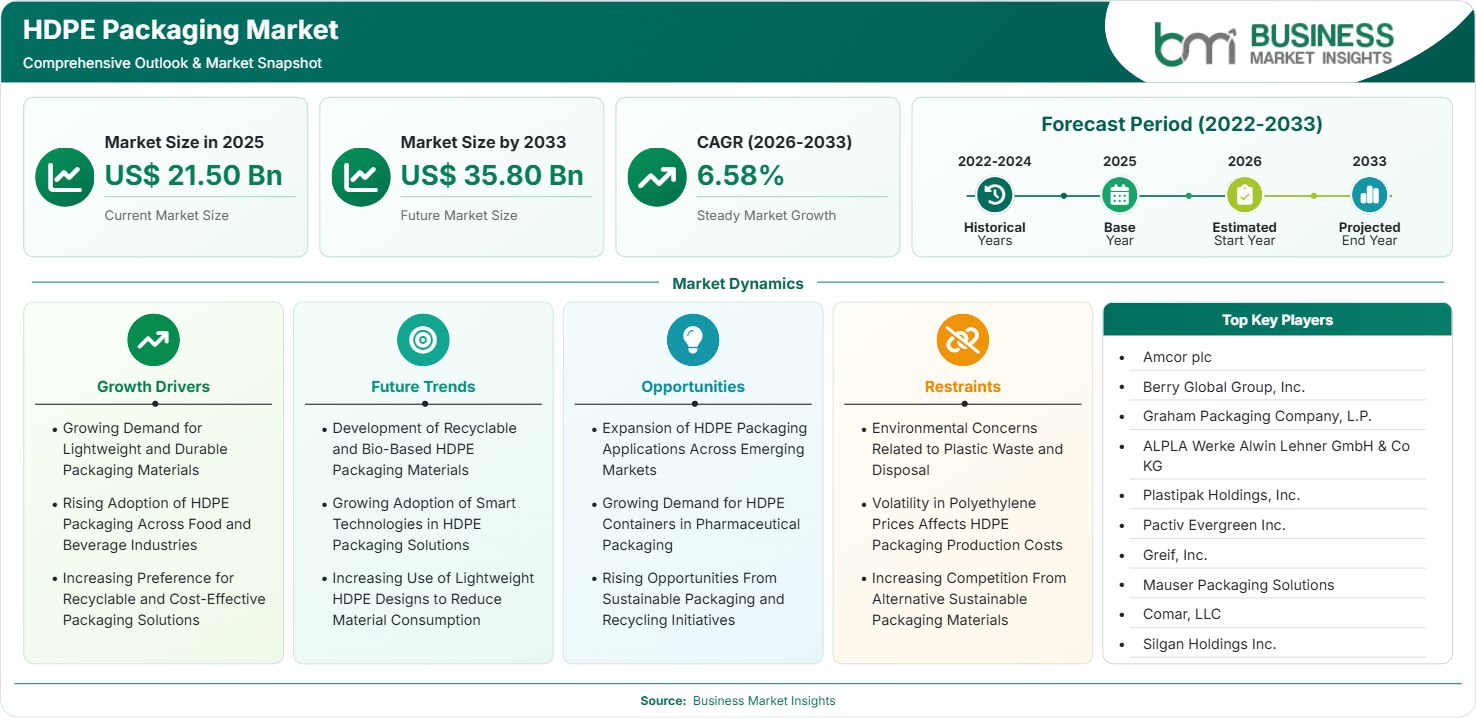
The HDPE Packaging Market size was valued at US$ 21.50 Billion in 2025 and is projected to reach US$ 35.80 Billion by 2033, growing at a CAGR of 6.58% during 2026–2033, supported by lightweight packaging demand, food and beverage consumption, pharmaceutical applications, recyclability initiatives, and emerging-market expansion.

Report Coverage
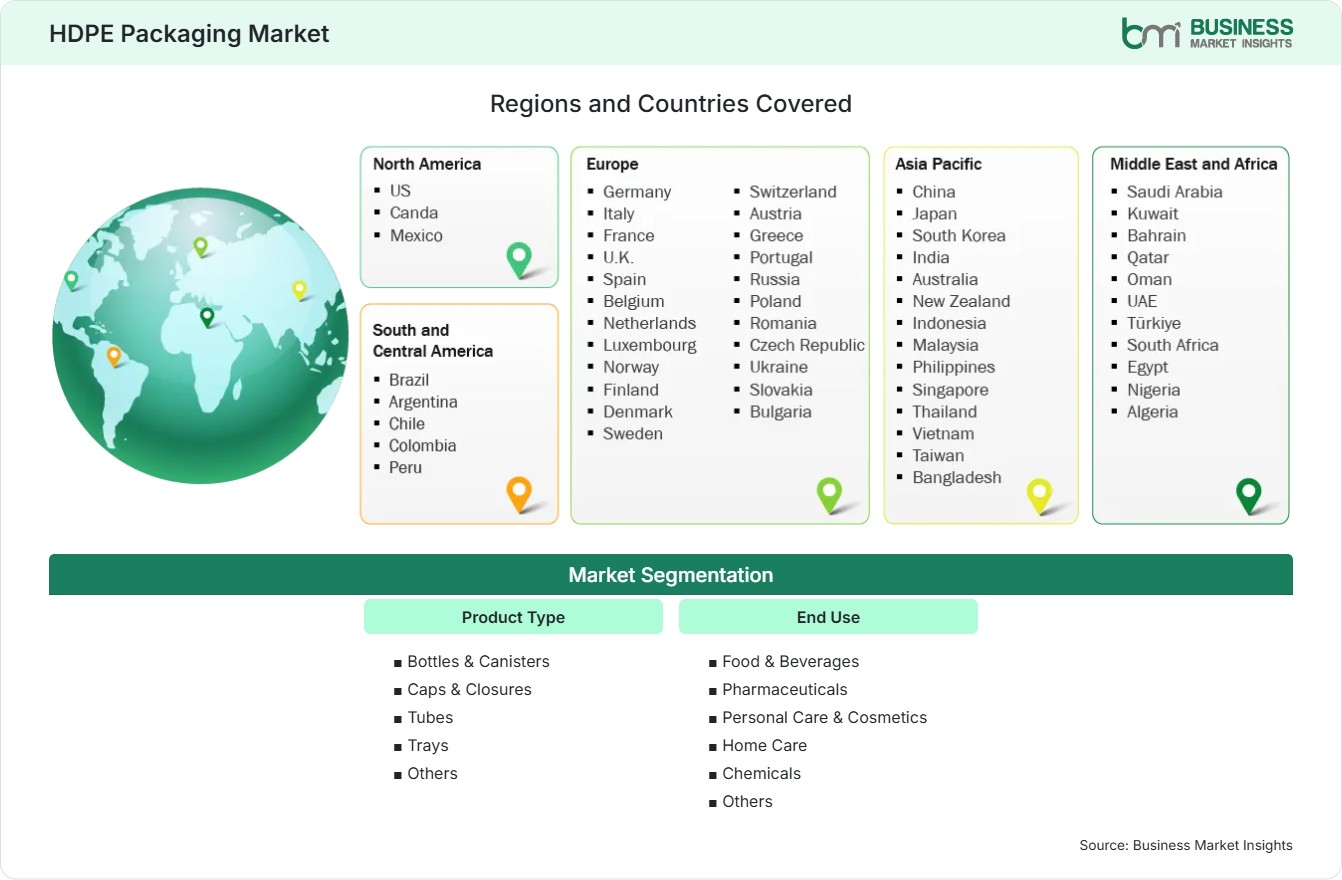
  • Product Type: Bottles & Canisters, Caps & Closures, Tubes, Trays, Others
  • End Use: Food & Beverages, Pharmaceuticals, Personal Care & Cosmetics, Home Care, Chemicals, Others
US$ 21.50 Bn Market size in 2025
US$ 35.80 Bn Market Size by 2033
6.58% CAGR, 2026 - 2033
2026-2033 Forecast Period

AI Overview

HDPE Packaging Market Summary

  • North America Region: North America held a 28%–32% HDPE packaging market share in 2025 and is projected to grow at a 5.8%–6.8% CAGR during 2026–2033, supported by food and beverage packaging demand, pharmaceutical consumption, established recycling infrastructure, lightweighting, and brand sustainability commitments. The US market is projected to grow at a 5.9%–6.9% CAGR through 2033, driven by packaged food demand, household products, healthcare packaging, e-commerce distribution, and increasing use of recycled resin.
  • Fastest Growing Region: Asia Pacific represented a 34%–38% share in 2025 and is projected to expand at a 7.5%–9.0% CAGR through 2033, driven by urbanization, packaged food consumption, pharmaceutical manufacturing, personal care demand, industrialization, rising disposable incomes, and investments in domestic packaging capacity.
  • Leading Segment: Product Type, Bottles & Canisters represented a 45%–49% share in 2025 and is projected to grow at a 6.3%–7.2% CAGR through 2033, supported by strong adoption across food, beverages, household products, chemicals, personal care, and healthcare packaging applications.
  • High Growth Segment: End Use, Pharmaceuticals represented a 12%–16% share in 2025 and is projected to grow at a 7.5%–9.0% CAGR through 2033, driven by expanding medicine consumption, healthcare access, secure packaging requirements, product protection, and demand for durable lightweight containers.
  • Key Market Opportunity: Recycled HDPE adoption, emerging-market manufacturing expansion, pharmaceutical packaging demand, and circular-economy investments are creating opportunities for converters offering lightweight, recyclable, compliant, and high-performance packaging formats.
  • Major Market Players: Amcor plc, Berry Global Group, Inc., Graham Packaging Company, L.P., ALPLA Werke Alwin Lehner GmbH & Co KG, Plastipak Holdings, Inc., Pactiv Evergreen Inc., Greif, Inc., Mauser Packaging Solutions, Comar, LLC, and Silgan Holdings Inc.
Strategic Insights

HDPE Packaging Market: Strategic Insights

HDPE Packaging Market Strategic Framework
FREE PDF
Request your free sample
Request free sample
Stakeholder View

Key Takeaways

  • The value chain spans polyethylene resin producers, compounders, packaging converters, molders, closure manufacturers, brand owners, retailers, recyclers, and waste-management operators, making material availability and recycling infrastructure strategically important.
  • Bottles and canisters remain the largest product opportunity because they serve high-volume applications across beverages, food, personal care, home care, and chemicals, while pharmaceutical packaging offers stronger incremental growth potential.
  • Packaging innovation is moving toward lightweighting, mono-material designs, recycled HDPE integration, improved barrier performance, tethered closures, and digitally optimized production processes that reduce material use without compromising functionality.
  • Asia Pacific presents the strongest regional expansion opportunity as packaged food consumption, pharmaceutical production, personal care demand, and domestic manufacturing capacity continue to increase across India, China, Southeast Asia, and other developing economies.
  • Industry consolidation and strategic partnerships are increasingly focused on achieving scale, strengthening recycled-material supply, improving recycling capabilities, and developing packaging solutions aligned with evolving circularity requirements.
  • Companies able to secure consistent recycled HDPE feedstock while meeting food-contact, pharmaceutical, performance, and regulatory requirements can strengthen customer relationships and capture higher-value sustainable packaging opportunities.
Geographic Outlook

HDPE Packaging Market Regional Highlights

North America HDPE Packaging Market

North America HDPE Packaging Market accounted for a 28%–32% share in 2025 and is projected to grow at a 5.8%–6.8% CAGR through 2033. The region benefits from mature packaging manufacturing, strong food and beverage consumption, pharmaceutical demand, and established recycling programs. The US dominates regional demand, supported by consumer-packaged goods, healthcare products, personal care, and household chemicals.

  • Food and beverage manufacturers continue shifting toward lightweight rigid containers that reduce material consumption while maintaining strength, stackability, transportation efficiency, and product protection throughout distribution.
  • Pharmaceutical packaging demand is supported by expanding medicine consumption and requirements for durable containers that protect products from moisture, chemicals, contamination, and physical damage.
  • Major packaging companies are investing in recycled-content solutions and circularity initiatives as brand owners seek to reduce virgin resin consumption and meet evolving sustainability objectives.

US HDPE Packaging Market

The US HDPE Packaging Market represented approximately 89%–93% of North American demand in 2025 and is projected to grow at a 5.9%–6.9% CAGR through 2033. Strong consumer packaged goods consumption, pharmaceutical distribution, household product sales, and personal care demand support market expansion. Packaging producers are also responding to brand-owner sustainability commitments through lightweighting, recycled resin integration, recyclable designs, and improved manufacturing efficiency across high-volume rigid packaging applications.

  • Food, beverage, and household product manufacturers remain major consumers of HDPE containers, particularly for applications requiring durability, chemical resistance, and convenient handling during distribution.
  • Pharmaceutical manufacturers increasingly require high-quality packaging that combines product protection, dimensional consistency, regulatory compliance, and compatibility with automated filling and labeling operations.
  • Recycled-content adoption is gaining momentum as packaging companies and consumer brands seek to reduce dependence on virgin resin while maintaining performance requirements.
  • Lightweighting initiatives are encouraging converters to redesign containers using optimized wall thicknesses and advanced molding techniques, reducing material consumption and transportation-related impacts.

Europe HDPE Packaging Market

Europe held a 24%–28% share in 2025 and Europe HDPE Packaging Market forecast to grow at a 5.5%–6.5% CAGR through 2033. Germany, France, the United Kingdom, Italy, and Spain represent leading markets, while Germany is projected to grow at a 5.8%–6.8% CAGR. Regulatory pressure surrounding recyclability and recycled content is accelerating packaging redesign. The EU PPWR is increasing demand for recyclable formats, recycled materials, and packaging solutions aligned with circular-economy objectives.

  • Germany represents a leading market due to its strong manufacturing base, food and beverage industry, chemical production, pharmaceutical activity, and advanced recycling ecosystem.
  • France and the United Kingdom are supported by consumer packaged goods, personal care, healthcare, and household product demand, encouraging packaging innovation and material efficiency.
  • Italy and Spain offer opportunities through food processing, beverage production, tourism-related consumption, pharmaceuticals, and growing emphasis on sustainable packaging solutions.
  • European packaging producers are increasing investment in recyclable designs and recycled content as regulations and eco-modulated producer responsibility mechanisms influence packaging economics.
  • Brand owners are increasingly collaborating with converters and recyclers to secure circular material streams and develop packaging formats compatible with existing collection and recycling infrastructure.

Asia Pacific HDPE Packaging Market

Asia Pacific HDPE Packaging Market represented a 34%–38% share in 2025 and is projected to achieve a 7.5%–9.0% CAGR through 2033, making it the fastest-growing region. China, India, Japan, South Korea, and Australia represent major markets, while India is projected to grow at a 8.5%–10.0% CAGR.

  • China remains a major production and consumption center, supported by extensive manufacturing capacity, food and beverage production, pharmaceuticals, household products, and consumer goods industries.
  • India offers strong growth potential as organized retail, packaged food consumption, healthcare access, pharmaceutical manufacturing, and personal care markets expand across urban and semi-urban areas.
  • Japan and South Korea benefit from advanced manufacturing capabilities and sophisticated consumer markets that favor high-quality, lightweight, functional, and increasingly sustainable packaging formats.
  • Southeast Asian economies are attracting packaging investment as consumer goods manufacturing, food processing, pharmaceuticals, and modern retail penetration increase across rapidly urbanizing markets.

Rest of World HDPE Packaging Market

South and Central America accounted for a 8%–10% share in 2025 and is projected to grow at a 6.0%–7.5% CAGR through 2033. Rising packaged-food penetration and urbanization are increasing demand for durable, affordable rigid packaging formats. The Middle East and Africa represented a 7%–9% share in 2025 and is projected to grow at a 6.5%–8.0% CAGR through 2033.

  • Brazil remains an important opportunity as food processing, beverage production, personal care, and household product consumption support demand for high-volume rigid packaging solutions.
  • Mexico benefits from manufacturing activity, food and beverage production, pharmaceuticals, and proximity to North American supply chains, encouraging investment in packaging conversion and production capabilities.
  • Saudi Arabia and the UAE are developing packaging opportunities through food manufacturing, healthcare investment, chemicals, and consumer goods diversification under broader industrial development strategies.
  • South Africa provides demand across food, beverages, pharmaceuticals, household products, and personal care, while recycling initiatives are influencing material selection and packaging design decisions.
Global Market Geography
FREE PDF
Request your free sample
Request free sample
Segment Analysis

HDPE Packaging Market Segmentation

Product Type

Bottles & Canisters represented a 45%–49% share in 2025 and are projected to grow at a 6.3%–7.2% CAGR during 2026–2033. Their broad use across food, beverages, pharmaceuticals, personal care, home care, and chemicals supports sustained demand.

  • Bottles & Canisters: Bottles and canisters serve high-volume food, beverage, healthcare, personal care, home care, and chemical applications, benefiting from durability, lightweighting, chemical resistance, and convenient handling.
  • Caps & Closures: Caps and closures support secure sealing, dispensing, tamper evidence, and product protection, with innovation increasingly focused on lightweighting, tethering, recyclability, and user convenience.
  • Tubes: HDPE tubes provide flexible dispensing and product protection for personal care, cosmetics, pharmaceutical, and household applications, supported by demand for convenient packaging formats and controlled product usage.
  • Trays: Trays support food, healthcare, industrial, and specialized applications requiring rigidity, stacking efficiency, product organization, and protection during storage and transportation.

End Use

Food & Beverages represented a 38%–42% share in 2025 and is projected to grow at a 6.0%–7.0% CAGR during 2026–2033. High consumption volumes and packaging replacement demand support leadership. Pharmaceuticals represent a faster-growing application due to expanding healthcare access, medicine consumption, and demand for protective, lightweight, and compliant packaging formats.

  • Food & Beverages: Food and beverage applications rely on HDPE for durable containers that provide moisture resistance, lightweight construction, product protection, convenient handling, and efficient transportation.
  • Pharmaceuticals: Pharmaceutical packaging uses HDPE containers for medicine protection, chemical resistance, dimensional stability, and compatibility with regulated filling, labeling, storage, and distribution processes.
  • Personal Care & Cosmetics: Personal care and cosmetics brands use HDPE packaging for shampoos, lotions, creams, and other products, with demand supported by convenience, durability, lightweighting, and attractive designs.
  • Home Care: Home care applications benefit from HDPE's chemical resistance and strength, supporting packaging for detergents, cleaners, disinfectants, and other household formulations requiring reliable containment.
  • Chemicals: Chemical packaging uses HDPE containers because of their resistance to many aggressive formulations, impact strength, and suitability for industrial handling, storage, and transportation requirements.
Market Forces

HDPE Packaging Market Dynamics

Key Market Drivers

Growing Demand for Lightweight and Durable Packaging Materials

There is increasing demand from brand owners and packaging converters for packaging materials that enable reducing packaging weight without compromising mechanical properties, such as strength, impact resistance, content protection, and logistics. HDPE is becoming a preferred material for the rigid packaging market owing to its good strength-to-weight ratio, which enables the design of optimal container shapes without compromising mechanical properties. This HDPE packaging market trend is supporting continued substitution toward efficient rigid packaging formats.

Rising Adoption of HDPE Packaging Across Food and Beverage Industries

The rise in consumption of packaged foods and beverages is driving demand for packaging solutions that offer good protection of the product along with handling and transportation efficiencies. HDPE packaging has been gaining benefits of wide adoption in applications such as milk, juices, sauces, foodstuffs, and other related categories where strength and water-resistance attributes are significant. Rise in modern retailing, convenience-based consumption, and food logistics is contributing to higher penetration levels of packaged goods in emerging countries. The combination of cost effectiveness and sustainability is giving HDPE an edge in certain rigid packaging applications.

Increasing Preference for Recyclable and Cost-Effective Packaging Solutions

There is increasing pressure on brand owners to minimize packaging waste while maintaining material and operational costs. The recycling capabilities of HDPE and its use in lightweight rigid packaging have helped make the material popular in sustainability-focused packaging initiatives. To respond to this trend, manufacturers are investing in recycled resins and sorting technology, and redesigning packaging. The development of this trend has created opportunities for converters to provide efficient packaging.

Key Market Opportunities

Expansion of HDPE Packaging Applications Across Emerging Markets

The emerging markets offer great potential as the levels of urbanization, modern retail, consumption of processed foods, access to medicines, and use of consumer goods rise. The increase in the level of local production has led to an investment in package production closer to where it is consumed, simplifying logistics. Collaborations with consumer goods companies and domestic producers would make access to the market even easier. Firms that set up manufacturing and resin logistics benefit from stable packaging demand.

Growing Demand for HDPE Containers in Pharmaceutical Packaging

Pharmaceutical packaging presents an attractive growth opportunity as consumption of healthcare expands in both emerging and advanced countries. The HDPE containers are used for many types of pharmaceutical solids and liquids because they provide strength, chemical resistance, a moisture barrier, and compatibility with automated filling. With the growing geographical presence of pharmaceutical companies in emerging countries, there will be a growing demand for high-quality primary and secondary packaging solutions.

Rising Opportunities from Sustainable Packaging and Recycling Initiatives

Circular-economy initiatives are creating opportunities for HDPE packaging manufacturers that can integrate recycled material while preserving safety, performance, and appearance. The EU PPWR is expected to increase demand for recycled-content solutions and recyclable-by-design packaging, encouraging investment in collection, sorting, recycling, and material processing infrastructure. Such developments demonstrate how recycling technology can create new material supply opportunities while addressing regulatory and brand-owner sustainability requirements.

Market Restraints and Challenges

Environmental Concerns Related to Plastic Waste and Disposal

Factor: Accumulation of plastic waste, poor collection systems, lack of recycling facilities, and worries about leakage into the environment continue to influence perceptions regarding conventional plastic packaging. Impact: Packaging companies are under increasing pressure to prove that their products are recyclable, use recycled materials, save on materials, and implement circular waste management practices. Such pressures may add to development expenses.

Volatility in Polyethylene Prices Affects HDPE Packaging Production Costs

Factor: HDPE packaging converters rely heavily on polyethylene resin, making their manufacturing processes sensitive to fluctuations in raw material and energy prices, the state of the petrochemical industry, and supply-and-demand dynamics. Impact: Instability in resin prices may narrow profit margins and complicate contract negotiations, leading to higher packaging costs for brand owners. The smaller converters have little chance of absorbing any unexpected price hikes or securing advantageous supply contracts.

Company Analysis

Competitive Landscape

The HDPE Packaging Market analysis involves competition among international packaging conglomerates, rigid container manufacturers, resin efficient converters, and integrated packaging suppliers. Competitive distinction is being increasingly determined by production scale, geographical spread, custom solutions, recycling abilities, light weighting know-how, and raw material availability.

Company Name

Overview

Products and Services relevant to this market

Amcor plc

Global packaging company serving food, beverage, healthcare, pharmaceutical, personal care, and consumer markets with broad packaging capabilities.

Rigid containers, bottles, closures, specialty packaging, lightweight formats, recyclable solutions, and recycled-content packaging technologies.

Berry Global Group, Inc.

Major global packaging manufacturer with extensive capabilities across consumer, healthcare, food, beverage, and industrial packaging applications.

Rigid packaging, bottles, containers, closures, engineered products, recycled-content solutions, and circular packaging technologies.

Graham Packaging Company, L.P.

Rigid packaging specialist focused on designing and manufacturing customized containers for consumer and industrial product applications.

HDPE bottles, containers, specialty packaging, blow-molded products, lightweight designs, and sustainable packaging solutions.

ALPLA Werke Alwin Lehner GmbH & Co KG

Global packaging and recycling specialist with extensive expertise in rigid plastic packaging and recycled material production.

HDPE bottles, containers, closures, packaging development, recycling services, and recycled HDPE solutions.

Plastipak Holdings, Inc.

Packaging manufacturer with global operations serving beverage, food, consumer, and industrial product markets.

Rigid containers, bottles, preforms, closures, recycled-content packaging, and advanced packaging manufacturing solutions.

Pactiv Evergreen Inc.

Packaging company serving foodservice, food and beverage, consumer, and commercial markets through broad packaging operations.

Containers, rigid packaging, food packaging, closures, trays, and specialized packaging solutions for consumer applications.

Greif, Inc.

Global industrial packaging company serving diverse end markets with containers and packaging solutions for demanding products.

Plastic containers, industrial packaging, rigid packaging solutions, and related services for chemicals and other applications.

Mauser Packaging Solutions

Global packaging provider specializing in industrial and consumer packaging with integrated manufacturing and recycling capabilities.

Plastic containers, drums, jerrycans, IBCs, reconditioning, recycling, and circular packaging solutions.

Comar, LLC

Packaging manufacturer specializing in rigid plastic containers and dispensing systems for healthcare and consumer applications.

Bottles, containers, closures, dispensing systems, pharmaceutical packaging, and custom rigid packaging solutions.

Silgan Holdings Inc.

Global packaging manufacturer serving food, beverage, personal care, household, and other consumer markets.

Plastic containers, closures, rigid packaging, dispensing solutions, and specialized packaging for consumer products.

Trust & Transparency

Research Methodology

The market analysis combines proprietary research with secondary data from government agencies, company disclosures, regulatory filings, industry databases and expert interviews. Market estimates are validated through data triangulation, cross-market benchmarking and analyst review.

View Full Research Methodology

Questions Answered

Frequently Asked Questions

How can manufacturers manage polyethylene price volatility?

Manufacturers can reduce exposure through resin sourcing diversification, lightweighting, long-term procurement agreements, recycled-material integration, production efficiency, and optimized container designs that lower material consumption.

What is driving recycled HDPE adoption?

Brand sustainability commitments and regulatory requirements are encouraging converters to use post-consumer recycled HDPE, improve collection systems, and develop packaging compatible with circular material streams.

Why is pharmaceutical packaging a growth opportunity in HDPE packaging market report?

Expanding healthcare access and medicine consumption are increasing demand for durable, protective, and compliant containers, while HDPE supports moisture resistance, chemical stability, and efficient high-volume manufacturing.

How is regulation changing HDPE packaging design?

Regulations are accelerating recyclable-by-design formats, recycled-content integration, lightweighting, and improved waste management, particularly in Europe under the Packaging and Packaging Waste Regulation.

Why is HDPE widely used for rigid packaging?

HDPE combines low weight with high impact strength, chemical resistance, moisture protection, and processability, making it suitable for bottles, canisters, containers, and industrial packaging across diverse end-use sectors.

Access the Full HDPE Packaging Market Report

Get segment-level forecasts, regional estimates, competitive benchmarking, company profiles and downloadable Excel datasets.

Access the full HDPE Packaging Market Report
350 pages PDF & Excel | 2026-08-06