
Seafood Packaging Market Outlook: Size, Share, Trends, Growth Analysis, Competitive Landscape & Forecast, 2026-2033

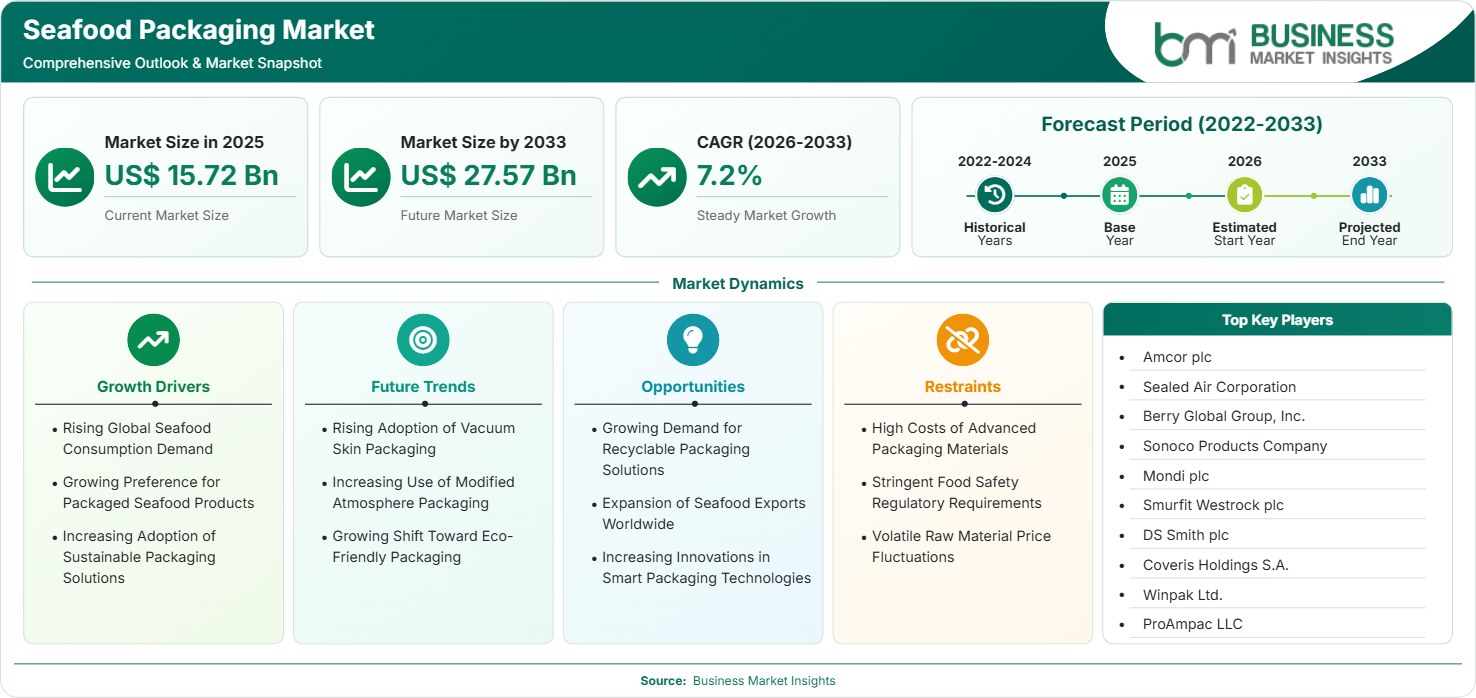
The Seafood Packaging Market size was valued at US$ 15.72 Billion in 2025 and is projected to reach US$ 27.57 Billion by 2033, growing at a CAGR of 7.2% during 2026–2033. The market is driven by rising global seafood consumption, growing preference for packaged seafood products, and increasing adoption of sustainable packaging solutions. Expanding seafood exports, growing demand for recyclable packaging materials, and continuous innovations in smart packaging technologies are expected to create significant opportunities throughout the forecast period.

Report Coverage
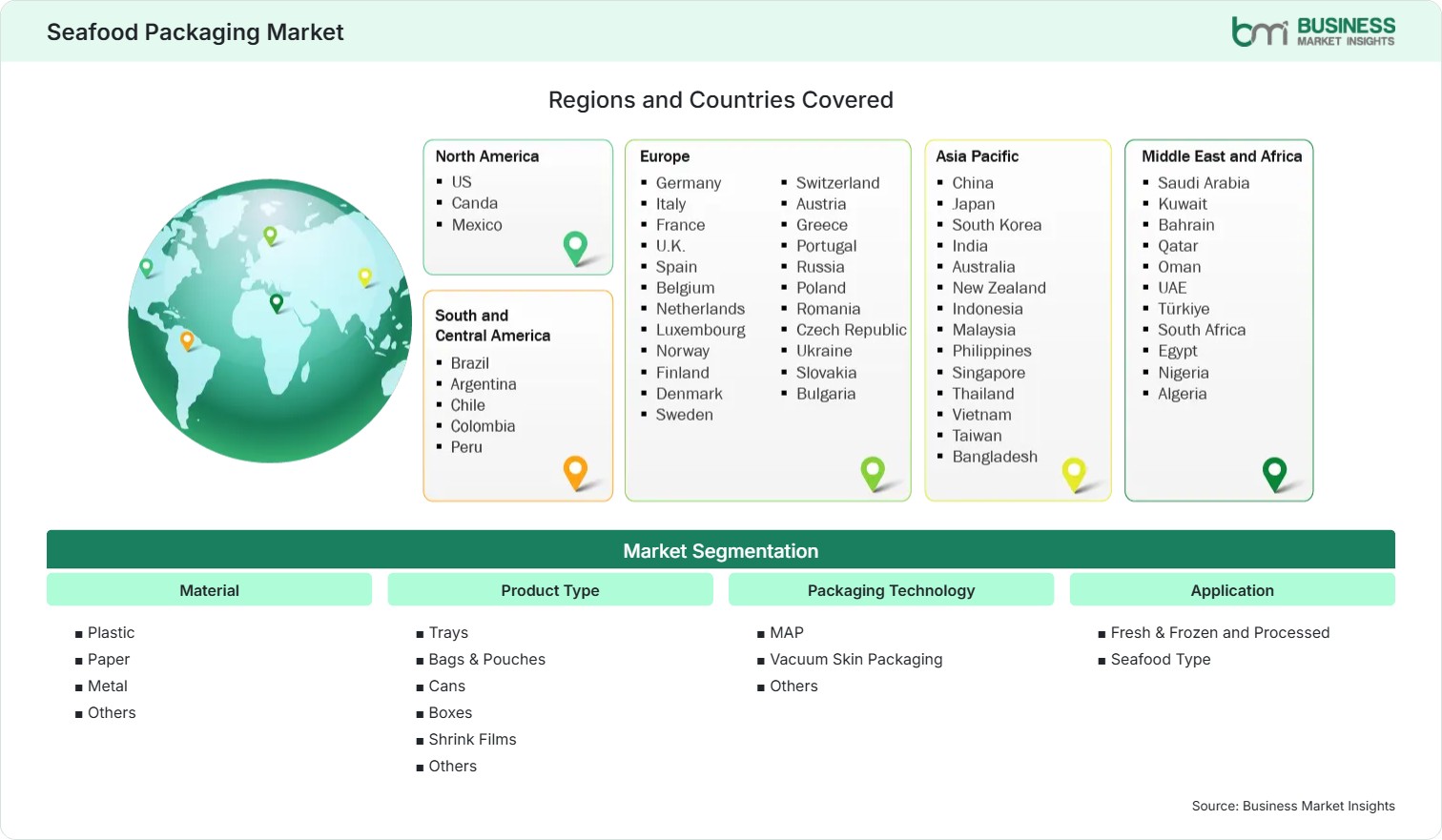
  • Material: Plastic, Paper, Metal, Others
  • Product Type: Trays, Bags & Pouches, Cans, Boxes, Shrink Films, Others
  • Packaging Technology: MAP, Vacuum Skin Packaging, Others
  • Application: Fresh & Frozen and Processed), Seafood Type (Fish, Molluscs, Crustaceans, Others
US$ 15.72 Bn Market size in 2025
US$ 27.57 Bn Market Size by 2033
7.2% CAGR, 2026 - 2033
2026-2033 Forecast Period

AI Overview

Seafood Packaging Market Summary

  • North America Region: North America accounted for 29%–32% of the global market in 2025 and is projected to register a CAGR of 6.8%–7.2% during 2026–2033. Rising demand for fresh and frozen seafood, stringent food safety regulations, and increasing adoption of modified atmosphere packaging (MAP) and vacuum skin packaging technologies continue supporting market expansion. The U.S. market is expected to grow at a CAGR of 6.9%–7.3%, driven by increasing seafood retail sales and growing preference for convenient packaged food products.
  • Fastest Growing Region: Asia Pacific held 34%–37% of the global market in 2025 and is projected to register the fastest CAGR of 7.8%–8.3% during 2026–2033. Growing seafood production, rising exports, expanding processed seafood industries, and increasing urbanization continue accelerating regional demand for advanced packaging solutions.
  • Leading Segment: Plastic accounted for 48%–51% of Seafood Packaging market revenue in 2025 and is projected to expand at a CAGR of 6.9%–7.3%, owing to its excellent barrier properties, lightweight nature, moisture resistance, and widespread use across seafood packaging applications.
  • High Growth Segment: Modified Atmosphere Packaging (MAP) accounted for 32%–35% of the market in 2025 and is expected to register the fastest CAGR of 8.1%–8.6%, driven by its ability to extend shelf life, preserve freshness, and reduce food waste during transportation and storage.
  • Key Market Opportunity: Growing investments in recyclable and biodegradable packaging materials, expansion of global seafood trade, and increasing integration of smart packaging technologies continue creating substantial growth opportunities for manufacturers.
  • Major Market Players: Amcor plc, Sealed Air Corporation, Berry Global Group, Inc., Sonoco Products Company, Mondi plc, Smurfit Westrock plc, DS Smith plc, Coveris Holdings S.A., Winpak Ltd., and ProAmpac LLC.
Strategic Insights

Seafood Packaging Market: Strategic Insights

Seafood Packaging Market Strategic Framework
FREE PDF
Request your free sample
Request free sample
Stakeholder View

Key Takeaways

  • Plastic remains the dominant packaging material due to its superior barrier performance, cost-effectiveness, and versatility.
  • Modified Atmosphere Packaging (MAP) is projected to witness the fastest growth owing to increasing demand for extended shelf life and food preservation.
  • Asia Pacific remains the largest and fastest-growing regional market supported by expanding seafood production, exports, and processing industries.
  • Sustainable and recyclable packaging solutions are becoming key competitive differentiators among packaging manufacturers.
  • Smart packaging technologies incorporating freshness monitoring, traceability, and intelligent labelling are expected to drive future product innovation.
Geographic Outlook

Seafood Packaging Market Regional Highlights

North America Seafood Packaging Market

North America accounted for 29%–32% of the global market in 2025 and is projected to expand at a CAGR of 6.8%–7.2% during 2026–2033. Strong seafood consumption, well-established cold chain infrastructure, and stringent food safety regulations continue driving regional market growth. The Seafood Packaging Market share remains significant due to increasing demand for fresh and frozen seafood, widespread adoption of advanced packaging technologies, and growing investments in sustainable packaging materials.

  • The United States remains the largest regional market owing to increasing retail seafood sales and strong demand for convenient packaged seafood products.
  • Food processors continue adopting modified atmosphere packaging (MAP) and vacuum skin packaging technologies to improve product shelf life.
  • Retailers increasingly prefer recyclable and lightweight packaging solutions to meet sustainability goals.
  • Continuous investments in cold chain logistics strengthen seafood distribution across the region.
  • Technological advancements in barrier films and intelligent packaging continue supporting market growth.

US Seafood Packaging Market

The United States represented 24%–27% of the global market in 2025 and is anticipated to grow at a CAGR of 6.9%–7.3% through 2026–2033. Rising seafood consumption, expanding supermarket distribution, and increasing consumer demand for ready-to-cook seafood continue driving Seafood Packaging Market growth.

  • Seafood processors continue investing in sustainable flexible packaging solutions.
  • Growth of online grocery and seafood delivery services is increasing demand for durable packaging.
  • Advanced packaging technologies continue reducing food waste while extending product freshness.
  • Increasing regulatory emphasis on food safety supports continuous packaging innovation.

Europe Seafood Packaging Market

Europe held 26%–29% of global revenue in 2025 and is expected to register a CAGR of 7.0%–7.4% during 2026–2033. Strong seafood processing industries, strict environmental regulations, and growing adoption of recyclable packaging continue driving regional growth. Germany remains the leading regional Seafood Packaging market, while Poland is projected to register the fastest growth.

  • Germany dominates regional demand owing to its advanced food processing sector and sustainable packaging initiatives.
  • Poland is projected to register a CAGR of 7.8%–8.2%, supported by expanding seafood processing capacity and export activities.
  • France, Spain, and Italy continue witnessing increasing demand for premium packaged seafood products.
  • Packaging manufacturers continue developing recyclable mono-material solutions to comply with EU sustainability regulations.
  • Investments in intelligent packaging and digital traceability continue supporting product innovation.

Asia Pacific Seafood Packaging Market

Asia Pacific accounted for 34%–37% of global Seafood Packaging market revenue in 2025 and is projected to register the fastest CAGR of 7.8%–8.3% during 2026–2033. Expanding seafood production, rising exports, increasing urbanization, and growing demand for processed seafood continue accelerating regional market growth. China remains the largest market, while India is projected to witness the fastest growth.

  • China dominates regional demand through its large seafood processing industry and export-oriented production.
  • India is projected to register a CAGR of 8.3%–8.8%, supported by growing seafood exports, expanding cold chain infrastructure, and increasing packaged food consumption.
  • Japan continues investing in premium seafood packaging technologies focused on freshness preservation.
  • Southeast Asian countries continue strengthening seafood export industries through advanced packaging solutions.
  • Growing adoption of sustainable materials continues supporting long-term regional growth.

Rest of World Seafood Packaging Market

The Rest of the World accounted for 8%–10% of global market revenue in 2025 and is expected to expand at a CAGR of 6.5%–6.9% during 2026–2033. Market growth is supported by expanding seafood exports, improving food processing infrastructure, and increasing adoption of modern packaging technologies across Latin America, the Middle East, and Africa.

Growing investments in seafood processing facilities, export-oriented packaging operations, and cold chain logistics continue creating new opportunities for seafood packaging manufacturers across emerging markets.

  • Brazil continues expanding seafood exports supported by investments in modern processing and packaging facilities.
  • Chile remains a major seafood exporting nation driving demand for high-performance packaging materials.
  • Saudi Arabia is increasing investments in food processing and cold storage infrastructure.
  • South Africa continues to witness steady growth in packaged seafood consumption.
  • Expansion of international seafood trade continues supporting demand for advanced protective packaging solutions.
Global Market Geography
FREE PDF
Request your free sample
Request free sample
Segment Analysis

Seafood Packaging Market Segmentation

Material

The Plastic segment accounted for 48%–51% of the global market in 2025 and is projected to expand at a CAGR of 6.9%–7.3% during 2026–2033. Plastic continues to dominate the market due to its excellent moisture barrier properties, lightweight nature, durability, flexibility, and ability to preserve seafood freshness throughout storage and transportation. The Market scope continues expanding as manufacturers increasingly develop recyclable and mono-material plastic packaging solutions that meet sustainability goals without compromising product protection.

  • Plastic: Dominates the market owing to its superior barrier performance, cost efficiency, lightweight properties, and compatibility with fresh, frozen, and processed seafood packaging.
  • Paper: Paper-based packaging continues to witness increasing adoption due to growing demand for sustainable, biodegradable, and recyclable packaging alternatives in retail seafood applications.
  • Metal: Metal packaging remains widely used for canned seafood products because of its long shelf life, excellent product protection, and resistance to contamination.
  • Others: Glass, biodegradable polymers, molded fiber, and composite packaging materials continue gaining attention for premium and environmentally friendly seafood packaging applications.

Product Type

The Trays segment accounted for 31%–34% of market revenue in 2025 and is projected to register a CAGR of 7.3%–7.7% during 2026–2033. Trays remain widely adopted due to their compatibility with modified atmosphere packaging (MAP), attractive product presentation, ease of handling, and suitability for fresh seafood retail displays.

  • Trays: Lead the market owing to widespread use in supermarkets, seafood retail outlets, and fresh seafood packaging operations.
  • Bags & Pouches: Flexible packaging formats continue experiencing rapid adoption because of reduced material consumption, lower transportation costs, and improved convenience.
  • Cans: Continue to maintain strong demand for processed seafood products requiring long-term preservation and extended shelf life.
  • Boxes: Widely used for bulk seafood transportation, export logistics, and cold chain distribution.
  • Shrink Films: Increasingly utilized to improve product protection, hygiene, and packaging integrity during transportation and storage.
  • Others: Thermoformed containers, clamshells, and specialty packaging solutions continue supporting niche seafood applications.

Packaging Technology

The Modified Atmosphere Packaging (MAP) segment accounted for 32%–35% of market revenue in 2025 and is projected to register the fastest CAGR of 8.1%–8.6% during 2026–2033. MAP significantly extends seafood shelf life by modifying gas composition within packaging, reducing microbial growth, and maintaining freshness during transportation.

  • Modified Atmosphere Packaging (MAP): Leads technology adoption due to superior freshness preservation, reduced spoilage, and enhanced product quality.
  • Vacuum Skin Packaging: Continues gaining popularity by minimizing oxygen exposure, improving product appearance, reducing leakage, and extending refrigerated shelf life.
  • Others: Active packaging, intelligent packaging, antimicrobial packaging, and vacuum packaging continue supporting advanced seafood preservation applications.

Application

The Fresh & Frozen segment accounted for 67%–70% of global market revenue in 2025 and is projected to expand at a CAGR of 7.4%–7.8% during 2026–2033. Growing consumer preference for fresh seafood, expanding frozen food retail, and increasing international seafood trade continue driving segment growth.

  • Fresh & Frozen: Dominates the market due to increasing demand for premium fresh seafood and efficient cold chain logistics.
  • Processed: Processed seafood packaging continues witnessing steady growth driven by increasing consumption of canned, smoked, ready-to-cook, and value-added seafood products.

Seafood Type

The Fish segment accounted for 56%–59% of global market revenue in 2025 and is projected to register a CAGR of 7.3%–7.7% during 2026–2033. Fish remains the largest seafood category due to high global consumption, expanding aquaculture production, and increasing demand for packaged fresh and frozen fish products.

  • Fish: Leads the market owing to widespread consumption, large-scale aquaculture production, and extensive retail distribution.
  • Molluscs: Continue witnessing increasing packaging demand due to growing consumption of oysters, mussels, scallops, and squid products.
  • Crustaceans: Shrimp, crab, and lobster packaging continues expanding with rising premium seafood exports and retail demand.
  • Others: Specialty seafood products including seaweed, cephalopods, and mixed seafood continue contributing to market diversification.
Market Forces

Seafood Packaging Market Dynamics

Key Market Drivers

Rising Global Seafood Consumption Demand

Growing consumer preference for protein-rich diets, increasing seafood consumption, and expanding aquaculture production continue driving demand for advanced seafood packaging solutions. Rising international seafood trade and expanding retail distribution networks further increase the need for packaging technologies capable of maintaining product freshness and food safety. These factors continue supporting market growth, while evolving Seafood Packaging Market trends indicate increasing investments in high-barrier materials, sustainable packaging, and intelligent freshness-monitoring technologies.

Growing Preference for Packaged Seafood Products

Consumers increasingly prefer hygienically packed, convenient, ready-to-cook, and portion-controlled seafood products. Modern retail formats, online grocery platforms, and food delivery services continue driving demand for packaging solutions that improve shelf appeal, product protection, and transportation efficiency while reducing food waste.

Increasing Adoption of Sustainable Packaging Solutions

The growing emphasis on environmental sustainability, along with the increasing number of sustainability laws, is pushing seafood processors and packaging producers to adopt eco-friendly packaging options that are recyclable, compostable, biodegradable, and mono-material. Innovative, eco-friendly packaging materials are constantly being developed to promote the circular economy.

Key Market Opportunities

Growing Demand for Recyclable Packaging Solutions

Increasingly stringent environmental laws and consumer preferences for sustainable goods present significant opportunities in the field of recyclable packaging for seafood. Packaging companies are developing mono-material plastics, fiber-based packaging, recyclable barrier films, and bio-materials that are environmentally friendly while offering product protection and shelf-life preservation. The Seafood Packaging Market forecasts encourage innovation in circular packaging that adheres to international sustainability programs and extended producer responsibility (EPR) regulations.

Expansion of Seafood Exports Worldwide

The growing global trade in seafood creates a strong need for advanced packaging that preserves freshness during long-distance transport. Growing production from aquaculture development, expanding logistics through cold-chain facilities, and increasing exports of fresh and processed fish present opportunities to advance packaging, vacuum skin packaging, and intelligent tracking systems.

Increasing Innovations in Smart Packaging Technologies

The rapid development of smart packaging technology enables seafood producers to ensure the safety, traceability, and quality management of their products. The use of freshness indicators, time/temperature indicators, RFID tagging, QR code traceability systems, antimicrobial packaging, and authentication tools has become common practice in the seafood industry. These developments help to decrease food waste, comply with regulations, and build consumer trust in packaged seafood.

Market Restraints and Challenges

High Costs of Advanced Packaging Materials

Factor: Advanced seafood packaging technologies, including high-barrier films, recyclable multilayer materials, smart packaging components, and modified atmosphere packaging systems, involve higher manufacturing and implementation costs compared to conventional packaging solutions. Impact: Elevated packaging costs can reduce profit margins for seafood processors and limit adoption among small and medium-sized enterprises, particularly in price-sensitive markets. Manufacturers continue focusing on cost optimization, lightweight packaging, and scalable production technologies to improve affordability.

Stringent Food Safety Regulatory Requirements

Factor: Seafood packaging manufacturers must comply with rigorous food safety, hygiene, labelling, migration, traceability, and environmental regulations across multiple international markets. Compliance with evolving standards requires continuous investments in quality assurance, certification, testing, and sustainable material development. Impact: Regulatory complexity increases operational costs and product development timelines but also drives continuous innovation in food-safe, compliant, and environmentally responsible packaging solutions, strengthening long-term market competitiveness.

Company Analysis

Competitive Landscape

The competitive landscape is characterized by strong investments in sustainable packaging materials, high-barrier films, flexible packaging, modified atmosphere packaging (MAP), and smart packaging solutions. In the Seafood Packaging Market analysis, major players are increasing production capacity, offering circular packaging solutions, and working with seafood processors to improve food safety and shelf life, among other benefits.

Company Name

Overview

Products and Services Relevant to this Market

Amcor plc

Global leader in flexible and rigid packaging solutions for food and beverage industries.

High-barrier flexible packaging, recyclable packaging, MAP solutions, seafood pouches, trays, and shrink films.

Sealed Air Corporation

Global packaging company specializing in food preservation and protective packaging.

Cryovac® vacuum packaging, vacuum skin packaging, MAP systems, barrier films, and seafood packaging solutions.

Berry Global Group, Inc.

Manufacturer of innovative plastic packaging and engineered materials.

Flexible packaging, rigid containers, thermoformed trays, recyclable films, and food packaging solutions.

Sonoco Products Company

Global supplier of consumer and industrial packaging products.

Paperboard packaging, rigid containers, cans, flexible packaging, and seafood transport packaging.

Mondi plc

International packaging and paper company focused on sustainable packaging innovations.

Paper-based packaging, flexible packaging, recyclable barrier materials, and food packaging solutions.

Smurfit Westrock plc

Global provider of paper-based packaging and corrugated packaging solutions.

Corrugated seafood boxes, paper packaging, transport packaging, and sustainable packaging solutions.

DS Smith plc

International packaging company specializing in fiber-based packaging.

Corrugated packaging, recyclable transport packaging, retail-ready packaging, and seafood logistics solutions.

Coveris Holdings S.A.

Manufacturer of flexible packaging for food, medical, and industrial applications.

Barrier films, vacuum packaging, recyclable flexible packaging, and seafood preservation solutions.

Winpak Ltd.

Global manufacturer of advanced packaging materials for food applications.

Vacuum packaging films, MAP packaging, lidding films, thermoforming materials, and seafood packaging.

ProAmpac LLC

Flexible packaging manufacturer serving food and consumer markets.

Recyclable pouches, barrier films, flexible seafood packaging, shrink packaging, and sustainable packaging solutions.

Industry Activity

Recent Developments

April 2026

Sealed Air Corporation completed its acquisition by Clayton, Dubilier & Rice (CD&R), strengthening its long-term investment strategy in food packaging innovation, automation, and sustainable packaging solutions across protein and seafood applications.

January 2026

Sealed Air Corporation celebrated its 85th anniversary, highlighting decades of innovation in food packaging technologies, including vacuum skin packaging and modified atmosphere packaging widely used for fresh seafood, meat, and poultry.

November 2024

Amcor plc announced an agreement to acquire Berry Global, creating one of the world's largest consumer and food packaging companies and strengthening its flexible and rigid packaging portfolio serving seafood and other food markets.

June 2024

Sealed Air Corporation announced new executive leadership appointments, reinforcing its strategy to accelerate innovation in sustainable food packaging technologies and automation for global food markets.

Trust & Transparency

Research Methodology

The market analysis combines proprietary research with secondary data from government agencies, company disclosures, regulatory filings, industry databases and expert interviews. Market estimates are validated through data triangulation, cross-market benchmarking and analyst review.

View Full Research Methodology

Questions Answered

Frequently Asked Questions

Why is the Seafood Packaging Market Report valuable for stakeholders?

The Market Report provides comprehensive insights into market size, emerging packaging technologies, sustainability trends, regional opportunities, competitive strategies, and future growth prospects, helping stakeholders make informed business and investment decisions.

Which packaging technology is expected to witness the fastest growth?

Modified Atmosphere Packaging (MAP) is expected to witness the fastest growth because it significantly extends seafood shelf life, preserves freshness, and minimizes product spoilage.

Which material segment holds the largest market share?

Plastic holds the largest market share owing to its excellent barrier properties, lightweight design, durability, moisture resistance, and cost-effectiveness.

Which region dominates the Market?

Asia Pacific dominates the market due to its large seafood production base, expanding aquaculture industry, increasing seafood exports, and growing demand for advanced packaging solutions.

What is driving the Seafood Packaging Market?

The market is driven by rising global seafood consumption, growing demand for packaged seafood products, increasing adoption of sustainable packaging solutions, and expanding international seafood trade.

Access the Full Seafood Packaging Market Report

Get segment-level forecasts, regional estimates, competitive benchmarking, company profiles and downloadable Excel datasets.

Access the full Seafood Packaging Market Report
350 pages PDF & Excel | 2026-08-03
Similar Research

Related Market Reports