
Internet Of Packaging Market Outlook: Size, Share, Trends, Growth Analysis, Competitive Landscape & Forecast, 2026-2033

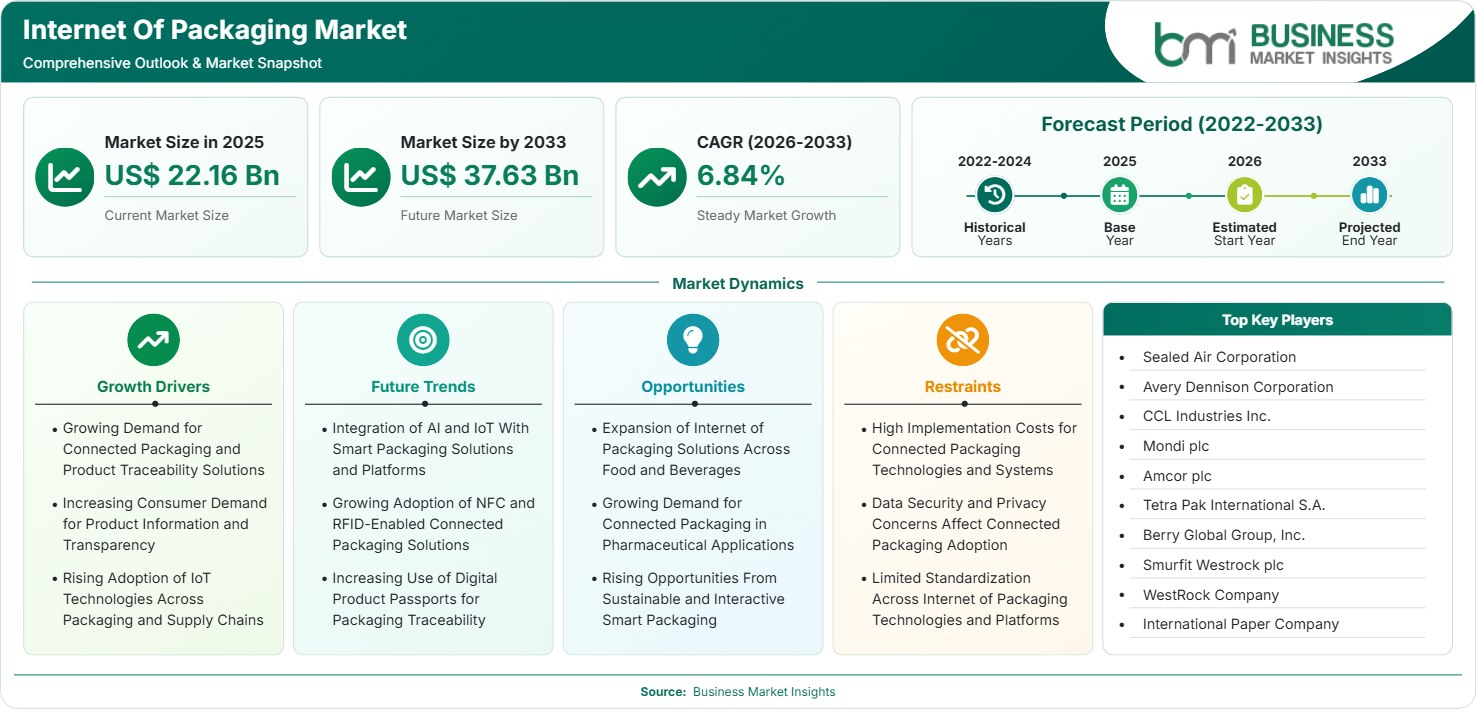
The Internet of Packaging Market size was valued at US$ 22.16 billion in 2025 and is projected to reach US$ 37.63 billion by 2033, growing at a CAGR of 6.84% during 2026–2033, driven by connected packaging, product traceability, consumer transparency, IoT integration, smart logistics, pharmaceutical authentication, and interactive brand experiences.

Report Coverage
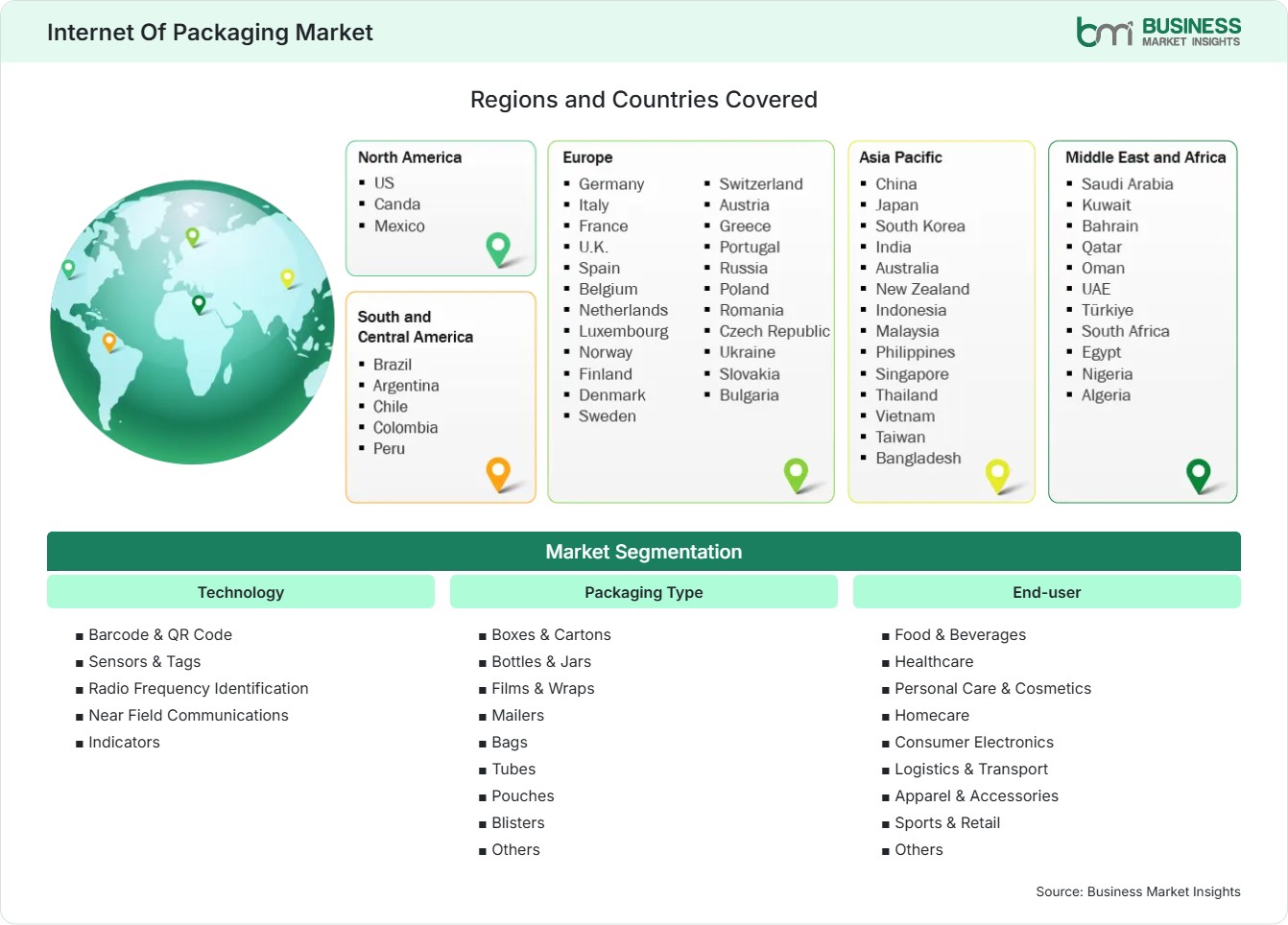
  • Technology: Barcode & QR Code, Sensors & Tags, Radio Frequency Identification, Near Field Communications, Indicators
  • Packaging Type: Boxes & Cartons, Bottles & Jars, Films & Wraps, Mailers, Bags, Tubes, Pouches, Blisters, Others
  • End-user: Food & Beverages, Healthcare, Personal Care & Cosmetics, Homecare, Consumer Electronics, Logistics & Transport, Apparel & Accessories, Sports & Retail, Others
US$ 22.16 Bn Market size in 2025
US$ 37.63 Bn Market Size by 2033
6.84% CAGR, 2026 - 2033
2026-2033 Forecast Period

01 AI Overview

Internet Of Packaging Market Summary

  • North America Region: North America held a 30%–34% share in 2025, growing at a CAGR of 6.2%–7.2%, supported by advanced retail infrastructure, stringent product traceability requirements, connected supply chains, and high adoption of QR codes, RFID, and sensor-enabled packaging. The US market is expanding at a CAGR of 6.4%–7.4%, driven by pharmaceutical authentication, food traceability, e-commerce logistics, and consumer engagement initiatives.
  • Fastest Growing Region: Asia Pacific held a 28%–32% share in 2025, growing at a CAGR of 7.8%–8.8%, driven by expanding e-commerce, food and beverage production, pharmaceutical manufacturing, digital retail, and growing investments in intelligent supply-chain infrastructure across China, India, Japan, and Southeast Asia.
  • Leading Segment: Barcode & QR Code held a 36%–40% share in 2025, growing at a CAGR of 6.5%–7.5%, supported by low deployment costs, smartphone compatibility, product authentication, digital content delivery, and broad adoption across food, retail, healthcare, and consumer goods.
  • High Growth Segment: Sensors & Tags held a 12%–16% share in 2025, growing at a CAGR of 8.5%–9.5%, driven by temperature monitoring, freshness tracking, condition visibility, supply-chain intelligence, and increasing demand for real-time product information.
  • Key Market Opportunity: Food, pharmaceuticals, and logistics offer strong opportunities as connected packaging combines traceability, authentication, sustainability information, consumer engagement, and supply-chain visibility within increasingly digital product ecosystems.
  • Major Market Players: Sealed Air Corporation, Avery Dennison Corporation, CCL Industries Inc., Mondi plc, Amcor plc, Tetra Pak International S.A., Berry Global Group, Inc., Smurfit Westrock plc, WestRock Company, and International Paper Company.
02 Strategic Insights

Internet Of Packaging Market: Strategic Insights

Internet Of Packaging Market Strategic Framework
FREE PDF
Request your free sample
Request free sample
03 Stakeholder View

Key Takeaways

  • The ecosystem is shifting toward integrated value chains connecting packaging converters, label manufacturers, technology providers, IoT platforms, retailers, logistics operators, and brand owners.
  • Food and beverages represent a particularly attractive application area because connected packaging can combine traceability, freshness information, authenticity verification, recycling guidance, and direct consumer engagement.
  • QR codes provide the broadest adoption pathway, while RFID, NFC, sensors, and indicators create higher-value opportunities where automated identification, condition monitoring, or product-level intelligence is required.
  • Asia Pacific offers a compelling expansion case as digital commerce, pharmaceutical manufacturing, modern retail, and sophisticated logistics networks accelerate adoption of connected packaging technologies.
  • Strategic partnerships between packaging companies and technology providers are becoming increasingly important as customers seek integrated solutions rather than standalone codes, tags, sensors, or software platforms.
  • Long-term competitiveness will depend on balancing connectivity with packaging cost, recyclability, data governance, interoperability, and ease of implementation across high-volume production environments.
04 Geographic Outlook

Internet Of Packaging Market Regional Highlights

North America Internet of Packaging Market

North America accounted for a 30%–34% share in 2025 and is projected to grow at a CAGR of 6.2%–7.2% through 2033. The region benefits from mature retail networks, and strong brand investment in consumer engagement. Internet of Packaging Market share is supported by widespread QR code adoption and increasing use of RFID and connected technologies for authentication, traceability, and inventory visibility.

  • Brands are using digitally enabled packaging to provide product information, authenticity verification, promotional content, and post-purchase engagement through smartphone-accessible interfaces.
  • Drug manufacturers and distributors are increasingly prioritizing serialization and authentication technologies to strengthen supply-chain visibility and reduce counterfeit risks.
  • Consumers increasingly seek information about ingredients, sourcing, sustainability, and product provenance, encouraging brands to connect physical packaging with digital information platforms.
  • Growing online purchasing is increasing demand for packaging technologies that support inventory identification, fulfilment visibility, product authentication, and post-delivery consumer engagement.

US Internet of Packaging Market

The US represented a 26%–30% share in 2025 and is expected to expand at a CAGR of 6.4%–7.4% through 2033. Internet of Packaging Market growth is supported by advanced consumer goods markets, pharmaceutical distribution, e-commerce, and sophisticated logistics systems. Major brands are increasingly using QR codes, RFID, and digital identifiers to strengthen product transparency, improve authentication, and create direct digital connections with consumers.

  • Serialization, authentication, and track-and-trace requirements are supporting connected packaging applications throughout pharmaceutical manufacturing and distribution networks.
  • Consumer brands are using QR-enabled experiences to deliver recipes, loyalty programs, product information, sustainability content, and promotional campaigns directly through packaging.
  • RFID and digital identification technologies are improving inventory accuracy and supporting more efficient product movement across retail and distribution operations.
  • Digital packaging interfaces allow brands to provide recycling instructions, sourcing information, and environmental disclosures without substantially increasing physical packaging complexity.

Europe Internet of Packaging Market

Europe Internet of Packaging market held a 22%–26% share in 2025 and is forecast to grow at a CAGR of 6.0%–7.0% through 2033. Germany and the UK remain important markets due to advanced manufacturing and retail ecosystems. Germany is projected to grow at a CAGR of 6.2%–7.2%, while the UK is expected to expand at 6.5%–7.5%. Sustainability, traceability, and digital product information are supporting regional adoption.

  • Germany's packaging and manufacturing base supports connected identification, RFID, QR codes, and digital supply-chain applications across food, industrial, and consumer product sectors.
  • The UK offers opportunities through advanced e-commerce, pharmaceutical distribution, retail digitization, and consumer interest in transparent product and sustainability information.
  • France is witnessing increasing interest in digitally connected packaging as brands seek improved traceability, authentication, consumer engagement, and sustainability communication.
  • European sustainability priorities are encouraging packaging companies to explore digital tools that communicate recycling guidance, product provenance, and environmental information more effectively.

Asia Pacific Internet of Packaging Market

Asia Pacific Internet of Packaging market represented a 28%–32% share in 2025 and is projected to grow at a CAGR of 7.8%–8.8% through 2033. China remains the leading regional market, while India represents a high-growth opportunity. China is projected to grow at a CAGR of 7.5%–8.5%, whereas India is expected to expand at 9.0%–10.0%. E-commerce, food processing, pharmaceuticals, and digital retail are key adoption catalysts.

  • China's extensive manufacturing and e-commerce ecosystem supports connected packaging across consumer goods, food, beverages, logistics, and pharmaceutical supply chains.
  • India's expanding organized retail and digital commerce sectors are creating opportunities for QR-enabled authentication, product information, traceability, and direct-to-consumer engagement.
  • Japan's advanced packaging and technology ecosystem supports adoption of RFID, NFC, sensors, and intelligent indicators across food, healthcare, electronics, and logistics.
  • Southeast Asian markets are gaining opportunities as modern retail, pharmaceutical distribution, and cross-border e-commerce increase the need for better product identification and supply-chain visibility.

Rest of World Internet of Packaging Market

South and Central America Internet of Packaging market accounted for a 7%–9% share in 2025 and are projected to grow at a CAGR of 6.5%–7.5% through 2033, led by Brazil and Mexico. Middle East and Africa represented a 5%–7% share and are expected to grow at a CAGR of 6.0%–7.0%, supported by modern retail and logistics development.

  • Brazil's food, beverage, pharmaceutical, and consumer goods sectors provide opportunities for connected packaging as brands seek stronger authentication and product traceability.
  • Mexico's integration with North American manufacturing and logistics networks supports adoption of digital identification technologies across packaged food, consumer products, and export-oriented industries.
  • Gulf markets are investing in sophisticated retail and logistics infrastructure, creating opportunities for smart packaging that supports authentication, product information, and consumer engagement.
  • South Africa offers opportunities for connected packaging as retailers and consumer brands increasingly explore digital product information, traceability, and supply-chain visibility solutions.
Global Market Geography
FREE PDF
Request your free sample
Request free sample
05 Segment Analysis

Internet Of Packaging Market Segmentation

Technology

Barcode & QR Code held a 36%–40% share in 2025 and is projected to grow at a CAGR of 6.5%–7.5% during 2026–2034. Low implementation costs and smartphone accessibility support broad adoption across consumer products and retail. Internet of Packaging Market scope continues expanding through connected product ecosystems.

  • Barcode & QR Code: Low-cost digital identifiers enable product information, authentication, promotional engagement, traceability, and direct smartphone access across mass-market packaging applications.
  • Sensors & Tags: Temperature, humidity, freshness, and condition monitoring technologies provide real-time product intelligence for sensitive goods moving through complex supply chains.
  • Radio Frequency Identification: RFID enables automated identification and inventory visibility, supporting retail, logistics, pharmaceuticals, and supply-chain applications requiring rapid product-level tracking.
  • Near Field Communications: NFC supports secure short-range interactions, enabling authentication, consumer engagement, product information access, and personalized digital experiences through compatible smartphones.
  • Indicators: Visual and digital indicators communicate changes in temperature, freshness, or product condition, supporting applications where product integrity must be assessed during distribution.

Packaging Type

Boxes & Cartons held a 28%–32% share in 2025 and are projected to grow at a CAGR of 6.0%–7.0% during 2026–2034. Their extensive use across food, healthcare, consumer goods, and retail makes them suitable for digital identifiers.

  • Boxes & Cartons: Large printable surfaces provide convenient locations for QR codes, smart labels, and digital identifiers across food, pharmaceutical, consumer, and retail packaging.
  • Bottles & Jars: Connected labels and embedded identifiers support authentication, consumer engagement, product information, and traceability across beverages, personal care, and healthcare products.
  • Films & Wraps: Digitally printed identifiers and smart labeling technologies enable connected functionality across flexible packaging while maintaining lightweight material requirements.
  • Mailers: E-commerce packaging can integrate digital identifiers that support tracking, authentication, returns management, and direct consumer communication throughout delivery journeys.
  • Bags: Connected labels and printed codes provide opportunities for product authentication, traceability, digital information, and promotional engagement across flexible consumer packaging.
  • Tubes: Digitally enabled tube packaging supports authentication, usage information, consumer education, and personalized engagement across personal care, cosmetics, and pharmaceutical applications.
  • Pouches: Flexible pouches can incorporate QR codes and smart labels to deliver product information, authenticity verification, recycling guidance, and promotional experiences.
  • Blisters: Smart identifiers can support pharmaceutical authentication, patient information, traceability, and product verification across healthcare packaging applications.

End-user

Food & Beverages held a 30%–34% share in 2025 and is projected to grow at a CAGR of 6.8%–7.8% during 2026–2034. Traceability, authenticity, sustainability communication, and consumer engagement are increasing adoption. Healthcare represents another important application because serialization and product authentication requirements support digital identification. Logistics, personal care, electronics, and apparel are also adopting connected packaging for improved visibility.

  • Food & Beverages: Connected packaging supports traceability, authenticity, ingredient information, freshness communication, sustainability disclosures, and direct consumer engagement across packaged products.
  • Healthcare: Digital identifiers support pharmaceutical authentication, serialization, product information, supply-chain monitoring, and patient engagement across increasingly regulated healthcare packaging environments.
  • Personal Care & Cosmetics: Brands use connected packaging to communicate authenticity, ingredients, usage guidance, sustainability information, and personalized digital content to consumers.
  • Homecare: Smart identification can improve product information access, authentication, recycling guidance, and consumer engagement across detergents, cleaners, and household products.
  • Consumer Electronics: Connected packaging supports product authentication, warranty registration, technical information, supply-chain tracking, and direct digital engagement with buyers.
  • Logistics & Transport: RFID, sensors, and digital identifiers improve shipment visibility, condition monitoring, inventory management, and traceability across complex distribution networks.
  • Apparel & Accessories: Smart labels and QR codes support authentication, product provenance, sustainability information, and digital brand engagement throughout product lifecycles.
  • Sports & Retail: Connected packaging enables product verification, promotional experiences, loyalty engagement, and digital content delivery across sports goods and retail products.
06 Market Forces

Internet Of Packaging Market Dynamics

Key Market Drivers

Growing Demand for Connected Packaging and Product Traceability Solutions

Connected packaging offers brands visibility via technologies such as QR codes, RFID, NFC, sensors, and digital identifiers. This technology facilitate authentication, inventory management, recalls, and supply chain transparency. The application of connected packaging becomes particularly valuable for drugs, food, luxury items, and premium consumer goods owing to their provenance and authenticity that plays a critical role in purchase decision-making processes. In addition, companies are using data generated by packaging in their enterprise analytics. Thus, connected packaging is moving from a marketing tool toward a broader supply-chain management capability.

Increasing Consumer Demand for Product Information and Transparency

Growing consumer interest is gaining information regarding the provenance, composition, use, authenticity, sustainability, and ethical sourcing of products. Through digital packaging experiences, companies have the ability to share more information without cluttering the actual label. QR codes and NFC tags can link consumers to web sites, digital product passports, instructions, certifications, and reward schemes. Such approach will prove particularly useful for foods, drinks, cosmetics, clothing, and consumer electronics. Connected packaging also creates a direct communication channel after purchase, allowing brands to update digital information without changing the physical package.

Rising Adoption of IoT Technologies Across Packaging and Supply Chains

The broader adoption of cloud computing, IoT connectivity, sensors, and real-time analytics enhances the capacity of firms to track and analyze data at a product level. Packaging can become a smart source of information as connected tags and sensors interact with platforms for supply chain management. Temperature-sensitive food items, medicines, and special items can utilize condition monitoring, whereas logistics providers can enhance visibility within their distribution systems. The growth in the market will become more related to digital transformations by firms rather than just investments in packaging. Internet of Packaging Market trends also highlight increased convergence between packaging, IoT, enterprise software, and logistics technology.

Key Market Opportunities

Expansion of Internet of Packaging Solutions Across Food and Beverages

The food and beverages industry has a strong opportunity of adopting connected packaging for enhancing issues of traceability, provenance, sustainability, freshness, and consumer engagement. QR codes can be used to provide information regarding sources and ingredients, while sensors can help in condition monitoring of sensitive items. Connected packaging through digital identification can be helpful in managing recalls and providing supply chain transparency. Brands can leverage connected packaging for creating customer loyalty by offering recipes, promotions, and personalized content after purchase.

Growing Demand for Connected Packaging in Pharmaceutical Applications

The packaging of pharmaceutical products is a valuable business opportunity, as product authenticity, serialization, traceability, and consumer engagement are critical throughout the medicine's life cycle. The use of connected packaging will allow for better product authentication and visibility through complex distribution networks for both manufacturers and distributors. The technologies of NFC and QR codes will also allow consumers to access dosing instructions and other educational materials, along with digital services. As healthcare systems increasingly emphasize medication adherence and counterfeit prevention, digitally enabled packaging can deliver benefits beyond traditional identification.

Rising Opportunities from Sustainable and Interactive Smart Packaging

Connected packaging can support sustainability initiatives by providing digital access to recycling instructions, material information, sourcing data, and environmental disclosures. This reduces the need to place extensive information on physical packaging while improving consumer access to relevant content. Interactive packaging can also create new revenue and engagement opportunities through loyalty programs, product education, and personalized experiences. Internet of Packaging Market Forecasts increasingly favor solutions that combine digital functionality with lightweight materials, recyclable structures, and efficient production processes.

Market Restraints and Challenges

High Implementation Costs for Connected Packaging Technologies and Systems

Factor: The use of connected packaging technology can necessitate the development of smart labelling, RFID or NFC technology, sensors, printing technology, software platforms, data integration, and supply chain management. Impact: The increased cost of implementation could act as a barrier to adoption of the technology by small companies with smaller profits from packaging operations. The problem is especially pronounced in the case where connected packaging technology would lead to a change of existing production and enterprise technologies. It would be necessary for the company to show how to make profits.

Data Security and Privacy Concerns Affect Connected Packaging Adoption

Factor: The connecting packaging creates and shares digital information which include consumer interactions, product information, location information, or supply chain information. Impact: Security and privacy issues could dissuade organizations from using the connecting technology on a large scale, especially when the connecting package is tied to customer accounts or enterprise software. Organizations will have to be mindful about authentication, access controls, encryption of data, and data management. Cybersecurity considerations will raise costs of implementation and integration between different vendors.

07 Company Analysis

Competitive Landscape

The Internet of Packaging Market analysis reflects competition among packaging manufacturers, material suppliers, label specialists, and technology-enabled packaging providers. Competitive positioning increasingly depends on the ability to combine physical packaging expertise with digital identification, traceability, RFID, sensors, smart labels, and connected data platforms. Companies are also pursuing partnerships to integrate packaging technologies with brand engagement, logistics, authentication, and sustainability applications.

Company Name

Overview

Products and Services relevant to this market

Sealed Air Corporation

Packaging solutions provider serving food, healthcare, e-commerce, and industrial markets globally.

Intelligent packaging, connected packaging technologies, digital identification, protective packaging, and supply-chain solutions.

Avery Dennison Corporation

Global materials science and labeling company with extensive expertise in intelligent identification technologies.

RFID inlays, smart labels, digital identification, NFC solutions, labeling materials, and connected product technologies.

CCL Industries Inc.

Major specialty packaging and labeling provider serving healthcare, consumer, and industrial markets.

Smart labels, RFID technologies, digital labels, authentication solutions, and specialty packaging systems.

Mondi plc

Global packaging and paper company developing solutions across consumer, industrial, and e-commerce markets.

Flexible packaging, paper-based packaging, smart packaging applications, labeling, and connected packaging solutions.

Amcor plc

Global packaging company serving food, beverage, healthcare, personal care, and other consumer sectors.

Flexible and rigid packaging, smart packaging technologies, connected solutions, and digitally enabled packaging applications.

Tetra Pak International S.A.

Food processing and packaging specialist integrating digital technologies into connected food packaging ecosystems.

Connected cartons, QR-enabled packaging, digital engagement, traceability, and food packaging solutions.

Berry Global Group, Inc.

Packaging manufacturer providing rigid and flexible solutions across consumer and industrial applications.

Smart packaging, labels, flexible packaging, rigid containers, and digitally enabled product identification solutions.

Smurfit Westrock plc

Global paper and packaging company serving consumer, retail, e-commerce, and industrial customers.

Connected corrugated packaging, digital printing, smart packaging, cartons, and e-commerce packaging solutions.

WestRock Company

Packaging provider offering paperboard and corrugated solutions across consumer and industrial markets.

Connected packaging, cartons, corrugated packaging, digital printing, and retail-focused packaging technologies.

International Paper Company

Global fiber-based packaging company focused on sustainable packaging and industrial supply-chain solutions.

Corrugated packaging, fiber-based packaging, digital packaging solutions, and connected packaging applications.

10 Trust & Transparency

Research Methodology

The market analysis combines proprietary research with secondary data from government agencies, company disclosures, regulatory filings, industry databases and expert interviews. Market estimates are validated through data triangulation, cross-market benchmarking and analyst review.

View Full Research Methodology

11 Questions Answered

Frequently Asked Questions

What factors will determine long-term adoption of connected packaging?

Adoption will depend on implementation costs, measurable return on investment, data security, interoperability, consumer participation, packaging recyclability, and integration with existing enterprise systems.

Which packaging technologies offer the strongest future potential in Internet of Packaging market report?

Sensors, RFID, NFC, and advanced smart labels offer strong potential because they provide capabilities beyond basic digital information access.

How does connected packaging support supply-chain management?

Connected packaging can improve product identification and visibility across manufacturing, warehousing, distribution, and retail.

Why are QR codes widely used in connected packaging?

QR codes require relatively low implementation investment and can be accessed using standard smartphones.

What is the main purpose of Internet of Packaging technologies?

The primary purpose is to connect physical packaging with digital systems, enabling product identification, traceability, authentication, consumer engagement, condition monitoring, and supply-chain visibility.

Access the Full Internet Of Packaging Market Report

Get segment-level forecasts, regional estimates, competitive benchmarking, company profiles and downloadable Excel datasets.

Access the full Internet Of Packaging Market Report
350 pages PDF & Excel | 2026-08-05