Microwave Packaging Market Regional Highlights
North America Microwave Packaging Market
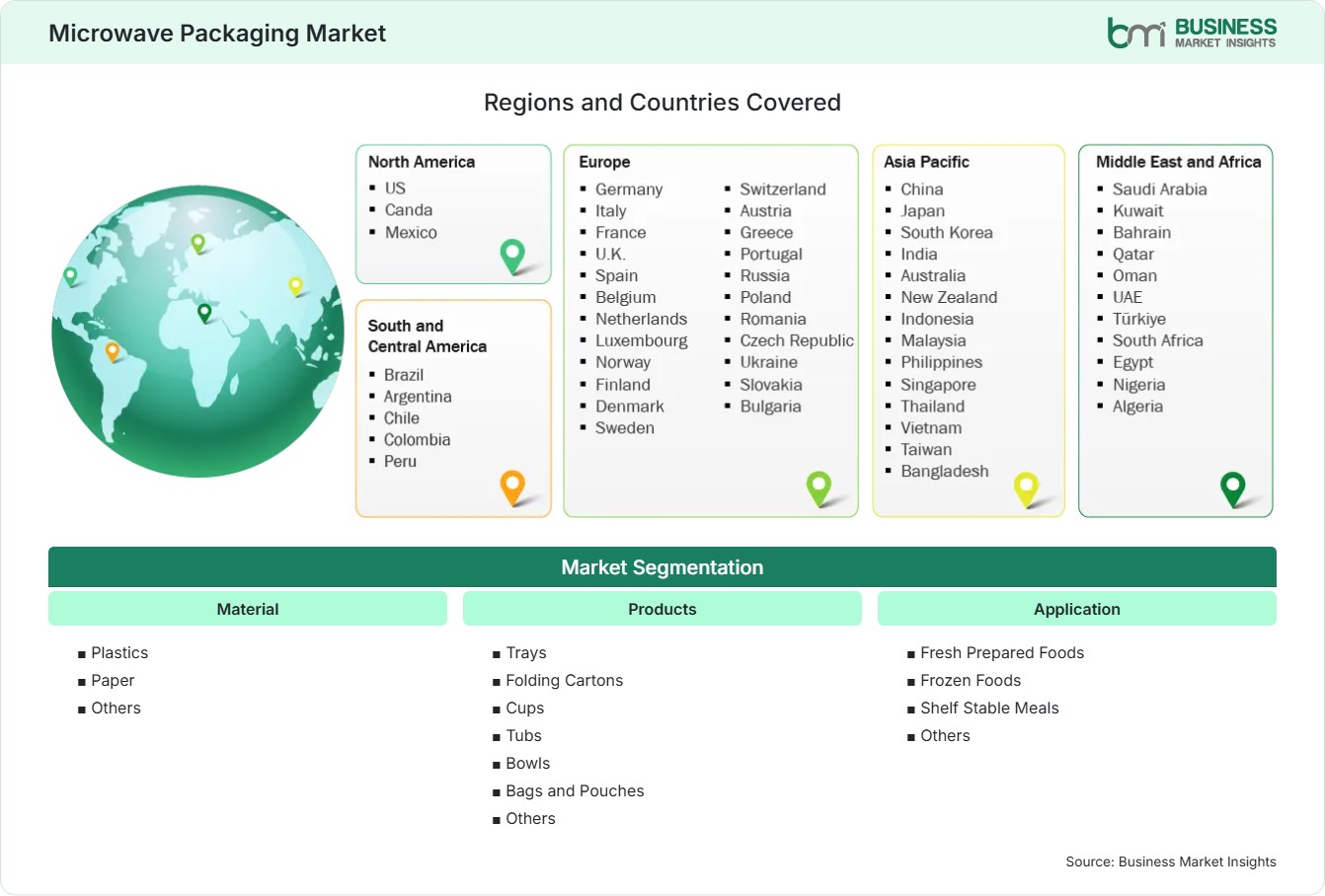
North America accounted for a Microwave Packaging Market share of 29%–33% in 2025 and is projected to grow at a CAGR of 8%–10% through 2033. The US represents the dominant regional market, supported by established frozen food consumption, convenience-oriented retail, ready-to-eat meals, and extensive microwave penetration. Canada contributes through growing demand for convenient prepared foods and sustainable packaging. Suppliers are increasingly developing recyclable structures, lightweight formats, and packaging capable of delivering reliable heating performance.
- Frozen meals and prepared foods remain important demand drivers as consumers prioritize convenience, portion control, and minimal preparation time.
- Retailers and food manufacturers are expanding ready-to-eat product portfolios, creating demand for trays, bowls, tubs, and flexible packaging compatible with microwave heating.
- Sustainability requirements are encouraging producers to reduce material intensity and develop recyclable alternatives to complex multilayer structures.
- Premium prepared meals are increasing demand for packaging that combines attractive presentation, reliable heating, food protection, and convenient handling.
US Microwave Packaging Market
The US represented 82%–86% of North America's Microwave Packaging Market share in 2025 and is projected to grow at a CAGR of 8%–10% through 2033. Strong frozen food consumption, ready-to-eat meals, convenience retail, and established microwave usage support demand. Food manufacturers are increasingly evaluating packaging sustainability alongside functionality.
- Ready-to-eat and frozen meal categories support demand for trays, bowls, pouches, and other packaging formats designed for direct microwave heating.
- Retail innovation is encouraging food brands to introduce premium prepared meals requiring packaging with attractive presentation and reliable thermal performance.
- Packaging sustainability initiatives are increasing demand for recyclable structures, reduced material usage, and alternatives to difficult-to-recycle multilayer formats.
- Consumer preference for convenience is supporting portion-controlled meals and packaging formats that simplify storage, heating, and serving.
Europe Microwave Packaging Market
Europe held a Microwave Packaging Market share of 21%–25% in 2025 and is projected to grow at a CAGR of 8%–10% through 2033. Germany, the UK, France, and Italy are leading markets supported by convenience foods, frozen meals, modern retail, and sustainability-focused packaging development. Germany is projected to grow at a CAGR of 8%–10%, while the UK is expected to expand at 9%–11%. Regulatory pressure is accelerating investment in recyclable and lower-material packaging solutions.
- Germany remains a major market due to its developed food processing sector, modern retail infrastructure, and strong consumer demand for convenient meal formats.
- The UK offers attractive opportunities as ready meals and convenience-oriented food products maintain strong retail penetration and packaging innovation requirements.
- France and Italy provide growth opportunities through premium prepared foods, frozen products, foodservice applications, and increasing interest in sustainable packaging.
- European packaging regulations are encouraging suppliers to improve recyclability and reduce unnecessary material use across food packaging formats.
Asia Pacific Microwave Packaging Market
Asia Pacific accounted for a Microwave Packaging Market share of 25%–29% in 2025 and is projected to grow at a CAGR of 11%–13% through 2033. China, Japan, India, South Korea, and Australia represent key markets, with India projected to grow at a CAGR of 12%–14%. Urbanization, organized retail, food delivery, rising disposable incomes, and changing household structures are increasing demand for convenient meal solutions.
- China represents a major opportunity due to its large consumer base, expanding convenience food sector, modern retail growth, and increasing packaged meal consumption.
- India is experiencing strong demand growth as urban households, food delivery platforms, and organized retailers expand access to ready-to-eat and microwaveable meals.
- Japan and South Korea offer mature markets where consumers increasingly value convenience, portion control, product quality, and advanced packaging functionality.
- Southeast Asian markets are expanding as urbanization and rising incomes increase consumption of frozen, prepared, and convenience food products.
Rest of World Microwave Packaging Market
South and Central America represented a Microwave Packaging Market share of 7%–10% in 2025 and are projected to grow at a CAGR of 8%–10%. Brazil and Mexico are leading markets, supported by expanding food processing, urbanization, modern retail, and convenience food consumption. Mexico benefits from integrated North American food supply chains, while Brazil provides opportunities through its large domestic consumer base. Growth remains influenced by economic conditions and packaging affordability. The Middle East and Africa accounted for a 5%–8% share in 2025 and are projected to grow at a CAGR of 9%–11%. The UAE, Saudi Arabia, and South Africa represent important markets. Saudi Arabia is projected to grow at a CAGR of 10%–12%, supported by food sector investment, urbanization, modern retail, and expanding convenience food consumption.
- Brazil offers opportunities through expanding food processing, retail modernization, frozen foods, and prepared meal categories requiring convenient packaging formats.
- Mexico benefits from proximity to North American food supply chains and growing domestic demand for convenience-oriented packaged foods.
- Saudi Arabia's food sector development and modern retail expansion are supporting demand for ready-to-eat meals and functional packaging solutions.
- The UAE provides opportunities through premium food products, hospitality, foodservice, and high-income consumers seeking convenient meal formats.
- South Africa remains an important market for frozen and prepared foods, although affordability and economic conditions influence packaging material selection.