
Nutraceutical Packaging Market Outlook: Size, Share, Trends, Growth Analysis, Competitive Landscape & Forecast, 2026-2033

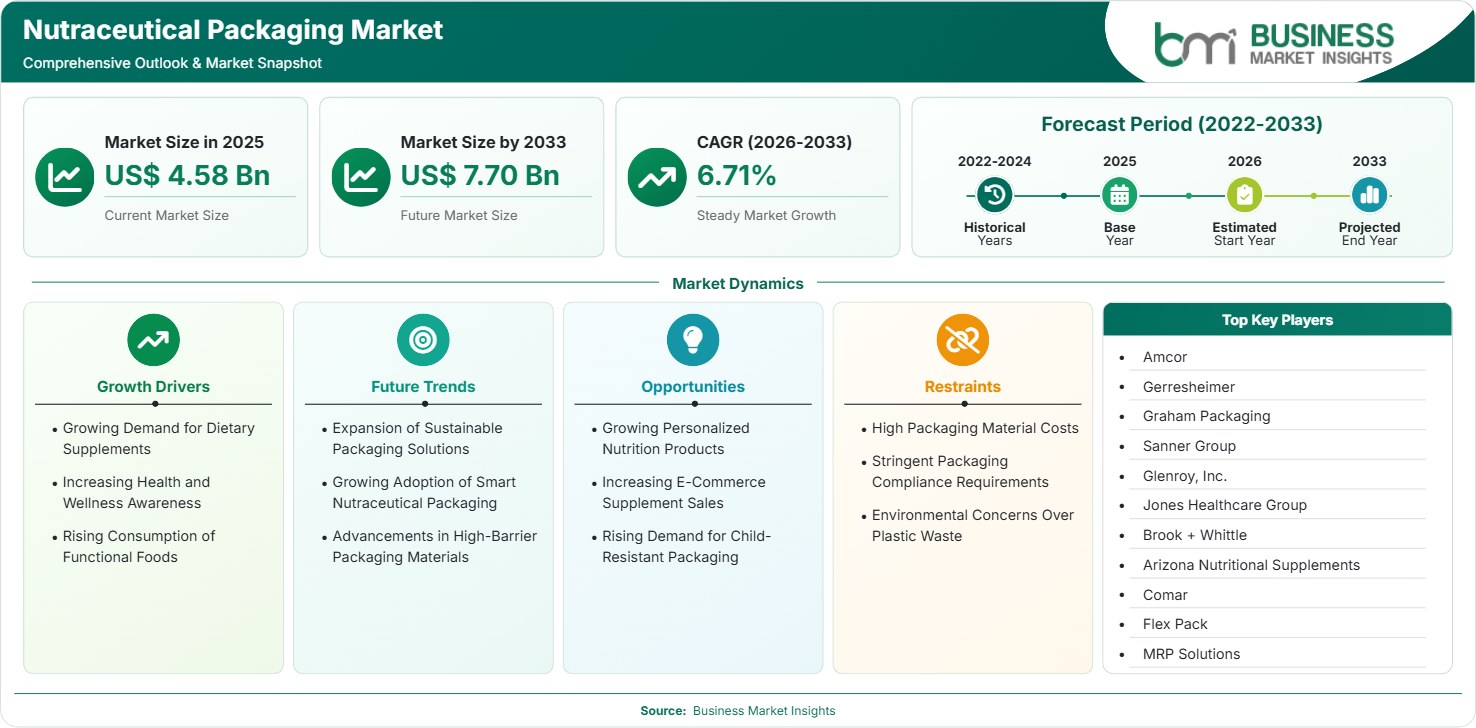
The Nutraceutical Packaging Market size was valued at US$ 4.58 Billion in 2025 and is projected to reach US$ 7.70 Billion by 2033, growing at a CAGR of 6.71% during 2026–2033, driven by rising supplement consumption, functional food adoption, sustainable packaging innovations, and expanding personalized nutrition solutions.

Report Coverage
  • Material: Plastic, Glass, Metal, Paper and Paperboard, Others
  • Packaging Type: Blisters, Bottles & Jars, Bags & Pouches, Sachets & Stick Packs, Boxes & Cartons, Caps & Closures, Others
  • Product Type: Dietary Supplements, Functional Foods, Functional Beverages, Others
US$ 4.58 Bn Market size in 2025
US$ 7.70 Bn Market Size by 2033
6.71% CAGR, 2026 - 2033
2026-2033 Forecast Period

AI Overview

Nutraceutical Packaging Market Summary

  • North America Region: North America holds a 32%–36% share in 2025, growing at a CAGR of 6.2%–6.8% during 2026–2033. Drivers include supplement demand, clean-label packaging, sustainability initiatives, advanced materials, and e-commerce growth. The US market analysis indicates steady expansion with a CAGR of 6.5%–7.0% supported by dietary supplement consumption and premium packaging demand.
  • Fastest Growing Region: Asia Pacific accounts for a 28%–32% share in 2025, expanding at a CAGR of 7.2%–7.8% during 2026–2033. Growth is supported by rising health awareness, growing middle-class consumption, functional beverage adoption, pharmaceutical packaging advancements, and increasing investment in modern packaging infrastructure.
  • Leading Segment: Bottles & Jars represent a 35%–39% share in 2025, growing at a CAGR of 6.5%–7.1% during 2026–2033. Growth is influenced by convenience, product protection, consumer familiarity, recyclable materials, and strong adoption across dietary supplements and functional nutrition products.
  • High Growth Segment: Sachets & Stick Packs represent a 15%–19% share in 2025, expanding at a CAGR of 7.5%–8.2% during 2026–2033. Growth is driven by portability, single-dose formats, personalized nutrition trends, online supplement sales, and demand for convenient consumption solutions.
  • Key Market Opportunity: Increasing demand for sustainable and customized packaging solutions creates opportunities through recyclable materials, smart packaging technologies, premium formats, and flexible designs supporting changing consumer preferences across nutraceutical applications.
  • Major Market Players: Amcor, Gerresheimer, Graham Packaging, Sanner Group, Glenroy, Inc., Jones Healthcare Group, Brook + Whittle, Arizona Nutritional Supplements, Comar, Flex Pack, and MRP Solutions.
Strategic Insights

Nutraceutical Packaging Market: Strategic Insights

Nutraceutical Packaging Market Strategic Framework
FREE PDF
Request your free sample
Request free sample
Stakeholder View

Key Takeaways

  • Packaging manufacturers are increasingly integrating material science, automation, and sustainable production methods to strengthen their position across nutraceutical supply chains.
  • Flexible packaging formats, including sachets and stick packs, offer significant growth potential due to convenience-driven consumption patterns and expanding direct-to-consumer supplement channels.
  • Innovation is shifting toward recyclable structures, smart labeling technologies, and improved barrier properties that enhance product protection while reducing environmental impact.
  • Asia Pacific presents a strong investment opportunity due to rising supplement consumption, expanding manufacturing capacity, and increasing adoption of premium nutrition products.
  • Strategic partnerships and acquisitions are increasing as packaging companies seek specialized capabilities in sustainable materials, healthcare-grade packaging, and customized solutions.
  • Digital commerce growth is encouraging brands to prioritize durable, lightweight, and consumer-friendly packaging formats suitable for direct shipping.
Geographic Outlook

Nutraceutical Packaging Market Regional Highlights

North America Nutraceutical Packaging Market

North America maintains a strong position with a 32%–36% share in 2025 and a CAGR of 6.2%–6.8% during 2026–2033. The region benefits from established supplement industries, advanced packaging infrastructure, and high consumer awareness. The Nutraceutical Packaging Market share reflects strong adoption of premium bottles, recyclable materials, and convenient formats. The US and Canada remain major contributors due to strong wellness trends, regulatory compliance, and expanding online supplement distribution channels.

  • Growing demand for dietary supplements is encouraging packaging suppliers to develop specialized containers with improved protection and consumer convenience features.
  • Sustainability regulations are accelerating adoption of recyclable plastics, lightweight designs, and environmentally responsible packaging solutions across nutraceutical manufacturers.
  • Premium supplement brands are investing in attractive packaging formats to improve shelf visibility and strengthen consumer engagement.
  • E-commerce expansion is increasing demand for durable packaging solutions designed for direct-to-consumer delivery models.

US Nutraceutical Packaging Market

The US represents approximately 65%–70% of North America's share in 2025, supported by strong supplement consumption and established healthcare product manufacturing. The market is projected to grow at a CAGR of 6.5%–7.0% during 2026–2033. The Nutraceutical Packaging Market growth in the country is influenced by clean-label trends, personalized nutrition products, and increasing demand for convenient packaging formats across online and retail channels.

  • Strong dietary supplement sales are driving demand for bottles, jars, and flexible packaging solutions with enhanced protection properties.
  • Regulatory compliance requirements encourage manufacturers to adopt tamper-resistant and traceable packaging technologies.
  • Consumer preference for sustainable products is increasing demand for recyclable and bio-based packaging materials.
  • Growing online supplement purchases require lightweight and shipping-efficient packaging structures.

Europe Nutraceutical Packaging Market

Europe accounts for a 24%–28% share in 2025, with a CAGR of 5.8%–6.5% during 2026–2033. Countries including Germany, the UK, and France are leading markets due to advanced supplement consumption patterns and sustainability regulations. The region emphasizes recyclable materials, circular economy initiatives, and strict packaging standards. The market share is supported by increasing demand for premium functional nutrition products and environmentally responsible packaging solutions.

  • Germany demonstrates strong adoption of sustainable packaging due to advanced recycling infrastructure and regulatory initiatives.
  • The UK market benefits from expanding wellness categories and increasing online supplement purchasing behavior.
  • France is witnessing rising demand for functional nutrition products requiring innovative packaging formats.
  • European manufacturers are investing in paper-based and recyclable packaging alternatives.
  • Regulatory pressure is encouraging suppliers to improve material efficiency and reduce packaging waste.

Asia Pacific Nutraceutical Packaging Market

Asia Pacific represents a 28%–32% share in 2025 and is expected to expand at a CAGR of 7.2%–7.8% through 2033. China, India, Japan, and South Korea are major contributors due to increasing health awareness, supplement adoption, and expanding manufacturing capabilities. The Nutraceutical Packaging Market trends indicate rising demand for flexible packaging, functional beverage containers, and cost-efficient solutions across developing economies.

  • China is expanding nutraceutical production capacity, creating demand for advanced packaging technologies and efficient supply chains.
  • India is experiencing increased supplement consumption driven by preventive healthcare awareness and wellness-focused consumers.
  • Japan and South Korea are adopting premium packaging formats for advanced functional nutrition products.
  • Regional manufacturers are investing in sustainable materials to meet changing consumer expectations.
  • Growing urban populations are supporting demand for portable and convenient supplement packaging formats.

Rest of World Nutraceutical Packaging Market

Rest of World contributes a 7%–10% share in 2025, growing at a CAGR of 6.0%–6.8% during 2026–2033. Latin America, the Middle East, and Africa are witnessing increasing supplement adoption due to healthcare awareness and expanding retail networks. Brazil, Mexico, UAE, and South Africa represent emerging opportunities as manufacturers improve packaging capabilities and distribution systems.

  • Latin American markets are adopting modern packaging solutions as nutraceutical brands expand retail and digital channels.
  • Brazil shows increasing demand for supplement packaging driven by wellness product consumption and local manufacturing growth.
  • Middle Eastern countries are investing in premium nutrition categories supported by rising healthcare awareness.
  • African markets are gradually expanding through improved retail access and imported supplement availability.
  • Packaging suppliers are developing cost-effective solutions suitable for emerging regional markets.
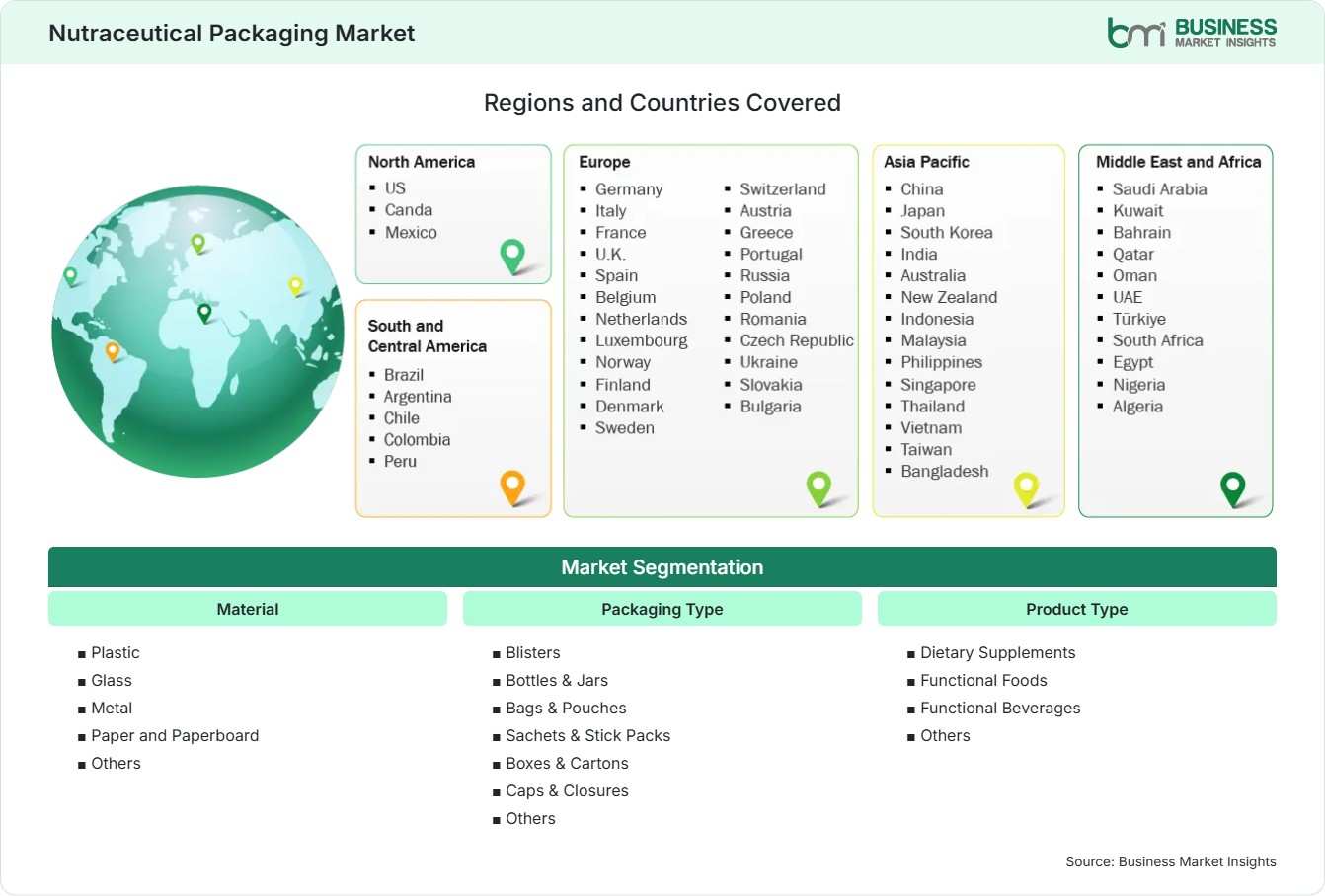
Global Market Geography
FREE PDF
Request your free sample
Request free sample
Segment Analysis

Nutraceutical Packaging Market Segmentation

Material

The material segment defines packaging performance, sustainability, and product compatibility across nutraceutical applications. Plastic maintains a leading position with a 42%–46% share in 2025, while the segment expands at a CAGR of 6.4%–7.0% during 2026–2033. The Nutraceutical Packaging Market scope is influenced by demand for lightweight, durable, recyclable, and cost-efficient materials supporting diverse supplement categories.

  • Plastic: Plastic packaging remains widely used due to flexibility, lightweight characteristics, durability, and compatibility with bottles, jars, pouches, and supplement containers requiring efficient manufacturing.
  • Glass: Glass packaging is preferred for premium nutraceutical products because of chemical resistance, product protection, recyclability, and suitability for brands emphasizing quality and longer shelf stability.
  • Metal: Metal packaging provides strong barrier protection against moisture, oxygen, and contamination, supporting specialized supplement products requiring enhanced preservation and premium positioning.
  • Paper and Paperboard: Paper-based packaging adoption is increasing through sustainable designs, recyclable structures, and eco-friendly branding initiatives targeting environmentally conscious consumers and nutraceutical manufacturers.

Packaging Type

Packaging type selection depends on product format, consumer convenience, shelf life requirements, and distribution channels. Bottles & Jars represent the leading category with a 35%–39% share in 2025 and a CAGR of 6.5%–7.1% during 2026–2033. Growing demand for convenient supplement storage and premium presentation continues influencing packaging innovation.

  • Blisters: Blister packaging supports accurate dosage management, product protection, and portability, making it suitable for tablets, capsules, and healthcare-oriented nutraceutical products.
  • Bottles & Jars: Bottles and jars remain dominant due to widespread supplement usage, easy handling, resealing capability, and strong consumer familiarity across retail and online channels.
  • Bags & Pouches: Flexible bags and pouches are gaining adoption because of lightweight designs, reduced material usage, transportation efficiency, and suitability for powder-based nutrition products.
  • Sachets & Stick Packs: Sachets and stick packs support single-serving applications, convenience, portability, and personalized nutrition formats for active consumers seeking easy consumption solutions.
  • Boxes & Cartons: Boxes and cartons provide branding opportunities, secondary protection, and information space for nutraceutical products distributed through retail and healthcare channels.
  • Caps & Closures: Caps and closures improve product safety, usability, and tamper resistance while supporting specialized requirements across supplement containers and functional nutrition packaging formats.

Product Type

Product type segmentation reflects changing consumer preferences toward preventive healthcare, functional nutrition, and wellness-focused consumption. Dietary supplements represent the largest category with a 48%–52% share in 2025, supported by strong demand for vitamins, minerals, and herbal products. The segment is expanding at a CAGR of 6.6%–7.2% during 2026–2033 due to increasing health awareness.

  • Dietary Supplements: Dietary supplements drive packaging demand through capsules, tablets, powders, and gummies requiring protective, convenient, and consumer-friendly packaging solutions.
  • Functional Foods: Functional foods require packaging solutions that preserve nutritional value, support product differentiation, and maintain quality across expanding health-oriented food categories.
  • Functional Beverages: Functional beverages encourage innovation in bottles, cans, and flexible packaging formats designed for convenience, portability, and improved product shelf stability.
Market Forces

Nutraceutical Packaging Market Dynamics

Key Market Drivers

Growing Demand for Dietary Supplements

Rising consumption of vitamins, minerals, herbal and health supplements is boosting the need for special package forms. The world dietary supplements market is witnessing growth due to consumer emphasis on preventive healthcare and customized nutrition needs. The Nutraceutical Packaging Market growth is driven by the necessity for packaging that offers protection against the effects of moisture, oxygen, and contamination of such sensitive products. The market trends point towards the increasing usage of bottles, jars and flexible packages that offer convenience and differentiation.

Increasing Health and Wellness Awareness

Increasing awareness about immunity, prevention of disease, and nutritional balance has made consumers increasingly interested in functional nutrition products. This is inspiring packaging firms to develop visually engaging packaging materials which convey information on the advantages of their products in a compelling manner. The growing trend of consuming clean label foods has been affecting the choice of packaging materials being used as well as the approach being adopted towards packaging.

Rising Consumption of Functional Foods

Consumption of functional foods is rising because of the consumer demand for products that not only provide nutritional value but also deliver extra health benefits. This trend is fueling the need for packaging options that can preserve active components and keep food fresh. Manufacturers have been targeting packaging materials that offer barriers as well as innovative packaging solutions to serve their brands of functional foods. The growth in distribution through retail stores and e-commerce has made the need even greater.

Key Market Opportunities

Growing Personalized Nutrition Products

Personalized nutrition has created new possibilities for custom packaging tailored to an individual’s nutritional needs. Small batches of products that are tailored according to consumer needs and subscription plans have become popular, thus necessitating flexible packaging solutions. The Nutraceutical Packaging Market Forecasts reveal that there will be more funding towards developing packaging technology that allows customization, traceability, and consumer interaction. Smart labels, digital printing, and modularity have emerged as great value propositions for packaging in the competitive nutrition space.

Increasing E-Commerce Supplement Sales

The increase in sales of supplements online is driving the need for packaging innovations suited to direct-to-consumer shipping. Packaging solutions that are lightweight and shipping efficient are now required as brands use digital platforms to compete. Packaging companies are coming up with packaging solutions that will help in cutting down shipping costs while keeping products safe. Packaging innovations will be created in areas such as tamper-resistant packaging and sustainable packaging.

Rising Demand for Child-Resistant Packaging

The growing concerns for the safety of consumers have been promoting the use of child-resistant package solutions for some nutraceuticals. There is an increased effort by manufacturers to use secure packages, user-friendly designs, and package design that comply with consumer safety needs. This presents chances for the packaging industry to innovate on closure techniques and special containers. Increased awareness about house safety standards will favor the development of safe packaging forms.

Market Restraints and Challenges

High Packaging Material Costs

Factor: Rising costs of polymers, glass, specialty coatings, and sustainable materials increase production expenses for packaging manufacturers. Impact: Increased material cost can affect the profit margin as well as the price strategy of nutraceutical products. This is being countered by using lightweight design, efficient use of material, and other forms of package design. Variability in raw material supply poses an issue in keeping the supply chain steady. Sustainable packaging requires more investment which affects small companies.

Stringent Packaging Compliance Requirements

Factor: Increasing regulatory requirements related to food safety, labeling, recyclability, and material compatibility create additional compliance obligations. Impact: Development costs for testing, certification, and quality control have to be taken into account by packaging makers, which makes the development process longer and more complex. Different regulatory requirements in different regions make customization of packaging necessary for different markets. This may prove to be a hindrance for small players, but will push established players toward innovation and standardization.

Company Analysis

Competitive Landscape

The Nutraceutical Packaging Market analysis highlights competition among global packaging manufacturers, healthcare packaging specialists, and customized solution providers. Companies are focusing on sustainable materials, advanced barrier technologies, lightweight packaging designs, and regulatory-compliant solutions to support dietary supplements, functional foods, and functional beverage applications.

Company Name

Overview

Products and Services relevant to this market

Amcor

Amcor is a global packaging company providing innovative solutions for healthcare, food, and consumer industries.

Offers flexible and rigid packaging solutions with barrier protection, recyclable materials, and specialty formats for nutraceutical products.

Gerresheimer

Gerresheimer develops pharmaceutical and healthcare packaging solutions with strong expertise in high-quality container systems.

Provides glass and plastic containers, bottles, closures, and packaging technologies for supplements and wellness products.

Graham Packaging

Graham Packaging specializes in plastic packaging solutions serving healthcare, food, and consumer product manufacturers globally.

Supplies bottles, containers, and custom packaging designs focused on durability, sustainability, and product protection.

Sanner Group

Sanner Group develops healthcare packaging systems with expertise in effervescent and pharmaceutical product protection.

Provides tablet packaging, desiccant solutions, plastic containers, and customized packaging systems for supplements.

Glenroy, Inc.

Glenroy is a flexible packaging manufacturer specializing in innovative and sustainable packaging solutions.

Offers stand-up pouches, flexible films, and specialty packaging structures for nutraceutical and wellness brands.

Jones Healthcare Group

Jones Healthcare Group provides advanced healthcare packaging solutions supporting medication adherence and consumer convenience.

Develops compliance packaging, blister solutions, and customized formats for dietary supplement applications.

Brook + Whittle

Brook + Whittle focuses on sustainable flexible packaging and label solutions for multiple consumer industries.

Supplies recyclable pouches, films, labels, and packaging technologies designed for nutraceutical applications.

Arizona Nutritional Supplements

Arizona Nutritional Supplements manufactures dietary supplements with integrated packaging and production capabilities.

Provides supplement manufacturing, packaging services, bottles, capsules, tablets, and customized nutraceutical solutions.

Comar

Comar develops plastic packaging solutions for healthcare, wellness, and specialty product applications.

Offers bottles, containers, closures, and dispensing systems designed for supplement and functional health products.

Flex Pack

Flex Pack provides flexible packaging solutions for food, healthcare, and consumer product markets.

Manufactures pouches, sachets, films, and customized flexible packaging formats for nutraceutical brands.

MRP Solutions

MRP Solutions specializes in packaging and supply chain solutions for health and wellness products.

Provides custom packaging development, sourcing support, and packaging solutions for supplement manufacturers.

Trust & Transparency

Research Methodology

The market analysis combines proprietary research with secondary data from government agencies, company disclosures, regulatory filings, industry databases and expert interviews. Market estimates are validated through data triangulation, cross-market benchmarking and analyst review.

View Full Research Methodology

Questions Answered

Frequently Asked Questions

What role does e-commerce play in packaging demand?

E-commerce growth is increasing demand for durable, lightweight, tamper-resistant, and shipping-friendly packaging formats that protect nutraceutical products throughout distribution channels.

Why is regulatory compliance important for nutraceutical packaging market report?

Compliance ensures packaging safety, product compatibility, accurate labeling, and adherence to regional food and supplement regulations, helping brands maintain consumer trust and market access.

How is sustainability affecting packaging strategies?

Sustainability is encouraging manufacturers to develop recyclable materials, paper-based solutions, reduced-material designs, and packaging structures that minimize environmental impact while maintaining product quality.

Which packaging formats are gaining adoption in supplement products?

Bottles, jars, pouches, sachets, stick packs, and blister formats are gaining adoption because they support portability, dosage convenience, shelf-life protection, and diverse supplement formulations.

What factors are influencing nutraceutical packaging market innovation?

Nutraceutical packaging innovation is influenced by sustainability requirements, consumer convenience preferences, product protection needs, and increasing demand for recyclable, lightweight, and functional packaging formats.

Access the Full Nutraceutical Packaging Market Report

Get segment-level forecasts, regional estimates, competitive benchmarking, company profiles and downloadable Excel datasets.

Access the full Nutraceutical Packaging Market Report
350 pages PDF & Excel | 2026-08-06