
Polypropylene Fiber Market Outlook: Size, Share, Trends, Growth Analysis, Competitive Landscape & Forecast, 2026-2033

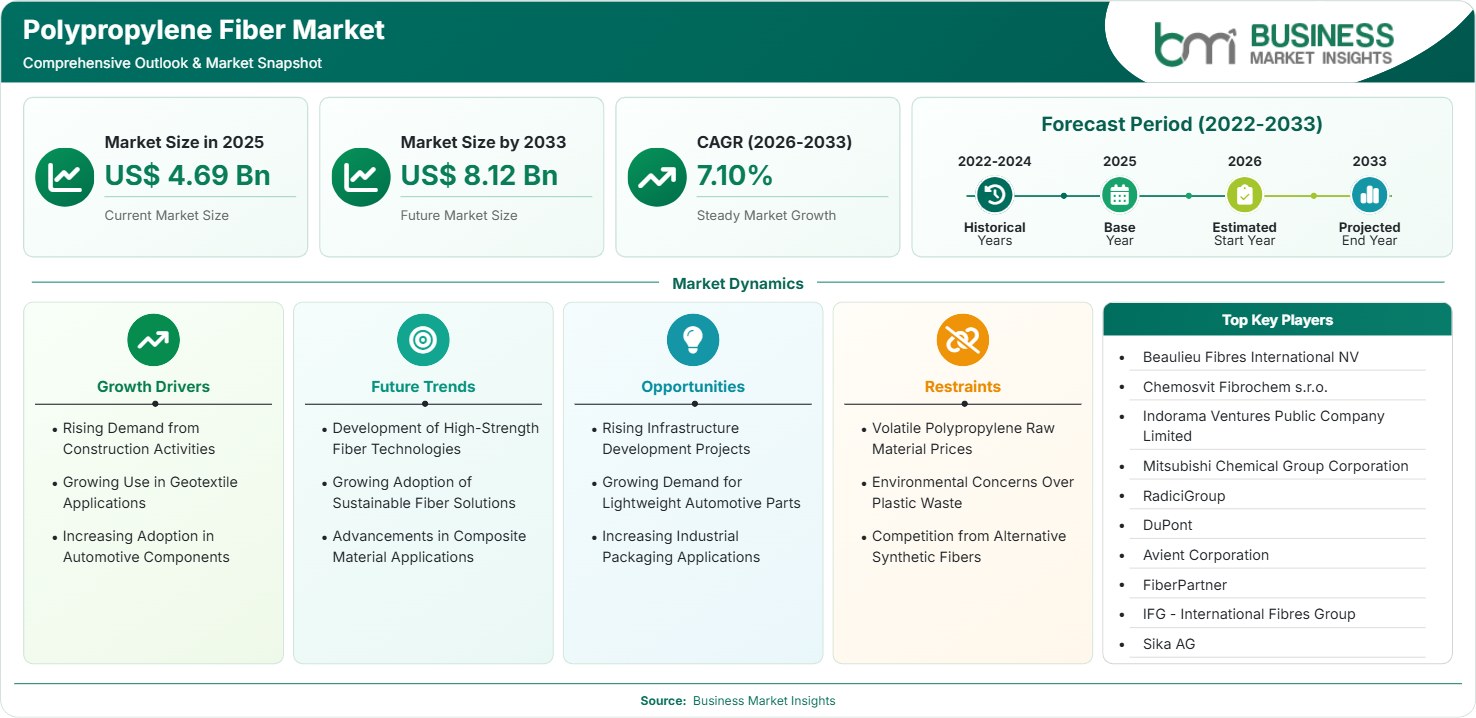
The Polypropylene Fiber Market size was valued at US$ 4.69 Billion in 2025 and is projected to reach US$ 8.12 Billion by 2033, growing at a CAGR of US$ 7.10% during 2026–2033, driven by infrastructure expansion, lightweight material demand, and increasing adoption across construction, hygiene, and industrial applications.

Report Coverage
  • Product Type: Staple, Yarn
  • End-use Industry: Textile, Construction, Healthcare & Hygiene, Others
US$ 4.69 Bn Market size in 2025
US$ 8.12 Bn Market Size by 2033
7.10% CAGR, 2026 - 2033
2026-2033 Forecast Period

01 AI Overview

Polypropylene Fiber Market Summary

  • North America Region: North America holds a 28%–32% share in 2025, growing with a CAGR of 6.4%–7.0% through 2033, supported by construction rehabilitation, advanced composites, and hygiene product demand. The US market advances through infrastructure modernization and specialty fiber adoption with a CAGR of 6.5%–7.1%.
  • Fastest Growing Region: Asia Pacific accounts for a 34%–38% share in 2025, expanding at a CAGR of 7.6%–8.2% during 2026–2033, supported by urbanization, infrastructure investments, textile production growth, and rising industrial applications.
  • Leading Segment: Staple products represent a 55%–59% share in 2025, growing at a CAGR of 6.8%–7.4%, driven by concrete reinforcement applications, filtration demand, and widespread compatibility with construction and hygiene manufacturing processes.
  • High Growth Segment: Construction end-use represents a 31%–35% share in 2025, expanding at a CAGR of 7.8%–8.4%, supported by durable concrete solutions, infrastructure projects, and demand for corrosion-resistant reinforcement materials.
  • Key Market Opportunity: Rising infrastructure spending, sustainable material innovation, and increasing use of lightweight fibers create opportunities for manufacturers to develop high-performance polypropylene solutions across construction, automotive, healthcare, and industrial sectors globally.
  • Major Market Players: Beaulieu Fibres International NV, Chemosvit Fibrochem s.r.o., Indorama Ventures Public Company Limited, Mitsubishi Chemical Group Corporation, RadiciGroup, DuPont, Avient Corporation, FiberPartner, IFG - International Fibres Group, and Sika AG.
02 Strategic Insights

Polypropylene Fiber Market: Strategic Insights

Polypropylene Fiber Market Strategic Framework
FREE PDF
Request your free sample
Request free sample
03 Stakeholder View

Key Takeaways

  • Supply chains are shifting toward integrated polymer-to-fiber production models, enabling manufacturers to improve cost efficiency, product consistency, and application-specific customization through advanced extrusion and finishing technologies.
  • Construction reinforcement remains a major growth avenue, as polypropylene fibers provide crack control, durability enhancement, and improved performance in concrete applications where corrosion resistance is required.
  • Innovation priorities are moving toward recycled polypropylene fibers, specialty coatings, and engineered structures that improve mechanical performance while addressing sustainability requirements from industrial buyers.
  • Asia Pacific presents a strong investment opportunity due to expanding infrastructure programs, growing manufacturing capacity, and increasing demand from textile and construction industries across developing economies.
  • Strategic investments and partnerships are increasing as companies seek geographic expansion, sustainable material capabilities, and enhanced product portfolios to capture demand across diverse end-use sectors.
04 Geographic Outlook

Polypropylene Fiber Market Regional Highlights

North America Polypropylene Fiber Market

North America accounted for a 28%–32% share in 2025 and is projected to expand at a CAGR of 6.4%–7.0% during 2026–2033. Demand is supported by construction refurbishment, advanced composite adoption, and established hygiene manufacturing capabilities. The market share remains strong due to mature industrial infrastructure and technological adoption across end-use applications.

  • Infrastructure modernization programs in the US and Canada are increasing demand for fiber-reinforced concrete solutions, supporting durable construction practices and reducing maintenance requirements across commercial and public projects.
  • Manufacturers are investing in advanced polypropylene formulations to improve strength, thermal stability, and application performance for specialty industrial products, including filtration systems and automotive components.
  • Sustainability initiatives are encouraging recycled polypropylene integration, enabling producers to develop lower-impact fiber solutions while maintaining performance standards required by construction and textile customers.
  • Healthcare and hygiene industries continue supporting regional consumption through demand for nonwoven materials used in medical textiles, personal care products, and filtration applications requiring lightweight fiber structures.

US Polypropylene Fiber Market

The US represented a 24%–28% share in 2025 and is expected to register a CAGR of 6.5%–7.1% from 2026–2033. The country benefits from infrastructure investment, construction renovation activities, and domestic manufacturing capabilities. Growing adoption of engineered fibers strengthens competitive positioning among suppliers serving construction, automotive, and industrial sectors.

  • Federal infrastructure initiatives are supporting increased usage of polypropylene fibers in concrete applications, particularly for transportation projects, bridges, and commercial construction requiring enhanced durability.
  • Automotive manufacturers are adopting lightweight polypropylene-based materials to reduce vehicle weight, improve fuel efficiency, and meet evolving performance requirements across interior and component applications.
  • Demand from hygiene manufacturers continues expanding due to increased consumption of nonwoven products, supporting fiber producers with opportunities in healthcare and personal care segments.

Europe Polypropylene Fiber Market

Europe held a 23%–27% share in 2025 and is projected to grow at a CAGR of 6.1%–6.8% through 2033. Germany, Italy, and France remain leading markets, while Poland and Spain show higher adoption potential. The Polypropylene Fiber Market share is influenced by sustainable construction practices, advanced textile production, and regulatory emphasis on resource efficiency.

  • Germany demonstrates strong demand through construction engineering applications, automotive manufacturing, and industrial textile production requiring technically advanced polypropylene fiber solutions.
  • Italy and France are supporting consumption through established textile industries, infrastructure renovation projects, and increasing adoption of lightweight materials across industrial applications.
  • Poland is emerging as a high-growth market with expanding manufacturing capacity and increasing investment in construction and industrial processing facilities.
  • European sustainability regulations are encouraging manufacturers to improve recyclability, production efficiency, and environmental performance across polypropylene fiber value chains.

Asia Pacific Polypropylene Fiber Market

Asia Pacific represented a 34%–38% share in 2025 and is expected to achieve a CAGR of 7.6%–8.2% during 2026–2033. China, India, Japan, and Southeast Asian economies drive regional expansion through infrastructure development, textile manufacturing, and industrial production. The Polypropylene Fiber Market growth is supported by increasing construction activity and rising material substitution trends.

  • China remains the largest regional contributor due to extensive infrastructure projects, strong polymer production capacity, and large-scale textile manufacturing ecosystems.
  • India is witnessing accelerated adoption through urban development programs, residential construction expansion, and increasing demand for cost-effective reinforcement materials.
  • Southeast Asian countries are attracting manufacturing investments due to growing industrial bases, favorable production economics, and expanding downstream application industries.
  • Japan and South Korea support premium applications through advanced manufacturing capabilities and demand for technically optimized fiber materials.

Rest of World Polypropylene Fiber Market

South and Central America, along with Middle East and Africa markets, accounted for a 9%–13% share in 2025 and are projected to grow at a CAGR of 6.0%–6.7% through 2033. Brazil, Mexico, Saudi Arabia, and the UAE represent important markets due to construction expansion and industrial development. The market share remains supported by infrastructure investments and material modernization.

  • Brazil and Mexico are expanding polypropylene fiber consumption through construction projects, agricultural applications, and growing industrial manufacturing activities.
  • Middle Eastern economies are adopting fiber-based construction solutions due to infrastructure diversification programs and large-scale commercial development initiatives.
  • Saudi Arabia and the UAE show increasing demand through urban development projects requiring durable and efficient construction materials.
  • African markets present emerging opportunities as infrastructure investment and manufacturing development create new applications for polypropylene fiber products.
  • Regional suppliers are improving distribution networks to address fragmented demand and support broader adoption across industrial sectors.
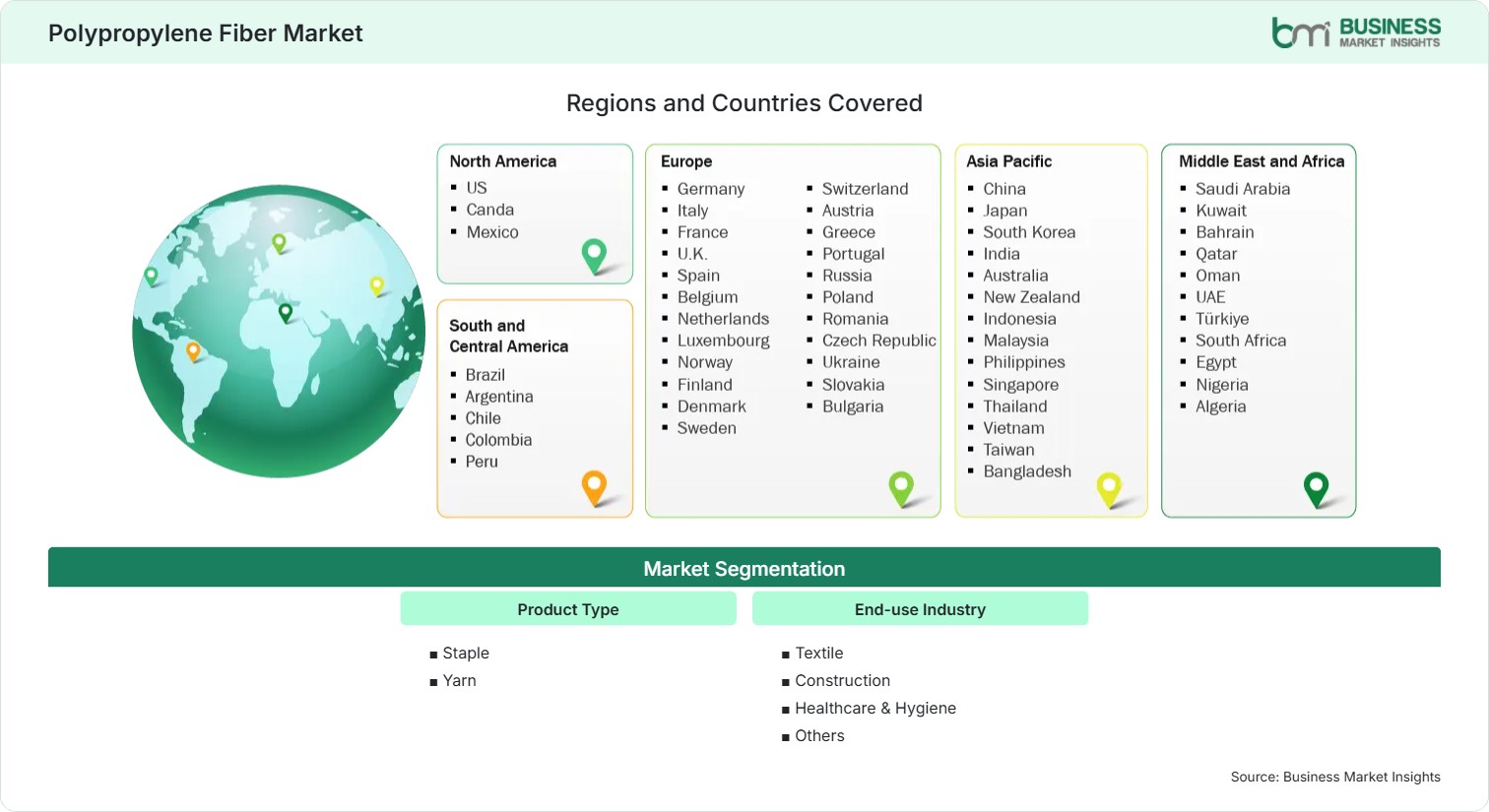
Global Market Geography
FREE PDF
Request your free sample
Request free sample
05 Segment Analysis

Polypropylene Fiber Market Segmentation

Product Type

Product Type segmentation demonstrates strong demand diversification between staple and yarn formats. The segment accounted for a 100% share structure in 2025, with staple products leading at 55%–59% share and expanding at a CAGR of 6.8%–7.4% between 2026–2034. Polypropylene Fiber Market scope continues widening as manufacturers develop specialized products for construction, textile, and industrial applications.

  • Staple: Staple fibers are widely used in concrete reinforcement, hygiene materials, and filtration products due to flexibility, chemical resistance, and compatibility with multiple manufacturing processes.
  • Yarn: Yarn-based polypropylene fibers support textile applications, industrial fabrics, and specialized products requiring strength, lightweight characteristics, and consistent processing performance.

End-use Industry

End-use Industry segmentation reflects increasing adoption across construction, textile, healthcare & hygiene, and industrial applications. Construction represented a leading application category with a 31%–35% share in 2025 and CAGR of 7.8%–8.4% through 2034. The market trends indicate rising demand for performance-oriented materials across multiple sectors.

  • Textile: Textile applications utilize polypropylene fibers for lightweight fabrics, sportswear, industrial textiles, and specialty products requiring moisture resistance and durability.
  • Construction: Construction demand is driven by concrete reinforcement, crack prevention solutions, and infrastructure applications requiring corrosion-resistant alternatives to traditional reinforcement materials.
  • Healthcare & Hygiene: Healthcare and hygiene industries use polypropylene fibers in nonwoven products, medical textiles, and personal care materials requiring filtration and softness characteristics.
06 Market Forces

Polypropylene Fiber Market Dynamics

Key Market Drivers

Rising Demand from Construction Activities

The expansion of construction in residential, commercial, and infrastructure developments is contributing to the growing use of polypropylene fibers because of their ability to increase the strength and decrease cracking of concrete. Global investments in infrastructure such as transportation and urbanization developments have contributed to the use of reinforced fiber material. Growth in the market can be attributed to the need for construction contractors for reinforcement materials that are lightweight, resistant to corrosion, and easy to handle. The Polypropylene Fiber Market trends show that there is a shift towards engineered fiber systems that improve lifecycle performance and reduce maintenance requirements across modern construction applications.

Growing Use in Geotextile Applications

Geotextile uses are increasing due to the use of polypropylene fibers that can resist chemicals, withstand moisture, and give mechanical strength needed in soil stabilization, drainage, and erosion control works. Increased investments in road construction, land development, and environmental protection infrastructures have created further need for synthetic fiber products that can be durable. The market gains advantage due to the increasing uses of geosynthetics in civil engineering works, where longevity and economy of the material become crucial. Companies are designing special fiber structure for their use in filtration, separation, and reinforcement purposes.

Increasing Adoption in Automotive Components

Polypropylene fiber is being used more extensively by automobile manufacturers because of the advantages provided by the use of light-weight materials and composite manufacturing techniques. It provides an opportunity to achieve goals such as weight reduction while still offering strength and durability features. An increase in vehicle production and the need for energy-efficient transportation methods are contributing to the use of polymer materials. There are several trends related to market that point towards an emphasis on the development of customized fibers to achieve efficiency and sustainability.

Key Market Opportunities

Rising Infrastructure Development Projects

The growth in infrastructure development in emerging economies provides substantial opportunities for manufacturers of polypropylene fibers since the governments focus on transportation infrastructure and robust construction systems. Investments in building roads and bridges demand durable and strong reinforcement fibers that will increase the durability of such projects. Among other benefits that polypropylene fibers have, there are resistance to corrosion and reduced maintenance requirements. The Polypropylene Fiber market forecast shows growing opportunities for manufacturers who produce polypropylene fibers intended for construction purposes. Growth in APAC, MEA, and LATAM will create further channels of demand.

Growing Demand for Lightweight Automotive Parts

The automobile industry provides new growth avenues in terms of rising demand for light-weight parts to enhance fuel economy and efficiency of electric vehicles. The use of polypropylene fibers is gaining traction in composite materials, interiors, and insulations because of their excellent weight/performance balance. The automobile industry is adopting innovative materials in order to ensure lighter weights of automobiles without compromising on their safety and strength. The manufacturers who can offer customized polypropylene fibers having better mechanical properties can leverage the new business prospects.

Increasing Industrial Packaging Applications

Industrial packaging uses are presenting themselves through the demand for light and strong packaging materials that are moisture resistant for transporting and storing purposes. Fiber from polypropylene helps in making special packaging cloths, bulk sacks, and protective materials in the industry. Increased trade transactions and manufacturing are boosting the demand for packaging. Those companies that are working on developing fiber technology specifically for their uses can benefit from this trend in order to meet changing needs regarding strength, recycling, and efficiency.

Market Restraints and Challenges

Volatile Polypropylene Raw Material Prices

Factor: Fluctuating polypropylene resin prices caused by crude oil volatility and supply chain disruptions can increase manufacturing costs for fiber producers. Impact: Higher input costs may pressure profit margins and create pricing challenges across competitive markets. Producers dependent on external polymer suppliers face difficulties maintaining consistent pricing structures during periods of raw material instability. The Polypropylene Fiber Market is affected by fluctuations in petrochemical markets, requiring companies to strengthen procurement strategies, improve operational efficiency, and explore recycled feedstock alternatives to manage cost pressures while maintaining product quality.

Environmental Concerns Over Plastic Waste

Factor: Increasing regulatory scrutiny regarding plastic waste and synthetic material disposal creates challenges for polypropylene fiber manufacturers. Impact: Companies may face pressure to invest in recycling technologies, sustainable production methods, and improved end-of-life management solutions. Growing environmental awareness among consumers and industrial buyers is influencing purchasing decisions across textile, packaging, and construction applications. Manufacturers are responding by developing recycled polypropylene fibers and circular economy initiatives. Compliance with evolving sustainability requirements remains essential for maintaining competitiveness and supporting long-term adoption of polypropylene-based materials.

07 Company Analysis

Competitive Landscape

The Polypropylene Fiber Market analysis highlights a competitive environment shaped by global fiber manufacturers, specialty material producers, and integrated chemical companies. Leading participants are focusing on product innovation, sustainable fiber development, capacity optimization, and application-specific solutions to strengthen their position across construction, textile, healthcare, and industrial markets.

Company Name

Overview

Products and Services relevant to this market

Beaulieu Fibres International NV

Global synthetic fiber manufacturer specializing in advanced nonwoven and technical fiber solutions.

Polypropylene staple fibers, nonwoven fibers, hygiene and industrial fiber applications.

Chemosvit Fibrochem s.r.o.

European fiber producer offering specialized synthetic materials for industrial applications.

Polypropylene fibers, technical yarns, textile and industrial solutions.

Indorama Ventures Public Company Limited

Integrated chemical company with extensive polymer and fiber manufacturing capabilities.

Polypropylene fibers, specialty fibers, hygiene and industrial applications.

Mitsubishi Chemical Group Corporation

Global materials company developing advanced polymer and chemical solutions.

Performance fibers, polymer materials, specialty applications and engineered products.

RadiciGroup

International chemical group producing synthetic fibers and sustainable materials.

Polypropylene fibers, technical yarns, textile and industrial fiber solutions.

DuPont

Science-driven materials company providing engineered polymer technologies.

Specialty fibers, advanced material solutions, industrial and performance applications.

Avient Corporation

Specialty polymer company focused on sustainable and high-performance materials.

Polymer additives, fiber solutions, engineered polypropylene materials.

FiberPartner

Fiber manufacturer providing customized synthetic fiber solutions.

Polypropylene fibers, staple fibers, customized fiber technologies.

IFG - International Fibres Group

Manufacturer specializing in synthetic fiber production for industrial markets.

Polypropylene fibers, technical fibers, industrial textile applications.

Sika AG

Global specialty chemicals company serving construction and industrial sectors.

Synthetic fibers for concrete reinforcement, construction material solutions.

10 Trust & Transparency

Research Methodology

The market analysis combines proprietary research with secondary data from government agencies, company disclosures, regulatory filings, industry databases and expert interviews. Market estimates are validated through data triangulation, cross-market benchmarking and analyst review.

View Full Research Methodology

11 Questions Answered

Frequently Asked Questions

Why is this Polypropylene Fiber Market Report valuable for industry participants?

The market report provides insights into competitive positioning, regional opportunities, application trends, growth factors, and strategic developments influencing future investment decisions.

How are companies differentiating products in this market?

Companies are developing customized fiber designs, improved mechanical properties, specialty coatings, and sustainable formulations to meet specific requirements across construction, textile, healthcare, and industrial sectors.

Which applications offer strong future growth potential?

Construction reinforcement, geotextiles, hygiene products, automotive components, and industrial packaging applications represent important growth areas due to increasing demand for lightweight and durable materials.

How is sustainability affecting polypropylene fiber manufacturing?

Manufacturers are investing in recycled polypropylene inputs, improved production efficiency, and circular economy approaches to address environmental concerns while maintaining performance standards required by industrial customers.

What factors are influencing polypropylene fiber adoption across construction industries?

Polypropylene fibers are increasingly adopted in construction due to improved crack resistance, corrosion-free reinforcement, lightweight handling, and compatibility with modern concrete technologies. Infrastructure development and demand for durable structures continue supporting wider application.

Access the Full Polypropylene Fiber Market Report

Get segment-level forecasts, regional estimates, competitive benchmarking, company profiles and downloadable Excel datasets.

Access the full Polypropylene Fiber Market Report
350 pages PDF & Excel | 2026-08-05