
Polypropylene Market Outlook: Size, Share, Trends, Growth Analysis, Competitive Landscape & Forecast, 2026-2033

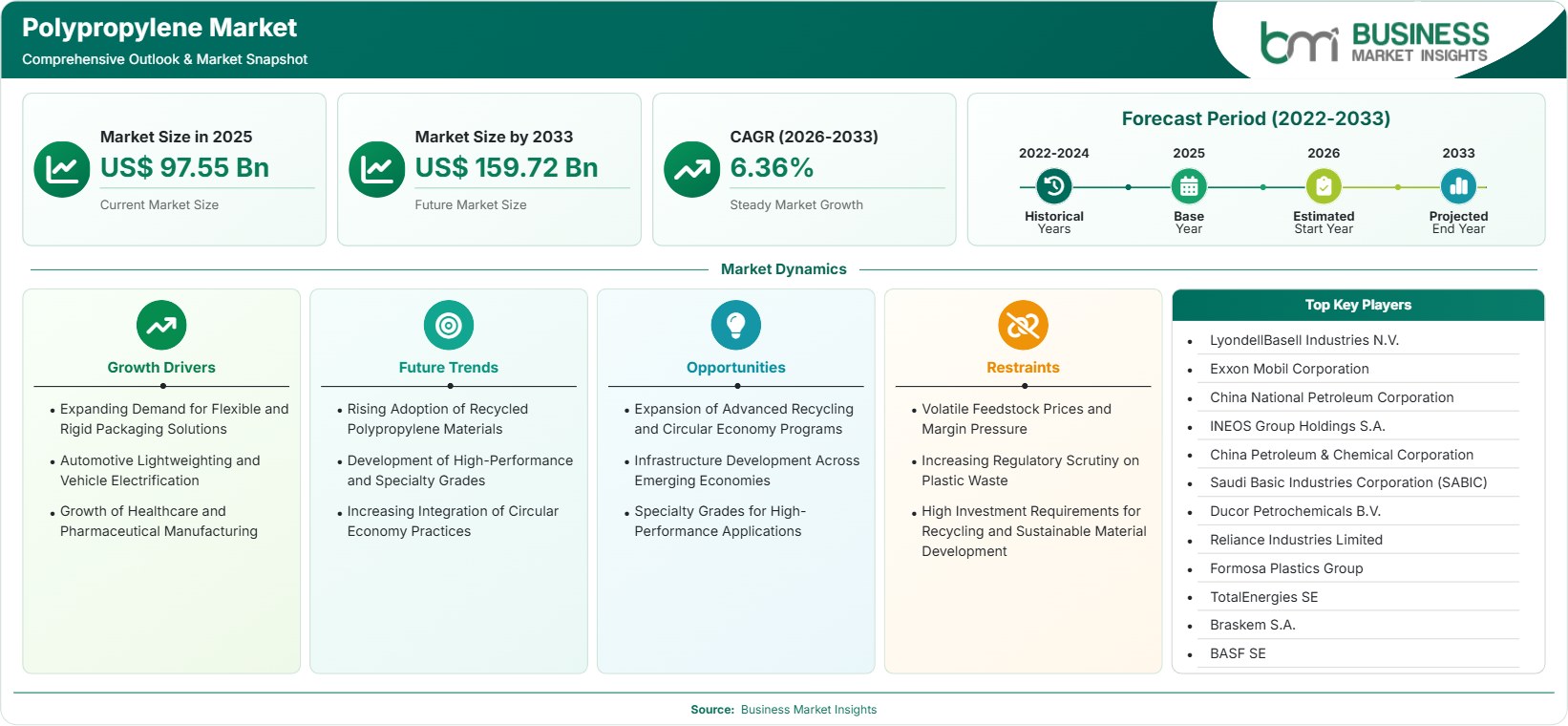
The Polypropylene Market size was valued at US$ 97.55 Billion in 2025 and is projected to reach US$ 159.72 Billion by 2033, growing at a CAGR of 6.36% during 2026–2033. Rising packaging demand, automotive lightweighting initiatives, expanding healthcare applications, circular economy investments, and advances in recyclable polymer technologies continue creating substantial growth opportunities across global industries.

Report Coverage
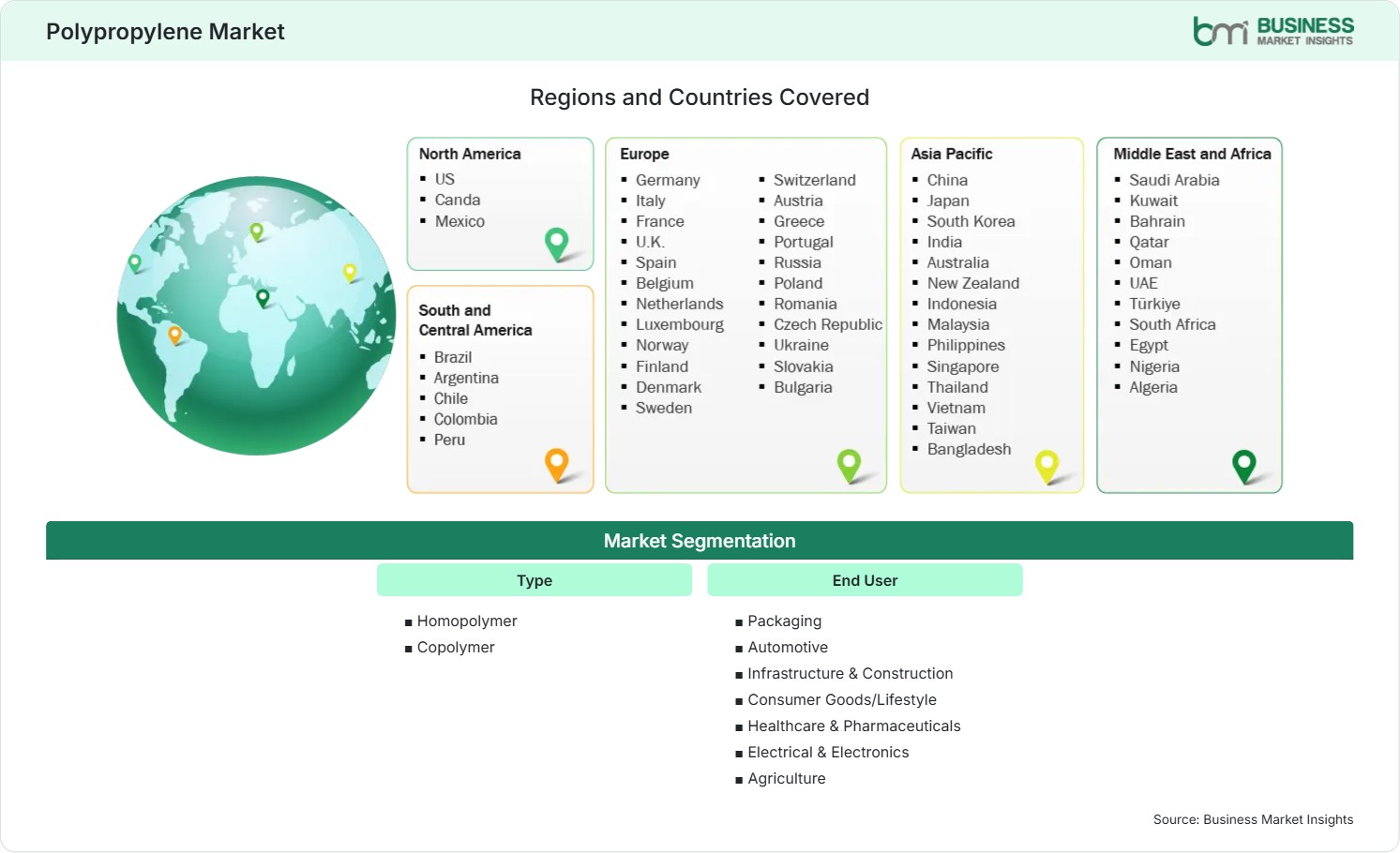
  • Type: Homopolymer, Copolymer
  • End User: Packaging, Automotive, Infrastructure & Construction, Consumer Goods/Lifestyle, Healthcare & Pharmaceuticals, Electrical & Electronics, Agriculture
US$ 97.55 Bn Market size in 2025
US$ 159.72 Bn Market Size by 2033
6.36% CAGR, 2026 - 2033
2026-2033 Forecast Period

AI Overview

Polypropylene Market Summary

  • North America Region: North America holds a market share of 20%–23% in 2025 and is projected to expand at a CAGR of 5.4%–6.0% during 2026–2033. Growth is supported by packaging innovation, automotive lightweight materials adoption, healthcare-grade polymer demand, and recycling infrastructure investments strengthening regional supply chains and sustainability objectives. The U.S. market benefits from strong domestic production and expands at an estimated CAGR of 5.5%–6.1% through 2033.
  • Fastest Growing Region: Asia Pacific accounts for 44%–47% of global demand in 2025 and is expected to register a CAGR of 7.2%–7.8% during 2026–2033. Industrialization, consumer goods manufacturing growth, urban infrastructure expansion, healthcare investments, and increasing packaging consumption continue accelerating regional polymer demand across major economies.
  • Leading Segment: Packaging represents 34%–38% share in 2025 and is forecast to grow at a CAGR of 6.4%–7.0% through 2033. Food packaging requirements, e-commerce expansion, lightweight material preferences, moisture resistance characteristics, and recyclability initiatives continue supporting broad industrial adoption globally.
  • High Growth Segment: Healthcare & Pharmaceuticals captures 8%–11% share in 2025 and is projected to expand at a CAGR of 7.8%–8.5% during 2026–2033. Rising medical device production, pharmaceutical packaging demand, sterilization compatibility, and healthcare infrastructure investments create attractive long-term opportunities for manufacturers.
  • Key Market Opportunity: Expansion of mechanically and chemically recycled polymer grades enables manufacturers to meet sustainability targets, regulatory requirements, and corporate circularity commitments while creating differentiated high-value product portfolios globally.
  • Major Market Players: LyondellBasell Industries N.V., Exxon Mobil Corporation, China National Petroleum Corporation, INEOS Group Holdings S.A., China Petroleum & Chemical Corporation, Saudi Basic Industries Corporation (SABIC), Ducor Petrochemicals B.V., Reliance Industries Limited, Formosa Plastics Group, TotalEnergies SE, Braskem S.A., BASF SE, Repsol S.A., Borouge Plc, Borealis AG, MOL Group, and Beaulieu International Group.
Strategic Insights

Polypropylene Market: Strategic Insights

Polypropylene Market Strategic Framework
FREE PDF
Request your free sample
Request free sample
Stakeholder View

Key Takeaways

  • There is increasing integration in the value chain within the industry, with players making investments throughout the process of feedstocks procurement, polymerization, compounding, recycling, and conversion processes.
  • Growth prospects in healthcare, advanced packaging, and electronics applications because of need for performance, regulations, and low-cost and light-weight materials.
  • The trend in product innovation is focusing on recyclable grades, clarity grades, impact-resistant compounds, and specialized polymers suitable for use in electric cars, medicine, and sustainable packaging products.
  • The region with the most compelling investment proposition includes the Asia-Pacific because of extensive manufacturing bases, growing consumer markets, investment in infrastructure and industrialization of China, India, Indonesia, and Vietnam.
  • Mergers and acquisitions, joint ventures, and recycling collaborations are gaining prominence as companies pursue material supply security, sustainability strengths, and geographic coverage in emerging regions.
  • Competitive advantage is increasingly hinging on circular economy strategies, compounding capabilities, and customized solutions for customers' sustainability requirements.
Geographic Outlook

Polypropylene Market Regional Highlights

North America Polypropylene Market

North America accounted for approximately 20%–23% of global demand in 2025 and is expected to record a CAGR of 5.4%–6.0% during 2026–2033. Strong feedstock availability, integrated petrochemical infrastructure, and substantial packaging demand support regional expansion. The region benefits from established healthcare and automotive manufacturing sectors. Growing investments in recycling technologies and circular polymer programs are strengthening competitiveness. The Polypropylene Market share in North America remains supported by continuous innovation in specialty grades and advanced processing capabilities.

  • Packaging manufacturers increasingly adopt recyclable polymer solutions to align with sustainability commitments while maintaining performance requirements across food, beverage, and industrial packaging applications.
  • Investments in advanced recycling facilities support circular economy objectives and create opportunities for producers to expand certified recycled-content product portfolios across diverse end-use sectors.
  • Automotive manufacturers continue incorporating lightweight polymer components to improve fuel efficiency and support vehicle electrification strategies, increasing material demand across transportation applications.
  • Healthcare product manufacturing benefits from reliable domestic supply chains, regulatory compliance capabilities, and demand for sterilizable polymer materials used in medical packaging and devices.
  • Consumer goods producers increasingly prefer durable and versatile polymer solutions that provide cost efficiency, design flexibility, and strong performance characteristics across product categories.

US Polypropylene Market

The United States Polypropylene Market represents approximately 74%–78% of North American consumption and is anticipated to expand at a CAGR of 5.5%–6.1% through 2033. Abundant shale-derived feedstocks, sophisticated refining infrastructure, and strong industrial demand support market development. Domestic investments in advanced recycling, sustainable materials, and high-performance polymer production strengthen competitiveness.

  • Major resin producers continue investing in capacity optimization and operational efficiency to strengthen supply reliability and address evolving customer requirements.
  • Demand from food packaging applications remains robust as manufacturers prioritize lightweight materials with excellent barrier and processing characteristics.
  • Sustainability commitments from consumer brands are accelerating procurement of recycled-content and circular polymer solutions across packaging value chains.
  • Growth in electric vehicle manufacturing supports demand for lightweight, durable, and thermally stable materials used in automotive components.

Europe Polypropylene Market

Europe holds approximately 18%–21% of Polypropylene Market demand in 2025 and is projected to grow at a CAGR of 5.8%–6.4% through 2033. Regulatory emphasis on recycling, circular economy frameworks, and sustainable materials innovation continues shaping regional development. Germany remains the leading market, while Eastern European countries demonstrate stronger growth momentum. Producers are prioritizing low-carbon production technologies, recycled content integration, and advanced compounding capabilities to address evolving customer and regulatory requirements.

  • Germany leads regional demand due to its strong automotive, industrial manufacturing, and packaging sectors, while maintaining substantial investments in polymer innovation.
  • Poland and other Eastern European markets demonstrate faster expansion, supported by industrial growth, manufacturing investments, and increasing consumer goods production.
  • European sustainability regulations are encouraging development of recycled materials and advanced waste management infrastructure across member states.
  • Brand owners increasingly seek materials supporting recyclability objectives, creating opportunities for premium sustainable polymer solutions.
  • Industrial modernization and automation investments continue supporting material demand across manufacturing and infrastructure applications.

Asia Pacific Polypropylene Market

Asia Pacific Polypropylene Market accounts for approximately 44%–47% of worldwide demand in 2025 and is forecast to register the fastest CAGR of 7.2%–7.8% during 2026–2033. Large manufacturing bases, expanding consumer populations, urbanization, and infrastructure investments drive substantial material consumption. China remains the dominant regional market, while India demonstrates the strongest growth trajectory.

  • China leads regional consumption through extensive manufacturing activity, packaging production, automotive output, and large-scale industrial operations.
  • India records the highest growth rate within the region, supported by infrastructure development, consumer spending expansion, and industrial policy initiatives.
  • E-commerce growth increases demand for lightweight and durable packaging materials across rapidly expanding logistics networks.
  • Rising healthcare expenditures support increased use of specialized polymer products in medical packaging and healthcare applications.
  • Investments in petrochemical production capacity strengthen regional self-sufficiency and improve supply chain competitiveness.

Rest of World Polypropylene Market

Rest of World contributes approximately 11%–14% of global demand and is expected to grow at a CAGR of 6.0%–6.7% during 2026–2033. South & Central America benefits from expanding packaging and consumer goods industries, while Middle East & Africa markets gain momentum through petrochemical investments and industrial diversification strategies. Brazil remains the leading market in South America, whereas Saudi Arabia and the UAE continue driving growth across the Middle East through production and export-oriented investments.

  • Brazil benefits from strong agricultural, packaging, and consumer products sectors that support sustained polymer demand growth.
  • Saudi Arabia continues expanding downstream petrochemical operations, enhancing regional production capabilities and export competitiveness.
  • UAE investments in industrial diversification support increasing consumption across infrastructure, packaging, and manufacturing applications.
  • Growing urbanization across emerging economies stimulates demand for consumer products, construction materials, and packaging solutions.
  • Regional producers are increasingly investing in value-added products and sustainability initiatives to improve long-term competitiveness.
Global Market Geography
FREE PDF
Request your free sample
Request free sample
Segment Analysis

Polypropylene Market Segmentation

Type

The Type segment accounted for approximately 58%–62% market share in 2025 through homopolymer dominance and is expected to expand at a CAGR of 6.1%–6.6% through 2033. Material selection depends on stiffness, impact resistance, transparency, and processing requirements. The Polypropylene Market scope continues expanding as manufacturers develop specialty formulations addressing evolving performance requirements across packaging, automotive, healthcare, and industrial applications.

  • Homopolymer: Widely utilized in rigid packaging, textiles, consumer products, and industrial applications due to high stiffness, excellent processability, cost efficiency, and strong performance across large-volume manufacturing environments.
  • Copolymer: Increasingly preferred in automotive components, medical products, durable packaging, and consumer goods because of improved impact resistance, flexibility, toughness, and performance under varying temperature conditions.

End User

End-user demand remains highly diversified, with Packaging representing approximately 34%–38% share in 2025 and expanding at a CAGR of 6.4%–7.0% through 2033. Growing requirements for lightweight, durable, recyclable, and cost-effective materials support adoption across industries. Evolving sustainability mandates, industrial modernization, and changing consumer preferences continue influencing purchasing behavior and application development globally.

  • Packaging: Remains the largest application category due to extensive use in rigid containers, flexible packaging, food storage solutions, closures, and transportation packaging requiring durability and lightweight characteristics.
  • Automotive: Supports vehicle lightweighting strategies through applications in interior components, bumpers, battery housings, trims, and structural parts that improve efficiency and design flexibility.
  • Infrastructure & Construction: Benefits from increasing use in pipes, insulation materials, geotextiles, and construction components requiring durability, corrosion resistance, and long service life.
  • Consumer Goods/Lifestyle: Maintains strong demand across furniture, household products, storage solutions, luggage, and personal care packaging driven by affordability and product versatility.
  • Healthcare & Pharmaceuticals: The Polypropylene Market trends indicate rising adoption in syringes, medical containers, diagnostic products, pharmaceutical packaging, and sterilizable healthcare applications.
  • Electrical & Electronics: Supports manufacturing of appliance components, electrical housings, cable insulation systems, and electronic products requiring durability and process efficiency.
  • Agriculture: Increasingly utilized in irrigation systems, agricultural films, storage solutions, and crop protection products supporting productivity improvements and operational efficiency.
Market Forces

Polypropylene Market Dynamics

Key Market Drivers

Expanding Demand for Flexible and Rigid Packaging Solutions

Packaging remains the largest application area due to increasing consumption of packaged food, beverages, personal care products, and pharmaceutical goods worldwide. The global packaging organizations claim that there is increasing demand for light packaging materials due to higher efficiency during transportation and cheaper cost of materials. The Polypropylene Market growth provides good moisture resistance, chemical resistance, processing capability, and recyclability features, which make this material applicable in different types of packaging. In addition, there is fast growth of e-commerce, which drives the demand for strong packaging materials, as it protects the product during the logistics process. There is also growing trend in usage of recyclable packaging by brands.

Automotive Lightweighting and Vehicle Electrification

Automotive manufacturers continue replacing heavier materials with advanced polymers to improve energy efficiency and reduce vehicle weight. According to industry reports, weight reduction continues to be an important consideration in increasing the range of electric vehicles and enhancing fuel economy. Polypropylene materials are durable, flexible in design, corrosion-resistant, and economical to produce. Some applications of the material in vehicle construction include interior trim, battery parts, bumpers, instrument panels, and engine compartment systems. There is a growing number of opportunities in light of the shift towards electric vehicles as automakers seek lightweight materials that can accommodate thermal management and integration of components.

Growth of Healthcare and Pharmaceutical Manufacturing

Healthcare systems worldwide are expanding investments in medical devices, pharmaceutical production, diagnostic equipment, and patient care infrastructure. Expenditure trends in international healthcare have also shown the ongoing need for sterilizable, chemical resistance, and safe materials. The Polypropylene Market trends utilize syringes, specimen collection kits, healthcare packaging, laboratory goods, and medicine dispensing products. Expanding production capability in the Asia Pacific region, North America, and Europe has also contributed to rising consumption. There is a continuous increase in concerns about infection control, healthcare accessibility, and medical technology advancements; hence the rising demand for high-performance polymers.

Key Market Opportunities

Expansion of Advanced Recycling and Circular Economy Programs

Growing regulatory pressure and corporate sustainability commitments are accelerating investments in recycling technologies. Recycling projects involving mechanical and chemical methods allow companies to recycle polymeric products back into production systems with the use of less virgin raw materials. Polypropylene Market Forecasts now emphasize the importance of recycling materials as one of the most significant sources of competitive advantage. The demand for sustainable materials arises from the fact that brand owners are setting up ambitious circular targets. Collaboration between the key stakeholders such as resin manufacturers, recyclers, packaging converters, and brand owners is helping to create sustainable circular ecosystems.

Infrastructure Development Across Emerging Economies

Rapid urbanization and industrialization across Asia, the Middle East, Africa, and selected Latin American markets continue generating demand for durable construction materials. The government is investing a lot in transportation systems, water, power plants, urban development, and other areas. Polypropylene utilization in piping systems, insulating materials, geotextile, and construction will be greatly boosted by these investments. Increasing construction activities for residential and commercial buildings will also contribute in increasing the use of these materials. Demand for these polypropylene materials is likely to increase tremendously with the growth of industries and urbanization in developing countries.

Specialty Grades for High-Performance Applications

Material innovation creates opportunities beyond traditional commodity applications. Specialty formulations with improved optical clarity, impact strength, heat stability, and processability have been introduced by manufacturers. The need for specialty polymers in the healthcare, electronics, electric cars, and premium packaging sectors drives the development of higher-value products. With the help of advanced catalyst and compounding know-how, it is possible to develop custom-designed solutions based on the application needs. The focus of industries on performance, sustainability, and efficiency leads to the growth of the share of specialty polymer grades in the Polypropylene Market.

Market Restraints and Challenges

Volatile Feedstock Prices and Margin Pressure

Factor: Polypropylene production remains closely linked to fluctuations in crude oil, natural gas, and propylene feedstock markets. Changes in energy prices, geopolitical tensions, supply disruptions, and refining economics can significantly influence production costs.

Impact: Instability in the cost of feedstock results in pricing instability across the entire value chain, and it impacts the profit margins of manufacturers as well as the purchasing methods of customers. Manufacturers can find it difficult to maintain their margins amid rapid fluctuations in prices. Consumers tend to be reluctant in making purchasing decisions amid fluctuations in the price of raw materials.

Increasing Regulatory Scrutiny on Plastic Waste

Factor: Governments and regulatory agencies worldwide are implementing stricter requirements related to plastic waste reduction, recycling performance, and environmental sustainability. Extended producer responsibility frameworks and packaging regulations continue expanding across major economies.

Impact: Compliance obligations increase operational complexity and investment requirements for manufacturers and downstream users. Companies must allocate resources toward recycling infrastructure, sustainable product development, and regulatory reporting. Failure to adapt may limit market access and reduce competitiveness. Although circular economy initiatives create long-term opportunities, short-term compliance costs and evolving regulatory frameworks remain significant challenges for industry participants operating across multiple jurisdictions.

Company Analysis

Competitive Landscape

The competitive environment remains characterized by capacity expansions, feedstock integration, sustainability investments, advanced catalyst technologies, and product differentiation strategies. Current Polypropylene Market analysis indicates that leading producers are prioritizing circular economy initiatives, specialty grades, and regional supply chain optimization to strengthen long-term competitiveness.

Company Name

Overview

Products and Services relevant to this market

LyondellBasell Industries N.V.

Global polyolefins leader with integrated production assets, advanced polymer technologies, and strong presence across packaging, automotive, and industrial markets.

Homopolymer and copolymer polypropylene grades, specialty compounds, circular polymers, recycling solutions, and advanced materials for diverse industrial applications.

ExxonMobil Chemical Company

Major petrochemical producer leveraging global manufacturing capabilities and technology platforms supporting large-scale polymer production.

Polypropylene resins, performance polymers, packaging materials, automotive-grade solutions, and industrial polymer applications.

China National Petroleum Corporation

State-owned energy and petrochemical enterprise with extensive refining and polymer manufacturing operations across China.

Commodity and specialty polypropylene products serving packaging, consumer goods, construction, and industrial sectors.

INEOS Group Holdings S.A.

One of the world's largest chemical producers with strong polyolefins production capabilities and diversified manufacturing assets.

Polypropylene resins, engineered polymers, packaging materials, automotive applications, and industrial compounds.

China Petroleum & Chemical Corporation

Integrated petrochemical company operating extensive refining and polymer production infrastructure supporting domestic and export markets.

Polypropylene materials for packaging, consumer products, electronics, construction, and automotive applications.

Saudi Basic Industries Corporation (SABIC)

Global chemicals manufacturer recognized for innovation, large-scale production capacity, and diversified polymer product portfolios.

Polypropylene solutions, specialty compounds, healthcare materials, automotive polymers, and sustainable product offerings.

Ducor Petrochemicals B.V.

European polypropylene specialist focused on customized polymer grades and value-added application development.

Tailored polypropylene compounds and specialty grades for packaging, consumer products, and industrial manufacturing.

Reliance Industries Limited

Major integrated energy and petrochemical producer with substantial polymer manufacturing capacity and downstream presence.

Polypropylene resins, packaging materials, industrial polymers, and application-specific compounds.

Formosa Plastics Group

Large Asian petrochemical conglomerate serving diverse manufacturing industries through extensive polymer production operations.

Polypropylene materials for packaging, electronics, automotive, healthcare, and consumer goods applications.

TotalEnergies SE

Integrated energy and chemicals company expanding sustainable materials and advanced polymer capabilities globally.

Polypropylene products, circular polymers, specialty compounds, and packaging-focused material solutions.

Braskem S.A.

Leading Latin American petrochemical producer recognized for innovation and sustainable polymer development initiatives.

Polypropylene grades, recycled-content materials, packaging solutions, and industrial polymer applications.

BASF SE

Global chemicals leader focused on high-performance materials, innovation, and specialty polymer technologies.

Advanced polymer solutions, polypropylene compounds, automotive materials, and industrial application support.

Repsol S.A.

Energy and petrochemical company investing in circular economy initiatives and advanced polymer production technologies.

Polypropylene resins, recycled-content materials, packaging solutions, and specialty compounds.

Borouge Plc

Major polyolefins producer serving infrastructure, packaging, and industrial markets across Asia, the Middle East, and Africa.

Polypropylene and polyolefin products, infrastructure materials, packaging solutions, and specialty grades.

Borealis AG

Leading European polyolefins producer emphasizing innovation, sustainability, and advanced recycling technologies.

Polypropylene solutions, recycled polymers, specialty compounds, healthcare materials, and mobility applications.

MOL Group

Integrated energy and chemicals company strengthening regional polymer production and downstream value creation.

Polypropylene products, industrial materials, packaging solutions, and specialty polymer applications.

Beaulieu International Group

Diversified manufacturing company with expertise in polymers, flooring solutions, and industrial materials.

Polypropylene-based materials supporting consumer, industrial, and construction-related applications.

Trust & Transparency

Research Methodology

The market analysis combines proprietary research with secondary data from government agencies, company disclosures, regulatory filings, industry databases and expert interviews. Market estimates are validated through data triangulation, cross-market benchmarking and analyst review.

View Full Research Methodology

Questions Answered

Frequently Asked Questions

What insights can stakeholders gain from a Polypropylene Market Report?

A comprehensive report helps stakeholders evaluate demand patterns, competitive positioning, investment opportunities, regional developments, technology trends, and strategic growth priorities across end-use industries.

Which region presents the strongest long-term growth opportunity?

Asia Pacific remains the most attractive growth region due to industrial expansion, infrastructure investments, rising consumer demand, expanding healthcare sectors, and significant petrochemical capacity additions.

How are sustainability initiatives influencing industry strategies?

Manufacturers are investing in mechanical recycling, chemical recycling, circular product portfolios, and lower-carbon production technologies to address regulatory requirements and customer sustainability expectations.

What makes polypropylene attractive compared with alternative plastics?

Polypropylene offers a combination of lightweight properties, chemical resistance, durability, processability, cost efficiency, and recyclability, making it suitable for packaging, automotive, healthcare, consumer goods, and industrial applications.

What factors are accelerating demand of Polypropylene Market?

Demand is being supported by packaging growth, automotive lightweighting initiatives, expanding healthcare applications, urban infrastructure development, and increasing adoption of recyclable polymer materials across global manufacturing sectors.

Access the Full Polypropylene Market Report

Get segment-level forecasts, regional estimates, competitive benchmarking, company profiles and downloadable Excel datasets.

Access the full Polypropylene Market Report
350 pages PDF & Excel | 2026-08-24
Similar Research

Related Market Reports