
Propylene Market Outlook: Size, Share, Trends, Growth Analysis, Competitive Landscape & Forecast, 2026-2033

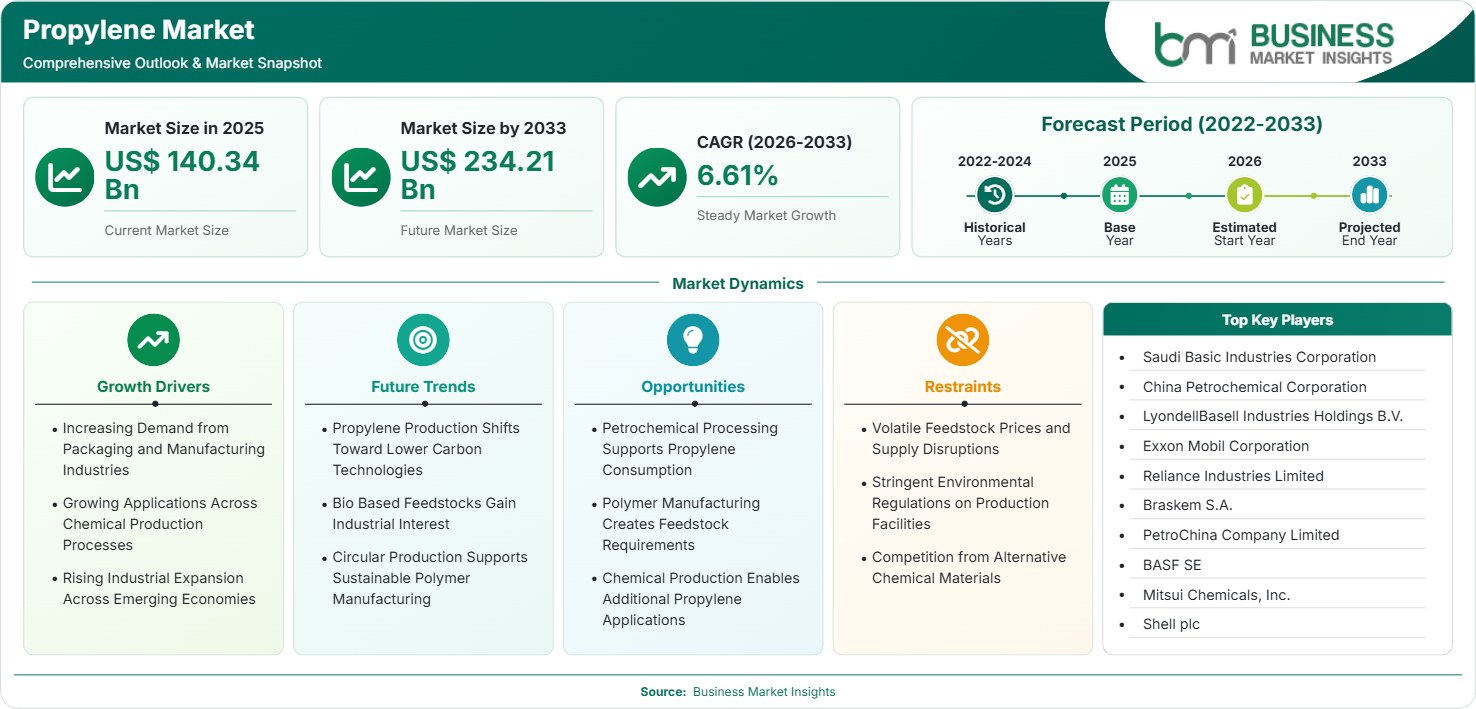
The Propylene Market size was valued at US$ 140.34 Billion in 2025 and is projected to reach US$ 234.21 Billion by 2033, growing at a CAGR of 6.61% during 2026–2033, supported by polypropylene demand, derivative expansion, packaging consumption, automotive lightweighting, and investment in integrated petrochemical capacity.

Report Coverage
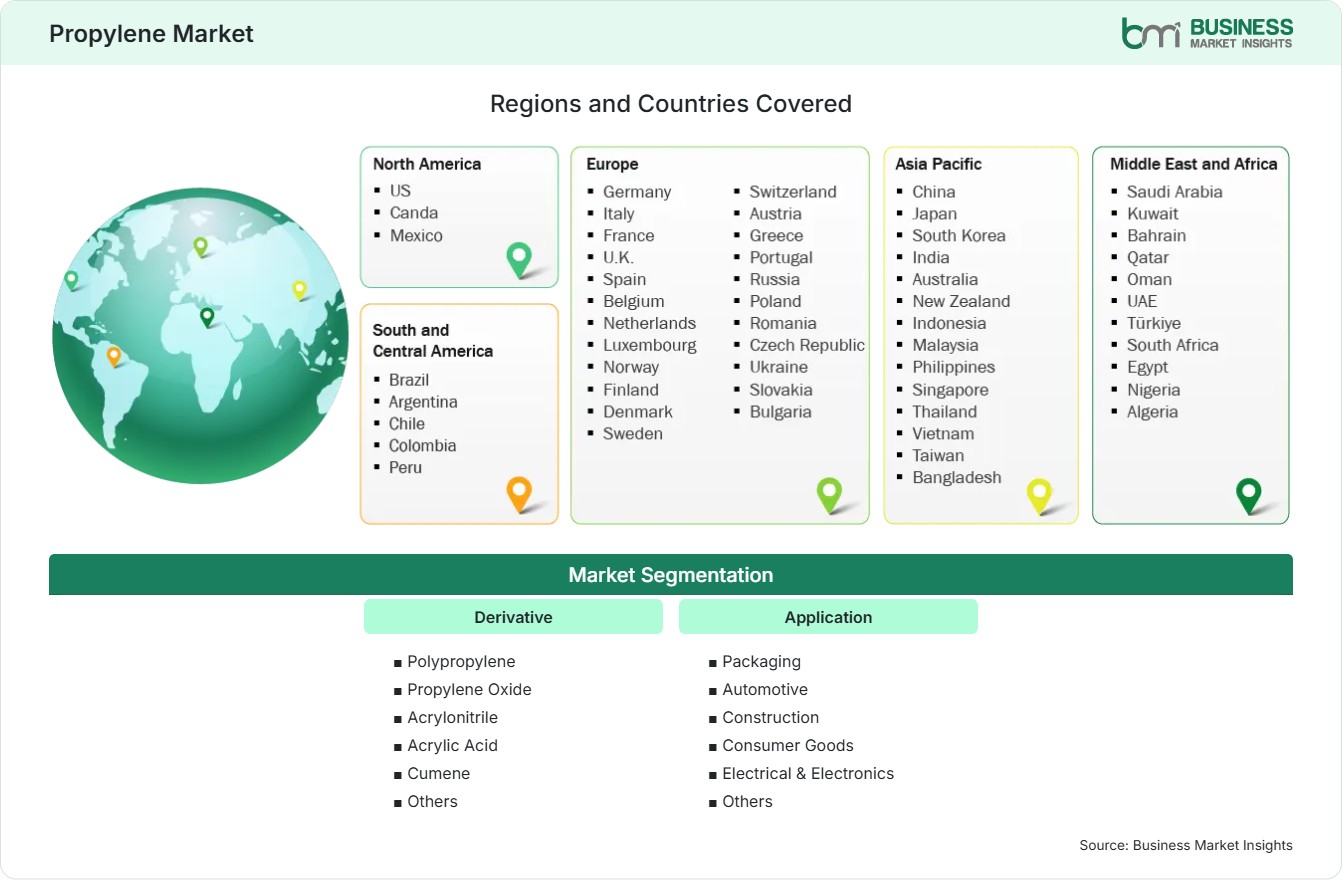
  • Derivative: Polypropylene, Propylene Oxide, Acrylonitrile, Acrylic Acid, Cumene, Others
  • Application: Packaging, Automotive, Construction, Consumer Goods, Electrical & Electronics, Others
US$ 140.34 Bn Market size in 2025
US$ 234.21 Bn Market Size by 2033
6.61% CAGR, 2026 - 2033
2026-2033 Forecast Period

AI Overview

Propylene Market Summary

  • North America Region: North America holds market share of 22%–25% in 2025, growing at a CAGR of 5.8%–6.4% during 2026–2033, influenced by advantaged feedstocks, integrated crackers, polypropylene capacity, reshoring, packaging demand, automotive materials, and chemical recycling investment. The US market benefits from abundant natural gas liquids, integrated petrochemical complexes, and polypropylene demand, supporting a 5.7%–6.3% CAGR during 2026–2033.
  • Fastest Growing Region: Asia Pacific holds market share of 46%–50% in 2025, advancing at a CAGR of 7.3%–8.0% during 2026–2033, supported by manufacturing expansion, urbanization, packaging conversion, automotive production, electronics demand, refinery integration, and new derivative capacity across China, India, and Southeast Asia.
  • Leading Segment: Polypropylene holds market share of 55%–59% in 2025, expanding at a CAGR of 6.3%–6.9% during 2026–2033, driven by flexible packaging, rigid containers, automotive components, medical products, consumer goods, lightweighting, and continuing substitution toward recyclable polymer formats.
  • High Growth Segment: Propylene Oxide holds an estimated share of 7%–10% in 2025, advancing at a CAGR of 7.1%–7.8% during 2026–2033, supported by polyurethane demand, construction insulation, automotive interiors, flexible foams, coatings, and investment in integrated propylene oxide production.
  • Key Market Opportunity: Circular feedstocks, high-purity derivatives, integrated production, and low-carbon propylene pathways can improve margins while helping producers satisfy recycled-content, emissions, and supply-security requirements across major consuming industries.
  • Major Market Players: Saudi Basic Industries Corporation; China Petrochemical Corporation; LyondellBasell Industries Holdings B.V.; Exxon Mobil Corporation; Reliance Industries Limited; Braskem S.A.; PetroChina Company Limited; BASF SE; Mitsui Chemicals, Inc.; Shell plc.
Strategic Insights

Propylene Market: Strategic Insights

Propylene Market Strategic Framework
FREE PDF
Request your free sample
Request free sample
Stakeholder View

Key Takeaways

  • Supply-chain competitiveness increasingly depends on integration from feedstock sourcing through propylene recovery and downstream conversion. Producers with refinery, cracker, storage, logistics, and derivative assets can manage feedstock volatility more effectively and capture value across multiple margin pools.
  • Polypropylene provides the strongest volume opportunity because packaging, automotive components, medical products, appliances, and consumer goods require lightweight, durable, and process-efficient materials. Demand for thin-wall packaging and high-performance grades can support premiumization beyond commodity resin volumes.
  • Technology development is moving toward higher-yield catalysts, flexible feedstock conversion, energy optimization, metathesis, propane dehydrogenation, and circular feedstocks. These approaches can improve asset economics while reducing exposure to conventional refinery-linked propylene availability.
  • Asia Pacific offers the strongest investment case because manufacturing concentration, population growth, packaging conversion, automotive production, and petrochemical integration create multiple demand channels. India and Southeast Asia provide particularly attractive incremental consumption opportunities as downstream manufacturing capacity expands.
  • Investment strategy is increasingly focused on selective debottlenecking, advantaged feedstocks, high-value derivatives, and portfolio optimization rather than indiscriminate commodity capacity. LyondellBasell, for example, combined new propylene investment with European portfolio rationalization during 2025.
  • Circularity is becoming a commercial differentiator. Producers able to provide traceable recycled or renewable feedstocks, mass-balance products, and compliant polymer grades can gain access to customers facing increasingly stringent packaging and sustainability requirements.
Geographic Outlook

Propylene Market Regional Highlights

North America Propylene Market

North America holds a 22%–25% Propylene Market share in 2025, with a 5.8%–6.4% CAGR during 2026–2033. The region benefits from the advantage of having an integrated refinery and petrochemical structure, an abundance of natural gas liquids, and a developed capability to convert polypropylene. The US continues to be the dominant source of demand and supply, while Canada and Mexico support their contributions via applications in automobiles, packaging, and other industries. Investments are now leaning towards advanced feedstock, downstream integration, efficiency, and circular plastics. Growth is characterized by replacement demand and some capacity additions.

  • US Gulf Coast integration supports competitive production through refinery, cracker, fractionation, storage, and derivative infrastructure, improving feedstock flexibility and export economics for major producers and converters.
  • Polypropylene consumption remains supported by food packaging, automotive components, medical products, appliances, and industrial applications requiring lightweight materials with strong chemical and impact resistance.
  • Chemical recycling investment is creating new feedstock channels. ExxonMobil reports expanded Baytown recycling capacity and continued development of circular raw-material systems for polymer production.
  • LyondellBasell’s Channelview expansion demonstrates continued confidence in Gulf Coast propylene demand, with approximately 400 thousand metric tons of additional annual capacity planned.

US Propylene Market

The US accounts for approximately 82%–86% of North American consumption and production value in 2025, with a 5.7%–6.3% CAGR over the Propylene Market Forecast period. The Gulf Coast has an infrastructure strength through its refining complex, crackers, pipeline networks, storage facilities, and export terminals. The economics of production depend on oil, natural gas, ethane, propane, and electricity prices. Specialty products such as polypropylene, propylene oxide, and derivatives play an increasingly important role in the decision-making process in changing margins.

  • The US Gulf Coast remains the dominant production corridor because integrated complexes can move propylene into polypropylene, oxo chemicals, acrylic derivatives, and other downstream chains with limited logistics friction.
  • ExxonMobil’s China and US chemical investments illustrate continued emphasis on large-scale integrated polymer systems, while its Baton Rouge polypropylene project adds 450,000 metric tons of annual capacity.
  • LyondellBasell’s Channelview project is designed to increase propylene self-sufficiency and supply polypropylene and propylene oxide value chains, reinforcing downstream integration.

Europe Propylene Market

Europe holds a 17%–20% Propylene Market share in 2025, expanding at a 4.9%–5.6% CAGR during 2026–2033. Germany, the Netherlands, France, Belgium, Italy, and Spain remain major producers of chemicals, even as high energy prices and Asian imports weigh on commodity markets. Germany and France will retain their leadership position, but Spain and Italy will provide better prospects for downstream activities. The regulatory environment supports circular feedstock, recyclability of packaging materials, energy efficiency, and value-added products as opposed to increased capacity alone.

  • Germany remains strategically important through integrated chemical manufacturing, downstream polymers, coatings, construction materials, and automotive supply chains requiring consistent propylene-derived intermediates.
  • France benefits from established petrochemical and automotive ecosystems. Demand opportunities center on polypropylene, acrylic derivatives, polyurethane systems, and materials supporting transportation and construction applications.
  • European production faces structural cost pressure. LyondellBasell and Covestro permanently closed the Maasvlakte PO11 unit in 2025 because of overcapacity, Asian imports, and high European production costs.
  • The EU packaging framework strengthens demand for recyclable and recycled-content solutions, creating opportunities for circular propylene derivatives and certified polymer grades.

Asia Pacific Propylene Market

Asia Pacific holds 46%–50% Propylene Market share in 2025, registering a 7.3%–8.0% CAGR during 2026–2033. China is the biggest producer/consumer region, whereas India, Japan, South Korea, Indonesia, Thailand, and Vietnam generate downstream demand. China still dominates the polypropylene production process, whereas India and Southeast Asia are key sources for future growth. Manufacturing location, urbanization, food transportation, consumer packaging, vehicle production, and electronics manufacturing help to generate derivative demand and stimulate capacity build-up.

  • China remains the leading regional market, supported by large polypropylene conversion capacity, packaging demand, automotive manufacturing, appliances, electronics, and expanding integrated petrochemical complexes.
  • India provides a compelling growth corridor as polymer demand, manufacturing investment, consumer packaging, automotive production, and infrastructure development increase downstream consumption across multiple propylene derivatives.
  • Southeast Asia is gaining strategic relevance as Thailand, Indonesia, Vietnam, and Malaysia expand manufacturing and packaging capabilities, creating additional demand for polypropylene and chemical intermediates.
  • Mitsui Chemicals continues to emphasize polyolefin technology, circular materials, and sustainable packaging applications, reflecting the region’s shift toward higher-performance and lower-impact polymer solutions.

Rest of World Propylene Market

South and Central America together contribute a 6%–8% Propylene Market share in 2025, while the Middle East and Africa contribute the balance, resulting in a 9%–12% RoW share and a 6.0%–6.7% CAGR during 2026–2033. The consumption leader in Latin America is Brazil, whereas Saudi Arabia acts as the supply base for the Middle East. Independent Africa has smaller markets but presents long-term opportunities via packaging, infrastructure, car assembly, and consumer goods manufacturing.

Brazil is advantaged by the integration of Braskem’s petrochemical network, as well as having a substantial conversion network for its domestic polymers. Mexico is an additional destination where downstream demand for packaging, automobiles, and industrial manufacturing exists. With regard to the Middle East, Saudi Arabia remains structurally advantaged due to the integration of its feedstocks, export capabilities, and large chemical plants that produce propylene and its derivatives.

  • Brazil combines domestic polymer demand with integrated production, making it the leading Latin American opportunity for polypropylene and downstream conversion industries.
  • Saudi Arabia benefits from advantaged feedstocks, integrated petrochemical infrastructure, export connectivity, and established derivative manufacturing, supporting its role as a major global supply hub.
  • Mexico offers growth through automotive manufacturing, food packaging, appliances, and industrial products, with proximity to US supply chains improving downstream competitiveness.
  • Africa provides emerging demand potential through urbanization, packaged food consumption, construction, healthcare, and consumer products, although infrastructure investment remains essential for sustained conversion growth.
Global Market Geography
FREE PDF
Request your free sample
Request free sample
Segment Analysis

Propylene Market Segmentation

Derivative

The Derivative segment accounts for approximately 92%–95% of total consumption value in 2025, with a 6.4%–6.9% CAGR during the Propylene Market Forecasts. Polypropylene dominates volume, while the higher value applications come from propylene oxide and acrylonitrile. Demand for acrylic acid, cumene, and similar products is diversified into applications in packaging, construction, coatings, automotive, consumer goods, and chemical production. The subsector enjoys extensive downstream diversification and continual substitution into high-performance materials.

  • Polypropylene: Represents the largest derivative outlet, supported by flexible packaging, rigid containers, automotive components, medical products, appliances, and consumer goods. Lightweighting and recyclable designs sustain demand for advanced grades.
  • Propylene Oxide: Serves polyurethane, propylene glycol, solvents, and chemical intermediates. Construction insulation, furniture, automotive interiors, and coatings provide recurring demand, while integrated production improves supply reliability.
  • Acrylonitrile: Supports acrylic fibers, ABS resins, and specialty plastics used in automotive, electronics, textiles, and consumer products. Demand benefits from durable lightweight materials and electronics manufacturing.
  • Acrylic Acid: Feeds superabsorbents, acrylate coatings, adhesives, and specialty polymers. Hygiene products, water-based coatings, construction chemicals, and packaging applications support continued derivative consumption.
  • Cumene: Primarily supports phenol and acetone value chains serving polycarbonate, resins, coatings, adhesives, and pharmaceuticals. Integrated refinery-aromatics infrastructure improves economics and feedstock availability.

Application

The Application segment is diversified across packaging, automotive, construction, consumer goods, electrical and electronics, and industrial uses. Packaging remains the largest application group with approximately 40%–44% Propylene Market share in 2025, while total applications expand at 6.2%–6.8% CAGR during 2026–2033 as lightweight materials replace heavier alternatives and downstream manufacturers seek performance, durability, and processing efficiency across high-volume products.

  • Packaging: Flexible films, rigid containers, caps, closures, food packaging, and healthcare packaging remain central demand areas, supported by lightweighting, shelf-life requirements, e-commerce distribution, and recyclable mono-material structures.
  • Automotive: Polypropylene and polyurethane-derived materials support bumpers, dashboards, trims, battery components, insulation, and interior systems. Lightweighting and electric-vehicle architecture create opportunities for engineered polymer grades.
  • Construction: Propylene derivatives support insulation, sealants, coatings, adhesives, and engineered materials. Infrastructure modernization and energy-efficient buildings increase demand for polyurethane and acrylic systems.
  • Consumer Goods: Household products, appliances, furniture, personal-care packaging, and durable goods use propylene-derived polymers for impact resistance, aesthetics, chemical resistance, and efficient mass production.
  • Electrical & Electronics: High-performance polypropylene and derivative materials support housings, insulation, capacitors, connectors, and protective components. Electronics manufacturing expansion strengthens demand for consistent quality and specialty grades.
Market Forces

Propylene Market Dynamics

Key Market Drivers

Polypropylene Demand Across Packaging and Mobility

Polypropylene will remain the primary driver of demand owing to its use in various industries such as packaging, automotive, medical, domestic appliances, and consumer goods, owing to its lightweight nature combined with rigidity and toughness. According to Reliance Industries, global demand for polymers is estimated to reach 259.0 million metric tons in 2025, with polypropylene demand increasing by 2.6%. The Propylene Market growth pattern is therefore directly correlated with polypropylene conversion volumes, particularly in the Asia-Pacific region. Packaging becomes critical as well, with thin-wall packaging, films, caps, closures, and medical packaging becoming lighter without compromising functionality. The automotive sector, through weight reduction, becomes yet another source of structural demand, particularly in the light of designing components for electric vehicles.

Feedstock Integration Improves Production Economics

Integration of feedstocks will increase producers' robustness amid volatility in prices of crude, naphtha, propane, ethane, and energy resources across different parts of the world. Both integrated refineries and crackers can extract propylene from various sources. The use of propane dehydrogenation and metathesis processes will also help increase flexibility. LyondellBasell’s Channelview project, scheduled for 2025, shows this approach. The Propylene Market trends increasingly favor assets capable of optimizing feedstock selection and maximizing derivative value rather than plants dependent on a single production route. Producers with integrated logistics and downstream assets can also reduce transportation exposure and manage regional supply disruptions more effectively.

Derivative Diversification Supports Higher-Value Growth

Propylene oxide, acrylonitrile, acrylic acid, and cumene are key diversification opportunities that do not rely solely on polypropylene for downstream products. Propylene oxide is cited by BASF as one of its significant monomers, and it has a production capacity of 675 thousand metric tons, underscoring the importance of downstream derivative production. The propylene oxide is used in the polyurethane and glycol chains for construction, furniture, auto, coating, and industrial applications. This diversification supports Propylene Market growth when individual polymer margins weaken. Producers increasingly evaluate projects based on combined derivative economics, feedstock flexibility, logistics, and access to specialty applications rather than headline propylene capacity alone.

Key Market Opportunities

Circular Propylene and Recycled Polymer Value Chains

The use of circular feedstocks represents an increasing business opportunity for both brand owners and packaging converters, who are now under pressure to use more recycled content in their products. The European Union’s Packaging Waste Regulation has set a minimum recycled content requirement for certain plastic packaging materials and broader recyclability requirements, a significant part of which will start to apply as of August 2026. The producers can address the challenge by using advanced recycling technology, mass-balance circular feedstocks, and mechanical recycling where feasible. For instance, ExxonMobil announced that the Baytown site increased its advanced recycling capacity and processed more than 100 million pounds of plastic by May 2025.

Asia Pacific Capacity and Downstream Manufacturing Expansion

The best investment opportunity lies in Asia-Pacific, driven by the development of new capacity for polymer conversion across the automotive, electronics, packaging, appliances, and construction manufacturing industries. China continues to be the largest demand center; India and Southeast Asia provide additional growth due to rising domestic demand and export manufacturing. It is possible to generate by integrating propylene, polypropylene, and propylene oxide, and again to be close to downstream users. Mitsui Chemicals' commitment to polyolefins, circular materials, and sustainable packaging illustrates how the region's producers combine traditional polymers with innovative materials.

Higher-Performance Grades and Specialty Derivatives

The premium grades offer an opportunity to increase product value per ton, since customers are now looking for materials in smaller quantities that are more durable, have good processability, and are easy to recycle. The packaging converters need high flow plastics in their thin-wall designs, whereas the automotive companies look for grades with stiffness, impact resistance, thermal properties, and low weight. In 2025, LyondellBasell introduced its grade called the Pro-fax EP649U, meant for use in the rigid packaging industry. It features high flow, rapid crystallization rate, and the ability to be lightweight. Similar strategies may be employed in the design of grades for use in the medical packaging, electrical, industrial, and automotive sectors.

Market Restraints and Challenges

Global Capacity Additions Pressure Commodity Margins

Factor: Rapid capacity additions, particularly across Asia, can exceed near-term derivative demand and increase regional export pressure.

Impact: Operating efficiency, producer margins, stock buildup, and delays in investment decisions may affect profitability despite consistent growth in underlying demand. Reliance Industries reported that polymer prices remained under pressure in FY2025-26 due to increased capacity additions worldwide, while polypropylene margins declined year on year. LyondellBasell also stated that global overcapacity and importation of Asian products were behind its decision to shut down its PO11 facility at Maasvlakte in 2025.

Energy Costs and Regulatory Complexity Constrain European Assets

Factor: European producers face comparatively high energy costs, environmental compliance requirements, carbon-related expenses, and evolving packaging regulations.

Impact: While production costs could climb faster than local prices, it would be difficult for the company to compete with foreign, cheaper inputs. This is one of the reasons LyondellBasell and Covestro decided to shut down their PO11 plant at Maasvlakte due to high production costs, Asian competition, and overcapacity. On the other hand, European Union regulations for packaging require the redesigning and testing of materials to make them recyclable and achieve higher recycling rates.

Company Analysis

Competitive Landscape

Propylene Market analysis indicates that competition is shaped by feedstock integration, geographic scale, derivative breadth, technology, logistics, and downstream customer access. Leading producers increasingly combine commodity propylene with polypropylene and intermediate chemicals, while sustainability investments are becoming important for maintaining access to global packaging and consumer-goods customers.

Company Name

Overview

Products and Services relevant to this market

Saudi Basic Industries Corporation

Saudi Arabia-based diversified petrochemical producer with major integrated manufacturing assets and strong global distribution.

Propylene, polypropylene, propylene-derived chemicals, polymers, intermediates, technology, and integrated petrochemical solutions.

China Petrochemical Corporation

Major Chinese integrated energy and chemical enterprise with extensive refining, olefins, polymer, and downstream manufacturing capabilities.

Propylene, polypropylene, propylene oxide, acrylonitrile, acrylic derivatives, refining, petrochemical production, and chemical technologies.

LyondellBasell Industries Holdings B.V.

Global chemical producer with significant olefins, polyolefin, intermediate, technology licensing, and integrated manufacturing operations.

Propylene, polypropylene, propylene oxide, olefins, polyolefin technologies, catalysts, and advanced polymer solutions.

Exxon Mobil Corporation

Integrated energy and chemicals company operating large-scale refining, olefins, polypropylene, and advanced recycling assets.

Propylene, polypropylene, olefins, performance polymers, chemical feedstocks, advanced recycling, and technology-enabled material solutions.

Reliance Industries Limited

Indian integrated energy and materials company with extensive refining, petrochemical, polymer, and downstream manufacturing infrastructure.

Propylene, polypropylene, polymers, petrochemicals, refinery-linked feedstocks, and integrated chemical products.

Braskem S.A.

Major Latin American petrochemical producer with integrated crackers, polymer assets, and strong regional customer networks.

Propylene-related olefins, polypropylene, polyolefins, chemical feedstocks, specialty polymer solutions, and circular materials.

PetroChina Company Limited

Chinese integrated energy producer with extensive refining and chemical operations supporting domestic and export markets.

Propylene, polypropylene, petrochemical intermediates, refining-linked feedstocks, polymers, and integrated chemical products.

BASF SE

Global chemical company with broad monomer, petrochemical, polymer, acrylic, and specialty chemical operations.

Propylene, propylene oxide, acrylic derivatives, monomers, catalysts, chemical intermediates, and application-focused materials.

Mitsui Chemicals, Inc.

Japanese chemical producer combining petrochemical operations with polyolefin technology, functional materials, and circular solutions.

Propylene, polypropylene, polyolefins, catalysts, sustainable packaging materials, circular polymers, and technology solutions.

Shell plc

Integrated energy and chemicals company with large-scale refining, chemicals, olefins, and polymer value-chain capabilities.

Propylene, olefins, polypropylene-related feedstocks, chemicals, refining, trading, logistics, and integrated petrochemical solutions.

Trust & Transparency

Research Methodology

The market analysis combines proprietary research with secondary data from government agencies, company disclosures, regulatory filings, industry databases and expert interviews. Market estimates are validated through data triangulation, cross-market benchmarking and analyst review.

View Full Research Methodology

Questions Answered

Frequently Asked Questions

How could packaging regulation influence future propylene demand?

Packaging regulation is likely to shift demand toward recyclable designs, recycled-content materials, mono-material structures, and traceable circular feedstocks. Producers able to combine polymer performance with documented sustainability characteristics can gain stronger access to regulated consumer markets.

Which applications offer the strongest premiumization potential?

High-performance packaging, automotive components, medical products, electrical components, and specialty industrial materials offer premiumization potential because customers value lightweighting, durability, process efficiency, thermal performance, and regulatory compliance rather than commodity pricing alone.

How is chemical recycling affecting propylene value chains?

Chemical recycling creates alternative feedstock streams for polymer production and can support certified circular products. Its commercial potential depends on collection economics, technology performance, regulatory recognition, energy requirements, and customer willingness to pay for circular materials.

Why is polypropylene the dominant propylene derivative?

The Propylene Market Report highlights that Polypropylene combines low density, chemical resistance, stiffness, impact performance, and efficient processing. These characteristics support high-volume applications including food packaging, healthcare products, automotive components, appliances, household goods, and industrial containers.

What determines propylene production economics across regions?

Feedstock availability, refinery integration, propane and ethane pricing, energy costs, logistics, plant scale, derivative integration, and regional operating rates determine production economics. Producers with multiple feedstock routes can adjust operating strategies when relative input costs change.

Access the Full Propylene Market Report

Get segment-level forecasts, regional estimates, competitive benchmarking, company profiles and downloadable Excel datasets.

Access the full Propylene Market Report
350 pages PDF & Excel | 2026-09-16
Similar Research

Related Market Reports