
Carbon Fiber Tapes Market Outlook: Size, Share, Trends, Growth Analysis, Competitive Landscape & Forecast, 2026-2033

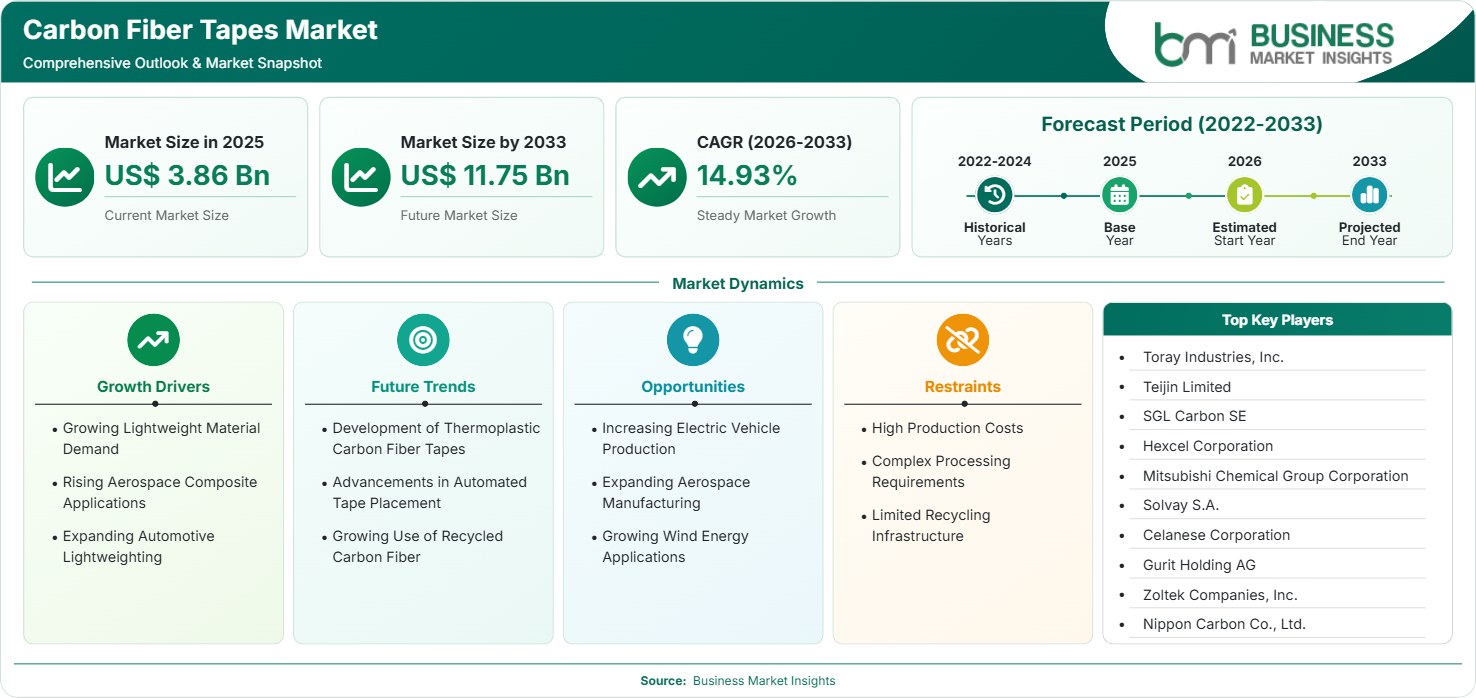
The Carbon Fiber Tapes Market size was valued at US$ 3.86 Billion in 2025 and is projected to reach US$ 11.75 Billion by 2033, growing at a CAGR of 14.93% during 2026–2033, supported by lightweighting, aerospace composites, electric mobility, automated processing, and renewable energy applications.

Report Coverage
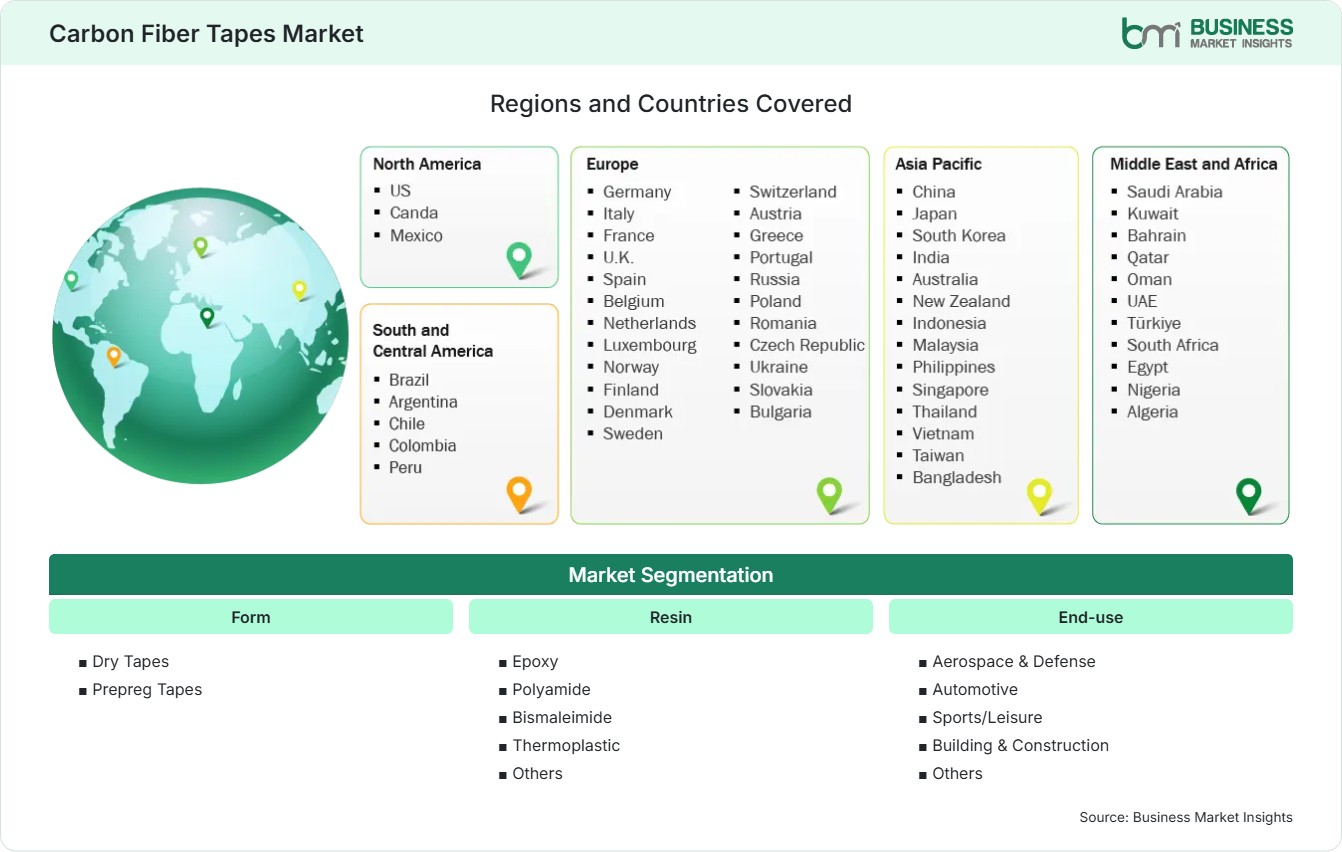
  • Form: Dry Tapes, Prepreg Tapes
  • Resin: Epoxy, Polyamide, Bismaleimide, Thermoplastic, Others
  • End-use: Aerospace & Defense, Automotive, Sports/Leisure, Building & Construction, Others
US$ 3.86 Bn Market size in 2025
US$ 11.75 Bn Market Size by 2033
14.93% CAGR, 2026 - 2033
2026-2033 Forecast Period

AI Overview

Carbon Fiber Tapes Market Summary

  • North America Region: North America holds a 29%–33% share in 2025, growing at a 14%–16% CAGR through 2033, supported by aerospace composites, defense modernization, automotive lightweighting, automated manufacturing, and advanced material investments. U.S. demand is led by aerospace, defense, automotive, and industrial applications, with a 14%–16% CAGR during 2026–2033.
  • Fastest Growing Region: Asia Pacific holds a 27%–31% share in 2025 and records a 16%–18% CAGR, driven by aerospace manufacturing, electric mobility, renewable energy equipment, industrial expansion, composite processing capacity, and increasingly localized advanced-material supply chains.
  • Leading Segment: Prepreg Tapes hold a 58%–62% share in 2025 and grow at a 15%–17% CAGR, supported by controlled resin distribution, predictable handling, automated placement compatibility, repeatable quality, and reduced downstream impregnation requirements.
  • High Growth Segment: Thermoplastic resin tapes hold a 12%–16% share in 2025 and expand at a 17%–19% CAGR, supported by rapid consolidation, welding compatibility, recyclability potential, shorter processing cycles, and increasing interest in high-rate composite manufacturing.
  • Key Market Opportunity: Opportunities center on automated tape placement, electric vehicle structures, aerospace components, wind applications, recyclable thermoplastic systems, selective reinforcement, and localized composite supply chains serving high-value applications.
  • Major Market Players: Toray Industries, Inc.; Teijin Limited; SGL Carbon SE; Hexcel Corporation; Mitsubishi Chemical Group Corporation; Solvay S.A.; Celanese Corporation; Gurit Holding AG; Zoltek Companies, Inc.; Nippon Carbon Co., Ltd.
Strategic Insights

Carbon Fiber Tapes Market: Strategic Insights

Carbon Fiber Tapes Market Strategic Framework
FREE PDF
Request your free sample
Request free sample
Stakeholder View

Key Takeaways

  • The value chain increasingly connects carbon fiber producers, resin suppliers, tape converters, equipment manufacturers, composite fabricators, and original equipment manufacturers.
  • Prepreg Tapes provide the strongest commercial foundation because controlled resin content, predictable handling, and automated placement compatibility support efficient composite manufacturing.
  • Product development is moving toward application-specific tape widths, resin chemistries, fiber architectures, tack levels, storage requirements, and processing windows.
  • Asia Pacific provides a compelling investment opportunity because aerospace, automotive, industrial, and renewable applications can generate multiple demand channels.
  • Investment priorities are increasingly centered on process automation, thermoplastic expertise, application engineering, and capacity flexibility.
Geographic Outlook

Carbon Fiber Tapes Market Regional Highlights

North America Carbon Fiber Tapes Market

North America accounts for 29%–33% share in 2025 and records a 14%–16% CAGR through 2033. Established composite engineering expertise, automated placement capabilities, and specialized material qualification strengthen regional competitiveness. The Carbon Fiber Tapes Market share is supported by advanced manufacturing clusters and demand for repeatable structural performance. Growth is also influenced by electric mobility, unmanned systems, industrial equipment, and localized supply-chain strategies across the region.

  • Aerospace uses need consistent reinforcement, light weight, stiffness, and automation placement compatible materials, which favor unique tape forms and rigorous qualification procedures.
  • The automotive industry evaluates the use of carbon reinforcement in certain structural parts that can benefit from low weight and controlled stiffness.
  • Defense relies on lightweight structures for mobility, load, durability, and equipment; this creates a need for specific reinforcing forms for these applications.
  • The opportunities presented by Canada and Mexico complement each other through aerospace, automotive, and industrial manufacturing.

US Carbon Fiber Tapes Market

The United States represents 68%–72% of North American demand in 2025 and advances at a 14%–16% CAGR through 2033. Demand favors specialized widths, controlled resin systems, and repeatable processing characteristics for high-value components. Supplier relationships can extend from fiber selection through composite fabrication, making technical support strategically important where material consistency and processing reliability outweigh lower-cost reinforcement alternatives.

  • Aerospace and defense remain core applications because demanding performance specifications support higher-value composite reinforcement and extended qualification relationships.
  • Automotive development creates opportunities for lightweight structures, battery-related components, performance parts, and selective reinforcement compatible with automated production.
  • Industrial users increasingly evaluate tapes for tooling, robotics, specialized machinery, and lightweight equipment where repeatability can improve production economics.

Europe Carbon Fiber Tapes Market

Europe holds 22%–26% share in 2025 and posts a 13%–15% CAGR through 2033. Germany, France, the United Kingdom, and Italy provide established aerospace, automotive, motorsport, machinery, and composite-processing capabilities. Germany provides strong industrial demand, while France remains important for aerospace. The United Kingdom and Italy offer specialist opportunities across advanced mobility, sports equipment, aerospace, and engineering.

  • Germany combines automotive engineering depth with industrial automation, supporting tailored tapes for structural and production-intensive composite applications.
  • France benefits from aerospace manufacturing concentration, encouraging qualification of high-performance reinforcement formats and process-compatible prepreg solutions.
  • The United Kingdom supports specialist aerospace, motorsport, defense, and engineering applications where customized reinforcement can command technical premiums.
  • Italy provides opportunities across automotive, sports equipment, machinery, and composite conversion where lower mass and design flexibility are valued.

Asia Pacific Carbon Fiber Tapes Market

Asia Pacific represents 27%–31% share in 2025 and achieves the fastest regional CAGR of 16%–18% through 2033. China, Japan, South Korea, and India provide manufacturing ecosystems spanning automotive, aerospace, electronics, industrial equipment, and renewable energy. Japan remains important for advanced carbon materials, while China combines large manufacturing capacity with expanding composite applications. India and South Korea provide high-growth opportunities through aerospace, mobility, and industrial investment.

  • China provides a broad application base linking composite demand with automotive production, renewable equipment, industrial machinery, and aerospace development.
  • Japan combines advanced carbon-material expertise with demanding automotive, electronics, aerospace, and industrial applications requiring consistent quality.
  • South Korea benefits from advanced manufacturing and mobility industries, creating opportunities for high-performance tapes and automated composite processing.
  • India offers emerging opportunities across aerospace, defense, automotive, infrastructure, and renewable equipment as domestic manufacturing capabilities expand.

Rest of World Carbon Fiber Tapes Market

Rest of World accounts for 15%–19% share in 2025 and expands at a 12%–15% CAGR through 2033. South and Central America gain opportunities from automotive, sports, industrial equipment, and renewable applications, while Middle East and Africa demand is linked with infrastructure, energy, transportation, and industrial diversification. Brazil represents a leading South American opportunity, while the United Arab Emirates and Saudi Arabia provide high-growth industrial platforms. Regional adoption remains selective and depends strongly on converter capabilities, technical support, supply reliability, and project-specific composite requirements.

  • Brazil provides the strongest regional platform because aerospace, automotive, sports, and industrial applications create several pathways for composite reinforcement adoption.
  • The United Arab Emirates offers specialized aerospace, mobility, and industrial opportunities supported by advanced manufacturing participation and international supply-chain connectivity.
  • Saudi Arabia provides opportunities through industrial diversification, transportation equipment, renewable projects, and localized manufacturing development.
  • Regional converters can capture additional value by pairing imported tape materials with cutting, forming, application engineering, and composite fabrication services.
Global Market Geography
FREE PDF
Request your free sample
Request free sample
Segment Analysis

Carbon Fiber Tapes Market Segmentation

Form

The Form segment is led by Prepreg Tapes, holding 58%–62% share in 2025 and growing at a 15%–17% CAGR between 2026–2033. Controlled resin content, handling consistency, automated placement compatibility, and reduced downstream impregnation support adoption. Dry Tapes remain important where manufacturers prefer customized infusion, consolidation, or resin integration during fabrication. Carbon Fiber Tapes Market scope expands as both forms address distinct production architectures.

  • Dry Tapes: Dry reinforcement supports infusion and consolidation processes where resin selection occurs downstream. Flexible handling and adaptable processing sustain demand across industrial and larger composite structures.
  • Prepreg Tapes: Pre-impregnated reinforcement provides controlled resin distribution and repeatable processing, supporting aerospace, automotive, sports, and precision components requiring efficient automated placement.

Resin

The Resin segment is led by Epoxy, representing 48%–52% share in 2025 and growing at a 14%–16% CAGR through 2033. Epoxy remains favored for structural performance, adhesion, and established processing knowledge. Thermoplastic systems provide the highest growth profile, supported by rapid consolidation, welding potential, and recyclability considerations. Bismaleimide retains specialized aerospace relevance, while polyamide supports selected thermal and processing requirements. Carbon Fiber Tapes Market trends increasingly reflect application-specific resin selection.

  • Epoxy: Epoxy systems support structural laminates through strong adhesion, established curing methods, and broad processing knowledge, making them central to aerospace, automotive, sports, and industrial applications.
  • Polyamide: Polyamide matrices serve applications requiring balanced toughness, thermal capability, and processing flexibility, supporting selected automotive, industrial, and mobility components.
  • Bismaleimide: Bismaleimide systems address demanding thermal environments, particularly specialized aerospace applications where elevated-temperature performance supports premium reinforcement.
  • Thermoplastic: Thermoplastic matrices enable rapid consolidation, welding, reshaping potential, and improved production throughput, creating strong opportunities in automotive, aerospace, and high-volume composite manufacturing.
  • Others: Other resin chemistries serve specialized requirements where thermal behavior, curing profile, toughness, or application compatibility justify alternatives to mainstream systems.

End-use

The End-use segment is led by Aerospace & Defense, holding 39%–43% share in 2025 and advancing at a 14%–16% CAGR through 2033. High-performance requirements, weight sensitivity, and qualification-driven procurement favor advanced tape formats. Automotive provides incremental demand through lightweighting and electrification, while sports, construction, and industrial uses broaden volume opportunities. Carbon Fiber Tapes Market share across end uses depends on qualification speed, processing economics, application engineering, and manufacturing scalability.

  • Aerospace & Defense: Aerospace and defense applications prioritize low mass, stiffness, durability, and repeatable reinforcement placement, supporting premium tapes for structural components, interiors, tooling, and specialized equipment.
  • Automotive: Automotive adoption centers on lightweight structures, performance components, electric mobility, and selective reinforcement, with automation and cycle-time reduction influencing commercial viability.
  • Sports/Leisure: Sports applications use carbon reinforcement for stiffness, low weight, and controlled performance, supporting demand in bicycles, equipment, protective products, and specialized recreational components.
  • Building & Construction: Construction applications can use carbon reinforcement for strengthening, lightweight structures, and repair-oriented composite systems where installation efficiency and durability support substitution.
  • Others: Other end uses include industrial tooling, robotics, energy equipment, and specialized machinery where lightweight construction, corrosion resistance, and design flexibility create application-specific demand.
Market Forces

Carbon Fiber Tapes Market Dynamics

Key Market Drivers

Growing Lightweight Material Demand

Reducing weight is one of the major considerations when designing structures in fields such as mobility, aerospace, industrial machinery, and sports equipment since it can lead to efficiency and other benefits. The use of carbon fiber tapes allows for selective reinforcement rather than uniform composite reinforcement, thereby optimizing material placement. Additionally, automated tape placement assists in ensuring orientation control and selective reinforcement. The Carbon Fiber Tapes Market growth is positively influenced by a shift towards composite architecture from metal-based architecture. The market is moving towards increased automation capabilities, manageable tape dimensions, reliable tape handling, and appropriate resin system cycle times.

Rising Aerospace Composite Applications

The aerospace industry requires structures that have stiffnes-to-weight ratio, dimensional stability, fatigue resistance, and manufacturing control. The carbon fiber tapes meet these demands via oriented fibers and compatibility with automated tape placement. With more composite-laden platforms being developed, the manufacturers of carbon fiber tapes may distinguish themselves through such qualities as width management, impregnation efficiency, storage properties and curing behavior. The Carbon Fiber Tapes Market trends are driven by aircraft manufacturing as well as by reducing cycle time without neglecting qualification processes. Another layer of demand comes from defense projects involving lightweight structures, unmanned systems, mobility equipment and other composite-requiring gear.

Expanding Automotive Lightweighting

The automotive industry tends to investigate advanced composites where lower weight, stiffness, durability, and assembly lead to more expensive materials and processes. Tape reinforcement can be used for some structural components without complete use of composite parts. Hybrid solutions, combining metals, polymers, and carbon-based reinforcement, are possible. Electric cars give an interesting field since the lower weight can play its role in achieving better efficiency and performance. Commercial exploitation depends on certain issues such as cycle time, automation, joining and scrap considerations. The trend is to have smaller reinforcement particles that use materials only in places where they are necessary.

Key Market Opportunities

Increasing Electric Vehicle Production

Electric vehicle platforms provide opportunities to develop lightweight composite components since low weight is beneficial in cases where efficiency, range, performance, or structural application is necessary. The use of carbon fiber tapes may be employed within the construction of battery structure parts, body parts, reinforcement areas, suspension parts, and high-performance parts when economics are in favor of their usage. Thermoplastic solutions offer more advantages for those applications where faster consolidation and joining of materials is required. It would be wise to concentrate efforts on repeatable processes, tape widths scaling up, and multi-functionality. The Carbon Fiber Tapes Market Forecasts highlight the fact that suppliers who manage to implement the benefits of material performance in production architecture will benefit from this approach.

Expanding Aerospace Manufacturing

Aerospace manufacturing offers a premium opportunity because lightweight composite structures can justify higher material and processing costs when performance requirements are stringent. Tape suppliers can capture value by creating application-based reinforcement systems, automation-friendly placing and qualification documentation. The manufacturers of fiber and resin who are also equipped with the capability to convert the materials into tapes will be able to meet quality demands. Technical centers located locally will be able to handle activities such as cutting, kitting, placing and optimization.

Growing Wind Energy Applications

Wind energy creates opportunities for carbon reinforcement in parts in which stiffness, fatigue behavior, and weight become factors in the design process. It is possible that carbon tapes could provide targeted reinforcement in difficult loading cases, avoiding unnecessary material in comparison to broader methods. The use would depend on the cost-effectiveness of the component, its size, durability, and compatibility with current composite manufacturing methods. The suppliers will concentrate on producing spars, reinforcements, tools, and other components for which carbon proves to be superior. Carbon Fiber Tapes Market analysis shows that design specificity, reliability, and predictability of supply may prove to be competitive advantages in the search for performance improvement.

Market Restraints and Challenges

High Production Costs

Factor: Carbon fiber precursor processing, fiber conversion, resin formulation, tape consolidation, quality control, and specialized handling contribute to higher production complexity and material costs than conventional reinforcement systems. Impact: Higher total material cost can restrict adoption in price-sensitive automotive, construction, and industrial applications. Growth of the market would therefore hinge on achieving greater production efficiencies and increased throughput rates. Manufacturers have an incentive to maximize efficiency in fiber usage, conversion into tapes, resin placement, and automation compatibility. In addition, the cost factor could motivate the use of selective reinforcement, as opposed to building components from carbon fiber altogether.

Complex Processing Requirements

Factor: Carbon fiber tape processing can require controlled temperature, pressure, resin management, fiber alignment, storage conditions, and specialized placement equipment. Impact: Processing complexity can increase capital requirements, operator training needs, qualification timelines, and manufacturing integration costs. The need to have materials that facilitate this process can make it difficult for processors without the ability to combine materials. The suppliers can however lower this barrier by ensuring the materials are easy to handle, having large processing windows, and providing technical assistance to their clients. Automated tape placement can similarly help in lowering variability when the materials are made in a manner suitable for the machines.

Company Analysis

Competitive Landscape

The Carbon Fiber Tapes Market analysis indicates competition across carbon-material expertise, resin technology, tape conversion, application engineering, qualification capabilities, and composite manufacturing support. Differentiation increasingly depends on technical consistency and application integration.

Company Name

Overview

Products and Services relevant to this market

Toray Industries, Inc.

Advanced-materials producer with extensive carbon fiber and composite capabilities serving demanding industrial applications.

Carbon fiber, prepreg materials, composite technologies, reinforcement solutions, and application engineering.

Teijin Limited

Diversified materials company with carbon fiber and composite capabilities across mobility and aerospace applications.

Carbon fiber, composite intermediate materials, prepreg technologies, and lightweight reinforcement solutions.

SGL Carbon SE

Carbon-material specialist serving automotive, aerospace, industrial, and energy applications.

Carbon fibers, composite materials, reinforcement products, and processing support.

Hexcel Corporation

Composite-material specialist focused strongly on aerospace and industrial applications.

Carbon fiber, prepreg, composite reinforcement, honeycomb materials, and engineering solutions.

Mitsubishi Chemical Group Corporation

Global chemicals and materials producer with carbon fiber and composite-material expertise.

Carbon fiber, thermoplastic and thermoset composite materials, prepreg technologies, and reinforcement systems.

Solvay S.A.

Advanced-materials supplier with high-performance composite technology capabilities.

Composite prepregs, resin systems, thermoplastic materials, and reinforcement technologies.

Celanese Corporation

Engineered-materials producer with polymer and composite expertise for lightweight components.

Thermoplastic composite materials, engineered polymers, and reinforcement-compatible systems.

Gurit Holding AG

Composite-material specialist providing engineered materials and manufacturing solutions.

Prepregs, core materials, adhesives, tooling, and composite engineering support.

Zoltek Companies, Inc.

Carbon fiber producer focused on industrial-scale and cost-sensitive composite applications.

Industrial carbon fiber, reinforcement materials, and composite solutions.

Nippon Carbon Co., Ltd.

Carbon-material specialist with established high-performance industrial material capabilities.

Carbon fiber, carbon materials, composite reinforcement, and specialized industrial materials.

Trust & Transparency

Research Methodology

The market analysis combines proprietary research with secondary data from government agencies, company disclosures, regulatory filings, industry databases and expert interviews. Market estimates are validated through data triangulation, cross-market benchmarking and analyst review.

View Full Research Methodology

Questions Answered

Frequently Asked Questions

What does the Carbon Fiber Tapes Market Report help companies evaluate?

It helps stakeholders evaluate regional demand patterns, material forms, resin choices, end-use opportunities, production constraints, supplier positioning, and investment priorities without introducing unsupported external statistics.

What determines tape selection for an aerospace component?

Selection depends on fiber architecture, resin chemistry, tape width, handling characteristics, temperature requirements, structural loading, curing method, qualification requirements, and compatibility with intended placement equipment.

Why are thermoplastic carbon fiber tapes gaining attention?

Thermoplastic matrices can support rapid consolidation, welding, reshaping potential, and higher production rates. These characteristics are attractive where manufacturers need shorter cycles and more automated composite processing.

Which manufacturing process benefits most from prepreg tapes?

Automated tape placement benefits strongly from prepreg tapes because resin distribution is established before placement. This can improve repeatability and reduce separate impregnation steps during composite fabrication.

How do carbon fiber tapes differ from conventional carbon fiber fabrics?

Carbon fiber tapes provide controlled directional reinforcement in continuous or tailored widths, making them suitable for automated placement and localized strengthening.

Access the Full Carbon Fiber Tapes Market Report

Get segment-level forecasts, regional estimates, competitive benchmarking, company profiles and downloadable Excel datasets.

Access the full Carbon Fiber Tapes Market Report
350 pages PDF & Excel | 2026-08-19