
PAN-Based Carbon Fiber Cloth Market Outlook: Size, Share, Trends, Growth Analysis, Competitive Landscape & Forecast, 2022-2033

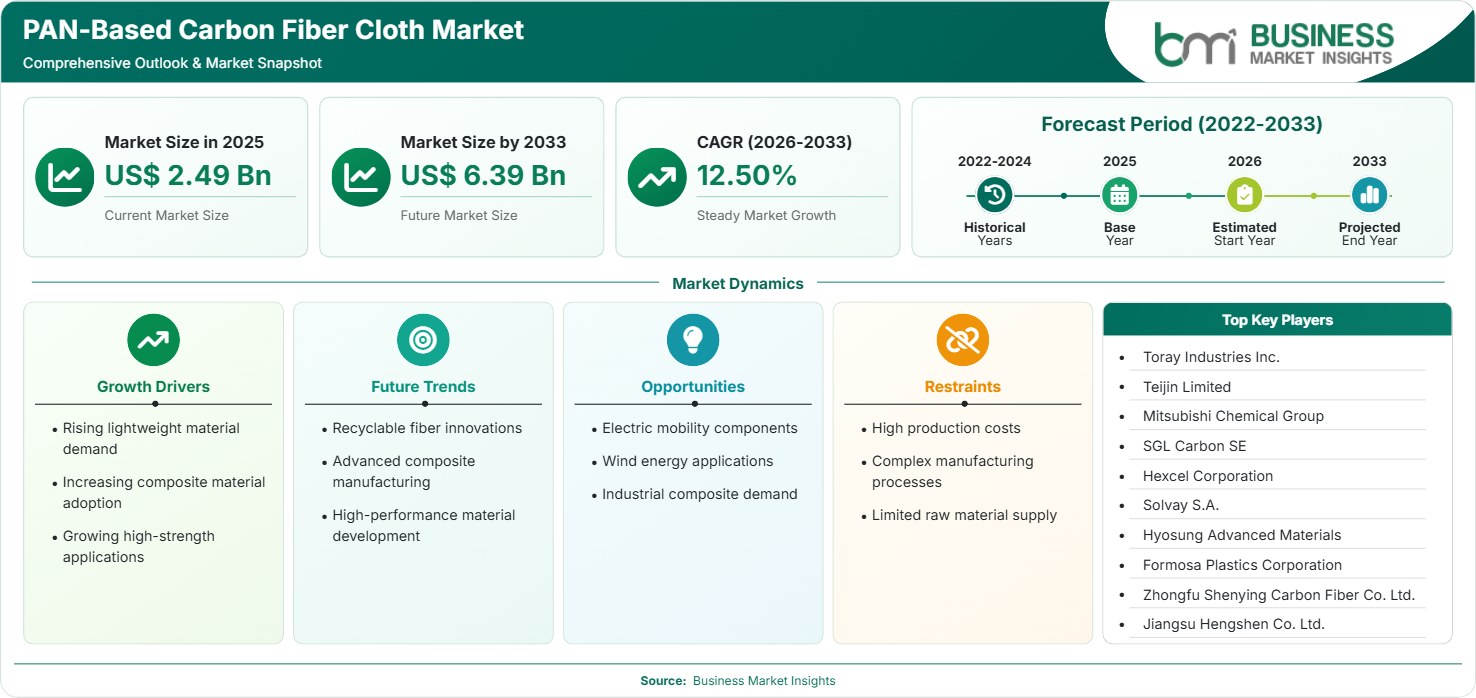
The PAN-Based Carbon Fiber Cloth Market size was valued at US$ 2.49 billion in 2025 and is projected to reach US$ 6.39 billion by 2033, growing at a CAGR of 2.50% during 2026–2033. Rising lightweight material demand, increasing composite material adoption, and growing high-strength applications continue driving industry expansion. Opportunities are emerging from electric mobility components, wind energy projects, and rising industrial composite consumption.

Report Coverage
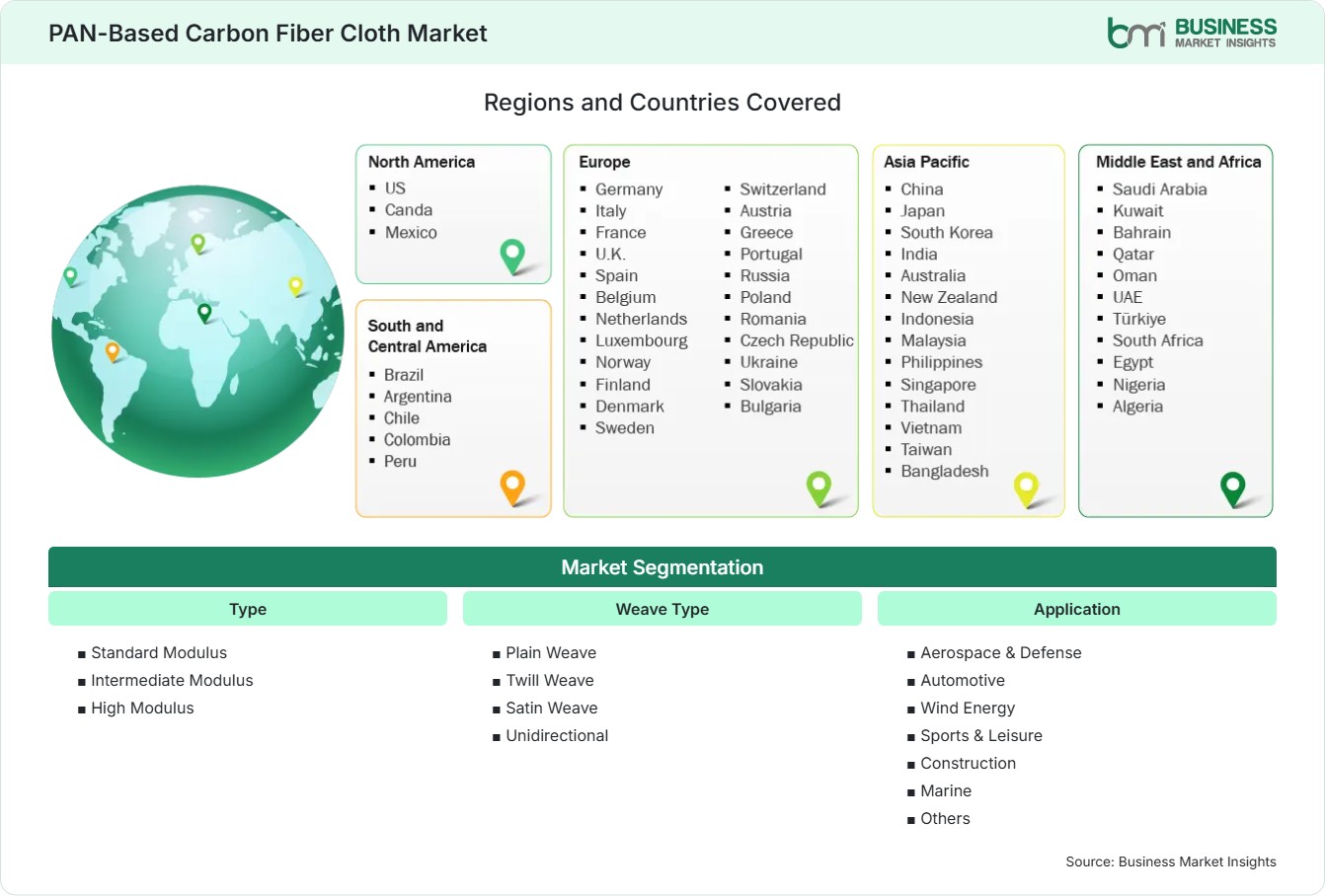
  • Type: Standard Modulus, Intermediate Modulus, High Modulus
  • Weave Type: Plain Weave, Twill Weave, Satin Weave, Unidirectional
  • Application: Aerospace & Defense, Automotive, Wind Energy, Sports & Leisure, Construction, Marine, Others
US$ 2.49 Bn Market size in 2025
US$ 6.39 Bn Market Size by 2033
12.50% CAGR, 2026 - 2033
2026-2033 Forecast Period

01 AI Overview

PAN-Based Carbon Fiber Cloth Market Summary

  • North America Region: North America accounts for 31%–34% market share in 2025 and is projected to grow at a CAGR of 2.3%–2.7% during 2026–2033. Strong aerospace manufacturing, defense investments, and increasing automotive lightweighting initiatives continue supporting regional demand. The U.S. market is expected to register a CAGR of 2.4%–2.8% through 2033, driven by advanced composite manufacturing and defense modernization.
  • Fastest Growing Region: Asia Pacific holds 34%–37% market share in 2025 while expanding at a CAGR of 2.7%–3.1% during 2026–2033. Expanding carbon fiber production capacity, increasing electric vehicle manufacturing, and growing wind energy investments continue accelerating market growth.
  • Leading Segment: Standard Modulus accounts for 47%–50% market share in 2025 and is expected to grow at a CAGR of 2.4%–2.8%. Broad application across aerospace, automotive, industrial, and sporting goods sectors continues supporting segment leadership.
  • High Growth Segment: Aerospace & Defense contributes 34%–37% market share in 2025 while growing at a CAGR of 2.8%–3.2%. Rising aircraft production, defense modernization, and increasing demand for lightweight structural materials continue driving adoption.
  • Key Market Opportunity: Growing adoption of carbon fiber composites in electric mobility, wind turbine blades, and industrial lightweight structures is creating long-term opportunities for advanced material manufacturers.
  • Major Market Players: Toray Industries Inc., Teijin Limited, Mitsubishi Chemical Group, SGL Carbon SE, Hexcel Corporation, Solvay S.A., Hyosung Advanced Materials, Formosa Plastics Corporation, Zhongfu Shenying Carbon Fiber Co. Ltd., Jiangsu Hengshen Co. Ltd.
02 Strategic Insights

PAN-Based Carbon Fiber Cloth Market: Strategic Insights

PAN-Based Carbon Fiber Cloth Market Strategic Framework
FREE PDF
Request your free sample
Request free sample
03 Stakeholder View

Key Takeaways

  • Aerospace and defense continue representing the most technologically advanced application area due to increasing demand for lightweight, high-strength composite structures.
  • Electric vehicle manufacturers are expanding carbon fiber utilization to reduce vehicle weight and improve battery efficiency.
  • Automation in composite manufacturing and improved fiber processing technologies are enhancing production quality and operational efficiency.
  • Asia Pacific offers the strongest long-term investment potential through expanding production capacity, industrialization, and renewable energy infrastructure.
  • Strategic investments in advanced composite materials, production expansion, and long-term supply agreements continue strengthening market competitiveness.
04 Geographic Outlook

PAN-Based Carbon Fiber Cloth Market Regional Highlights

North America PAN-Based Carbon Fiber Cloth Market

North America remains one of the leading regional markets owing to strong aerospace manufacturing, defense investments, and advanced composite production capabilities. The region accounts for 31%–34% PAN-Based Carbon Fiber Cloth Market share in 2025 and is projected to grow at a CAGR of 2.3%–2.7% through 2033. Rising adoption of lightweight engineering materials continues supporting long-term regional demand.

  • Aerospace manufacturers continue increasing composite material utilization to improve aircraft fuel efficiency and structural performance.
  • Automotive companies expand lightweight vehicle development to improve energy efficiency and emissions performance.
  • Defense modernization programs support demand for advanced carbon fiber composite components.
  • Technological innovation continues strengthening PAN-Based Carbon Fiber Cloth Market growth across industrial applications.

US PAN-Based Carbon Fiber Cloth Market

The United States represents the largest country-level market, accounting for 25%–28% global market share in 2025 while growing at a CAGR of 2.4%–2.8% through 2033. Expanding aerospace production, defense procurement, and advanced manufacturing capabilities continue driving market growth.

  • Commercial aircraft production supports consistent demand for carbon fiber reinforcement materials.
  • Defense programs continue expanding the use of lightweight structural composites.
  • Industrial automation strengthens domestic advanced material manufacturing capabilities.

Europe PAN-Based Carbon Fiber Cloth Market

Europe accounts for 27%–30% market share in 2025 and is projected to expand at a CAGR of 2.4%–2.8% during the forecast period. Germany leads regional demand through advanced automotive and aerospace manufacturing, while Spain records one of the fastest growth rates at 2.8%–3.2% supported by renewable energy investments.

  • Germany remains the regional leader through strong automotive engineering and industrial composite production.
  • Spain benefits from expanding wind energy installations and composite manufacturing activities.
  • Sustainable transportation initiatives increase lightweight material adoption across Europe.
  • Renewable energy investments support additional carbon fiber consumption.

Asia Pacific PAN-Based Carbon Fiber Cloth Market

Asia Pacific is the largest and fastest-growing regional market, accounting for 34%–37% market share in 2025 while expanding at a CAGR of 2.7%–3.1% through 2033. China dominates production and consumption, while India records the fastest growth at 3.0%–3.4% due to expanding electric vehicle production and industrial manufacturing.

  • China continues expanding carbon fiber production capacity and downstream composite manufacturing.
  • India benefits from increasing investments in electric mobility and industrial composites.
  • Japan and South Korea maintain technological leadership in advanced carbon fiber production.
  • Wind energy expansion continues supporting demand for high-performance reinforcement materials.

Rest of World PAN-Based Carbon Fiber Cloth Market

The Rest of World region contributes 8%–10% market share in 2025 and is expected to register a CAGR of 2.5%–2.9% through 2033. Brazil leads South American demand, while the United Arab Emirates records one of the fastest growth rates at 2.9%–3.3% owing to increasing aerospace investments and industrial diversification.

  • Brazil supports demand through expanding industrial manufacturing and transportation sectors.
  • The UAE invests in aerospace manufacturing and advanced industrial technologies.
  • Marine and infrastructure projects increase utilization of corrosion-resistant composite materials.
  • Regional industrial diversification continues creating opportunities for advanced composite suppliers.
Global Market Geography
FREE PDF
Request your free sample
Request free sample
05 Segment Analysis

PAN-Based Carbon Fiber Cloth Market Segmentation

By Type

The type segment is led by Standard Modulus carbon fiber cloth due to its balanced mechanical properties, cost-effectiveness, and broad industrial applicability. The segment accounts for 47%–50% market share in 2025 and is projected to grow at a CAGR of 2.4%–2.8% during 2026–2033. Increasing utilization across aerospace, automotive, and industrial manufacturing continues expanding the PAN-Based Carbon Fiber Cloth Market scope.

  • Standard Modulus: Standard modulus carbon fiber cloth dominates owing to its excellent strength-to-weight ratio, versatile processing characteristics, and widespread use across structural composite manufacturing applications.
  • Intermediate Modulus: Intermediate modulus products are increasingly adopted in aerospace, automotive, and sporting equipment where enhanced stiffness and mechanical performance are required without significantly increasing component weight.
  • High Modulus: High modulus carbon fiber cloth is utilized in premium aerospace, defense, satellite, and high-performance industrial applications requiring exceptional rigidity, dimensional stability, and lightweight structural performance.

By Weave Type

Plain Weave represents the largest weave segment owing to its balanced strength characteristics, dimensional stability, and ease of handling during composite manufacturing. The segment contributes 38%–41% market share in 2025 while expanding at a CAGR of 2.3%–2.7% through 2033. Increasing demand for high-quality composite laminates continues strengthening the PAN-Based Carbon Fiber Cloth Market share across multiple industries.

  • Plain Weave: Plain weave offers excellent fabric stability, uniform fiber distribution, and simplified processing, making it suitable for aerospace, automotive, and industrial composite applications.
  • Twill Weave: Twill weave provides superior drapability and surface finish, enabling manufacturers to fabricate complex composite components with improved mechanical performance.
  • Satin Weave: Satin weave is preferred for applications requiring enhanced flexibility, smooth surface characteristics, and reduced fiber crimp in high-performance composite structures.
  • Unidirectional: Unidirectional carbon fiber cloth delivers maximum strength along a single axis, making it ideal for structural reinforcement, wind turbine blades, and aerospace components.

By Application

The Aerospace & Defense segment remains the largest application area owing to extensive adoption of lightweight composite materials in aircraft structures and defense systems. The segment accounts for 34%–37% market share in 2025 while growing at a CAGR of 2.8%–3.2% through 2033. Increasing aircraft production and advanced composite engineering continue supporting long-term market expansion.

  • Aerospace & Defense: The leading application segment driven by demand for lightweight, corrosion-resistant, and high-strength composite materials that improve aircraft efficiency and structural durability.
  • Automotive: Automotive manufacturers increasingly utilize carbon fiber composites to reduce vehicle weight, improve fuel efficiency, and enhance electric vehicle driving range.
  • Wind Energy: Wind energy applications continue expanding through increased use of lightweight composite materials in turbine blades and structural reinforcement components.
  • Sports & Leisure: Sports equipment manufacturers utilize carbon fiber cloth to improve product strength, durability, and lightweight performance across premium sporting goods.
  • Construction: Construction companies increasingly adopt carbon fiber reinforcement for structural strengthening, bridge rehabilitation, and infrastructure repair applications.
  • Marine: Marine applications benefit from corrosion-resistant composite materials that reduce vessel weight while improving durability and operational efficiency.
06 Market Forces

PAN-Based Carbon Fiber Cloth Market Dynamics

Key Market Drivers

Rising lightweight material demand

The increasing need for lightweight materials in aerospace, automobile, renewable energy, and manufacturing industries is continuously influencing the usage of carbon fiber cloth made from polyacrylonitrile. The manufacturers are constantly using composite materials rather than metals to increase fuel efficiency and decrease emissions while simultaneously enhancing their performance. The use of lightweight engineering materials is further helping in developing electric vehicles through efficient batteries and increasing driving ranges.

Increasing composite material adoption

The use of composite materials has been increasing to replace conventional materials owing to their high strength, corrosion resistance, fatigue endurance, and design capability. Companies dealing with aerospace industry, automotive industry, wind turbine production, and industrial equipment manufacture have continued to explore more uses for composite materials so as to enhance their efficiency. Developments in automated composite manufacturing and resin systems make it possible to utilize carbon fiber composites in diverse industries.

Growing high-strength applications

The rising need for materials that can offer excellent mechanical strength with minimal weight is creating a rising demand for carbon fiber fabrics made from PAN. Such high performance uses include aircraft components, pressure vessels, military products, marine systems, and machinery where materials have to be fatigue-resistant and dimensionally stable. The rising investment in various engineering applications is anticipated to create future demand for such high-strength reinforcing materials.

Key Market Opportunities

Electric mobility components

The rapid expansion of electric vehicle production is creating significant growth opportunities reflected in the PAN-Based Carbon Fiber Cloth Market forecast, as lightweight composite materials improve battery efficiency, vehicle performance, and driving range while helping manufacturers comply with increasingly stringent emissions and energy efficiency regulations. Growing investments in premium electric vehicles and next-generation mobility solutions are expected to increase the utilization of PAN-based carbon fiber cloth across structural components, battery enclosures, and other lightweight automotive applications, supporting long-term market expansion and technological innovation.

Wind energy applications

Expanding global investment in renewable energy infrastructure is increasing demand for advanced composite materials used in wind turbine blades, making this a key PAN-Based Carbon Fiber Cloth Market trend. PAN-based carbon fiber cloth provides high stiffness, reduced weight, and superior fatigue resistance required for longer, more efficient turbine blades. Furthermore, continued expansion of offshore and onshore wind energy capacity is creating long-term growth opportunities for composite material suppliers while driving innovation in high-performance carbon fiber solutions for renewable energy applications.

Industrial composite demand

Advanced composite materials are being utilized in the industries for pressure vessel, robotics, manufacturing equipment, chemical processing system, industrial machine, and infrastructure reinforcement applications. The carbon fiber cloth provides improved durability, corrosion resistance, high strength-to-weight ratio, and increased operational efficiency in extreme industrial applications. The increasing focus on industrial automation, advanced manufacturing processes, and modernization programs is driving the use of lightweight and advanced composite materials. The rising need for efficient and durable reinforcement material in difficult working environments is further helping in driving the market forward. Continued industrial modernization, infrastructure modernization, and automation are likely to drive the demand for high-performance carbon fiber cloth and composite reinforcement materials.

Market Restraints and Challenges

High production costs

Factor: Manufacturing PAN-based carbon fiber cloth requires expensive precursor materials, energy-intensive stabilization and carbonization processes, and advanced production equipment.

Impact: High manufacturing costs increase product prices and restrict adoption in cost-sensitive industries. Manufacturers continue investing in process optimization and production scale improvements to enhance affordability while maintaining material performance and quality standards.

Complex manufacturing processes

Factor: Carbon fiber production involves multiple precision-controlled stages, including precursor preparation, stabilization, oxidation, carbonization, surface treatment, weaving, and rigorous quality inspection, all of which require advanced manufacturing technologies, specialized equipment, and highly skilled technical expertise. Maintaining consistent product quality across every production stage further adds to manufacturing complexity.

Impact: Manufacturing complexity increases production time, operational costs, energy consumption, and quality control requirements while requiring significant capital investment. These challenges can limit production capacity expansion, extend lead times, and reduce manufacturing flexibility. As a result, adoption may slow among cost-sensitive industries seeking lower-cost alternative reinforcement materials, creating challenges for broader commercialization despite the superior performance characteristics of carbon fiber

07 Company Analysis

Competitive Landscape

The market is characterized by strong competition among global carbon fiber manufacturers investing in capacity expansion, advanced composite technologies, and high-performance material innovation. The PAN-Based Carbon Fiber Cloth Market analysis indicates that companies are strengthening strategic partnerships with aerospace, automotive, wind energy, and industrial manufacturers to expand their global presence and improve supply chain resilience.

Company Name

Overview

Products and Services Relevant to this Market

Toray Industries Inc.

Global leader in advanced materials and carbon fiber technologies.

PAN-based carbon fiber cloth, prepregs, composite materials, aerospace-grade carbon fibers.

Teijin Limited

Manufacturer of high-performance fibers and composite solutions.

Carbon fiber fabrics, composite materials, thermoplastic composites, aerospace reinforcement products.

Mitsubishi Chemical Group

Global supplier of advanced chemicals and performance materials.

Carbon fiber cloth, composite materials, industrial reinforcement solutions, specialty fibers.

SGL Carbon SE

German producer of carbon-based materials for industrial applications.

Carbon fiber fabrics, composite materials, graphite products, lightweight engineering solutions.

Hexcel Corporation

Leading manufacturer of advanced composite materials for aerospace.

Carbon fiber cloth, prepregs, honeycomb structures, aerospace composite systems.

Solvay S.A.

Global specialty materials company serving advanced manufacturing industries.

Carbon fiber composites, thermoset materials, aerospace-grade reinforcement solutions.

Hyosung Advanced Materials

Producer of industrial fibers and advanced reinforcement materials.

Carbon fiber products, industrial reinforcement fabrics, composite materials.

Formosa Plastics Corporation

Diversified materials manufacturer with advanced composites portfolio.

Carbon fiber materials, industrial composites, engineered material solutions.

Zhongfu Shenying Carbon Fiber Co. Ltd.

Chinese manufacturer specializing in carbon fiber production.

PAN-based carbon fibers, woven carbon fiber cloth, composite reinforcement materials.

Jiangsu Hengshen Co. Ltd.

Integrated carbon fiber manufacturer serving industrial applications.

Carbon fiber cloth, PAN precursor materials, woven composites, structural reinforcement products.

08 Industry Activity

Recent Developments

June 2026

Hexcel Corporation announced a long-term industrial partnership with Deutsche Aircraft to supply advanced carbon fiber composite materials for the D328eco regional aircraft program, strengthening the adoption of PAN-based carbon fiber composites in next-generation aerospace structures.

March 2026

Toray Carbon Fibers Europe S.A. announced the start-up of a new carbon fiber production facility, expanding manufacturing capacity for PAN-based carbon fiber materials used in aerospace, automotive, energy, and industrial composite applications.

March 2026

Hexcel Corporation announced that it would showcase its latest high-performance carbon fiber, woven fabrics, prepregs, and composite material solutions at JEC World 2026, including new products for aerospace, defense, automotive, and industrial markets.

February 2026

Toray Industries, Inc. announced that the Toray Group would jointly exhibit at JEC World 2026, showcasing new PAN-based carbon fiber fabrics, composite materials, and advanced reinforcement technologies for aerospace, mobility, energy, and industrial applications.

10 Trust & Transparency

Research Methodology

The market analysis combines proprietary research with secondary data from government agencies, company disclosures, regulatory filings, industry databases and expert interviews. Market estimates are validated through data triangulation, cross-market benchmarking and analyst review.

View Full Research Methodology

11 Questions Answered

Frequently Asked Questions

What opportunities are expected in the market?

Key opportunities include electric mobility components, wind energy applications, and industrial composite demand, supported by increasing investment in lightweight engineering materials and renewable energy infrastructure.

Who are the leading companies in the PAN-Based Carbon Fiber Cloth Market Report?

Major companies include Toray Industries Inc., Teijin Limited, Mitsubishi Chemical Group, SGL Carbon SE, Hexcel Corporation, Solvay S.A., Hyosung Advanced Materials, Formosa Plastics Corporation, Zhongfu Shenying Carbon Fiber Co. Ltd., and Jiangsu Hengshen Co. Ltd.

Which type dominates the market?

Standard Modulus carbon fiber cloth leads the market because it offers an excellent balance of strength, durability, processing efficiency, and cost-effectiveness across multiple high-performance applications.

Which region is expected to experience the fastest growth?

Asia Pacific is projected to record the fastest growth due to expanding carbon fiber production, increasing electric vehicle manufacturing, renewable energy investments, and growing industrial composite demand.

What is driving the PAN-Based Carbon Fiber Cloth Market?

The market is driven by rising lightweight material demand, increasing composite material adoption, and growing high-strength applications across aerospace, automotive, renewable energy, and industrial sectors.

Access the Full PAN-Based Carbon Fiber Cloth Market Report

Get segment-level forecasts, regional estimates, competitive benchmarking, company profiles and downloadable Excel datasets.

Access the full PAN-Based Carbon Fiber Cloth Market Report
350 pages PDF & Excel | 2026-07-31