
Viscose Staple Fiber Market Outlook: Size, Share, Trends, Growth Analysis, Competitive Landscape & Forecast, 2026-2033

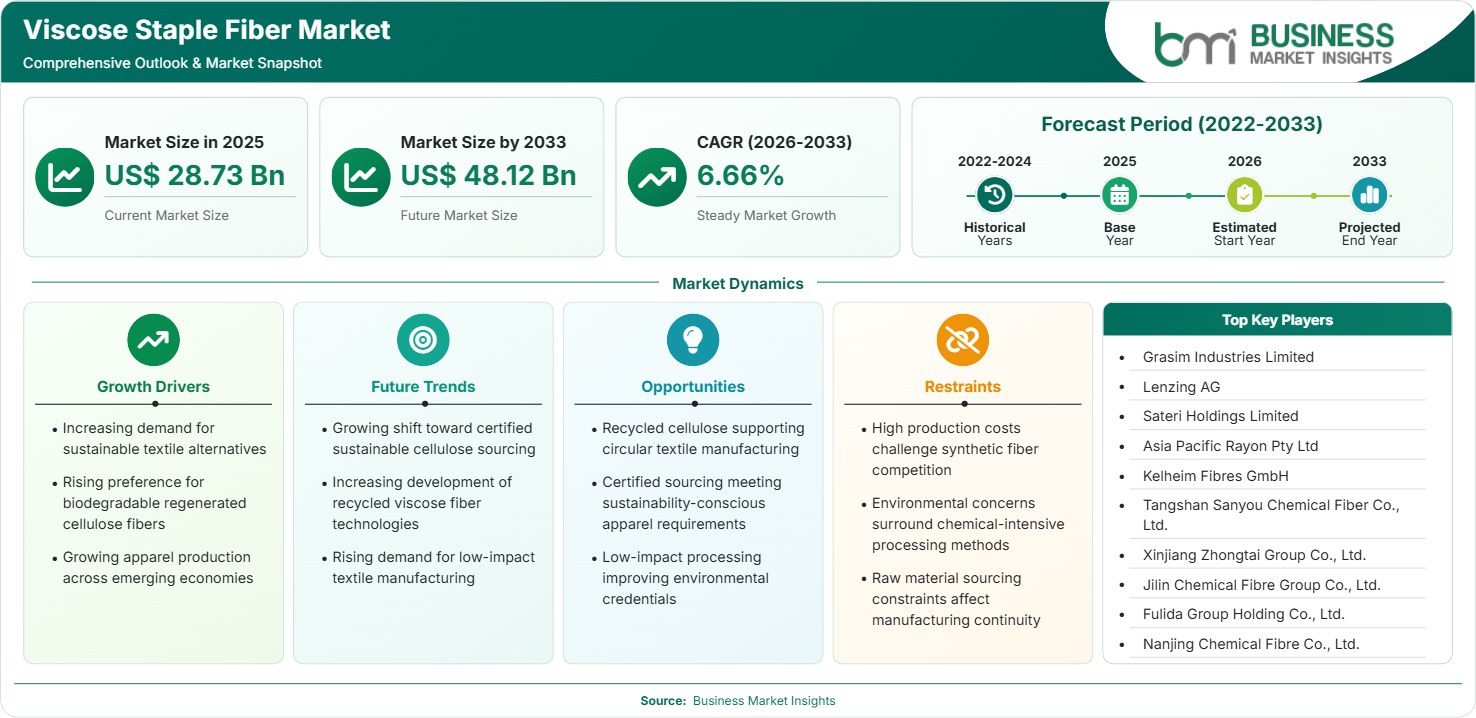
The Viscose Staple Fiber Market size was valued at US$ 28.73 Billion in 2025 and is projected to reach US$ 48.12 Billion by 2033, growing at a CAGR of 6.66% during 2026–2033. Rising sustainable textile demand, expanding nonwoven applications, circular fiber investments, bio-based material adoption, and improving manufacturing efficiencies are creating substantial growth opportunities across global value chains.

Report Coverage
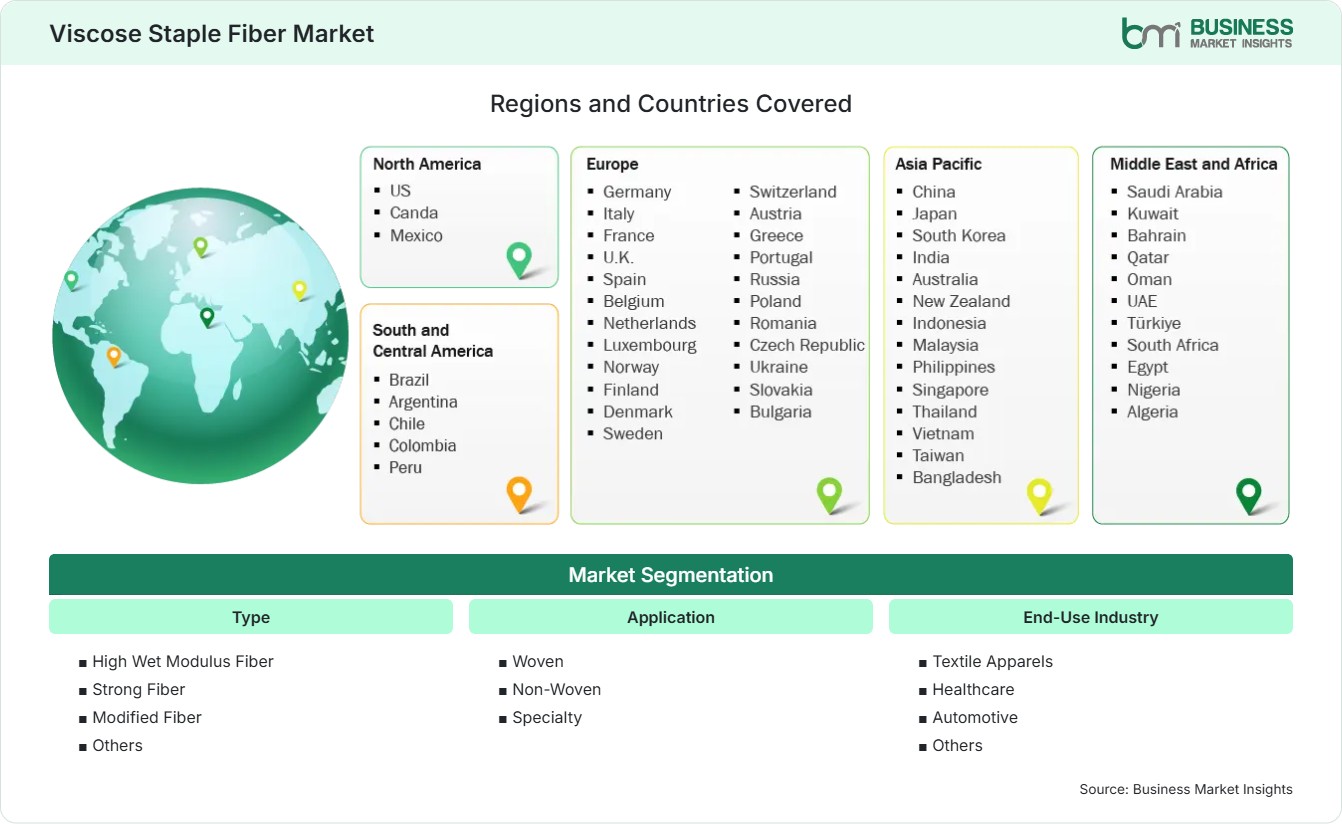
  • Type: High Wet Modulus Fiber, Strong Fiber, Modified Fiber, Others
  • Application: Woven, Non-Woven, Specialty
  • End-Use Industry: Textile Apparels, Healthcare, Automotive, Others
US$ 28.73 Bn Market size in 2025
US$ 48.12 Bn Market Size by 2033
6.66% CAGR, 2026 - 2033
2026-2033 Forecast Period

AI Overview

Viscose Staple Fiber Market Summary

  • North America Region: Holds a Viscose Staple Fiber Market share of 22%–25% in 2025, growing at a CAGR of 5.8%–6.2% during 2026–2033. Demand for sustainable apparel materials, healthcare nonwovens, traceable sourcing, and recycled cellulose solutions supports expansion across premium textile and industrial users. US market benefits from domestic sustainability initiatives and grows at 5.9%–6.3% CAGR through 2033.
  • Fastest Growing Region: Asia Pacific accounts for 46%–50% share in 2025 and advances at 7.2%–7.8% CAGR during 2026–2033. Expanding textile manufacturing, growing disposable income, integrated supply chains, and fiber capacity additions encourage consumption across apparel, hygiene, industrial, and specialty applications.
  • Leading Segment: Textile Apparels represents a 48%–52% share in 2025 and expands at 6.4%–6.9% CAGR during 2026–2033. Fashion sustainability goals, comfort properties, moisture management, and replacement of petroleum-based fibers continue supporting adoption among global garment manufacturers.
  • High Growth Segment: Healthcare captures 14%–17% of the Viscose Staple Fiber Market share in 2025 and grows at 7.4%–8.0% CAGR during 2026–2033. Increasing utilization in hygiene products, medical disposables, wound-care materials, and biodegradable nonwoven solutions strengthens long-term consumption patterns.
  • Key Market Opportunity: Commercialization of recycled cellulose feedstocks, closed-loop processing technologies, sustainable sourcing certification, and circular textile platforms can enhance margins, regulatory compliance, brand differentiation, and long-term fiber demand globally.
  • Major Market Players: Grasim Industries Limited, Lenzing AG, Sateri Holdings Limited, Asia Pacific Rayon Pty Ltd, Kelheim Fibres GmbH, Tangshan Sanyou Chemical Fiber Co., Ltd., Xinjiang Zhongtai Group Co., Ltd., Jilin Chemical Fibre Group Co., Ltd., Fulida Group Holding Co., Ltd., Nanjing Chemical Fibre Co., Ltd.
Strategic Insights

Viscose Staple Fiber Market: Strategic Insights

Viscose Staple Fiber Market Strategic Framework
FREE PDF
Request your free sample
Request free sample
Stakeholder View

Key Takeaways

  • Integrated producers with access to dissolving pulp maintain stronger cost control, supply reliability, and margin resilience compared with standalone fiber manufacturers.
  • Healthcare nonwovens and specialty technical textiles present the highest medium-term upside because sustainability regulations increasingly favor biodegradable fiber alternatives.
  • Product innovation is moving toward low-impact production processes, recycled cellulose feedstocks, certified sourcing systems, and circular material recovery platforms.
  • India, Indonesia, Vietnam, and Bangladesh provide compelling investment opportunities due to expanding textile production ecosystems and export-oriented manufacturing growth.
  • Strategic alliances between global fashion brands and fiber suppliers are accelerating capacity expansion, sustainability certification adoption, and value-chain transparency initiatives.
  • Premium viscose grades designed for performance apparel and hygiene applications are likely to generate higher profitability than commodity-focused offerings.
Geographic Outlook

Viscose Staple Fiber Market Regional Highlights

North America Viscose Staple Fiber Market

North America accounts for 22%–25% Viscose Staple Fiber Market share in 2025 and is projected to expand at 5.8%–6.2% CAGR through 2033. Demand is concentrated in sustainable apparel manufacturing, home textiles, healthcare products, and industrial nonwoven applications. Consumer preference for environmentally responsible fibers continues strengthening procurement activity. Regulatory focus on traceability and responsible sourcing is encouraging premium-grade adoption. Regional converters increasingly collaborate with global fiber suppliers to secure certified materials and support supply-chain transparency initiatives.

  • Sustainable fashion commitments encourage fiber substitution and support increasing procurement of certified cellulose-based materials.
  • Healthcare nonwoven demand continues expanding through wound-care products, hygiene applications, and disposable medical textiles.
  • Investments in circular textile infrastructure strengthen recycling ecosystems and promote sustainable material utilization.
  • Brand requirements for traceability, emissions disclosure, and responsible sourcing influence procurement decisions.

US Viscose Staple Fiber Market

The United States represents 72%–76% of North American share and advances at 5.9%–6.3% CAGR through 2033. Growth is supported by premium apparel demand, sustainability commitments from major brands, and increasing adoption of biodegradable nonwoven materials. Domestic textile modernization and supply-chain diversification initiatives are reinforcing consumption patterns. Corporate ESG targets remain an important driver of purchasing decisions throughout the value chain.

  • Apparel retailers increasingly specify certified cellulose fibers within sourcing programs.
  • Healthcare manufacturers are expanding biodegradable nonwoven product portfolios.
  • Recycling and circularity projects improve long-term sustainability credentials.
  • Digital traceability tools enhance transparency across textile supply networks.

Europe Viscose Staple Fiber Market

Europe contributes 20%–23% in 2025 and records a 6.0%–6.5% CAGR. Regional demand is influenced by stringent environmental standards, responsible forestry requirements, and circular-economy policies. Germany remains the leading market, while Eastern European manufacturing hubs display faster expansion rates. Premium textile producers increasingly adopt certified cellulose fibers to comply with sustainability commitments. Regulatory emphasis on product lifecycle transparency supports value-added product development and commercialization.

  • Germany leads regional demand supported by advanced textile and industrial manufacturing.
  • Poland and Romania exhibit higher growth due to expanding textile processing activity.
  • EU sustainability policies accelerate transition toward renewable fiber materials.
  • Circular textile programs encourage collection, recycling, and reuse investments.
  • Branded sustainable textile collections stimulate demand for premium viscose products.

Asia Pacific Viscose Staple Fiber Market

Asia Pacific holds a 46%–50% share in 2025 and remains the fastest-growing region with a 7.2%–7.8% CAGR. China represents the largest production center, while India delivers strong consumption growth. Integrated supply chains, abundant manufacturing capacity, and rising disposable incomes support long-term expansion. Export-focused textile industries across South and Southeast Asia continue increasing procurement of cellulose fibers. The region also benefits from ongoing investments in sustainable production technologies.

  • China continues leading production and consumption across textile applications.
  • India demonstrates strong growth supported by apparel manufacturing expansion.
  • Vietnam and Bangladesh strengthen regional textile export competitiveness.
  • Capacity additions improve supply availability and production efficiency.
  • Sustainability certifications increasingly influence export-oriented manufacturing strategies.

Rest of World Viscose Staple Fiber Market

The Rest of World category accounts for 8%-11% of market share in 2025 and is expected to grow at a 6.3%-6.8% CAGR. Textile consumption and sustainability concerns drive growth in South and Central America. The Middle East & Africa have potential for investment in diversifying industries and in textile manufacturing. Brazil is the most dominant market of Latin America, whereas the UAE and South Africa are expected to exhibit growth due to industry development programs.

  • Brazil leads demand through its established textile manufacturing sector.
  • UAE investment initiatives support textile and nonwoven industry development.
  • South Africa benefits from industrial modernization and diversified fiber consumption.
  • Rising apparel demand contributes to regional market expansion.
  • Infrastructure improvements support broader manufacturing competitiveness.
Global Market Geography
FREE PDF
Request your free sample
Request free sample
Segment Analysis

Viscose Staple Fiber Market Segmentation

Type

Type segmentation held around 38%–42% market share in 2025 and is estimated to grow at a 6.5%–7.0% CAGR. Product differentiation will be based on performance, strength properties, moisture content, and sustainability. The scope of the Viscose Staple Fiber Market continues to expand due to the availability of specialized grades for various textile applications.

  • High Wet Modulus Fiber: Preferred for dimensional stability and durability. Increasing adoption in premium apparel and home textiles supports market expansion through enhanced fabric performance.
  • Strong Fiber: Gains traction where higher tensile strength is essential, especially in industrial, technical, and blended textile applications demanding durability and operational reliability.
  • Modified Fiber: Developed for specialty performance characteristics including flame resistance, absorbency enhancement, and customized functionality addressing emerging industrial requirements.

Application

Application categories are expected to account for around 31%–35% of the market in 2025 and are forecast to grow at a CAGR of 6.6%–7.1%. The application varies depending on the required durability, comfort, absorbency, and sustainability. Viscose Staple Fiber Market trends suggest a growing preference for multifunctional products that can be used in many textile manufacturing processes.

  • Woven: Dominates consumer textile usage due to comfort, softness, breathability, and extensive use across apparel and home furnishing products.
  • Non-Woven: Expanding rapidly through healthcare, hygiene, filtration, and disposable product applications requiring absorbency and biodegradability.
  • Specialty: Focuses on niche technical requirements, premium performance fabrics, and application-specific functionality supporting differentiated product offerings.

End-Use Industry

The end-use industry segment accounts for 48%-52 % of revenue in 2025 and is expected to grow at a 6.4%-6.9% CAGR. Trends affecting consumption include sustainable goals, functional performance demands, and compliance aspects. The Viscose Staple Fiber market shares the largest share in the apparel market because of textile manufacturing globally.

  • the scale of Textile Apparel: Largest ction segment driven by softness, dyeability, comfort, and compatibility with sustainable fashion initiatives.
  • Healthcare: Rapid expansion supported by medical disposables, hygiene products, wound-care materials, and biodegradable nonwoven adoption.
  • Automotive: Increasingly utilized in interiors, insulation materials, and lightweight textile components requiring comfort and sustainability attributes.
Market Forces

Viscose Staple Fiber Market Dynamics

Key Market Drivers

Expansion of Sustainable Textile Consumption

Growing awareness of the environmental impacts of synthetic fibers is prompting textile manufacturers to adopt cellulose-based fibers. The leading brands in the fashion industry are continuing their efforts toward sustainability, including the use of renewable materials. Industry actions, including CanopyStyle and responsible forestry certifications, are enhancing the traceability of material sourcing. The increase in demand is even more apparent in the segments of premium clothing, household textiles, and lifestyle, where customers opt for low-impact fabrics. The ability to recycle and biodegrade is driving the trend towards using cellulose-based fibers. Companies with certified production processes for their fibers stand to gain from rising demand.

Growth in Hygiene and Healthcare Nonwoven Markets

Healthcare & hygiene-related applications are becoming an important source of demand for regenerated cellulose fibers. Growing use in the form of wipes, healthcare disposables, hygiene goods, and absorbers provides diversification of demand beyond conventional textile applications. Population growth, rising healthcare spending, and improved access to medical facilities are other factors that will sustain consumption trends. Manufacturers of nonwovens have been turning towards environmentally friendly sources for their materials. Technological advancements in absorbency, softness, and functionality have led to the development of products that are accepted for advanced medical uses. This has led to increased use of nonwovens and greater versatility across various industries.

Technological Advancements in Production Efficiency

These companies remain focused on investing in the development of closed-loop processes, chemical recycling, digital process control, and energy-efficient production facilities. This results in lower emission intensity and improved resource utilization efficiency. The new facilities also demonstrate increased productivity and consistent quality. Improved production technology enables the development of specialized fibers for various applications. Increased efficiency will enable producers to cope with rising pressures from material costs and regulations.

Key Market Opportunities

Commercialization of Circular Textile Ecosystems

The increasing interest in textile-to-textile recycling creates an enormous opportunity for producers. By creating strategic partnerships between fiber producers, fashion companies, and recycling companies, a closed material loop is being established. Recycled cellulose materials would reduce dependence on raw materials and improve sustainability performance. Circularity infrastructure is also seen by investors as a very promising area for growth. Policy initiatives make adoption even more favorable. Innovative business models can increase efficiency and help create a premium brand. Long-term Viscose Staple Fiber Market forecasts remain heavily dependent on the development of circular supply chain technologies.

Rapid Industrialization Across Emerging Asian Economies

Developing nations, including India, Vietnam, Bangladesh, and Indonesia, are still making significant investments to build textile production capabilities. With increased export business and rising local consumption, there is a favorable environment for growth in fiber demand. Urbanization trends drive apparel consumption, while government manufacturing policies spur industry growth. Chain synergies in the region improve efficiency and make the producers more competitive. Producers that can provide manufacturing clusters with their products can benefit from tremendous growth. Capacity expansion projects continue to reinforce the region's strategic importance within the global fiber ecosystem.

Development of High-Performance Specialty Fiber Products

Fibers for technical textiles, automotive interior fabrics, health care goods, and performance wear offer higher-value-added potential than commodity grades. Innovation efforts aimed at strength, absorbency, antimicrobial properties, and sustainability create added value. Consumers look for functionality-based products tailored specifically to applications. Investments in research facilitate the development of solutions for emerging performance needs. Successful commercialization of specialty fibers mitigates risks of price instability.

Market Restraints and Challenges

Raw Material Price Volatility and Supply Dependence

Factor: The use of wood pulp and other raw materials renders the companies vulnerable to fluctuations in raw material costs, forest availability, and transport costs. Impact: Production costs may increase without notice, affecting the products' profitability and price stability. Other factors contributing to the volatility include global supply interruptions, transportation problems, and currency fluctuations. Manufacturers always experience difficulty in balancing customer-expected prices and cost-recovery requirements. Sustained volatility may delay investment decisions, pressure operating margins, and influence procurement strategies among downstream users, creating variability in demand and profitability.

Environmental Compliance and Regulatory Pressures

Factor: There must be ongoing capital expenditure to address emissions, treat wastewater, and adhere to sustainable sourcing guidelines. Impact: It might increase compliance costs, increase capital expenditures, and create operational difficulties. The differing regulations across states make it necessary for companies to implement highly elaborate systems of monitoring and reporting. This will be more challenging for small firms. Violating environmental regulations can be detrimental to the market, business relationships, and corporate image. Consequently, compliance obligations remain a significant challenge across the competitive landscape.

Company Analysis

Competitive Landscape

The Viscose Staple Fiber Market analysis reflects competition based on capacity, sustainability credentials, vertical integration, specialty products, and global supply coverage.

Company Name

Overview

Products and Services relevant to this market

Grasim Industries Limited

Global leader in cellulosic fibers with integrated manufacturing and strong global textile relationships.

Viscose staple fiber, specialty fibers, sustainable textile solutions, cellulose-based materials.

Lenzing AG

Austrian producer recognized for sustainability, innovation, and premium regenerated cellulose products.

Viscose fibers, ECOVERO, specialty cellulosic fibers, textile sustainability solutions.

Sateri Holdings Limited

Major Asian producer focused on large-scale viscose manufacturing and traceable sourcing.

Viscose staple fibers, textile-grade cellulose fibers, sustainability programs.

Asia Pacific Rayon Pty Ltd

Integrated Indonesian producer supporting sustainable and certified fiber manufacturing.

Viscose fibers, textile materials, traceability and sustainability services.

Kelheim Fibres GmbH

Specialist manufacturer serving niche technical and hygiene applications.

Specialty viscose fibers, hygiene solutions, filtration materials.

Tangshan Sanyou Chemical Fiber Co., Ltd.

Large Chinese producer with extensive manufacturing capacity and export presence.

Viscose staple fiber, functional fibers, textile materials.

Xinjiang Zhongtai Group Co., Ltd.

Integrated industrial group active across fiber production and materials manufacturing.

Cellulose fibers, viscose materials, textile industry products.

Jilin Chemical Fibre Group Co., Ltd.

Diversified fiber company supplying domestic and international markets.

Viscose fibers, specialty textile fibers, industrial materials.

Fulida Group Holding Co., Ltd.

Chinese textile materials producer with broad manufacturing capabilities.

Regenerated cellulose fibers, textile raw materials, value-added solutions.

Nanjing Chemical Fibre Co., Ltd.

Established producer focused on cellulose-based fiber products.

Viscose staple fibers, textile applications, industrial fiber products.

Trust & Transparency

Research Methodology

The market analysis combines proprietary research with secondary data from government agencies, company disclosures, regulatory filings, industry databases and expert interviews. Market estimates are validated through data triangulation, cross-market benchmarking and analyst review.

View Full Research Methodology

Questions Answered

Frequently Asked Questions

Why are specialty fibers gaining importance?

Specialty products provide enhanced functionality, support premium pricing strategies, and enable penetration into healthcare, technical textile, automotive, and industrial applications.

How is the Viscose Staple Fiber Market Report useful for investors?

The Market Report helps investors evaluate growth opportunities, competitive positioning, regional demand patterns, sustainability trends, and long-term strategic opportunities.

What factors influence purchasing decisions among major buyers?

Traceability, sustainability certification, price stability, product quality consistency, and compliance with environmental standards are increasingly important procurement criteria.

Which region offers the strongest growth potential?

Asia Pacific presents the strongest growth outlook due to integrated textile ecosystems, capacity expansion projects, rising disposable incomes, and export-oriented manufacturing growth.

Which industry generates the highest demand for viscose staple fiber?

Textile apparel manufacturing remains the largest consumer because of fiber softness, comfort, dyeability, and compatibility with sustainability-driven fashion production requirements.

Access the Full Viscose Staple Fiber Market Report

Get segment-level forecasts, regional estimates, competitive benchmarking, company profiles and downloadable Excel datasets.

Access the full Viscose Staple Fiber Market Report
350 pages PDF & Excel | 2026-09-10
Similar Research

Related Market Reports