Metal Glass Market Regional Highlights
North America Metal Glass Market
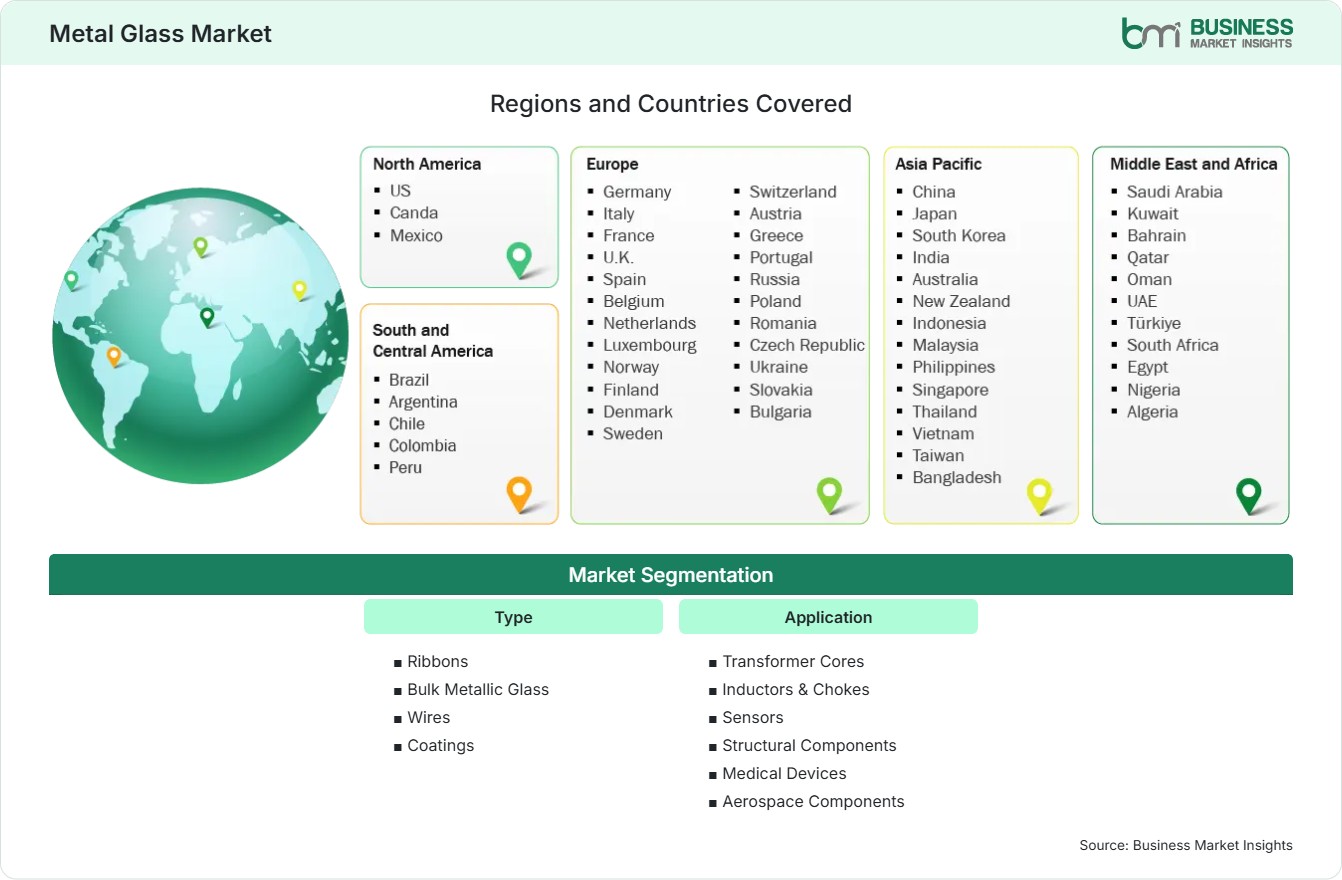
The North America region was expected to have a market share of 28%-31% in 2025 and grow at a CAGR of 6.20%-6.70% till 2033. The demand is driven by the need for transformer development, the aerospace and sensor industries, and medical devices. The US dominates regional demand due to the large number of transformers in the country that need upgrading or replacement. DOE predicts that more than 60 million transformers are present in the United States.
- The need for transformers and component limitations is leading utilities and producers to seek more efficient core materials while mitigating sourcing risks.
- The aerospace industry can capitalize on the ongoing need for fleet upgrades. According to IATA, there were 35,550 commercial aircraft in the global commercial fleet in June 2025.
- Sensors and precision components have become increasingly relevant due to the growing demand for miniaturized magnetoelastic materials in industrial automation, monitoring, and electronics.
- Domestic manufacturing policies strengthen the investment case for localized alloy processing, ribbon production, transformer cores, and specialized components.
US Metal Glass Market
The US held a 22%–25% share of the global Metal Glass Market in 2025 and is expected to grow at a 6.30%–6.80% CAGR through 2033. The country's demand profile is shaped by grid reliability, transformer availability, data-center electricity consumption, aerospace production, and advanced medical manufacturing. IEA expects US electricity demand to increase through 2027, with data centers and semiconductor facilities contributing to the requirement for additional electrical capacity.
- DOE's distribution-transformer working group is addressing supply-chain vulnerabilities, long lead times, component shortages, and excessive specification diversity across utilities.
- Rising data-center loads are strengthening requirements for reliable power infrastructure, increasing opportunities for efficient transformer cores and magnetic components.
- Aerospace and defense applications favor materials combining strength, corrosion resistance, low mass, and dimensional precision for demanding operating environments.
Europe Metal Glass Market
Europe has a market share of 23%–26% in 2025 and is expected to grow at a CAGR of 5.80%–6.30% until 2033. Germany is the leading country in manufacturing, backed by high proficiency in materials science and industrial automation. France, Italy, and the United Kingdom contribute through their expertise in aerospace, medical technologies, electronics, and precision engineering. In Germany, the Heraeus environment is innovating with amorphous alloys using injection molding and 3D printing technologies.
- Germany leads in industrial materials engineering, with metallic-glass processing increasingly connected to robotics, medical technology, mobility, sensors, and precision components.
- France and the United Kingdom provide aerospace and defense demand where high strength, dimensional stability, and weight reduction can support advanced component design.
- Italy offers opportunities through industrial machinery, electrical equipment, and specialty manufacturing networks seeking higher-performance materials.
- European decarbonization priorities favor lower-loss electrical components, strengthening the commercial rationale for amorphous magnetic materials in transformers and inductive devices.
Asia Pacific Metal Glass Market
The Asia-Pacific region accounted for 34%-37% in 2025 and is anticipated to register a CAGR of 7.20%-7.80%, making it the most rapidly growing Metal Glass Market Region. China is the largest manufacturer, while Japan specializes in advanced materials expertise. India's rapid growth stems from grid development and the local production of transformer materials. South Korea and Taiwan offer chances through electronics, sensors, and power equipment manufacturing.
- China combines large transformer production capacity with established amorphous-alloy manufacturing, while Qingdao Yunlu operates dedicated amorphous ribbon and core product lines.
- Japan benefits from deep expertise in magnetic materials, precision engineering, electronics, and industrial components, supporting premium-value applications.
- India offers strong upside from rising electricity demand and domestic infrastructure investment. IEA reports electricity demand growth of 6.6% is forecast for India in 2026.
- South Korea and Taiwan provide high-value opportunities in electronics, sensors, power conversion, and miniaturized components requiring specialized materials.
Rest of World Metal Glass Market
Rest of World held a 10%–13% share in 2025 and is projected to expand at a 5.30%–6.00% CAGR. South and Central America are supported by grid modernization, renewable integration, industrial electrification, and replacement of aging electrical equipment. Brazil and Mexico represent the leading demand centers, with Mexico benefiting from network modernization programs and growing industrial activity.
The Middle East and Africa require products for power systems, renewable energy, industrial automation, and high-reliability electrical systems. There are many opportunities available in Saudi Arabia, the UAE, and South Africa as the utilities expand their investment in transmission, distribution, and industrial sectors. Mexico has launched a program to modernize its electrical network by 2028, with costs projected at 60.8 billion pesos by 2025.
- Brazil's expanding electricity infrastructure supports opportunities for efficient transformer materials and magnetic components as renewable generation increases.
- Mexico combines industrial electrification with network modernization, creating a favorable environment for transformer and power-component suppliers.
- Gulf countries provide opportunities through grid expansion, renewable integration, industrial automation, and high-temperature operating environments.
- South Africa offers demand potential from grid reliability programs, renewable integration, and replacement of aging power infrastructure.