
Glass Packaging Market Outlook: Size, Share, Trends, Growth Analysis, Competitive Landscape & Forecast, 2026-2033

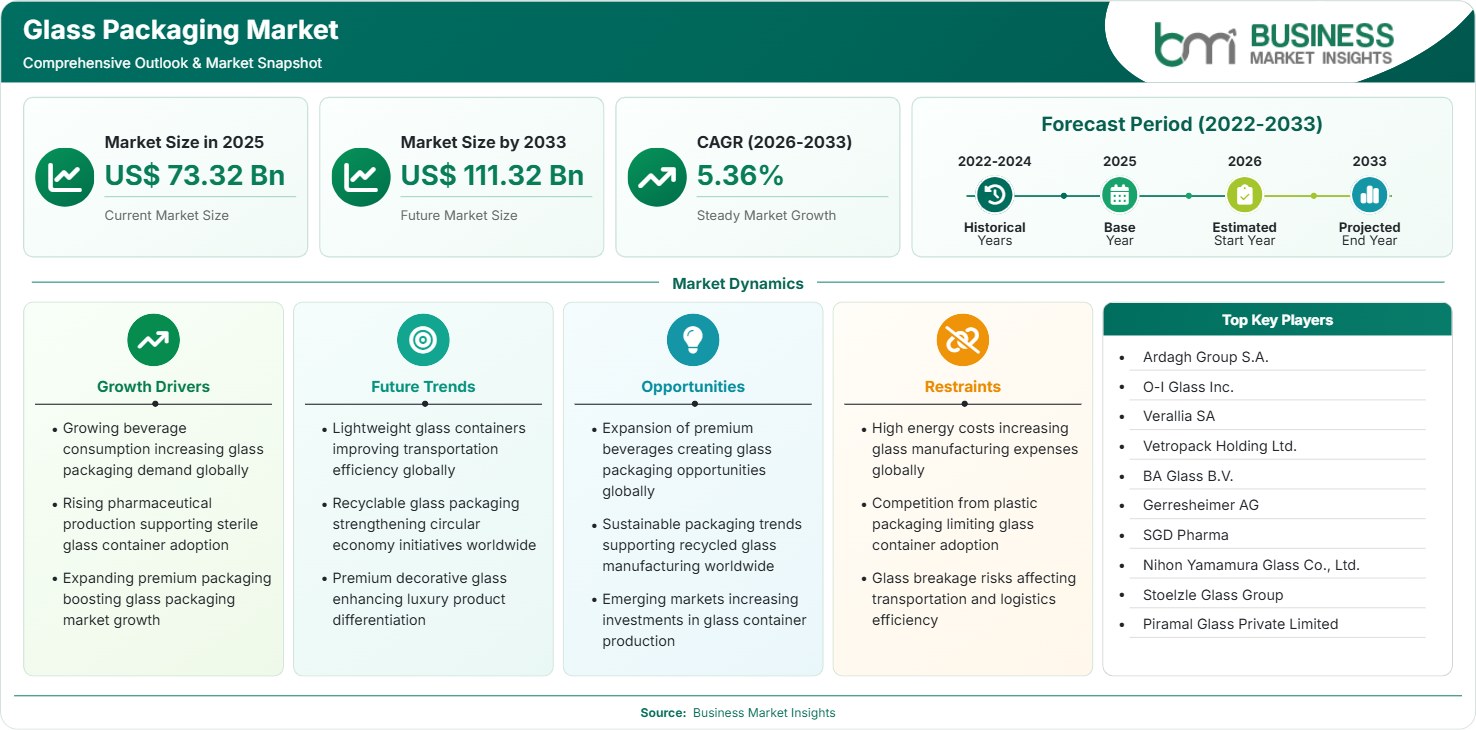
The Glass Packaging Market size was valued at US$ 73.32 billion in 2025 and is projected to reach US$ 111.32 billion by 2033, growing at a CAGR of 5.36% during 2026–2033, driven by rising beverage consumption, pharmaceutical packaging demand, premium product positioning, sustainability initiatives, and increasing preference for recyclable packaging solutions.

Report Coverage
  • Product: Bottles, Jars & Containers, Ampoules, Vials, Others
  • End-user: Food, Beverage , Pharmaceuticals, Personal Care & Cosmetics, Others
US$ 73.32 Bn Market size in 2025
US$ 111.32 Bn Market Size by 2033
5.36% CAGR, 2026 - 2033
2026-2033 Forecast Period

01 AI Overview

Glass Packaging Market Summary

  • North America Region: North America holds a 29%–32% share in 2025 and is projected to grow at a CAGR of 4.70%–5.10% during 2026–2033, supported by premium beverage demand, pharmaceutical manufacturing, and recycling infrastructure. The US market is expected to grow at a CAGR of 4.80%–5.20%, driven by increasing demand for sustainable food, beverage, and pharmaceutical packaging.
  • Fastest Growing Region: Asia Pacific accounts for 33%–36% share in 2025 and is forecast to expand at a CAGR of 6.30%–6.80% through 2026–2033, supported by rapid urbanization, beverage consumption growth, pharmaceutical manufacturing expansion, and investments in packaging production capacity.
  • Leading Segment: Beverage (Alcoholic & Non-alcoholic) holds 42%–45% glass packaging market share in 2025 and is expected to grow at a CAGR of 5.60%–6.00%, supported by premium beverage demand, product preservation requirements, and increasing consumer preference for sustainable packaging.
  • High Growth Segment: Pharmaceuticals is projected to grow at a CAGR of 6.80%–7.30%, supported by expanding biologics production, vaccine manufacturing, sterile packaging requirements, and increasing healthcare expenditure worldwide.
  • Key Market Opportunity: Growing demand for recyclable packaging, premium consumer products, pharmaceutical expansion, and investment in lightweight manufacturing technologies are creating long-term opportunities for glass packaging manufacturers globally.
  • Major Market Players: Ardagh Group S.A., O-I Glass Inc., Verallia SA, Vetropack Holding Ltd., BA Glass B.V., Gerresheimer AG, SGD Pharma, Nihon Yamamura Glass Co., Ltd., Stoelzle Glass Group, Piramal Glass Private Limited
02 Strategic Insights

Glass Packaging Market: Strategic Insights

Glass Packaging Market Strategic Framework
FREE PDF
Request your free sample
Request free sample
03 Stakeholder View

Key Takeaways

  • Global value chains are increasingly integrating recycled glass suppliers, furnace technology providers, converters, and consumer goods manufacturers to improve sustainability and production efficiency.
  • Beverage packaging remains the largest revenue contributor, while pharmaceutical applications offer the strongest long-term expansion potential due to increasing sterile packaging requirements.
  • Innovation is shifting toward lightweight containers, higher recycled glass content, smart quality inspection systems, and energy-efficient manufacturing technologies that reduce production costs and emissions.
  • Asia Pacific offers the strongest investment opportunity because of expanding beverage production, pharmaceutical manufacturing, favorable industrial policies, and increasing domestic packaging demand.
  • Strategic investments increasingly focus on furnace modernization, recycling infrastructure, regional production expansion, and acquisitions that strengthen manufacturing capacity and supply chain resilience.
04 Geographic Outlook

Glass Packaging Market Regional Highlights

North America Glass Packaging Market

North America accounts for 29%–32% share in 2025 and is projected to expand at a CAGR of 4.70%–5.10% during 2026–2033. Demand is supported by premium alcoholic beverages, pharmaceutical manufacturing, strong recycling infrastructure, and sustainability regulations. The Glass Packaging Market share remains strong because major beverage brands increasingly prefer recyclable packaging while pharmaceutical manufacturers continue adopting high-quality glass containers for sterile applications. Consumer preference for environmentally responsible packaging also supports long-term regional demand.

  • The US leads regional demand through strong beverage production, pharmaceutical manufacturing, and well-established recycling systems supporting sustainable packaging initiatives.
  • Canada is expanding glass packaging consumption through premium food products, beverage innovation, and increasing investment in circular economy infrastructure.
  • Manufacturers continue modernizing production facilities with energy-efficient furnaces and higher recycled glass utilization to reduce environmental impact.
  • Premium spirits, wine, and specialty food products continue increasing demand for high-quality glass containers across North America.

US Glass Packaging Market

The US represents 24%–27% of the global market in 2025 and is expected to register a CAGR of 4.80%–5.20% during 2026–2033. High consumer spending, advanced pharmaceutical manufacturing, and strong beverage production continue supporting market expansion. Investments in sustainable packaging technologies, recycling infrastructure, and premium consumer products are strengthening domestic manufacturing capabilities while encouraging adoption of lightweight glass packaging solutions.

  • Beverage manufacturers increasingly adopt lightweight bottles to improve transportation efficiency while maintaining premium product positioning.
  • Pharmaceutical companies continue expanding demand for sterile glass packaging used for injectable drugs and biologics.
  • Recycling initiatives are improving cullet availability, reducing raw material consumption and supporting sustainable manufacturing practices.
  • Automation technologies are improving manufacturing productivity and packaging quality across production facilities.

Europe Glass Packaging Market

Europe holds 27%–30% share in 2025 and is forecast to grow at a CAGR of 5.00%–5.40% during 2026–2033. Germany, France, Italy, and Spain remain major contributors due to strong beverage industries and advanced recycling systems. Germany leads regional production while Eastern Europe is emerging as a higher-growth manufacturing base supported by industrial investments and packaging modernization.

  • Germany maintains leadership through advanced glass manufacturing capabilities and high recycled glass utilization.
  • France and Italy support demand through premium wine, spirits, cosmetics, and pharmaceutical packaging industries.
  • European sustainability regulations continue encouraging greater adoption of recyclable glass packaging across consumer industries.
  • Manufacturers are investing in low-emission furnaces and circular production systems to improve environmental performance.

Asia Pacific Glass Packaging Market

Asia Pacific captures 33%–36% share in 2025 and is projected to grow at a CAGR of 6.30%–6.80% during 2026–2033. China, India, Japan, and Southeast Asia are driving regional expansion through increasing beverage production, pharmaceutical manufacturing, urbanization, and rising consumer spending. Rapid industrialization and expanding packaged food industries continue supporting investments in new glass manufacturing capacity.

  • China remains the largest regional producer through strong manufacturing capabilities and growing domestic beverage demand.
  • India is emerging as the fastest-growing country due to pharmaceutical expansion and increasing packaged food consumption.
  • Japan continues supporting premium cosmetic and pharmaceutical glass packaging through advanced manufacturing technologies.
  • Southeast Asia is attracting investments in beverage production and export-oriented packaging manufacturing.
  • Regional manufacturers are increasing recycled glass usage to improve sustainability and production efficiency.

Rest of World Glass Packaging Market

Rest of World accounts for 9%–12% share in 2025 and is expected to expand at a CAGR of 5.20%–5.70% during 2026–2033. South America benefits from growing beverage production, while the Middle East and Africa are increasing investments in food processing and pharmaceutical manufacturing. Brazil, Saudi Arabia, and the UAE remain key growth markets due to industrial diversification and expanding consumer packaging demand.

  • Brazil continues increasing demand through beverage exports and expanding domestic food manufacturing industries.
  • Saudi Arabia and UAE are investing in packaging production to strengthen regional manufacturing capabilities.
  • Food processing expansion across Middle Eastern markets supports increasing demand for glass containers.
  • African economies are gradually increasing pharmaceutical and beverage packaging production through industrial development initiatives.
  • International manufacturers continue expanding regional partnerships to improve production capacity and distribution networks.
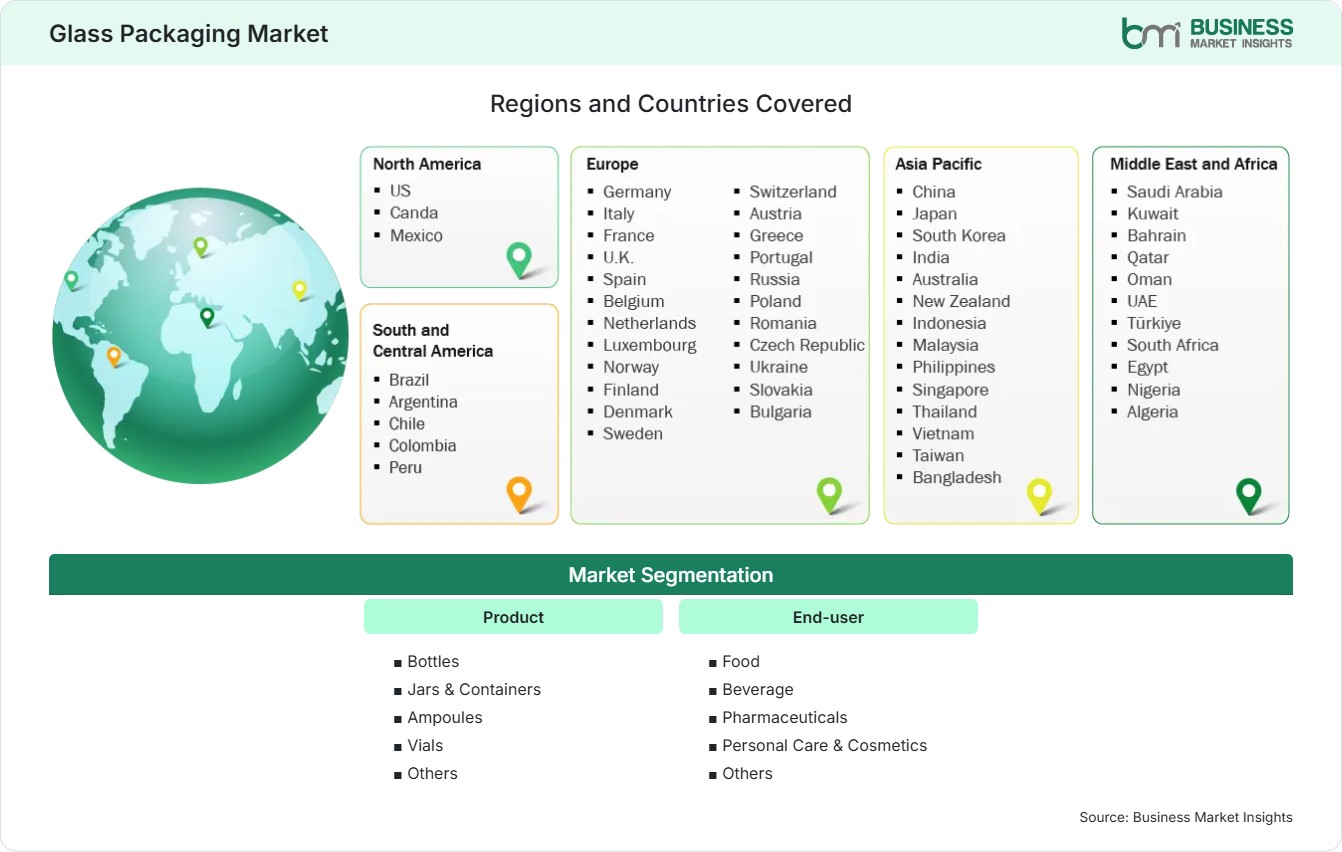
Global Market Geography
FREE PDF
Request your free sample
Request free sample
05 Segment Analysis

Glass Packaging Market Segmentation

Product

The Product segment represents the foundation of the Glass Packaging Market scope, serving diverse food, beverage, pharmaceutical, and personal care industries. The segment accounted for 100% of the market in 2025 and is projected to grow at a CAGR of 5.36% during 2026–2033. Product innovation, lightweight container development, improved strength, and increasing recycled glass utilization continue supporting adoption across multiple end-use industries.

  • Bottles: Bottles represent the largest product category due to extensive use across alcoholic beverages, soft drinks, edible oils, and premium consumer products. Manufacturers continue improving lightweight designs while maintaining durability and product protection.
  • Jars & Container: Jars & Container are widely used for packaged food, baby food, sauces, cosmetics, and pharmaceutical applications because they provide superior barrier protection, product visibility, and complete recyclability.
  • Ampoules: Ampoules support sterile pharmaceutical packaging by providing contamination-resistant storage for injectable medicines, vaccines, and biologics while maintaining product stability throughout distribution.
  • Vials: Vials are experiencing increasing demand from pharmaceutical manufacturers due to expanding biologics production, injectable therapies, clinical research activities, and vaccine manufacturing requirements.

End-user

The End-user segment reflects growing demand across consumer goods and healthcare industries. The segment accounted for 100% of the market in 2025 and is expected to expand at a CAGR of 5.36% during 2026–2033. The Glass Packaging Market trends indicate rising preference for sustainable, premium, and chemically stable packaging solutions across multiple industries driven by environmental regulations and changing consumer preferences.

  • Food: Food manufacturers increasingly adopt glass containers for sauces, spreads, dairy products, baby food, and premium packaged products because glass preserves freshness while supporting sustainable packaging initiatives.
  • Beverage (Alcoholic & Non-alcoholic): Beverage manufacturers remain the largest users of glass packaging because premium appearance, flavor preservation, and complete recyclability strengthen brand positioning and consumer preference.
  • Pharmaceuticals: Pharmaceutical companies continue expanding adoption of glass packaging for injectable medicines, vaccines, biologics, and laboratory applications requiring high chemical resistance and sterile storage.
  • Personal Care & Cosmetics: Personal care and cosmetics brands increasingly utilize premium glass containers to improve product aesthetics, luxury positioning, and sustainability while ensuring compatibility with sensitive formulations.
06 Market Forces

Glass Packaging Market Dynamics

Key Market Drivers

Growing beverage consumption increasing glass packaging demand globally

Growing global consumption of alcoholic and non-alcoholic beverages is increasing demand for durable and recyclable glass containers. Premium beverages, wine, spirits, juices, and specialty drinks increasingly use glass packaging because it preserves taste, maintains product quality, and enhances brand perception. According to industry beverage associations, premium beverage categories continue recording steady volume growth across developed and emerging economies. Market growth is further supported by sustainability initiatives encouraging replacement of single-use plastics with recyclable materials. These changing consumption patterns continue strengthening Glass Packaging Market trends, encouraging manufacturers to expand production capacity, lightweight bottle development, and recycled glass utilization.

Rising pharmaceutical production supporting sterile glass container adoption

Increase in pharmaceuticals manufacturing is causing an increase in the need for sterile glass containers that will be used for storing the injectable drugs, vaccines, biologicals, and laboratory uses. Increased healthcare spending, increased development of biological drugs, and increase in immunization drives the pharmaceuticals companies to make investments in quality packaging materials. Glass continues to be the material of choice due to its chemical inertness, barrier protection, and compatibility. The manufacture of pharmaceutical vials, ampoules, and other special packaging is being increased to match global healthcare demands.

Expanding premium packaging boosting glass packaging market growth

High-end consumer products are now adopting glass packaging as an effective means of enhancing the value of their brand, making their product packaging attractive to buyers, and providing greater protection for their products. Food, beverages, cosmetics, and luxury personal care brands are still releasing their high-end products using glass packaging. Increasing disposable income levels and the new preferences for sustainable, high-quality products among consumers are motivating producers to focus on innovation and advanced technologies in packaging.

Key Market Opportunities

Expansion of premium beverages creating glass packaging opportunities globally

Premium alcoholic beverages, craft drinks, specialty juices, and functional beverages continue creating significant opportunities for glass packaging manufacturers. Brand owners increasingly prefer glass containers because they improve product presentation, preserve flavor integrity, and strengthen premium positioning. Investments in premium beverage production facilities across Asia Pacific, Europe, and North America are supporting higher demand for innovative bottle designs. Glass Packaging Market Forecasts indicate sustained opportunities as premium beverage consumption continues expanding across both developed and emerging economies.

Sustainable packaging trends supporting recycled glass manufacturing worldwide

The emergence of the circular economy concept is prompting manufacturing companies to adopt increased amounts of recycled glass in their operations. The government is implementing recycling goals and extended producer responsibility policies to ensure that more cullet is used in production processes, while simultaneously cutting down the amount of CO2 emissions. Companies which have invested in efficient recycling systems, low carbon emissions furnaces, and lighter packaging products are performing more efficiently.

Emerging markets increasing investments in glass container production

The emerging countries are investing in advanced glass manufacturing plants owing to the growth in food processing, beverages manufacturing, pharmaceuticals manufacturing, and cosmetics industry. There is a growing requirement for premium packaging material as a result of high disposable income levels, urbanization, and industrialization. Manufacturing plants located in close proximity would result in lower cost of logistics and a stronger supply chain. Investment in state-of-the-art manufacturing technology is anticipated to aid future market growth.

Market Restraints and Challenges

High energy costs increasing glass manufacturing expenses globally

Factor: Glass manufacturing requires energy-intensive furnace operations that significantly increase production costs during periods of volatile fuel and electricity prices. Impact: High operating costs lower the profitability of the manufacturer, raise product prices, and have an impact on market competitiveness. Manufacturers are making efforts towards improving efficiency through energy efficient furnaces, energy recovery systems, and utilization of renewable energy sources. Nevertheless, the high capital investments and the volatile energy market continue posing financial difficulties to manufacturers running large manufacturing plants.

Competition from plastic packaging limiting glass container adoption

Factor: Plastic packaging offers lower production costs, lighter weight, and lower transportation expenses across many consumer product applications. Impact: Plastic packaging is favored over glass by cost-conscious producers, constraining adoption to certain types of products despite their sustainable features. However, there have been some efforts by glass makers in response to that challenge. These include the development of lightweight products, recycling, efficiency in production processes, and high-end products.

07 Company Analysis

Competitive Landscape

The Glass Packaging Market analysis reflects a competitive industry focused on sustainability, lightweight packaging innovation, furnace modernization, pharmaceutical container expansion, and strategic capacity investments. Leading manufacturers continue investing in recycled glass utilization, energy-efficient manufacturing technologies, premium packaging solutions, and regional production expansion to strengthen their competitive positions.

Company Name

Overview

Products and Services relevant to this market

Ardagh Group S.A.

Ardagh Group S.A. is a global manufacturer of sustainable metal and glass packaging serving food, beverage, and pharmaceutical industries.

Produces glass bottles, jars, beverage containers, food packaging, and customized glass packaging solutions.

O-I Glass Inc.

O-I Glass Inc. is one of the world's largest glass container manufacturers serving consumer goods industries globally.

Manufactures glass bottles and containers for beverages, food, pharmaceuticals, and specialty packaging applications.

Verallia SA

Verallia SA specializes in sustainable glass packaging for food and beverage producers across international markets.

Provides glass bottles, jars, customized container designs, and premium packaging solutions for consumer brands.

Vetropack Holding Ltd.

Vetropack Holding Ltd. develops recyclable glass packaging solutions for food and beverage manufacturers across Europe.

Supplies glass bottles, food containers, beverage packaging, and customized sustainable packaging products.

BA Glass B.V.

BA Glass B.V. manufactures glass containers serving beverage, food, and consumer goods industries worldwide.

Offers glass bottles, jars, packaging containers, and decorative glass packaging solutions.

Gerresheimer AG

Gerresheimer AG is a leading supplier of pharmaceutical and healthcare packaging solutions globally.

Produces pharmaceutical glass vials, ampoules, bottles, cartridges, and healthcare packaging systems.

SGD Pharma

SGD Pharma specializes in pharmaceutical glass packaging for injectable medicines and healthcare applications.

Manufactures pharmaceutical glass vials, molded glass containers, sterile packaging, and injectable drug packaging solutions.

Nihon Yamamura Glass Co., Ltd.

Nihon Yamamura Glass Co., Ltd. develops glass packaging products for food, beverage, and industrial markets.

Produces beverage bottles, food containers, pharmaceutical packaging, and specialty glass products.

Stoelzle Glass Group

Stoelzle Glass Group manufactures premium glass packaging for pharmaceuticals, cosmetics, spirits, and specialty products.

Provides pharmaceutical bottles, cosmetic containers, spirits bottles, and premium customized glass packaging.

Piramal Glass Private Limited

Piramal Glass Private Limited supplies specialty glass packaging for pharmaceuticals, cosmetics, food, and beverages.

Manufactures glass containers, pharmaceutical bottles, cosmetic packaging, food jars, and premium beverage bottles.

10 Trust & Transparency

Research Methodology

The market analysis combines proprietary research with secondary data from government agencies, company disclosures, regulatory filings, industry databases and expert interviews. Market estimates are validated through data triangulation, cross-market benchmarking and analyst review.

View Full Research Methodology

11 Questions Answered

Frequently Asked Questions

What does the market report cover?

The Glass Packaging Market Report includes market size, regional analysis, segmentation, competitive landscape, technology trends, investment opportunities, growth drivers, challenges, and future industry outlook.

Why is glass preferred for pharmaceutical packaging?

Glass provides excellent chemical resistance, product stability, sterility, and barrier protection, making it suitable for injectable medicines, vaccines, biologics, and other sensitive pharmaceutical formulations.

Which end-user segment generates the highest revenue?

Beverage (Alcoholic & Non-alcoholic) remains the leading end-user segment because glass preserves product quality, enhances premium branding, and supports sustainable packaging objectives.

Which region dominates the global glass packaging industry?

Asia Pacific holds the largest regional share due to expanding beverage production, pharmaceutical manufacturing, urbanization, industrial growth, and continuous investments in packaging manufacturing facilities.

What is driving demand for glass packaging?

Growing beverage consumption, pharmaceutical production, premium product demand, sustainability initiatives, and increasing preference for recyclable packaging materials are the primary factors supporting market expansion.

Access the Full Glass Packaging Market Report

Get segment-level forecasts, regional estimates, competitive benchmarking, company profiles and downloadable Excel datasets.

Access the full Glass Packaging Market Report
350 pages PDF & Excel | 2026-08-12