
Glass Ceramics Market Outlook: Size, Share, Trends, Growth Analysis, Competitive Landscape & Forecast, 2026-2033

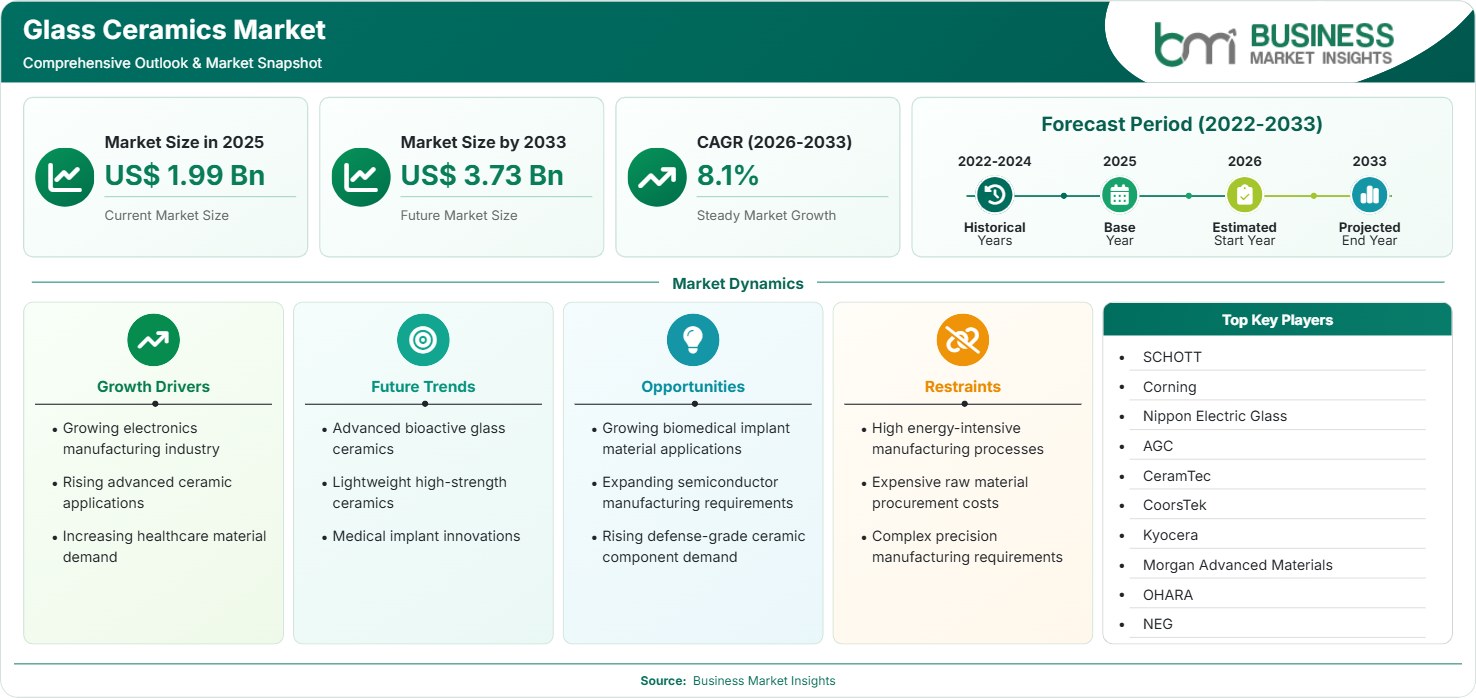
The Glass Ceramics Market size was valued at US$ 1.99 Billion in 2025 and is projected to reach US$ 3.73 Billion by 2033, growing at a CAGR of 8.1% from 2026 to 2033. Rising electronics manufacturing, advanced ceramic adoption, healthcare material demand, semiconductor expansion, biomedical applications, and defense-grade component requirements are supporting market development.

Report Coverage
  • Material Type: Lithium Aluminosilicate, Zinc Aluminosilicate, Magnesium Aluminosilicate, Others
  • Application: Household Appliances, Building & Construction, Electrical & Electronics, Healthcare & Medical, Industrial Equipment, Aerospace & Defense, Others
US$ 1.99 Bn Market size in 2025
US$ 3.73 Bn Market Size by 2033
8.1% CAGR, 2026 - 2033
2026-2033 Forecast Period

01 AI Overview

Glass Ceramics Market Summary

  • North America Region: North America holds a market share of 28%–31% in 2025 and is projected to grow at a CAGR of 7.8%–8.5% during 2026–2033. Growth is supported by semiconductor manufacturing, aerospace applications, healthcare innovation, and advanced material research. The US market is expanding at a CAGR of 8.0%–8.6% due to electronics production, medical device development, and defense technology investments.
  • Fastest Growing Region: Asia Pacific accounts for 39%–42% market share in 2025 and is expected to grow at a CAGR of 8.7%–9.4% during 2026–2033. Growth is driven by electronics manufacturing expansion, semiconductor investments, industrial modernization, and increasing adoption of advanced ceramic materials.
  • Leading Segment: Lithium Aluminosilicate (LAS) represents 52%–55% market share in 2025 and is projected to grow at a CAGR of 8.2%–8.8% during 2026–2033. Adoption is supported by superior thermal stability, low expansion properties, and extensive use in cookware, optical components, and industrial applications.
  • High Growth Segment: Electrical & Electronics applications account for 21%–24% share in 2025 and are estimated to grow at a CAGR of 9.0%–9.7% through 2026–2033. Growth is supported by semiconductor manufacturing, electronic components, thermal management requirements, and advanced device development.
  • Key Market Opportunity: Expanding semiconductor fabrication, biomedical implant development, and defense-grade ceramic component requirements are creating opportunities for manufacturers developing high-performance glass ceramic materials.
  • Major Market Players: SCHOTT, Corning, Nippon Electric Glass, AGC, CeramTec, CoorsTek, Kyocera, Morgan Advanced Materials, OHARA, NEG.
02 Strategic Insights

Glass Ceramics Market: Strategic Insights

Glass Ceramics Market Strategic Framework
FREE PDF
Request your free sample
Request free sample
03 Stakeholder View

Key Takeaways

  • The market value chain includes raw material suppliers, glass ceramic manufacturers, component fabricators, technology developers, and end-use industries requiring advanced performance materials.
  • Electrical and electronics applications provide strong growth opportunities due to semiconductor expansion, miniaturization trends, thermal management needs, and increasing demand for reliable components.
  • Material innovation is focused on improving thermal resistance, optical properties, mechanical strength, biocompatibility, and processing efficiency for specialized applications.
  • Asia Pacific offers significant investment opportunities due to semiconductor manufacturing growth, electronics production capacity expansion, and increasing industrial applications.
  • Companies are strengthening positions through research collaborations, production capacity expansion, strategic partnerships, and development of application-specific glass ceramic solutions.
  • Long-term competitiveness will depend on improving manufacturing efficiency, reducing production costs, and developing sustainable material processing technologies.
04 Geographic Outlook

Glass Ceramics Market Regional Highlights

North America Glass Ceramics Market

North America accounted for a 28%–31% share of the Glass Ceramics Market in 2025 and is projected to grow at a CAGR of 7.8%–8.5% during 2026–2033. The region benefits from advanced manufacturing capabilities, semiconductor investments, healthcare innovation, and aerospace technology development. The United States remains the leading contributor due to strong demand for specialty materials in electronics, medical devices, defense systems, and industrial applications.

  • The United States drives regional growth through semiconductor production, aerospace programs, healthcare innovation, and advanced material research activities.
  • Canada is expanding adoption through industrial modernization, healthcare applications, and investments in advanced manufacturing technologies.
  • Electronics manufacturers are increasing demand for glass ceramics due to thermal stability, insulation properties, and component reliability requirements.
  • Aerospace and defense sectors are adopting high-performance ceramic materials for specialized applications requiring durability and resistance.

US Glass Ceramics Market

The US represented a 25%–28% share of the Glass Ceramics Market in 2025 and is expected to grow at a CAGR of 8.0%–8.6% during 2026–2033. Demand is supported by semiconductor manufacturing expansion, medical technology development, defense investments, and industrial equipment requirements. Domestic manufacturers are focusing on advanced materials for high-temperature, precision, and reliability-driven applications.

  • Semiconductor manufacturing expansion is increasing demand for glass ceramic components used in advanced electronic applications.
  • Medical device producers are adopting biocompatible ceramic materials for specialized healthcare and implant-related applications.
  • Defense organizations are utilizing advanced ceramics for components requiring strength, thermal resistance, and durability.
  • Research institutions are supporting innovation through material science development and specialized manufacturing processes.

Europe Glass Ceramics Market

Europe held a 22%–25% share of the Glass Ceramics Market in 2025 and is forecast to grow at a CAGR of 7.6%–8.3% from 2026–2033. The region benefits from advanced industrial manufacturing, healthcare technology development, and strong demand for premium materials. Germany, France, Italy, and Switzerland represent major markets due to automotive, electronics, medical, and industrial applications.

  • Germany supports market development through precision manufacturing, industrial equipment production, and advanced electronics applications.
  • France is increasing adoption through aerospace programs, healthcare innovation, and specialized ceramic material requirements.
  • Switzerland demonstrates demand through medical technology, research activities, and high-performance material applications.
  • Italy is expanding usage through industrial equipment, construction applications, and advanced manufacturing industries.

Asia Pacific Glass Ceramics Market

Asia Pacific captured a 39%–42% share of the Glass Ceramics Market in 2025 and is expected to achieve a CAGR of 8.7%–9.4% during 2026–2033. The region represents the fastest-growing market due to electronics manufacturing expansion, semiconductor investments, industrial development, and increasing demand for advanced materials. China, Japan, South Korea, and Taiwan are major contributors to regional growth.

  • China is expanding glass ceramic adoption through electronics manufacturing, semiconductor development, and industrial material applications.
  • Japan continues driving innovation through advanced ceramics research, precision manufacturing, and high-value electronic components.
  • South Korea is increasing demand through semiconductor production, display technologies, and electronic equipment manufacturing.
  • Taiwan supports market expansion through semiconductor fabrication growth and advanced component manufacturing requirements.

Rest of World Glass Ceramics Market

Rest of World represented a 7%–10% share of the Glass Ceramics Market in 2025 and is projected to grow at a CAGR of 7.9%–8.6% during 2026–2033. South America and the Middle East & Africa are developing through industrial diversification, healthcare infrastructure expansion, and technology investments. Brazil, UAE, Saudi Arabia, and South Africa represent emerging opportunities.

South American countries are adopting advanced materials through industrial development, while Middle Eastern markets are investing in healthcare, construction, and technology-driven applications requiring durable ceramic materials.

  • Brazil is expanding demand through industrial applications, healthcare development, and advanced manufacturing investments.
  • South Africa is adopting specialty materials through industrial modernization and healthcare technology improvements.
  • Saudi Arabia is increasing investment in advanced industries, infrastructure development, and technology-based manufacturing applications.
  • The United Arab Emirates is supporting adoption through aerospace, healthcare, and high-performance material applications.
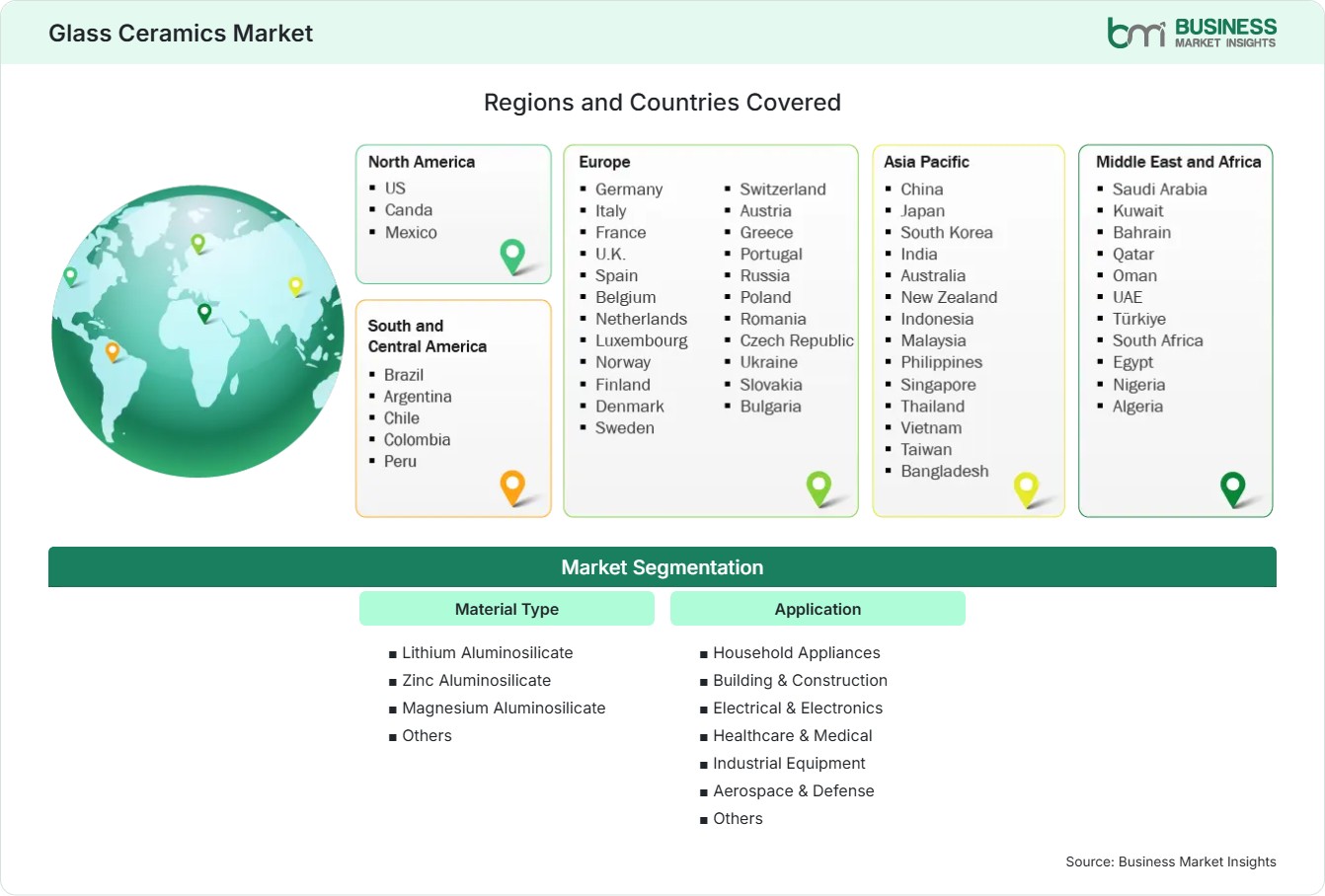
Global Market Geography
FREE PDF
Request your free sample
Request free sample
05 Segment Analysis

Glass Ceramics Market Segmentation

Material Type

Material Type segmentation includes Lithium Aluminosilicate (LAS), Zinc Aluminosilicate (ZAS), Magnesium Aluminosilicate (MAS), and Others. Lithium Aluminosilicate (LAS) represented the leading segment in 2025 due to excellent thermal shock resistance, low thermal expansion, and broad usage in cookware, optical systems, and industrial components. ZAS and MAS materials are gaining adoption in specialized applications requiring durability and chemical stability. The segment is projected to grow at a CAGR of 8.2%–8.8% during 2026–2033, supported by increasing advanced material requirements across industries.

  • Lithium Aluminosilicate (LAS): LAS materials are widely used due to superior thermal stability, low expansion characteristics, and suitability for household, industrial, and optical applications.
  • Zinc Aluminosilicate (ZAS): ZAS materials support specialized applications requiring improved mechanical properties, chemical resistance, and durability in demanding operating environments.
  • Magnesium Aluminosilicate (MAS): MAS materials are adopted for applications requiring thermal resistance, structural performance, and reliability across industrial and electronic component applications.

Application

Application segmentation includes Household Appliances, Building & Construction, Electrical & Electronics, Healthcare & Medical, Industrial Equipment, Aerospace & Defense, and Others. The applications of electrical & electronics witness the highest growth rate owing to the growing expansion of semiconductors, components, and thermal management. The household appliances segment continues to register strong demand with glass ceramics and heat-resistant materials. The application segment is expected to grow at a CAGR of 8.5% to 9.2% from 2026 to 2033, supported by advanced manufacturing, healthcare innovation, and industrial technology adoption.

  • Household Appliances: Household applications utilize glass ceramics in cooktops, cookware, and heat-resistant surfaces requiring durability, thermal stability, and aesthetic performance.
  • Building & Construction: Construction applications incorporate glass ceramics for specialized architectural elements, durable surfaces, and materials requiring strength and thermal resistance.
  • Electrical & Electronics: Electronics applications are expanding through semiconductor components, insulating materials, thermal management solutions, and high-performance electronic device requirements.
  • Healthcare & Medical: Healthcare applications use glass ceramics for medical devices, biomedical components, and materials requiring biocompatibility and mechanical reliability.
  • Industrial Equipment: Industrial applications adopt glass ceramics for machinery components, thermal-resistant parts, and equipment operating under demanding conditions.
  • Aerospace & Defense: Aerospace and defense applications utilize advanced ceramics for lightweight, durable, and high-temperature-resistant components.
06 Market Forces

Glass Ceramics Market Dynamics

Key Market Drivers

Growing Electronics Manufacturing Industry

The growing production of electronic products is enhancing the need for glass ceramic material that is being used in semiconductors, insulation, heat dissipation, and electronic equipment. As a result of miniaturization and the need for higher performance, it has become essential for organizations to use materials that are highly heat-resistant, insulating, and dimensionally accurate. The Glass Ceramics Market growth is driven by increasing capital investments in semiconductors, innovations in advanced devices, and rising demand for materials that provide reliability in electronics. The market trends show an increase in the usage of some specific compounds in high-end applications. The manufacturers have formulated improved compounds for use in various consumer electronics, industrial electronics, and other applications requiring resistant materials.

Rising Advanced Ceramic Applications

The increasing use of superior ceramic materials in industry, aerospace, defense, and electronics is creating a rise in the demand for glass ceramics products. This material offers a variety of superior attributes such as thermal resistance, mechanical strength, and chemical stability. Industries are moving towards the use of high-performance materials for improving the efficiency of their components. The growing use of precision equipment, advanced manufacturing systems, and specialized components is creating additional demand opportunities, reflecting Glass Ceramics Market trends. Manufacturers are focusing on R&D to enhance material quality and expand their applications. Rising demand for lightweight, tough, and temperature-resistant components has helped in the wider adoption of glass ceramics in various industries.

Increasing Healthcare Material Demand

Growing healthcare technology development is creating demand for glass ceramic materials in medical devices, biomedical components, and specialized healthcare applications. Their biocompatibility, strength, chemical resistance, and reliability make them suitable for applications requiring long-term performance. Increased investment in medical technologies, aging populations, and robust healthcare infrastructure are driving the use of the material. Manufacturers are designing tailor-made ceramic products for implants, diagnostic devices, and precise medical components. The need for materials that are durable and safe is prompting cooperation between material manufacturers and healthcare technology firms. Expansion of healthcare applications is helping to drive growth in the market through the increased use of glass ceramic materials.

Key Market Opportunities

Growing Biomedical Implant Material Applications

Glass ceramics can present a new business opportunity for manufacturers because of rising demand for strong, biocompatible materials in healthcare. The benefits of using glass ceramics include chemical stability, mechanical strength, and compatibility with the biological environment. This makes them well-suited for medical use. Increased interest in medical research and innovations in the field of implant technology is driving the production of innovative materials. Companies that concentrate on developing custom materials can find their application in this lucrative market. Modernization of the healthcare sector and growing demands for better results are likely to increase the use of glass ceramic materials in biomedical applications.

Expanding Semiconductor Manufacturing Requirements

The growth in the manufacture of semiconductors will present major business opportunities for glass ceramic manufacturers owing to the growing need for precise parts, thermal management products, and electrical insulators. The manufacture of semiconductors will call for materials that can be stable during the processing period. Investments in the manufacture of chips, packaging, and electronics are likely to drive up demand for superior ceramics. There are business opportunities for manufacturers of specialized glass-ceramic materials for semiconductors. Growth in semiconductor clusters around Asia Pacific and North America is expected to boost material demand.

Rising Defense-Grade Ceramic Component Demand

Defensive applications will create many opportunities for companies in the glass-ceramic business, owing to the need for such products in military systems, which require light yet strong materials that can withstand heat. Advanced ceramics are used in parts that need to exhibit high reliability even under high stress. The increasing modernization of military systems, investment in aerospace projects, and the requirement for sophisticated technology are aiding the production of special ceramic products. This opportunity is expected to strengthen Glass Ceramics Market forecasts by increasing demand for customized glass ceramic solutions across defense and aerospace applications.

Market Restraints and Challenges

High Energy-Intensive Manufacturing Processes

Factor: Glass ceramic production requires high-temperature processing, specialized equipment, and significant energy consumption during manufacturing stages. Impact: Rising energy costs and sustainability pressures can increase production expenses and affect profit margins for manufacturers. Energy-intensive operations also create challenges related to environmental compliance and carbon reduction targets. Companies are investing in process optimization, energy-efficient technologies, and improved production methods to reduce operational costs. However, maintaining material quality while lowering energy consumption remains a major challenge. Manufacturers must balance performance requirements with sustainable production practices to remain competitive in the evolving advanced materials industry.

Expensive Raw Material Procurement Costs

Factor: High-quality raw materials required for glass ceramic production, including specialized minerals and chemical compounds, can involve significant procurement costs. Impact: Fluctuating raw material prices may increase manufacturing expenses and influence product pricing across end-use industries. Supply chain disruptions and limited availability of specialized inputs can create additional cost pressures. Manufacturers are exploring alternative materials, supplier diversification, and recycling approaches to improve cost management. However, maintaining consistent material properties while controlling procurement expenses remains challenging. Effective supply chain strategies and long-term sourcing agreements will be important for companies seeking stable production and competitive pricing.

07 Company Analysis

Competitive Landscape

The Glass Ceramics Market analysis highlights increasing competition among advanced material manufacturers, specialty glass producers, ceramic technology providers, and industrial solution companies. Leading players are focusing on material innovation, application-specific formulations, production expansion, and partnerships with electronics, healthcare, aerospace, and industrial sectors. Companies are investing in high-performance glass-ceramic solutions to meet the growing demand for thermal resistance, durability, and precision components.

Company Name

Overview

Products and Services relevant to this market

SCHOTT

Specialty glass manufacturer providing advanced material solutions globally.

Glass ceramics, specialty glass materials, optical components, and healthcare applications.

Corning

Advanced materials company developing glass and ceramic technologies.

Glass ceramic materials, semiconductor solutions, specialty glass products, and technical ceramics.

Nippon Electric Glass

Glass technology company specializing in advanced functional materials.

Glass ceramics, electronic materials, specialty glass products, and industrial applications.

AGC

Global glass manufacturer serving construction, electronics, and technology markets.

Advanced glass ceramics, electronic materials, display solutions, and specialty products.

CeramTec

Technical ceramics company providing high-performance ceramic solutions.

Medical ceramics, industrial components, advanced ceramic materials, and engineering solutions.

CoorsTek

Advanced ceramics manufacturer serving multiple industrial sectors.

Technical ceramics, semiconductor components, industrial ceramic products, and engineered solutions.

Kyocera

Technology company producing advanced ceramic components and materials.

Fine ceramics, electronic components, industrial ceramics, and healthcare applications.

Morgan Advanced Materials

Materials technology company specializing in advanced engineered solutions.

Ceramic materials, thermal products, industrial components, and specialty applications.

OHARA

Optical glass manufacturer developing precision material solutions.

Glass ceramics, optical materials, specialty glass products, and precision components.

NEG

Glass technology company providing advanced material solutions for industries.

Specialty glass, electronic materials, glass ceramics, and high-performance products.

08 Industry Activity

Recent Developments

March 2026

Corning Incorporated launched Corning Gorilla Glass Ceramic 3, a next-generation glass ceramic cover material designed for enhanced drop durability and long-term device protection, with adoption planned for Motorola’s upcoming foldable device.

November 2025

SCHOTT completed a major glass-ceramic recycling pilot project by successfully processing and remelting end-of-life glass-ceramic cooktops, advancing circular economy initiatives for glass-ceramic materials.

May 2025

CSIR-Central Glass and Ceramic Research Institute (CGCRI) and IIT (BHU) signed a collaboration agreement to advance research in glass-ceramics and related technologies, including energy materials, electronic ceramics, and advanced functional materials

March 2025

Corning Incorporated introduced Corning Gorilla Glass Ceramic, a transparent and strengthenable glass ceramic material designed to improve drop performance for mobile device cover applications and expand its advanced glass materials portfolio.

10 Trust & Transparency

Research Methodology

The market analysis combines proprietary research with secondary data from government agencies, company disclosures, regulatory filings, industry databases and expert interviews. Market estimates are validated through data triangulation, cross-market benchmarking and analyst review.

View Full Research Methodology

11 Questions Answered

Frequently Asked Questions

What does the Glass Ceramics Market Report analyze?

The report evaluates market size, material segments, applications, regional trends, competitive strategies, technology developments, and factors affecting industry expansion.

How are healthcare applications influencing market development?

Healthcare applications are supporting market growth through demand for biocompatible materials used in medical devices, biomedical components, and specialized healthcare technologies.

Why are glass ceramics important for semiconductor applications?

Glass ceramics provide thermal stability, dimensional accuracy, electrical insulation, and durability required for semiconductor manufacturing equipment and advanced electronic components.

Which material type dominates the Glass Ceramics Market share?

Lithium Aluminosilicate (LAS) represents the leading material type due to its excellent thermal stability, low expansion properties, and broad application across multiple industries.

What industries are driving demand for glass ceramics?

Electronics, healthcare, aerospace, defense, industrial equipment, and household appliance industries are increasing adoption due to the material’s thermal resistance, durability, and reliability.

Access the Full Glass Ceramics Market Report

Get segment-level forecasts, regional estimates, competitive benchmarking, company profiles and downloadable Excel datasets.

Access the full Glass Ceramics Market Report
350 pages PDF & Excel | 2026-07-31