
Advanced Ceramics Market Outlook: Size, Share, Trends, Growth Analysis, Competitive Landscape & Forecast, 2026-2033

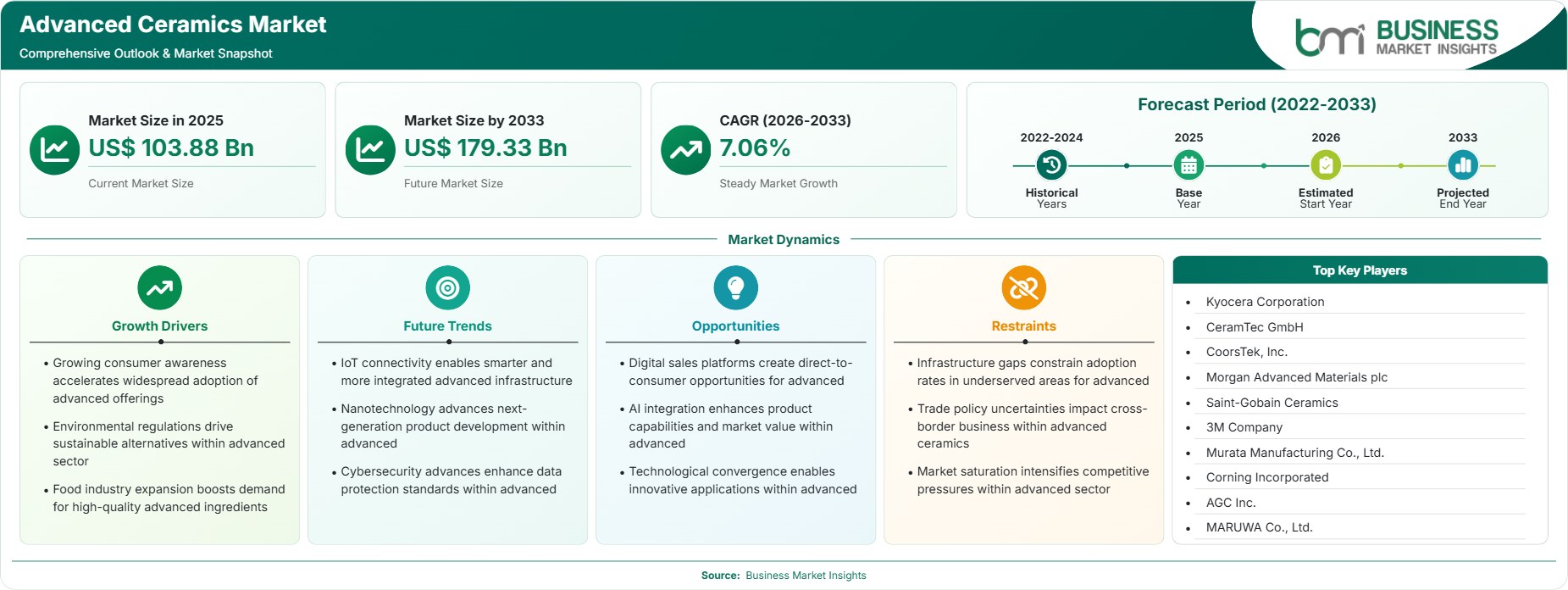
The Advanced Ceramics Market size was valued at US$ 103.88 Billion in 2025 and is projected to reach US$ 179.33 Billion by 2033, growing at a CAGR of 7.06% during 2026–2033. Key drivers include semiconductor expansion, electrification of mobility, healthcare implants, industrial automation, and demand for high-temperature materials. Opportunities are emerging across energy systems, aerospace, additive manufacturing, and advanced electronics.

Report Coverage
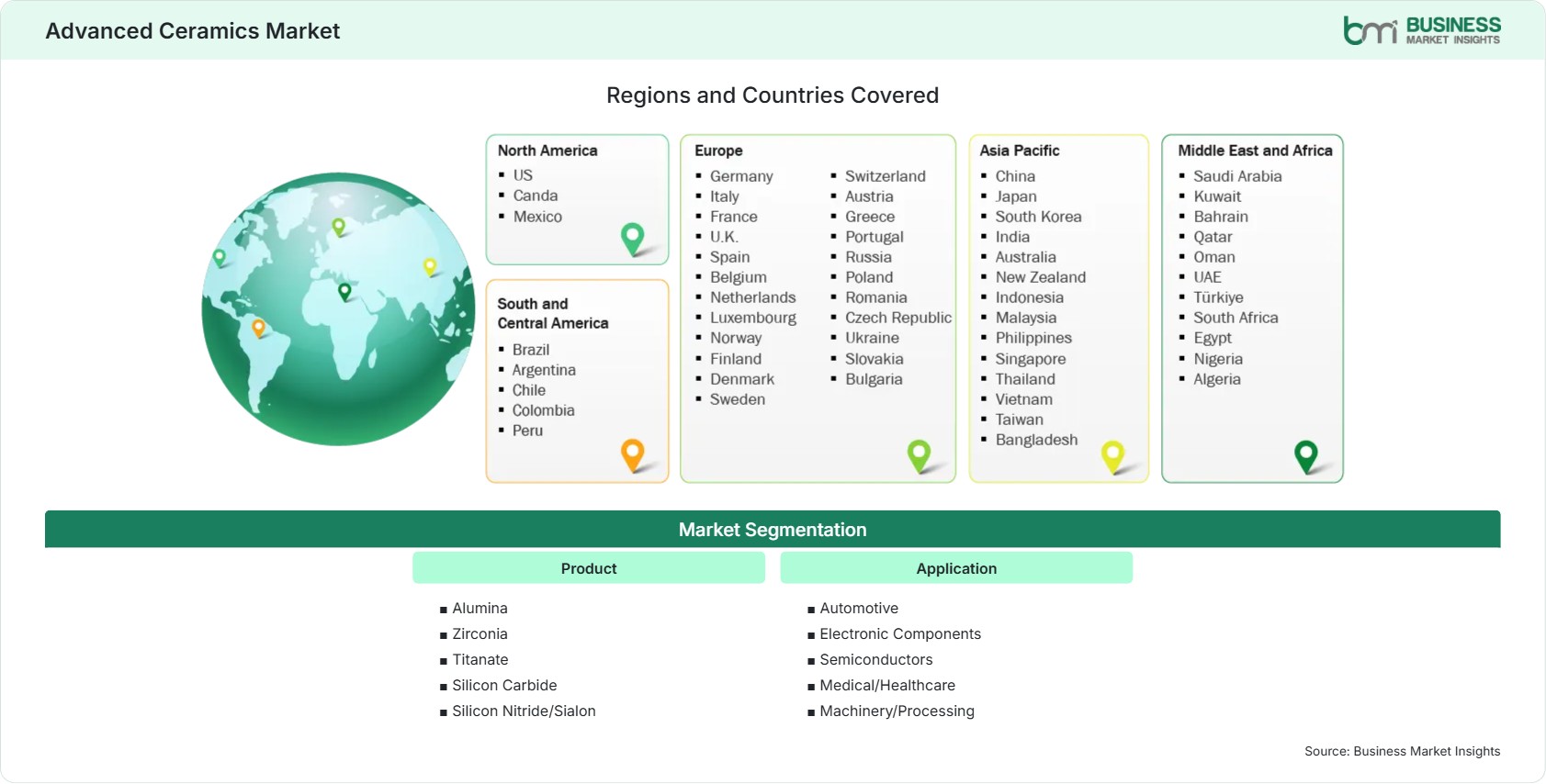
  • Product: Alumina, Zirconia, Titanate, Silicon Carbide, Silicon Nitride/Sialon
  • Application: Automotive , Electronic Components , Semiconductors , Medical/Healthcare , Machinery/Processing
US$ 103.88 Bn Market size in 2025
US$ 179.33 Bn Market Size by 2033
7.06% CAGR, 2026 - 2033
2026-2033 Forecast Period

AI Overview

Advanced Ceramics Market Summary

  • North America Region: North America holds a market share of 32%–35% in 2025, growing with a CAGR of 6.3%–6.8% during 2026–2033. Rising semiconductor fabrication, defense modernization, EV power electronics, medical device innovation, and reshoring initiatives support material demand across high-value manufacturing ecosystems and specialized applications. US market benefits from advanced manufacturing investments and semiconductor incentives, recording an estimated CAGR of 6.4%–6.9%.
  • Fastest Growing Region: Asia Pacific holds a market share of 38%–41% in 2025, expanding at a CAGR of 8.1%–8.6% during 2026–2033. Electronics manufacturing concentration, renewable energy deployment, electric vehicle production, industrial capacity expansion, and government-supported technology programs continue stimulating regional consumption.
  • Leading Segment: Alumina holds a market share of 34%–37% in 2025, growing at a CAGR of 6.6%–7.1%. Strong adoption in substrates, wear-resistant parts, insulation components, semiconductor equipment, and medical applications reinforces sustained commercial demand across industries.
  • High Growth Segment: Semiconductors accounts for 18%–21% of 2025 demand and advances at a CAGR of 8.5%–9.0%. Rising chip fabrication investments, process equipment upgrades, contamination-control requirements, and advanced packaging technologies accelerate consumption of precision ceramic components.
  • Key Market Opportunity: Expanding deployment of ceramic components in EV power modules, hydrogen systems, solid-state batteries, and next-generation semiconductor equipment presents significant opportunities for performance differentiation and long-term revenue development.
  • Major Market Players: Kyocera Corporation, CeramTec GmbH, CoorsTek, Inc., Morgan Advanced Materials plc, Saint-Gobain Ceramics, 3M Company, Murata Manufacturing Co., Ltd., Corning Incorporated, AGC Inc., and MARUWA Co., Ltd.
Strategic Insights

Advanced Ceramics Market: Strategic Insights

Advanced Ceramics Market Strategic Framework
FREE PDF
Request your free sample
Request free sample
Stakeholder View

Key Takeaways

  • The value chain is increasingly integrated, with raw-material suppliers, powder processors, component fabricators, and precision-machining specialists collaborating to improve quality consistency and shorten lead times.
  • Semiconductor processing equipment and medical applications present some of the strongest growth opportunities due to strict performance requirements and high barriers to entry.
  • Product innovation is shifting toward ultra-high-purity ceramics, nanostructured materials, ceramic matrix composites, and additive manufacturing-enabled component geometries.
  • India, Vietnam, and selected Gulf economies offer compelling investment potential through electronics manufacturing expansion and industrial diversification programs.
  • Strategic acquisitions continue to target specialty material expertise, advanced machining capabilities, and application-focused portfolios that strengthen end-market penetration.
  • Sustainability initiatives are encouraging energy-efficient manufacturing processes and greater recycling of process materials across production facilities.
Geographic Outlook

Advanced Ceramics Market Regional Highlights

North America Advanced Ceramics Market

North America accounted for 32%–35% of global revenue in 2025 and is expected to expand at 6.3%–6.8% CAGR through 2033. The region benefits from strong aerospace, defense, healthcare, and semiconductor ecosystems. The Advanced Ceramics Market share remains supported by domestic manufacturing investments and advanced research activities. Demand is concentrated in high-purity alumina, silicon carbide, and precision-engineered components used across industrial automation and electronics infrastructure. Continued investment in advanced fabrication capacity strengthens regional competitiveness and long-term consumption.

  • Semiconductor manufacturing incentives increase demand for wafer-processing, plasma-resistant, and contamination-control ceramic components.
  • Defense and aerospace programs accelerate utilization of lightweight, thermally stable, and wear-resistant engineered materials.
  • Medical-device innovation supports zirconia and alumina adoption in implants, surgical tools, and dental systems.
  • Industrial automation upgrades create sustained replacement demand for high-performance wear components and insulating materials.

US Advanced Ceramics Market

The United States represents 78%–82% of North American demand and records a 6.4%–6.9% CAGR. Federal support for semiconductor manufacturing, strong healthcare spending, and defense procurement continue driving adoption. Domestic producers are expanding advanced processing capabilities to address growing demand from electronics and industrial customers. Research institutions and commercial manufacturers increasingly collaborate on next-generation material innovations, extending application scope into energy, mobility, and advanced communications systems while improving manufacturing efficiency.

  • Semiconductor fabrication investments strengthen domestic demand for specialized structural and processing components.
  • Orthopedic and dental procedure volumes sustain consumption of biocompatible ceramic materials.
  • EV manufacturing expansion increases use of thermal management and electrical insulation components.
  • Research funding supports commercialization of additive-manufactured and nanostructured ceramic technologies.

Europe Advanced Ceramics Market

Europe holds 24%–27% of global revenue in 2025 and is projected to grow at 6.8%–7.3% CAGR. Germany remains the leading national market with growth around 6.9%–7.4%, while Eastern European manufacturing hubs demonstrate faster expansion. Regional demand stems from industrial engineering, automotive electrification, and renewable-energy technologies. Advanced materials support stringent energy-efficiency requirements and equipment durability targets across multiple sectors. Strong engineering expertise and specialized manufacturing capabilities enhance competitiveness in premium applications.

  • Germany leads consumption through industrial machinery, automotive systems, and precision manufacturing demand.
  • France and Italy support growth through aerospace, medical technology, and advanced engineering industries.
  • Sustainability regulations encourage durable materials capable of reducing maintenance and energy usage.
  • Expanding semiconductor initiatives strengthen demand for high-purity technical ceramic components.

Asia Pacific Advanced Ceramics Market

Asia Pacific commands 38%–41% of global revenue and delivers the fastest expansion at 8.1%–8.6% CAGR. China leads regional consumption, while India exhibits the highest growth trajectory. Electronics manufacturing, EV production, semiconductor investments, and industrial modernization underpin demand. Strong local supply chains and expanding processing capabilities improve regional competitiveness. The region contributes substantially to overall Advanced Ceramics Market growth through extensive manufacturing capacity and accelerating domestic technology development programs.

  • China dominates consumption through electronics, machinery, and industrial production ecosystems.
  • India records one of the fastest growth rates due to manufacturing incentives and infrastructure expansion.
  • Japan maintains leadership in precision ceramics, specialty materials, and advanced production technologies.
  • South Korea strengthens demand through semiconductor fabrication and electronics manufacturing investments.
  • Renewable-energy deployment increases utilization of heat-resistant and insulating ceramic components.

Rest of World Advanced Ceramics Market

Rest of World accounts for 7%–10% of global revenue and expands at 7.0%–7.5% CAGR. South and Central America benefit from industrial equipment modernization and mining-related applications. Middle East and Africa growth is supported by diversification initiatives, energy infrastructure projects, and emerging manufacturing investments. Brazil leads Latin America, while the UAE and Saudi Arabia provide important growth momentum. Increasing industrial sophistication is creating new opportunities for engineered materials across several end-use sectors.

  • Brazil drives regional demand through industrial processing and machinery applications.
  • Mexico benefits from manufacturing integration and automotive supply-chain expansion.
  • Saudi Arabia supports adoption through industrial diversification and technology investment programs.
  • UAE focuses on advanced manufacturing, aerospace, and healthcare-related material applications.
  • Mining, oil-processing, and energy infrastructure projects create demand for durable wear-resistant components.
Global Market Geography
FREE PDF
Request your free sample
Request free sample
Segment Analysis

Advanced Ceramics Market Segmentation

Product

Product segmentation is led by alumina with a 34%–37% share in 2025 and a 6.6%–7.1% CAGR. The Advanced Ceramics Market scope continues expanding as manufacturers develop high-purity oxide and non-oxide materials for demanding industrial environments. Performance requirements in electronics, medical, automotive, and semiconductor sectors remain the primary adoption catalyst.

  • Alumina: Widely used in electrical insulation, wear components, and substrates due to strong hardness, affordability, thermal stability, and broad industrial acceptance.
  • Zirconia: Gains traction in dental restorations, cutting applications, and structural components requiring toughness, strength, and biocompatibility characteristics.
  • Titanate: Supports electronic and functional applications where dielectric properties and frequency-control performance are essential.
  • Silicon Carbide: Preferred in high-temperature processing, semiconductor systems, and power applications requiring exceptional thermal conductivity and wear resistance.
  • Silicon Nitride/Sialon: Expands across automotive, machinery, and aerospace environments demanding strength, shock resistance, and durability.

Application

Application demand is diversified across transportation, electronics, healthcare, and industrial sectors. Semiconductors represent the fastest-growing category with 18%–21% share in 2025 and 8.5%–9.0% CAGR. The Advanced Ceramics Market trends indicate increasing reliance on precision-engineered components capable of operating in aggressive processing environments.

  • Automotive: Advanced materials support efficiency, heat management, emissions control, and durability requirements across conventional and electrified vehicles.
    • Engine Parts: Enhance reliability under elevated temperatures and mechanical stress.
    • Exhaust Systems: Improve thermal performance and corrosion resistance.
    • Automotive Electronics: Enable insulation and precision functionality in electronic assemblies.
    • Braking Systems: Deliver wear resistance and consistent operational performance.
  • Electronic Components: Critical for miniaturization, performance stability, and electrical insulation across modern devices.
    • Substrates: Provide thermal management and structural support for electronics.
    • Functional Components: Enable sensing, dielectric, and electrical control capabilities.
    • Micro Components: Support compact designs and high-performance electronic architectures.
  • Semiconductors: Essential for contamination control, precision processing, and equipment durability.
    • Structural & Optical Components: Deliver dimensional stability and process reliability.
    • Plasma-Resistant Wear Parts: Withstand aggressive fabrication environments and extended operating cycles.
    • Precision Machined Tools: Enable exacting performance requirements within advanced chip manufacturing.
  • Medical/Healthcare: Adoption continues rising due to biocompatibility and long service life.
    • Dental Application: Supports crowns, bridges, and aesthetic restorative solutions.
    • Orthopedic Application: Used in joint replacements requiring wear resistance and biocompatibility.
    • Surgical Instruments: Improve durability, precision, and sterilization performance.
  • Machinery/Processing: Expanding deployment in industrial equipment where abrasion resistance and longer operating life reduce maintenance requirements.
Market Forces

Advanced Ceramics Market Dynamics

Key Market Drivers

Semiconductor Manufacturing Expansion

Global semiconductor fabrication investments continue supporting demand for contamination-resistant, thermally stable ceramic components used throughout wafer-processing environments. Complex machines require highly refined materials that can maintain performance in the presence of plasma and in rigorous operating environments. There are investment programs undertaken by the industrial sector in the United States, Europe, Japan, South Korea, and China. Market players are enjoying the benefits of prolonged qualification processes and stringent technical specifications. This enhances the retention of customers and profitability. At the same time, the premium position of the product is enhanced.

Electrification of Transportation Systems

The transition toward electric mobility increases the adoption of ceramic materials in battery systems, power electronics, sensors, and thermal management assemblies. High-voltage operating environments require reliable electrical insulation and temperature resistance. The automobile industry looks for sturdy, lightweight materials to increase efficiency and performance. The rising volume of electric vehicle production in the Asia Pacific, Europe, and North America will result in the increased use of different types of materials. Manufacturers will keep coming up with specific materials used for rapid charging, improved longevity, and reliability. This ensures there is a constant need.

Healthcare and Bioceramic Adoption

Medical providers increasingly utilize alumina and zirconia materials due to biocompatibility, wear resistance, and long service life. Rising orthopedic procedures, aging populations, and dental restoration demand contribute to expanding application opportunities. Improved material performance will enhance the outcome of patients as well as the longevity of the product. New healthcare markets will enhance accessibility and hence create a new demand channel. Product innovation will improve functionality and aesthetics. High-end medical products maintain positive profit margins for manufacturers while providing steady growth opportunities independent of industrial cycles.

Key Market Opportunities

Hydrogen and Clean Energy Infrastructure

Increasingly, the production, storage, and energy conversion of hydrogen are processes that necessitate chemically resistant materials. Ceramic materials assist in increasing efficiencies and the longevity of fuel cell systems. The promotion of clean energy by various governments continues via financing programs and industrial approaches. This presents a window to take early positions in developing value chains due to extended equipment lifespans and performance demands. Advanced Ceramics Market Forecasts indicate growing relevance of energy-transition applications through the coming decade.

Additive Manufacturing of Technical Ceramics

Advances in ceramic additive manufacturing allow the production of intricate geometries that were previously difficult or uneconomical to fabricate. This provides an opening to more opportunities in the aerospace industry, healthcare, electronics, and even defense. Flexibility in design leads to better-performing products that will make the process less complicated. Those who will invest in the process of digital manufacturing will be able to cater to those niche, high value applications.

Localization of Strategic Manufacturing

Governments and corporations are prioritizing supply-chain resilience through regional production expansion. Technical ceramic parts are becoming widely known as being crucial components that aid sectors such as semiconductors, defense, and medicine. Strategies for localization facilitate the creation of production units as well as research links in addition to processes. Organizations with proven knowledge in this field can enjoy the advantages of procurement programs and contracts.

Market Restraints and Challenges

High Manufacturing Costs and Processing Complexity

Factor: advanced formulations require high-purity raw materials, controlled processing conditions, specialized equipment, and energy-intensive manufacturing steps.

Impact: Production costs are still considerably higher than most traditional materials, preventing its use in many applications because of cost concerns. Certification and precision specifications can also drive up the cost of operations. The smaller manufacturers could struggle to upgrade their technologies and boost capacity. Buyers are likely to compare the lifetime value for performance advantages against high procurement costs in the process of purchasing.

Brittleness and Design Limitations

Factor: Despite excellent hardness and thermal performance, many ceramic materials exhibit brittleness under specific loading conditions.

Impact: The designers of these components should ensure that their designs do not pose any chances of fracturing, which makes it more difficult for them to develop these components. The choice of material often results from weighing the pros against the cons with respect to mechanical problems. The consumers could opt to use other materials that are more resistant to impacts.

Company Analysis

Competitive Landscape

The Advanced Ceramics Market analysis highlights strong competition based on material purity, precision manufacturing capabilities, application expertise, and long-term customer relationships.

Company Name

Overview

Products and Services relevant to this market

Kyocera Corporation

Global materials and electronics manufacturer with extensive advanced ceramic expertise across industrial and semiconductor markets.

Fine ceramics, semiconductor components, substrates, automotive and industrial ceramic solutions.

CeramTec GmbH

European specialist focused on engineered ceramic materials serving healthcare and industrial sectors.

Medical ceramics, wear-resistant components, industrial and electronic ceramic products.

CoorsTek, Inc.

Major technical ceramics producer with broad manufacturing footprint and application knowledge.

High-performance ceramics, semiconductor parts, engineered industrial components.

Morgan Advanced Materials plc

Global advanced materials supplier serving energy, healthcare, and industrial customers.

Technical ceramics, thermal management products, electrical insulation solutions.

Saint-Gobain Ceramics

Performance materials division serving demanding industrial and technology applications.

Ceramic components, engineered materials, industrial processing solutions.

3M Company

Diversified technology company supporting specialty ceramic and industrial applications.

Advanced ceramic materials, abrasives, engineered component solutions.

Murata Manufacturing Co., Ltd.

Leading electronic component manufacturer utilizing advanced ceramic technologies.

Capacitors, substrates, functional ceramic components, electronic solutions.

Corning Incorporated

Materials science company specializing in advanced engineered materials and precision manufacturing.

Ceramic substrates, specialty materials, industrial ceramic technologies.

AGC Inc.

Diversified materials producer supporting electronics and industrial markets.

Advanced ceramic products, electronic materials, industrial components.

MARUWA Co., Ltd.

Specialist supplier of high-performance ceramic and electronic materials.

Ceramic substrates, semiconductor-related products, thermal management materials.

Trust & Transparency

Research Methodology

The market analysis combines proprietary research with secondary data from government agencies, company disclosures, regulatory filings, industry databases and expert interviews. Market estimates are validated through data triangulation, cross-market benchmarking and analyst review.

View Full Research Methodology

Questions Answered

Frequently Asked Questions

What does an Advanced Ceramics Market Report typically evaluate?

An Advanced Ceramics Market Report generally assesses demand trends, technology developments, regional performance, competitive positioning, application opportunities, supply-chain dynamics, and long-term growth prospects.

How are advanced ceramics used in healthcare?

They are used in dental restorations, orthopedic implants, surgical instruments, and specialized medical devices where biocompatibility, wear resistance, and long service life are critical.

Which region offers the strongest future growth potential?

Asia Pacific offers the strongest growth potential due to extensive electronics production, EV manufacturing expansion, semiconductor investments, and supportive industrial policies across several economies.

What is the most widely used product category?

Alumina remains the most widely used category because of its favorable balance of cost, hardness, insulation performance, corrosion resistance, and manufacturing scalability across many industries.

What factors are increasing demand for advanced ceramics?

Demand is rising due to semiconductor manufacturing growth, electric vehicle adoption, medical implants, industrial automation, and the need for materials that perform reliably under extreme thermal and chemical conditions.

Access the Full Advanced Ceramics Market Report

Get segment-level forecasts, regional estimates, competitive benchmarking, company profiles and downloadable Excel datasets.

Access the full Advanced Ceramics Market Report
350 pages PDF & Excel | 2026-08-31